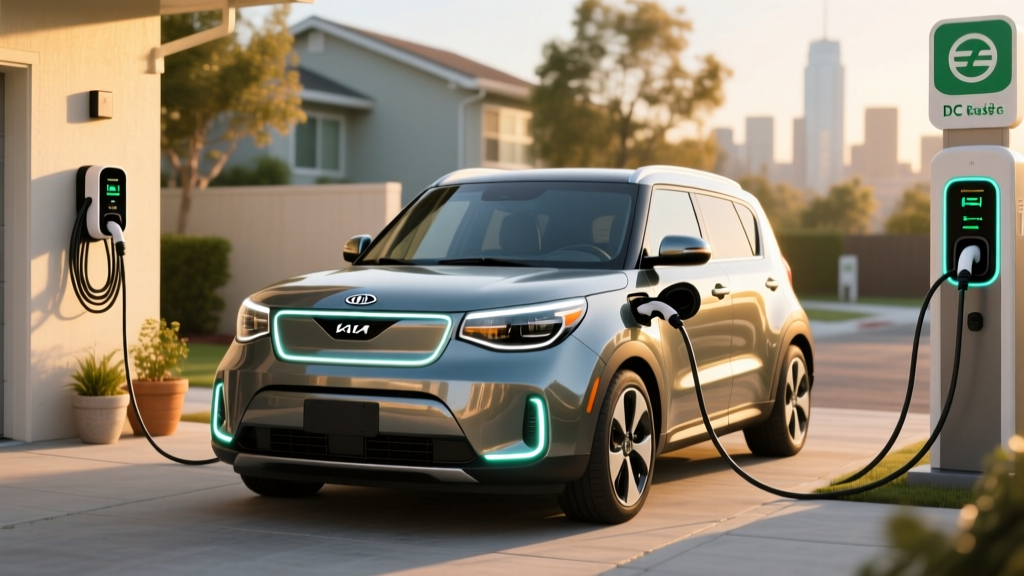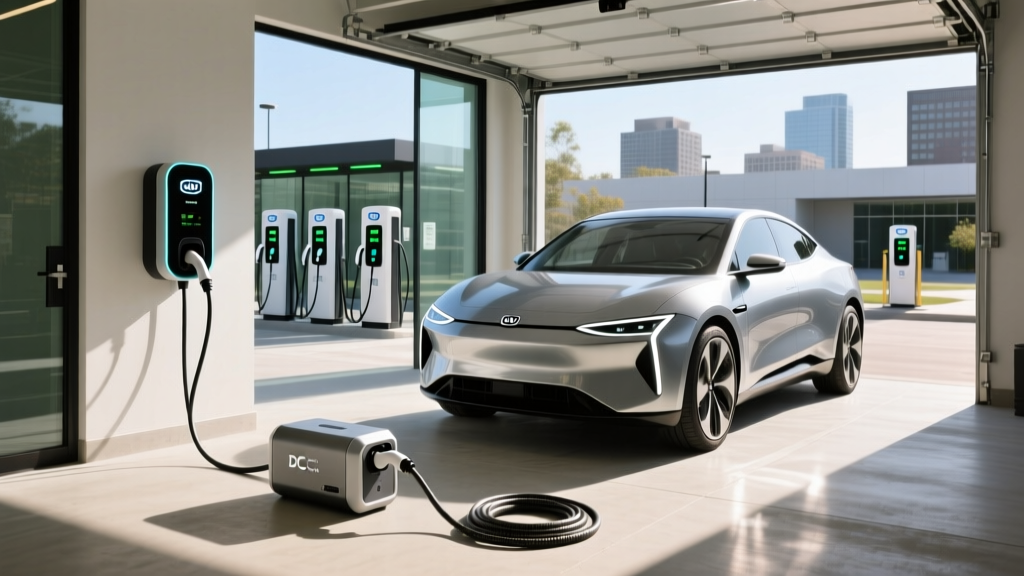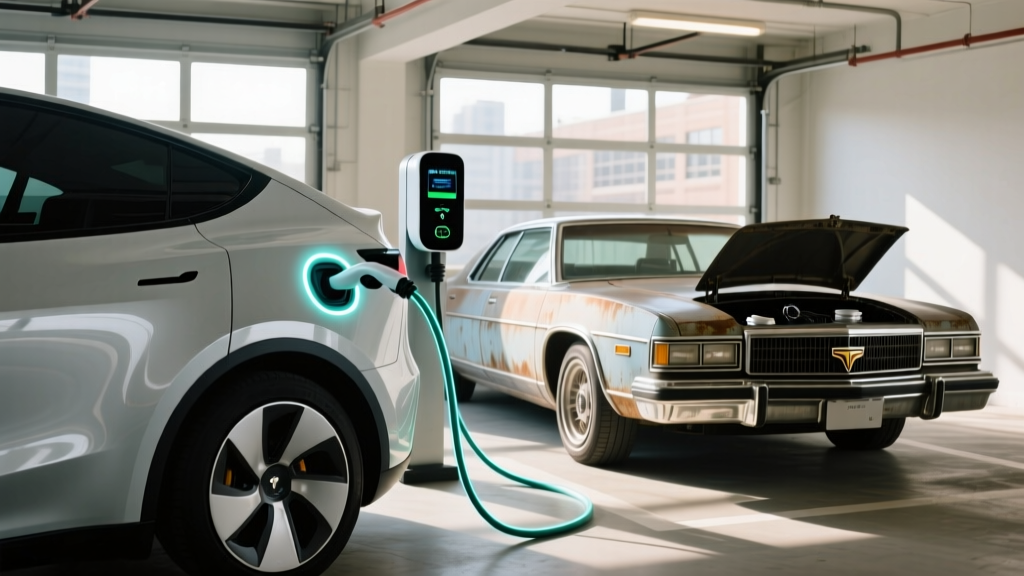
From Supercharged V6 to Kilowatts: Understanding the EV Charging Shift
If you've ever owned or admired a 1997 Supercharged Buick Riviera, you know its 3.8L L67 supercharged V6 produced 240 horsepower and delivered roughly 18 MPG combined — meaning a 15-gallon fill-up cost about $45–$55 at today's pump prices and took four minutes at any gas station. Transitioning from that world to an electric vehicle means rethinking "refueling" entirely: you trade gas pumps for kilowatts, and the four-minute stop becomes a spectrum from overnight home charging to 20-minute DC fast sessions.
This guide covers every EV charging level, real-world installation costs, connector standards, and per-mile economics — with the kind of exact numbers that help you plan a purchase, budget a home install, and compare true ownership costs against legacy vehicles like the '97 Riviera.
Charging Levels Explained: Level 1, Level 2, and DC Fast Charging
Every EV sold in the US supports three charging tiers, but their speeds differ by orders of magnitude. Here's the breakdown by the numbers:
| Level | Voltage | Typical Power (kW) | Miles of Range Added Per Hour | Best Use Case |
|---|---|---|---|---|
| Level 1 | 120V AC | 1.0–1.4 kW | 3–5 mi/hr | Overnight top-up; PHEVs with small batteries |
| Level 2 | 240V AC | 3.3–19.2 kW | 14–75 mi/hr | Daily home charging; workplace; public destinations |
| DC Fast (Level 3) | 200–800V DC | 50–350 kW | 150–1,000+ mi/hr (peak) | Road trips; rapid top-ups on highways |
A practical example: a 2026 Hyundai Ioniq 5 with a 77.4 kWh (usable) battery charging from 10% to 80% on a 350 kW DC fast charger takes approximately 18 minutes under ideal conditions, adding roughly 210 miles of EPA range. On a 7.2 kW Level 2 home charger, that same 10–80% session takes about 7.5 hours — perfect for overnight.
Real-world caveat: DC fast charging speeds are not linear. Chargers hit peak kW only between roughly 10–40% State of Charge (SoC), then taper significantly. A "250 kW" charger may average 100–140 kW across a full 10–80% session. Cold batteries (below 50°F) further reduce charge acceptance — always precondition your battery via the vehicle's navigation routing to a charger when possible.
Home Charger Installation: Requirements, Costs, and Panel Upgrades
Installing a Level 2 home charger is the single highest-impact upgrade an EV owner can make. Here's what it actually involves and costs in 2026:
Electrical Requirements
- Circuit: A dedicated 240V circuit, typically 40A or 50A (breaker rated 125% above continuous load, so a 40A charger needs a 50A breaker)
- Wire gauge: 6 AWG copper for 50A circuits; 8 AWG for 40A
- Outlet type: NEMA 14-50 (most common, also used by RVs and dryers) or hardwired connection (required for circuits above 50A and some local codes)
- GFCI protection: Required by NEC 2020+ for EV charging outlets in garages — adds ~$30–$50 for a GFCI breaker
Panel Upgrade Reality
If you drive a home built before 2000 — like the era that produced the 1997 Supercharged Buick Riviera — your electrical panel may be 100A or even 60A. Modern homes typically have 200A service. Adding a 40–50A dedicated EV circuit to a maxed-out 100A panel can trigger a required panel upgrade:
| Component | Cost Range (2026) | Notes |
|---|---|---|
| Level 2 charger (equipment) | $300–$750 | Smart Wi-Fi chargers at upper end |
| Electrician labor (standard install) | $500–$1,500 | Depends on panel-to-garage distance |
| Electrical permit | $50–$200 | Varies by municipality |
| Panel upgrade (if needed: 100A → 200A) | $1,500–$3,500 | Major cost driver for older homes |
| Trenching/conduit (detached garage) | $500–$2,500 | Distance-dependent |
| Total (no panel upgrade) | $850–$2,450 | Most suburban homes with 200A panels |
| Total (with panel upgrade) | $2,350–$5,950 | Older homes, 100A or 60A service |
Always get a licensed electrician to perform a load calculation (NEC Article 220) before committing to a charger amperage. Some utilities offer rebates of $200–$500 for home charger installation — check with your local provider.
Connector Compatibility: NACS, CCS1, CHAdeMO, and Adapters
The connector landscape in 2026 has largely consolidated around NACS (North American Charging Standard, originally Tesla's proprietary connector), but CCS1 and CHAdeMO vehicles remain on the road. Here's what fits what:
| Connector | Brands Using It (2026 Models) | DC Fast Network Access |
|---|---|---|
| NACS (Tesla) | Tesla, Ford, GM, Rivian, Hyundai/Kia (new models), Volvo, Polestar, BMW, Mercedes | Tesla Supercharger network (20,000+ stalls); growing third-party NACS stations |
| CCS1 | VW ID.4 (older), legacy Ford/GM models pre-2025, some Stellantis | Electrify America, EVgo, ChargePoint; declining new-vehicle adoption |
| CHAdeMO | Nissan Leaf (discontinued after 2025), Mitsubishi Outlander PHEV (older) | Limited and shrinking network |
Adapter needs: If you own a CCS1-equipped EV and want Supercharger access, a CCS-to-NACS adapter (approximately $150–$250 from Tesla or third-party brands like Lectron) unlocks the Supercharger network. CHAdeMO-to-NACS adapters are not widely available — CHAdeMO owners should plan around Electrify America and EVgo networks.
Cost to Charge: Per-Mile Economics vs. the 1997 Riviera's Gas Bill
The 1997 Supercharged Buick Riviera achieved roughly 18 MPG combined. At $3.50/gallon (2026 national average), that's $0.194 per mile in fuel alone. How do EVs compare?
| Charging Scenario | Cost per kWh | Vehicle Efficiency | Cost Per Mile |
|---|---|---|---|
| Home Level 2 (off-peak TOU rate) | $0.08–$0.12 | 3.0 mi/kWh (e.g., Tesla Model Y) | $0.027–$0.040 |
| Home Level 2 (standard rate) | $0.14–$0.18 | 3.0 mi/kWh | $0.047–$0.060 |
| Public Level 2 (workplace/mall) | $0.20–$0.30 | 3.0 mi/kWh | $0.067–$0.100 |
| DC Fast Charging ( Electrify America, EVgo) | $0.35–$0.55 | 3.0 mi/kWh | $0.117–$0.183 |
| 1997 Buick Riviera (gasoline) | $3.50/gallon | 18 MPG combined | $0.194 |
The takeaway: Home-charged EVs cost 65–85% less per mile than the '97 Riviera on gasoline. Even exclusive DC fast charging approaches parity with gasoline but rarely exceeds it. A driver covering 12,000 miles/year would spend approximately $2,330 on gasoline in the Riviera versus $480–$720 on home electricity in a modern EV — a savings of $1,600–$1,850 annually.
Equipment Recommendations: Top Home Chargers for 2026
These are the chargers that consistently earn high marks for reliability, smart features, and value — with exact specs:
ChargePoint Home Flex
- Power output: Up to 12 kW (50A circuit), adjustable down to 16A for lower-capacity panels
- Connector: NACS or J1772 (selectable at purchase)
- Cable length: 23 feet
- Smart features: Wi-Fi, Alexa integration, scheduled charging, energy tracking via app
- Price: ~$550–$650
- Best for: Most homeowners; flexible amperage accommodates older panels
Tesla Wall Connector
- Power output: Up to 11.5 kW (48A / 60A circuit)
- Connector: NACS native; J1772 adapter included
- Cable length: 24 feet
- Smart features: Wi-Fi, OTA updates, power sharing (link multiple units on one circuit), load management
- Price: ~$475
- Best for: Tesla and NACS-equipped vehicle owners; excellent value
Emporia Vue Level 2 Charger
- Power output: Up to 11.5 kW (48A)
- Connector: J1772 (NACS adapter available separately)
- Cable length: 24 feet
- Smart features: Integrates with Emporia home energy monitoring, solar-aware charging, TOU scheduling
- Price: ~$400–$450
- Best for: Budget-conscious buyers; solar panel owners who want generation-matched charging
Grizzl-E Smart
- Power output: Up to 10 kW (40A)
- Connector: J1772 (NACS adapter available)
- Cable length: 24 feet
- Smart features: OCPP-compatible, adjustable amperage, extreme cold-rated (-40°F)
- Price: ~$450–$550
- Best for: Cold-climate owners; outdoor installs (IP67 rated)
Safety, Code, and Permitting Essentials
EV charging involves sustained high-current draw — unlike a dryer that cycles on and off, a Level 2 charger runs at full load for hours. This makes code compliance critical:
- Dedicated circuit: Your EV charger must have its own breaker — never share a circuit with other appliances
- Continuous load rule: NEC requires circuits to be rated 125% above the charger's maximum draw (a 32A charger needs a 40A breaker minimum)
- GFCI protection: Required for all 240V EV receptacles in garages and outdoor locations per NEC 2020 and later; hardwired units may be exempt in some jurisdictions
- Outdoor rating: If installing outside, ensure the charger carries at least an IP65 rating (dust-tight, water-jet resistant); IP67 is preferable for flood-prone areas
- Permit and inspection: Most municipalities require an electrical permit ($50–$200) and a post-install inspection. Skipping this can void home insurance coverage for electrical fires
Charging Time Examples: 10% to 80% by Battery Size
Real charge times depend on battery size, charger power, and the vehicle's charge acceptance curve. Here are representative examples at common battery capacities:
| Battery Size (usable kWh) | Example Vehicle | 7.2 kW Level 2 (10–80%) | 150 kW DC Fast (10–80%) | 350 kW DC Fast (10–80%) |
|---|---|---|---|---|
| 60 kWh | 2026 Chevy Equinox EV | ~5.8 hrs | ~28 min | ~22 min (if vehicle accepts) |
| 77 kWh | 2026 Hyundai Ioniq 5 | ~7.5 hrs | ~25 min | ~18 min |
| 85 kWh | 2026 Tesla Model Y Long Range | ~8.3 hrs | ~30 min | ~22 min (250 kW peak) |
| 100 kWh | 2026 Ford F-150 Lightning Ext. Range | ~9.7 hrs | ~40 min | ~32 min (150 kW sustained avg) |
| 18 kWh (PHEV) | 2026 Toyota RAV4 Prime | ~2.0 hrs | N/A (no DC fast) | N/A |
Note: PHEVs with smaller batteries (12–20 kWh) typically do not support DC fast charging — Level 2 is their fastest option, and that's usually sufficient given the small battery.
Frequently Asked Questions
How much does it cost to install a home EV charger?
A standard Level 2 home charger installation in a home with an adequate 200A electrical panel costs between $850 and $2,450 in 2026, including equipment ($300–$750), electrician labor ($500–$1,500), and permits ($50–$200). If your home requires a panel upgrade from 100A to 200A — common in pre-2000 construction — add $1,500–$3,500. Always get a load calculation from a licensed electrician before choosing charger amperage.
How fast will each charging level add range?
Level 1 (120V) adds 3–5 miles of range per hour — adequate for PHEVs with 25–40 miles of electric range. Level 2 (240V, 7.2 kW typical) adds 20–30 miles per hour, replenishing most EVs overnight. DC fast charging adds 150–250 miles in 20–30 minutes at modern 150–350 kW stations, though speeds taper significantly above 80% SoC.
Which connector/charger is compatible with my EV?
For 2026 model-year vehicles, most new EVs from Ford, GM, Hyundai/Kia, Rivian, Volvo, and Tesla use the NACS connector. Older CCS1-equipped vehicles (pre-2025 VW ID.4, legacy models) can use a CCS-to-NACS adapter (~$150–$250) to access Tesla Superchargers. CHAdeMO is essentially discontinued on new vehicles. For home Level 2 charging, all EVs accept J1772 or NACS — choose your charger's connector to match your vehicle's inlet.
How much does charging cost per mile vs. gas?
Home-charged EVs on off-peak electricity ($0.08–$0.12/kWh) cost $0.027–$0.040 per mile — roughly 80% less than a 1997 Supercharged Buick Riviera at 18 MPG and $3.50/gallon ($0.194/mile). Even exclusive DC fast charging at $0.35–$0.55/kWh yields $0.12–$0.18/mile, still below gasoline. Annual savings for a 12,000-mile driver range from $1,600 to $1,850.
What electrical upgrades might I need?
The most common upgrade is a panel capacity increase from 100A to 200A service ($1,500–$3,500), required when your existing panel lacks headroom for a new 40–50A dedicated circuit. Older homes may also need aluminum-to-copper wiring replacement, conduit runs to detached garages ($500–$2,500), or a second meter for utility TOU rate programs. A licensed electrician's load calculation (NEC Article 220) determines your specific needs.
Sources: fueleconomy.gov (EPA efficiency data), IRS §30D clean vehicle credits, NHTSA.gov (vehicle safety data). All pricing reflects 2026 market estimates; verify local electrician quotes and utility rates for your area.