If you've ever pulled into a parking spot only to find the charging cable falls three feet short of your car's charge port, you've probably wondered: can I use an EV charging extension cord? The short answer is that it depends entirely on the charging level, the cord's wire gauge, and whether you're talking about a portable EVSE (the "charger" that lives in your trunk) or a hardwired wall unit. Get it wrong and you risk melted connectors, tripped breakers, or even an electrical fire. Get it right and you can safely bridge that gap without violating the National Electrical Code (NEC).
This guide covers exactly what's safe at Level 1 (120V) and Level 2 (240V), the wire-gauge math behind it, what the NEC actually says, and the equipment setups that solve reach problems without resorting to a dangerous daisy-chain.
Why EV Charging Extension Cords Are a Controversial Topic
Most EV owner's manuals — Tesla's, Ford's, Hyundai's — explicitly warn against using extension cords with the mobile EVSE (Electric Vehicle Supply Equipment). The reason is liability and worst-case scenarios: a thin, 16-gauge household cord running 12 amps continuously for 12+ hours can overheat, especially if coiled, buried under a rug, or exposed to sunlight on hot pavement.
But physics doesn't care about warnings — it cares about wire gauge, amperage, and distance. A properly rated cord that matches or exceeds the EVSE's amperage draw, kept short and uncoiled, operates within safe thermal limits. The problem is that most consumers don't know how to spec one correctly, and the NEC generally prohibits extension cords as a substitute for permanent wiring in residential installations.
Here's the practical reality: for occasional Level 1 use in a pinch, a heavy-duty 10-gauge or 12-gauge cord under 25 feet can work. For Level 2 home charging, extension cords are almost never code-compliant, and the correct solution is a longer EVSE cable or a relocated outlet.
Charging Levels Explained: Speed, Power, and Where Extension Cords Fit
Before evaluating any cord, you need to understand the power levels involved. EV charging is measured in kW (kilowatts), which is the rate of power delivery. The energy stored in your battery is measured in kWh (kilowatt-hours) — think of kW as the speed of water flowing through a hose, and kWh as the total volume in the bucket.
| Level | Voltage | Max Power (kW) | Miles of Range Added Per Hour | Typical Use | Extension Cord Feasible? |
|---|---|---|---|---|---|
| Level 1 | 120V AC | 1.4 – 1.9 kW | 3 – 5 mi/hr | Overnight home, emergency | Yes — with correct gauge (see below) |
| Level 2 | 240V AC | 7.2 – 19.2 kW | 20 – 60+ mi/hr | Home wallbox, workplace, public AC | No — not NEC-compliant for permanent use |
| DC Fast | 400–800V DC | 50 – 350 kW | 150 – 1,000+ mi/hr | Highway stops, public stations | No — never use extension cords with DCFC |
Level 1 is where extension cord questions arise most. At 120V and 12 amps (the typical continuous draw for a mobile EVSE on a standard 15A outlet), you're pulling about 1.4 kW. That's a small space heater running non-stop for 10–14 hours. A 14-gauge household cord rated for 15A might technically carry the load, but voltage drop over distance and sustained heat buildup make 12-gauge or 10-gauge the only defensible choice.
Level 2 at 240V and 32–48 amps is an entirely different animal. A 48A continuous load requires 6-gauge copper wire and a 60A breaker. No consumer extension cord is rated for this duty cycle, and the NEC (Article 625) explicitly requires EVSE to be supplied by a dedicated branch circuit — not an extension.
Wire Gauge, Amperage, and the Math Behind Safe Cord Selection
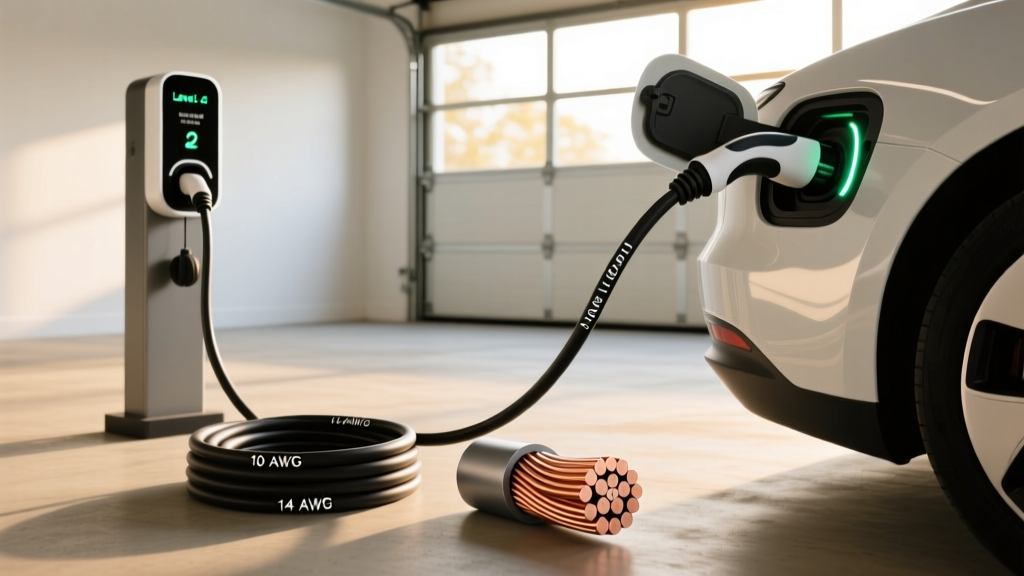
American Wire Gauge (AWG) is counterintuitive: lower numbers mean thicker wire. Thicker wire has lower resistance, generates less heat, and can carry more current safely over longer distances.
| Wire Gauge (AWG) | Max Continuous Amps | Max Length for <3% Voltage Drop (120V) | Suitable For |
|---|---|---|---|
| 16 AWG | 10A | ~10 ft | Not recommended for EV charging |
| 14 AWG | 15A | ~15 ft | Marginal — only very short Level 1 runs |
| 12 AWG | 20A | ~25 ft | Minimum acceptable for Level 1 (12A draw) |
| 10 AWG | 30A | ~50 ft | Recommended for Level 1 at 25+ ft |
| 8 AWG | 40A | N/A at 120V | Level 2 circuits (not extension cord use) |
| 6 AWG | 55A | N/A at 120V | Level 2 48A circuits (hardwired) |
The critical concept here is voltage drop. Over long distances, resistance in the wire causes the voltage at the EVSE end to sag below 120V. Most EVSEs will still operate down to about 110V, but the reduced voltage means the car draws more current to maintain the same power, which generates more heat — a dangerous feedback loop. The NEC recommends keeping voltage drop under 3% for branch circuits, and under 5% total from panel to outlet.
For a 12A Level 1 EVSE on a 120V circuit, here's what that means practically:
- 12 AWG, 25 feet: ~1.5% voltage drop — safe and acceptable.
- 12 AWG, 50 feet: ~3% voltage drop — borderline, the EVSE may run warmer.
- 10 AWG, 50 feet: ~1.5% voltage drop — the correct choice for longer runs.
- 14 AWG, 25 feet: ~4.7% voltage drop — unsafe for continuous duty.
What the NEC and Electrical Code Actually Say
The National Electrical Code (NFPA 70) addresses EV charging under Article 625 (Electric Vehicle Charging System Equipment). Key provisions relevant to extension cord use:
NEC Article 625.40 requires that EVSE rated over 1.9 kW (most Level 2 units) be supplied by a dedicated branch circuit. Extension cords are not branch circuits. Using one to supply a Level 2 wallbox violates code and will fail inspection. For Level 1 (under 1.9 kW), the NEC doesn't explicitly ban extension cords, but Article 400.8 prohibits using flexible cords as a substitute for fixed wiring — meaning you cannot use an extension cord as a permanent installation.
For occasional, temporary Level 1 use — say, charging at a relative's house where the outlet is 20 feet from the driveway — a properly rated cord used temporarily and monitored is not a code violation in the same way a permanent installation would be. But for daily home charging, the compliant solution is always to install an outlet closer to where you park or use an EVSE with a longer integrated cable.
Home Level 2 Installation: Requirements, Costs, and the Right Way to Solve Reach Problems
If you're considering an extension cord because your 240V outlet is too far from your parking spot, the correct fix is a proper Level 2 installation. Here's what that involves:
Electrical Requirements
- Voltage: 240V (same as a clothes dryer or electric range)
- Amperage: 32A, 40A, or 48A continuous load — requires a breaker rated at 125% of continuous load (so 40A, 50A, or 60A breaker respectively)
- Wire gauge: 8 AWG copper for 40A circuits, 6 AWG for 48A/60A circuits
- Outlet type: NEMA 14-50 (most common) or hardwired connection (required for circuits over 50A in some jurisdictions)
- Dedicated circuit: The EV charger must be the only load on this breaker — no sharing with a dryer or workshop
- GFCI protection: Required by NEC 2020+ for all 125V–250V receptacles in garages and outdoors
Installation Cost Breakdown
| Component | Simple Install (Panel Near Garage) | Complex Install (Long Run / Panel Upgrade) |
|---|---|---|
| Level 2 EVSE Equipment | $350 – $700 | $350 – $700 |
| Electrical Permit | $50 – $150 | $50 – $200 |
| Electrician Labor (2–4 hrs simple, 6–12 hrs complex) | $300 – $800 | $1,200 – $3,000 |
| Wire, Conduit, Breaker, Outlet | $100 – $300 | $400 – $1,200 |
| Electrical Panel Upgrade (if needed: 100A → 200A) | $0 | $1,500 – $4,000 |
| Total Estimated Cost | $800 – $1,950 | $3,200 – $9,100 |
The biggest variable is whether your home's electrical panel has spare capacity. A modern 200A panel with open breaker slots can usually accommodate a 60A EV circuit without issue. Older homes with 100A service — common in houses built before 1990 — may require a panel upgrade to safely add a high-amperage EV circuit alongside existing loads (HVAC, electric range, dryer). A licensed electrician will perform a load calculation per NEC Article 220 to determine if your panel can handle the addition.
Solving the Reach Problem the Right Way
Instead of an extension cord, consider these code-compliant alternatives:
- Longer EVSE cable: Many Level 2 chargers offer 25-foot cables (vs. the standard 18 feet). The ChargePoint Home Flex and Emporia Vue both offer 24–25 ft options.
- Relocate the outlet: Have your electrician move the NEMA 14-50 receptacle closer to your parking position. This typically costs $200–$500 if the panel is nearby.
- Ceiling-mounted or pedestal mount: Some installations route the EVSE cable from above, eliminating floor-level reach issues.
Connector Compatibility: NACS, CCS, and CHAdeMO Explained
When shopping for an EVSE or evaluating whether a cord/adapter will work, you need to know your car's connector standard. As of 2026, the North American market has largely consolidated around NACS (the Tesla-style connector), but millions of CCS-equipped vehicles remain on the road.
| Connector | Used By | Level 2 (240V AC) | DC Fast Charging | Adapter Available? |
|---|---|---|---|---|
| NACS (Tesla) | Tesla (all), Ford, GM, Rivian, Hyundai, Kia, Volvo, Polestar (2025+ models) | Yes — native | Yes — Tesla Supercharger network | N/A (becoming the standard) |
| CCS1 | Older Ford, GM, VW, BMW, Hyundai, Kia models (pre-NACS switch) | Yes — native | Yes — Electrify America, EVgo, ChargePoint | Tesla CCS adapter (~$250); Magic Dock at some Superchargers |
| CHAdeMO | Nissan Leaf, Mitsubishi Outlander PHEV (legacy) | Yes — native | Yes — declining network | Limited; no NACS-to-CHAdeMO adapter widely available |
| J1772 | All non-Tesla EVs (Level 1 and Level 2 only) | Yes — native | No (AC only) | Tesla Mobile Connector includes J1772 adapter |
If you own a CCS-equipped vehicle and want to access the Tesla Supercharger network, you'll need a Tesla CCS adapter (approximately $250) or use a Supercharger station equipped with Tesla's Magic Dock (a built-in CCS adapter). For Level 2 home charging, any J1772-compatible EVSE will work with non-Tesla vehicles, and Tesla owners can use the J1772 adapter included with their Mobile Connector.
Cost to Charge: Per-Mile Economics vs. Gas
One of the strongest arguments for home charging is cost. Electricity prices vary by region and time-of-use, but the per-mile cost of EV charging is almost always lower than gasoline.
| Scenario | Cost per kWh | Cost to Add 200 Miles (70 kWh battery, ~3.5 mi/kWh) | Cost per Mile |
|---|---|---|---|
| Home Level 2, off-peak rate | $0.08 – $0.14 | $5.60 – $9.80 | $0.028 – $0.049 |
| Home Level 2, standard rate | $0.12 – $0.20 | $8.40 – $14.00 | $0.042 – $0.070 |
| Public Level 2 (ChargePoint, EVgo) | $0.25 – $0.49 | $17.50 – $34.30 | $0.088 – $0.172 |
| DC Fast Charging (Electrify America, EVgo) | $0.35 – $0.55 | $24.50 – $38.50 | $0.123 – $0.193 |
| Gasoline (25 MPG combined, $3.40/gal) | — | $27.20 | $0.136 |
At off-peak residential rates, home charging costs roughly $0.03–$0.05 per mile — about one-quarter the cost of gasoline. Even at public DC fast-charging rates, EVs are often cheaper per mile than a 25 MPG gas car. The economics strongly favor installing a proper Level 2 home circuit rather than relying on public charging or stretching a Level 1 cord to its limits.
For a real-world example: a Hyundai Ioniq 5 with a 77.4 kWh battery and an EPA-estimated 303 miles of range will consume roughly 25–28 kWh per 100 miles in mixed driving (per fueleconomy.gov). Charging that battery from 10% to 80% (about 54 kWh) costs roughly $6.50 at home on a $0.12/kWh rate, versus about $17 at a public DC fast charger at $0.35/kWh.
Recommended Equipment: EVSEs That Solve the Reach Problem
Rather than cobbling together an extension cord, these Level 2 EVSEs offer longer cables, smart features, and reliable performance:
ChargePoint Home Flex
- Power output: Up to 12 kW (50A) on a 60A circuit; configurable down to 16A
- Cable length: 24 feet
- Connector: J1772 (NACS adapter included or available separately)
- Smart features: Wi-Fi, app scheduling, Alexa integration, energy tracking
- Price: ~$549 (unit only)
Emporia Vue Level 2 Charger
- Power output: Up to 11.5 kW (48A) on a 60A circuit
- Cable length: 24 feet
- Connector: J1772 (NACS version available)
- Smart features: Wi-Fi, solar integration, real-time energy monitoring, load management
- Price: ~$399
Tesla Wall Connector
- Power output: Up to 11.5 kW (48A) on a 60A circuit
- Cable length: 24 feet
- Connector: NACS (native Tesla); J1772 adapter for non-Tesla EVs
- Smart features: Wi-Fi, over-the-air updates, power sharing (dual units on one circuit)
- Price: ~$450
All three units are UL-listed, rated for indoor and outdoor use (NEMA 4 enclosure), and compatible with the Alternative Fuel Vehicle Refueling Property Credit (IRS Form 8911), which can cover up to 30% of equipment and installation cost (max $1,000) if you live in an eligible census tract. Consult a tax professional for eligibility.
Safety Checklist: If You Must Use an Extension Cord Temporarily
If you're in a situation where a temporary extension cord is the only option for Level 1 charging — visiting family, staying at a rental, or waiting for your electrician — follow these rules to minimize risk:
- Use 10 AWG or 12 AWG minimum. Never use 14 AWG or 16 AWG for EV charging, regardless of what the packaging says.
- Keep it short. Under 25 feet for 12 AWG; under 50 feet for 10 AWG.
- Never coil the cord. Coiled cord traps heat. Lay it out straight, fully unspooled.
- Never run it under rugs, through walls, through doorways that pinch it, or across walkways.
- Use a cord rated for outdoor use (SJTW or STW jacket) if any portion runs outside.
- Check the plug and outlet temperature after 30 minutes of charging. If either is warm to the touch, stop immediately.
- Plug directly into a wall outlet — never into a power strip or another extension cord (daisy-chaining).
- Use a dedicated 15A or 20A circuit — not one shared with a refrigerator, microwave, or space heater.
- Inspect the cord before each use for cracked insulation, bent prongs, or discoloration at the plug.
After 30 minutes of Level 1 charging through any cord, touch the plug blades, the cord near both connectors, and the outlet face. If any surface is too hot to hold your hand on comfortably (above ~140°F / 60°C), the setup is unsafe. Disconnect immediately and reduce the EVSE's amperage setting (many mobile units allow you to dial down from 12A to 8A) or switch to a heavier-gauge cord.
Frequently Asked Questions
How much does it cost to install a home EV charger?
A straightforward Level 2 installation (panel near garage, short wire run, no panel upgrade) typically costs $800–$1,950 including equipment, labor, and permit. Complex installations with long wire runs or a panel upgrade from 100A to 200A can range from $3,200 to $9,100. Always get a quote from a licensed electrician who will perform a load calculation.
How fast will each charging level add range?
Level 1 (120V) adds roughly 3–5 miles of range per hour — adequate for overnight charging if your daily commute is under 40 miles. Level 2 (240V, 32–48A) adds 20–60+ miles per hour and can fully recharge most EVs overnight. DC fast charging adds 150–1,000+ miles per hour at peak power, though charging speed tapers significantly above 80% state of charge due to the battery's charge curve.
Which connector is compatible with my EV?
For 2025–2026 model-year vehicles, most new EVs from Ford, GM, Rivian, Hyundai, Kia, and others now use the NACS connector. Older models (2024 and prior) from non-Tesla brands typically use CCS1. The Nissan Leaf uses CHAdeMO. For Level 2 home charging, any J1772 EVSE works with non-Tesla vehicles, and Tesla includes a J1772 adapter with the Mobile Connector.
How much does charging cost per mile vs. gas?
Home Level 2 charging at typical residential rates ($0.10–$0.16/kWh) costs approximately $0.03–$0.06 per mile for an EV averaging 3–4 miles per kWh. A comparable gas vehicle at 25 MPG and $3.40/gallon costs about $0.14 per mile. Public DC fast charging narrows the gap to $0.12–$0.19 per mile but is still generally cheaper than gas.
What electrical upgrades might I need for a Level 2 charger?
The most common upgrade is adding a dedicated 240V circuit with a NEMA 14-50 outlet or hardwired connection. Homes with older 100A electrical panels may need a panel upgrade to 200A to accommodate the additional load — this is the single largest cost variable ($1,500–$4,000). Your electrician will also need to install a GFCI breaker (required by NEC 2020+ for garage and outdoor receptacles), which adds $50–$150 to the materials cost.
Can I use an extension cord with a Level 2 (240V) charger?
No. There is no safe, code-compliant consumer extension cord for 240V Level 2 EV charging at 32–48 amps. The NEC requires a dedicated branch circuit, and the sustained high-amperage load creates serious fire risk with any flexible cord. If your Level 2 EVSE doesn't reach your car, the solution is a longer EVSE cable (24–25 ft models are available), a relocated outlet, or a different mounting position.
Is a 10-gauge extension cord safe for daily Level 1 charging?
For temporary use, a 10 AWG cord under 50 feet is the safest consumer option for Level 1 (120V, 12A) charging. However, the NEC prohibits using flexible cords as a substitute for permanent wiring. For daily home charging, install a properly located 120V or 240V outlet instead. Continuous daily use of an extension cord — even a heavy-duty one — increases the risk of connector wear, moisture ingress, and thermal fatigue over months and years.