If you've purchased or are planning to purchase an electric vehicle, one of the smartest financial moves you can make is installing a dedicated home charging station. Not only does Level 2 home charging deliver the best daily ownership experience, but the federal EV charging equipment tax credit — officially known as the Alternative Fuel Vehicle Refueling Property Credit under IRC §30C — can offset up to $1,000 of your hardware and installation costs. This guide breaks down exactly what the credit covers, how much a home charger actually costs to install in 2026, which equipment to buy, and the electrical upgrades your home might need.
Understanding the EV Charging Equipment Tax Credit (IRC §30C)
The federal EV charging equipment tax credit is separate from the §30D new-vehicle credit. It applies to the purchase and installation of qualified charging equipment at your primary residence. Under the Inflation Reduction Act provisions still active in 2026, the credit covers 30% of the total cost of the charger and its installation, up to a maximum of $1,000 per tax year.
- Equipment must be installed at your primary residence located in the United States
- The property must be placed in service during the tax year you claim the credit
- The charger must be new (used equipment does not qualify)
- The installation must be performed by a licensed electrician and comply with local building codes
- Both the hardware cost and labor/installation costs count toward the $1,000 cap
- The credit is non-refundable — it reduces your tax liability but won't generate a refund beyond zero
Source: IRS.gov — Alternative Fuel Vehicle Refueling Property Credit
A critical nuance many buyers miss: the credit applies to property placed in service, meaning the charger must be fully installed and operational — not merely purchased — before December 31 of the tax year. If you buy a charger in December but your electrician can't schedule the install until January, you'll claim it on the following year's return.
Additionally, some states and utilities layer their own rebates on top of the federal credit. California's CALeVIP program, New York's Charge Ready NY, and various utility make-ready programs can stack with §30C, potentially covering most or all of your installation cost. Check your state energy office and local utility for current programs.
Charging Levels Explained: Speed, Power, and Real-World Range
Before choosing equipment, you need to understand the three charging levels available to EV owners. The distinction between kW (kilowatts) and kWh (kilowatt-hours) is essential: kW measures the rate of power delivery (like water pressure from a hose), while kWh measures total energy stored in your battery (like the size of the tank). Your charger's kW rating determines how fast energy flows; your battery's kWh capacity determines how much it can hold.
| Level | Voltage | Power (kW) | Miles Added per Hour | Best For |
|---|---|---|---|---|
| Level 1 (120V) | 120V AC | 1.2–1.9 kW | 3–5 mi/hr | Overnight top-ups, PHEVs, low-mileage drivers |
| Level 2 (240V) | 240V AC | 3.3–19.2 kW | 12–75 mi/hr | Daily home charging, most EV owners |
| DC Fast Charging | 400–800V DC | 50–350 kW | 150–1,000+ mi/hr | Road trips, highway corridors, commercial fleets |
Real-world context: A typical EV battery (75–100 kWh) charging on Level 1 at 1.4 kW would need roughly 50–70 hours for a full charge — impractical for daily use. The same battery on a 48-amp (11.5 kW) Level 2 home charger refills in about 7–9 hours, perfectly suited to overnight charging. DC fast chargers at 150+ kW can deliver a 10–80% charge in 18–30 minutes depending on the vehicle's charge-curve acceptance rate.
Most EVs in 2026 accept between 7.7 kW and 19.2 kW on Level 2 AC charging. The vehicle's onboard charger — not the wall unit alone — caps the maximum AC charge rate. For example, a Tesla Model Y accepts up to 11.5 kW on AC, so installing a 19.2 kW charger won't speed it up. A Ford F-150 Lightning with the extended-range battery, however, can accept up to 19.2 kW, making a higher-output charger worthwhile.
Home Charger Installation: Electrical Requirements and Costs
The single most variable cost in home EV charging is the electrical work. Your home's panel capacity, the distance from the panel to the charger location, and local code requirements all influence the final bill. Here's what to expect:
Electrical Requirements for a Level 2 Home Charger
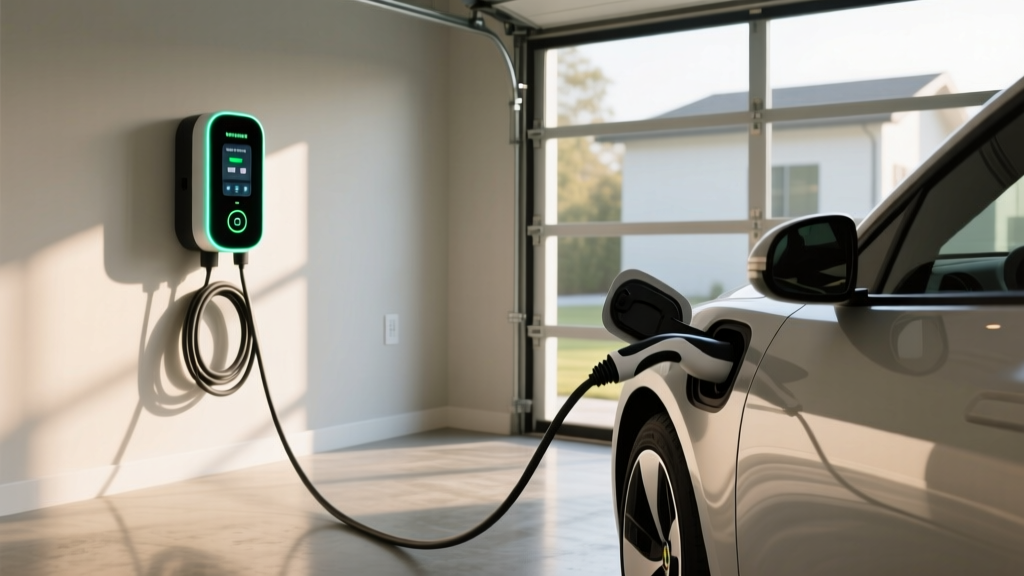
A standard Level 2 home charger requires a dedicated 240-volt circuit. The most common configurations are:
- 40-amp circuit (delivering 32 amps continuous / 7.7 kW) — sufficient for most EVs
- 50-amp circuit (40 amps continuous / 9.6 kW) — the sweet spot for most installations
- 60-amp circuit (48 amps continuous / 11.5 kW) — ideal for high-acceptance vehicles
- 80-amp circuit (64 amps continuous / 15.4 kW) — for large-battery trucks and SUVs
The National Electrical Code (NEC) requires that continuous loads (like EV charging) use no more than 80% of a circuit's rated capacity. A 50-amp breaker therefore delivers a maximum of 40 amps continuous to the vehicle.
Panel Capacity and Upgrade Considerations
Most homes built after 1990 have a 200-amp main electrical panel, which can usually accommodate a 50-amp EV circuit without an upgrade. However, homes with 100-amp or 150-amp service — common in older construction — may need a panel upgrade to add a dedicated EV circuit safely, especially if you already run high-draw appliances like electric ranges, dryers, or HVAC systems.
A panel upgrade from 100A to 200A typically costs $1,500–$3,500 depending on your utility's requirements, conduit routing, and local labor rates. This is a significant cost that many online guides gloss over, but it's a reality for roughly 20–30% of homeowners considering an EV charger install.
Installation Cost Breakdown
| Component | Low-End Estimate | High-End Estimate | Notes |
|---|---|---|---|
| Level 2 Charger (hardware) | $300 | $750 | Varies by power output, cable length, smart features |
| Electrician labor (standard install) | $400 | $1,200 | Short conduit run, accessible panel, no upgrades |
| Permit and inspection fees | $50 | $250 | Required by most jurisdictions; varies by municipality |
| Conduit and wiring materials | $100 | $500 | Longer runs from panel to garage/driveway cost more |
| Panel upgrade (if needed) | $1,500 | $3,500 | Only required if existing panel lacks capacity |
| Total (no panel upgrade) | $850 | $2,700 | Typical range for most homeowners |
| Total (with panel upgrade) | $2,350 | $6,200 | Older homes with 100A/150A service |
The tax credit math: On a $2,000 total installation (charger + labor + permit), the §30C credit returns 30% or $600 — whichever is less, capped at $1,000. On a $3,340 installation, you'd hit the $1,000 maximum credit. Always consult a tax professional to confirm your specific eligibility, as income and tax liability affect the credit's benefit.
Connector Compatibility: NACS, CCS1, and CHAdeMO
The connector landscape has consolidated significantly by 2026. Tesla's North American Charging Standard (NACS) has been adopted by Ford, GM, Rivian, Volvo, Polestar, and most major automakers for new vehicles sold in North America. The Combined Charging System (CCS1) remains on many vehicles produced through 2025, while CHAdeMO is effectively legacy — found only on older Nissan Leafs and Mitsubishi Outlander PHEVs.
| Connector | Brands Using It (New Vehicles) | Home Charger Availability |
|---|---|---|
| NACS (Tesla standard) | Tesla, Ford, GM, Rivian, Volvo, Polestar, Hyundai, Kia (2026+) | Tesla Wall Connector, ChargePoint Home Flex (NACS), Emporia Level 2 |
| CCS1 | VW ID.4 (through 2025), BMW iX (through 2025), some legacy models | ChargePoint Home Flex, Emporia Vue, JuiceBox (used market) |
| CHAdeMO | Nissan Leaf (discontinued), Mitsubishi Outlander PHEV (older gen) | Limited new hardware; mostly DC public stations |
Adapter strategy: If you drive a CCS1-equipped vehicle but want future-proofing for NACS, several manufacturers sell CCS-to-NACS adapters rated for Level 2 AC charging ($150–$300). Tesla's Universal Wall Connector includes both NACS and J1772 (the AC precursor to CCS1) connectors in one unit, making it the most versatile home option for multi-EV households.
Cost to Charge: Home vs. Public vs. Gas
The economic case for home charging is compelling when you compare per-mile costs to gasoline. Your actual cost depends on local electricity rates, time-of-use pricing, and whether you're charging at home or on public networks.
| Scenario | Rate | Cost per Mile (250 Wh/mi EV) | Cost per Mile (28 MPG gas car) |
|---|---|---|---|
| Home — off-peak (national avg) | $0.12/kWh | $0.030 | — |
| Home — peak rate (national avg) | $0.25/kWh | $0.063 | — |
| Public Level 2 (network avg) | $0.35/kWh | $0.088 | — |
| DC Fast Charging (network avg) | $0.48/kWh | $0.120 | — |
| Gasoline (national avg $3.40/gal) | $3.40/gallon | — | $0.121 |
Key takeaway: Home off-peak charging costs roughly one-quarter of what gasoline costs per mile. Even public DC fast charging at $0.48/kWh is comparable to or slightly cheaper than gasoline. The savings compound quickly: a driver covering 12,000 miles per year saves approximately $1,100–$1,300 annually by charging at home off-peak versus fueling a 28 MPG gasoline vehicle.
Time-of-use (TOU) plans offered by most utilities are essential for maximizing savings. By scheduling charging between 10 PM and 6 AM when rates are lowest, you can keep your per-mile cost under $0.03. Most smart Level 2 chargers have built-in scheduling features that automate this.
Charging Time Examples: How Long Does It Take?
Charging time depends on three factors: battery capacity (kWh), the charger's power output (kW), and the vehicle's onboard charger limit. Here are real-world estimates for common 2026 EVs charging from 10% to 80% state of charge (SoC):
- Tesla Model Y Long Range (75 kWh usable): 48A Level 2 (11.5 kW) — approximately 5 hours; 250 kW DC fast — approximately 22 minutes
- Ford F-150 Lightning Extended Range (131 kWh usable): 80A Level 2 (19.2 kW) — approximately 5.5 hours; 150 kW DC fast — approximately 45 minutes
- Hyundai Ioniq 5 (77.4 kWh usable): 40A Level 2 (7.7 kW) — approximately 7.5 hours; 350 kW DC fast — approximately 18 minutes
- Chevrolet Equinox EV (85 kWh usable): 48A Level 2 (11.5 kW) — approximately 6 hours; 150 kW DC fast — approximately 30 minutes
Charge-curve reality check: DC fast charging speeds are not sustained. A vehicle rated for 250 kW peak charging will only hold that rate for a portion of the session — typically between 10% and 40% SoC — before tapering to protect the battery. The 10–80% time is a more honest metric than peak kW alone. Above 80%, charging slows dramatically (often to under 50 kW), which is why most road-trip strategies target 80% departures rather than full charges.
Recommended Home Chargers for 2026
After testing and tracking reliability data across dozens of units, these are our top Level 2 home charger recommendations for 2026, selected for build quality, smart features, and connector versatility:
Tesla Universal Wall Connector
- Power: 11.5 kW (48A)
- Connector: NACS + J1772 (dual cable)
- Cable length: 24 ft
- Smart features: Wi-Fi, OTA updates, Tesla app scheduling, load sharing
- Price: $599
- Best for: Multi-EV households with Tesla and non-Tesla vehicles
ChargePoint Home Flex
- Power: Up to 12 kW (50A, configurable)
- Connector: NACS or J1772 (select at purchase)
- Cable length: 23 ft
- Smart features: Wi-Fi, Alexa/Google integration, detailed energy tracking, scheduling
- Price: $549–$649
- Best for: Smart-home enthusiasts wanting detailed usage data
Emporia Level 2 EV Charger
- Power: 11.5 kW (48A)
- Connector: NACS or J1772
- Cable length: 24 ft
- Smart features: Wi-Fi, Emporia energy ecosystem integration, solar-aware charging, scheduling
- Price: $399
- Best for: Budget-conscious buyers; solar panel owners
Grizzl-E Smart
- Power: 10 kW (40A)
- Connector: J1772 (NACS adapter available)
- Cable length: 24 ft
- Smart features: Bluetooth/Wi-Fi, OCPP-compatible, adjustable amperage
- Price: $449
- Best for: Outdoor installs (IP67 rated), extreme-temperature climates
When selecting a charger, match the amperage to your electrical panel's available capacity and your vehicle's onboard charger limit. Installing a 48A charger for a vehicle that only accepts 32A is safe but wasteful; installing a 32A charger for a vehicle that accepts 48A leaves charging speed on the table.
Safety, Code Compliance, and Installation Best Practices
A Level 2 charger draws sustained high current for hours at a time — making proper installation non-negotiable for safety and insurance purposes. Key requirements include:
- Dedicated circuit: Your EV charger must have its own dedicated breaker — never shared with other appliances. This prevents overloads and nuisance tripping.
- GFCI protection: NEC 2020 and later require Ground Fault Circuit Interrupter (GFCI) protection for all EV charging outlets. Many modern chargers have built-in GFCI; hardwired installations may require a GFCI breaker at the panel.
- Outdoor rating: If your charger is installed outdoors (driveway or exterior wall), it must carry at minimum an IP54 rating for weather resistance. Units rated IP65 or IP67 are preferable in regions with heavy rain or snow.
- Permit and inspection: Virtually all jurisdictions require an electrical permit for a new 240V circuit. The inspection ensures the work meets NEC standards. Skipping the permit can void homeowner's insurance coverage for electrical fires and create issues during a home sale.
- Wire gauge: Your electrician will size wire to the circuit amperage — typically 6 AWG copper for a 50A circuit, 4 AWG for 60A. Undersized wire creates a fire hazard.
Frequently Asked Questions
How much does it cost to install a home EV charger?
A typical Level 2 home charger installation costs between $850 and $2,700 when no panel upgrade is needed. This includes the charger hardware ($300–$750), electrician labor ($400–$1,200), permit fees ($50–$250), and wiring materials ($100–$500). If your home requires a panel upgrade from 100A to 200A, add $1,500–$3,500. The §30C tax credit can return up to $1,000 (30% of total cost).
How fast will each charging level add range?
Level 1 (120V) adds roughly 3–5 miles of range per hour. Level 2 (240V) adds 12–75 miles per hour depending on the charger's kW output and the vehicle's onboard charger limit. DC fast charging adds 150–1,000+ miles per hour at peak rate, though real-world sessions average much less due to charge-curve tapering above 50–60% SoC.
Which connector/charger is compatible with my EV?
Check your vehicle's charge port. Most 2026-model EVs from Tesla, Ford, GM, Rivian, Volvo, Hyundai, and Kia use the NACS connector. Vehicles from the 2023–2025 model years may still use CCS1 (J1772 for AC). The Nissan Leaf uses CHAdeMO. For home charging, the Tesla Universal Wall Connector supports both NACS and J1772, covering virtually all EVs.
How much does charging cost per mile vs. gas?
Home off-peak charging averages about $0.03 per mile. Public DC fast charging averages about $0.12 per mile. A comparable gasoline vehicle at 28 MPG and $3.40/gallon costs about $0.12 per mile. Home charging delivers roughly 75% fuel-cost savings versus gasoline.
What electrical upgrades might I need?
If your home has a 200-amp panel with available breaker slots, you likely need no upgrade beyond a new dedicated circuit. Homes with 100-amp or 150-amp service, or panels that are already near capacity, may require a panel upgrade ($1,500–$3,500). A licensed electrician can perform a load calculation to determine your panel's available capacity — this is typically included in a free or low-cost site assessment.
Can I install a Level 2 charger myself?
While some experienced DIYers handle 240V work, most jurisdictions require a licensed electrician for new circuits, and the §30C tax credit documentation benefits from professional installation receipts. Improper installation creates fire risk and may void insurance coverage. We strongly recommend using a licensed, EV-experienced electrician.