The Short Answer: Yes, but the Savings Depend on How You Charge
If you charge primarily at home on a standard residential electricity rate, driving an electric vehicle costs roughly 50–70% less per mile than fueling a comparable gasoline car. But plug into a DC fast charger on a road trip every week, and that gap narrows considerably — sometimes to near parity with gas. The real question isn't whether EVs are cheaper to fuel in the abstract; it's whether your charging habits and local electricity rates deliver those savings.
This guide walks through every charging scenario — Level 1 trickle, Level 2 home, and DC fast charging on the road — with exact cost-per-mile figures, installation economics, equipment picks, and the electrical upgrades that can make or break your budget.
Charging Levels Explained: Speed, Power, and Range Added Per Hour
Before comparing costs, you need to understand the three charging tiers. A common mistake is confusing kW (kilowatts — the rate of power delivery, like water pressure) with kWh (kilowatt-hours — the total energy stored, like gallons in a tank). Your electricity bill charges per kWh consumed; your charger's speed is rated in kW delivered.
| Level | Voltage | Power (kW) | Miles of Range Added per Hour | Typical Use Case |
|---|---|---|---|---|
| Level 1 | 120V AC | 1.0–1.4 kW | 3–5 miles | Overnight top-up, low-mileage drivers |
| Level 2 | 240V AC | 3.3–19.2 kW | 12–75 miles | Primary home charging, workplace |
| DC Fast | 400–800V DC | 50–350 kW | 150–1,000+ miles (equivalent rate) | Road trips, highway corridors |
Most EV owners do 80–90% of their charging at home on Level 2. A typical 11.5 kW home charger adds roughly 40–45 miles of range per hour — enough to fully replenish a 75 kWh battery (think Tesla Model Y or Hyundai Ioniq 5) in about 7 hours overnight.
Real-world charging time examples (10–80% State of Charge):
- 60 kWh battery (Chevrolet Bolt EV): ~26 min at 150 kW DC fast charger; ~4.5 hours at 11.5 kW Level 2
- 82 kWh battery (Tesla Model 3 Long Range): ~25 min at 250 kW Supercharger; ~6 hours at 11.5 kW Level 2
- 100 kWh battery (Ford F-150 Lightning Extended Range): ~41 min at 150 kW DC fast charger; ~8 hours at 11.5 kW Level 2
Note that DC fast charging follows a charge curve — peak kW is only sustained between roughly 10–50% State of Charge. Above 80%, the battery management system tapers power significantly to protect cell health. That's why manufacturers quote 10–80% times, not 0–100%.
Cost Per Mile: EV Charging vs. Gasoline in 2026
Here's where the rubber meets the road. We'll compare a midsize electric SUV averaging 3.0 miles/kWh (roughly 112 MPGe) against a midsize gas SUV averaging 27 MPG combined, using national averages as of early 2026.
| Scenario | Rate | Cost per kWh (or Gallon) | Cost per Mile | Annual Cost (12,000 mi) |
|---|---|---|---|---|
| Home Level 2 (national avg. residential) | $0.16/kWh | $0.16 | $0.053 | $640 |
| Home Level 2 (off-peak TOU rate) | $0.09/kWh | $0.09 | $0.030 | $360 |
| Public Level 2 (network pricing) | $0.25–$0.40/kWh | $0.32 avg. | $0.107 | $1,280 |
| DC Fast Charging (public) | $0.35–$0.55/kWh | $0.45 avg. | $0.150 | $1,800 |
| Gasoline (national avg.) | $3.20/gal | $3.20 | $0.119 | $1,422 |
Key takeaways:
- Home charging on a standard residential rate saves roughly $780/year versus gas for a typical driver.
- Home charging on a time-of-use (TOU) off-peak rate saves roughly $1,060/year.
- Exclusive DC fast charging can actually exceed the cost of gasoline — a critical consideration for apartment dwellers without home charging access.
- Most owners mix home and public charging, landing somewhere between $600–$1,100 annually.
Electricity rates vary enormously by state. Louisiana averages around $0.10/kWh; California can exceed $0.30/kWh on standard tiers but offers TOU plans as low as $0.07–$0.09/kWh overnight. Check your utility's EV-specific rate plans — many now offer dedicated EV tariffs with deep overnight discounts. The U.S. Department of Energy's EV cost calculator lets you compare fuel costs by ZIP code and vehicle model.
Home Charger Installation: Electrical Requirements, Costs, and Gotchas
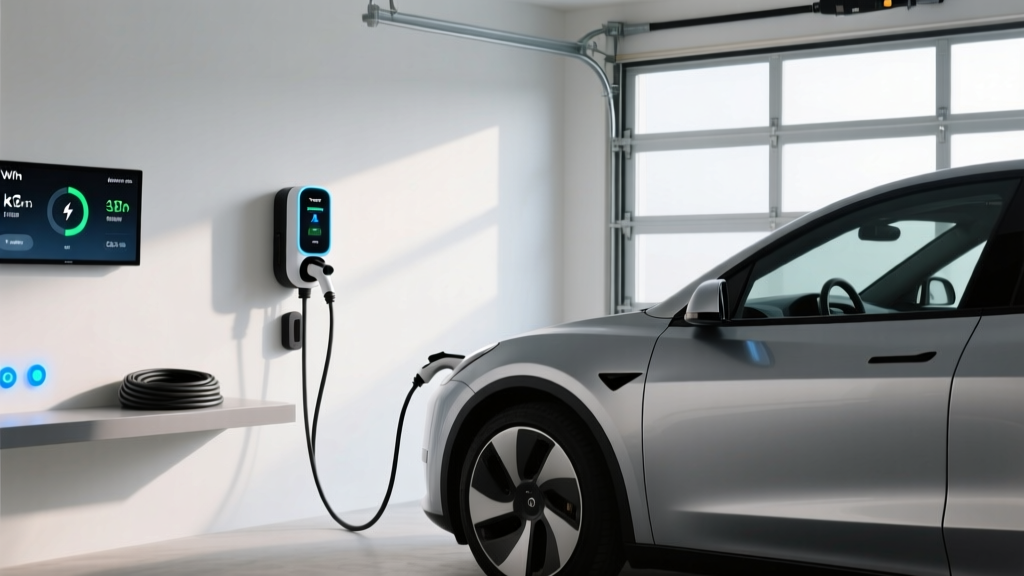
A Level 2 home charger is the single biggest factor in making EV ownership economical. But installation costs range widely depending on your home's electrical infrastructure.
Electrical Requirements
Most Level 2 chargers require a 240V dedicated circuit, similar to what an electric dryer or oven uses. Common configurations:
- 40-amp circuit / 32-amp continuous draw: Delivers up to 7.7 kW — the most common residential setup
- 50-amp circuit / 40-amp continuous: Delivers up to 9.6 kW — ideal for larger batteries
- 60-amp circuit / 48-amp continuous: Delivers up to 11.5 kW — requires robust panel capacity
The National Electrical Code (NEC) requires that continuous loads (including EV charging) not exceed 80% of the circuit's rated amperage. A 40A breaker supports 32A continuous charging — this is not optional, it's code.
Panel Upgrade: The Hidden Cost
Homes built before 2000 often have 100-amp or 150-amp main panels that may already be near capacity. Adding a 40–60 amp EV circuit could require a panel upgrade to 200 amps, which typically costs $1,500–$3,000 on top of the charger installation. A licensed electrician will perform a load calculation to determine if your panel can handle the additional draw.
Installation Cost Breakdown
| Component | Simple Install (panel nearby) | Complex Install (panel upgrade + long run) |
|---|---|---|
| Level 2 charger (equipment) | $350–$700 | $350–$700 |
| Electrician labor (2–4 hrs vs. 6–10 hrs) | $400–$900 | $1,200–$2,500 |
| Electrical materials (conduit, wire, breaker) | $150–$400 | $400–$800 |
| Permit and inspection | $50–$200 | $50–$200 |
| Panel upgrade (if needed) | $0 | $1,500–$3,000 |
| Total | $950–$2,200 | $3,500–$7,200 |
The IRS §30C Alternative Fuel Vehicle Refueling Property Credit covers 30% of home charging equipment and installation costs, up to $1,000 — but only if you live in an eligible census tract (typically rural or low-income communities as defined by the IRS). Check the IRS guidance or consult a tax professional before assuming eligibility.
Which Connector Does Your EV Need?
The North American charging connector landscape has shifted dramatically. As of 2026, the NACS (North American Charging Standard) — originally Tesla's proprietary connector — has become the dominant standard. Most new EVs from Ford, GM, Rivian, Hyundai, Kia, and others now ship with NACS ports natively.
| Connector | Brands Using It (Native) | Notes |
|---|---|---|
| NACS (Tesla) | Tesla, Ford, GM, Rivian, Hyundai, Kia, Volvo, Polestar, Fisker | Access to Tesla Supercharger network directly |
| CCS1 | Volkswagen, BMW, some Stellantis models, legacy 2020–2024 EVs | Requires NACS adapter for Supercharger access |
| CHAdeMO | Nissan Leaf (discontinued), Mitsubishi Outlander PHEV (legacy) | Rapidly disappearing from public networks |
If your EV has a CCS1 port but you want Supercharger access, Tesla and third-party manufacturers sell CCS-to-NACS adapters ($150–$250). Ford and GM provide these adapters free to owners. For home Level 2 charging, all EVs use the universal J1772 connector (or NACS, which also handles Level 2 AC via the same port on newer vehicles).
Equipment Recommendations: Top Home Level 2 Chargers in 2026
Here are four proven Level 2 chargers spanning different budgets and feature sets. All are UL-listed for safety and support NACS or J1772 connectors.
Tesla Wall Connector (Gen 4)
- Power: Up to 11.5 kW (48A on 60A circuit)
- Connector: NACS native; J1772 adapter available
- Cable length: 24 feet
- Smart features: Wi-Fi, OTA updates, load sharing between multiple units, Tesla app integration
- Price: ~$475
- Best for: Tesla owners and NACS-equipped EVs wanting maximum power
ChargePoint Home Flex
- Power: Up to 12 kW (50A configurable, requires 60A+ circuit for max)
- Connector: J1772 (NACS adapter included in recent bundles)
- Cable length: 23 feet
- Smart features: Wi-Fi, Alexa integration, scheduling, ChargePoint app, amperage adjustable via DIP switch
- Price: ~$550–$650
- Best for: Multi-EV households, flexible amperage for older panels
Emporia Vue Level 2 Charger
- Power: Up to 11.5 kW (48A)
- Connector: J1772
- Cable length: 24 feet
- Smart features: Wi-Fi, energy monitoring, solar integration, scheduling, Emporia app
- Price: ~$399
- Best for: Budget-conscious buyers with solar panels wanting energy tracking
Grizzl-E Smart
- Power: Up to 10 kW (40A)
- Connector: J1772 or NACS (selectable at purchase)
- Cable length: 24 feet
- Smart features: Wi-Fi, OCPP protocol support, adjustable amperage, extreme cold rating (-40°F)
- Price: ~$449–$549
- Best for: Cold-climate owners, outdoor installations, rugged durability
Safety, Code, and Installation Best Practices
EV charging draws sustained high current for hours — more than almost any other household appliance. Cutting corners on installation is both dangerous and a code violation. Key requirements:
- Dedicated circuit: Your EV charger must have its own breaker — it cannot share a circuit with other appliances.
- GFCI protection: The NEC (2023 edition, adopted in most jurisdictions by 2026) requires GFCI protection for all outdoor receptacles and many indoor EV charging installations. Hardwired chargers typically integrate GFCI internally; plug-in units via a 240V receptacle may require a GFCI breaker.
- Outdoor rating: If your charger is mounted outside or in an unsealed garage, ensure it carries a NEMA 4 (weatherproof) rating. All chargers recommended above meet this standard.
- Permit and inspection: Virtually all jurisdictions require an electrical permit for a new 240V circuit. The inspection ensures proper wire gauge, breaker sizing, and grounding. Skipping the permit risks voiding your homeowner's insurance in the event of a fire.
- Wire gauge: A 48A continuous load requires 6 AWG copper wire (or 4 AWG aluminum) per NEC Table 310.16. Your electrician will size this correctly — don't attempt DIY on a 240V circuit unless you're a licensed professional.
Panel load calculation warning: Even if your panel has an open breaker slot, it may not have the capacity. A licensed electrician will calculate your home's total connected load against your main breaker rating. If you're already running electric heat, an electric oven, and a dryer on a 150A panel, adding 48A of EV charging will likely require a panel upgrade. Budget for this possibility — it's the single most common surprise in home charger installations.
Frequently Asked Questions
How much does it cost to install a home EV charger?
A straightforward Level 2 installation with the electrical panel close to the charging location typically costs $950–$2,200 including equipment, labor, materials, and permit. If your home requires a panel upgrade or a long conduit run (e.g., charger in a detached garage), expect $3,500–$7,200. The IRS §30C credit may offset up to $1,000 if you're in an eligible census tract.
How fast will each charging level add range?
Level 1 (120V) adds roughly 3–5 miles per hour — fine for PHEVs with small batteries but too slow for daily BEV use by most drivers. Level 2 (240V) at a typical 11.5 kW adds 40–45 miles per hour. DC fast charging at 150+ kW can add 150–250 miles in 20–30 minutes, though the charge curve tapers significantly above 80% State of Charge.
Which connector is compatible with my EV?
For 2026 model-year vehicles, most new EVs from major manufacturers now use the NACS connector natively. Older EVs (2020–2024) typically have CCS1. The Nissan Leaf uses CHAdeMO. For home Level 2 charging, J1772 is the universal standard, though NACS-equipped vehicles handle Level 2 AC through their NACS port. Check your vehicle's charge port or owner's manual to confirm, and purchase an adapter if needed for public network compatibility.
How much does charging cost per mile compared to gas?
Home charging averages $0.03–$0.05 per mile depending on your electricity rate — roughly 55–75% cheaper than gasoline at $3.20/gallon in a 27 MPG vehicle ($0.12/mile). Public DC fast charging at $0.35–$0.55/kWh costs $0.12–$0.18 per mile, which is comparable to or slightly more than gas. The savings are maximized by charging at home on off-peak TOU rates.
What electrical upgrades might I need?
The most common upgrade is a panel replacement from 100A or 150A to 200A service, costing $1,500–$3,000. You may also need a new conduit run from the panel to the charger location (especially for detached garages or outdoor mounts), a GFCI breaker, or a sub-panel if your main panel lacks space. A licensed electrician's load calculation during the initial site visit will identify these requirements before work begins — always get this assessment before purchasing equipment.