If you've started researching home EV charger installation, you've likely encountered the phrase EV charging continuous load NEC and wondered what it means for your garage, your electrical panel, and your wallet. The National Electrical Code (NEC) treats EV charging as a continuous load — a designation that fundamentally changes how your circuit must be sized, what breaker you need, and whether your existing panel can handle the job.
Getting this wrong isn't just a code violation — it's a fire risk. This guide breaks down exactly what the NEC requires for EV charging circuits, how those rules affect your equipment choices, and what you'll actually pay to get a safe, code-compliant Level 2 charger running at home.
Why the NEC Classifies EV Charging as a Continuous Load
Under NEC Article 625 (Electric Vehicle Charging System Equipment) and Article 210.20(A), a continuous load is any load expected to operate at maximum current for three hours or more. Since most EV batteries require 4–10+ hours on Level 2 to charge from 10% to 80%, EV charging always qualifies.
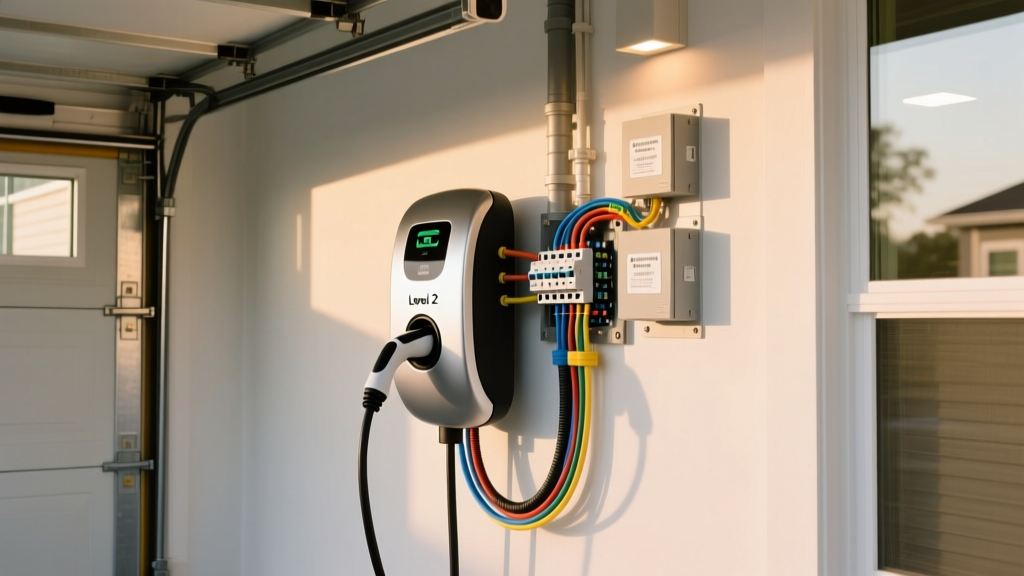
The practical consequence: your circuit breaker must be rated at 125% of the charger's maximum continuous draw. In other words, you can only use 80% of a breaker's rated capacity for continuous EV charging.
- 40-amp breaker → max 32 amps continuous (7.7 kW at 240V)
- 50-amp breaker → max 40 amps continuous (9.6 kW at 240V)
- 60-amp breaker → max 48 amps continuous (11.5 kW at 240V)
This is why a "48-amp charger" requires a 60-amp breaker — not a 50-amp breaker. Many homeowners and even some electricians get this wrong.
This rule is non-negotiable and applies whether you're installing a hardwired wall connector or a 240V NEMA 14-50 receptacle. The National Fire Protection Association (NFPA) publishes the NEC, and your local AHJ (Authority Having Jurisdiction — typically your city or county electrical inspector) enforces it.
Charging Levels Explained: kW, Miles Per Hour, and Charge Times
Before sizing circuits, you need to understand what each charging level actually delivers. Remember: kW (kilowatts) measures power — the rate of energy delivery, while kWh (kilowatt-hours) measures energy — the total capacity of your battery. Think of kW as the flow rate of a hose and kWh as the size of the bucket.
| Level | Voltage | Max Power (kW) | Miles of Range Added/Hour | 10–80% Time (75 kWh Battery) |
|---|---|---|---|---|
| Level 1 (120V outlet) | 120V | 1.4 kW | 3–5 mi/hr | ~32 hours |
| Level 2 (240V home/public) | 240V | 7.7–19.2 kW | 20–60+ mi/hr | ~4–9 hours |
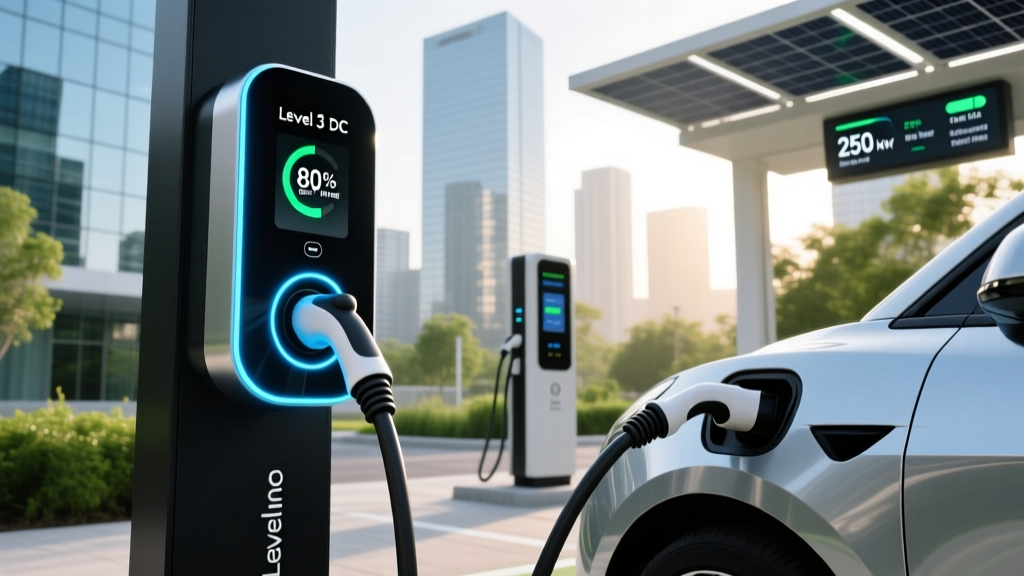
| DC Fast Charging | 400–800V DC | 50–350 kW | 150–1,200+ mi/hr | 18–45 minutes |
Real-world note: DC fast charging speeds are peak rates, not sustained rates. A vehicle rated for 250 kW peak charging will typically sustain that rate only between roughly 10–40% state of charge, then taper significantly. Expect a 75 kWh battery (like a Tesla Model Y Long Range or Hyundai Ioniq 5) to charge 10–80% in about 18–25 minutes at a 250–350 kW station, not the theoretical minimum.
Electrical Requirements for Home Level 2 Installation
Most home Level 2 installations fall into one of three configurations, each with specific NEC continuous-load breaker requirements:
| Charger Output | Max Continuous Amps | Required Breaker | Wire Gauge | Typical Receptacle |
|---|---|---|---|---|
| 7.7 kW (32A) | 32A | 40A | 8 AWG copper | NEMA 14-50 or hardwired |
| 9.6 kW (40A) | 40A | 50A | 6 AWG copper | NEMA 14-50 or hardwired |
| 11.5 kW (48A) | 48A | 60A | 4 AWG copper | Hardwired only* |
*NEC 625.41 requires hardwired installation for circuits exceeding 50 amps. There is no standard residential receptacle rated for 60A continuous EV service. If you want a 48-amp charger, it must be hardwired.
Panel Capacity: The Upgrade Question Most Guides Skip
Your electrical panel has a total amperage rating — typically 100A, 150A, or 200A in residential homes. Adding a 40–60A dedicated EV circuit consumes a significant chunk of that capacity. Your electrician will perform a NEC Article 220 load calculation to determine whether your panel can handle the additional draw alongside your existing loads (HVAC, electric range, dryer, water heater).
If you have a 100-amp panel in an older home with multiple large electric appliances, a panel upgrade to 200A is likely required. This is the single biggest cost variable in home EV charger installation and the one most online guides gloss over.
Home Charger Installation Cost Breakdown
Costs vary enormously based on your panel condition, the distance from panel to charger location, and local labor rates. Here's a realistic 2026 breakdown based on national averages and real contractor quotes:
| Component | Simple Install (Same Wall) | Moderate Install (50–80 ft run) | Complex Install (Panel Upgrade) |
|---|---|---|---|
| EVSE Equipment (Level 2 charger) | $350–$700 | $350–$700 | $350–$700 |
| Electrical Materials (wire, conduit, breaker) | $50–$150 | $200–$500 | $300–$600 |
| Electrician Labor | $300–$600 | $600–$1,500 | $800–$1,500 |
| Permit & Inspection | $50–$150 | $50–$200 | $100–$300 |
| Panel Upgrade (if needed) | N/A | N/A | $1,500–$3,500 |
| TOTAL | $750–$1,600 | $1,200–$2,900 | $3,050–$6,600 |
Always get an itemized quote from a licensed electrician that separates equipment, labor, materials, and permit fees. If a quote doesn't mention NEC continuous-load compliance or the 80% breaker rule, find another electrician.
Connector Compatibility: NACS, CCS1, and CHAdeMO
The connector landscape has consolidated significantly since 2024. Here's where things stand for 2026 model-year vehicles:
| Connector | Brands Using It (Native) | Adapter Needed? |
|---|---|---|
| NACS (Tesla/J3400) | Tesla, Ford, GM, Rivian, Volvo, Polestar, Mercedes-Benz, Hyundai/Kia (2025+), BMW, Nissan (2025+) | CCS-to-NACS adapter for legacy CCS public chargers (~$200–$300) |
| CCS1 | Legacy models: pre-2025 VW ID.4, older Hyundai/Kia, Stellantis, Honda Prologue (2024–2025) | NACS-to-CCS adapter for Tesla Superchargers (~$200–$250) |
| CHAdeMO | Nissan Leaf (discontinued), Mitsubishi Outlander PHEV (legacy) | Limited adapter options; CHAdeMO stations increasingly rare |
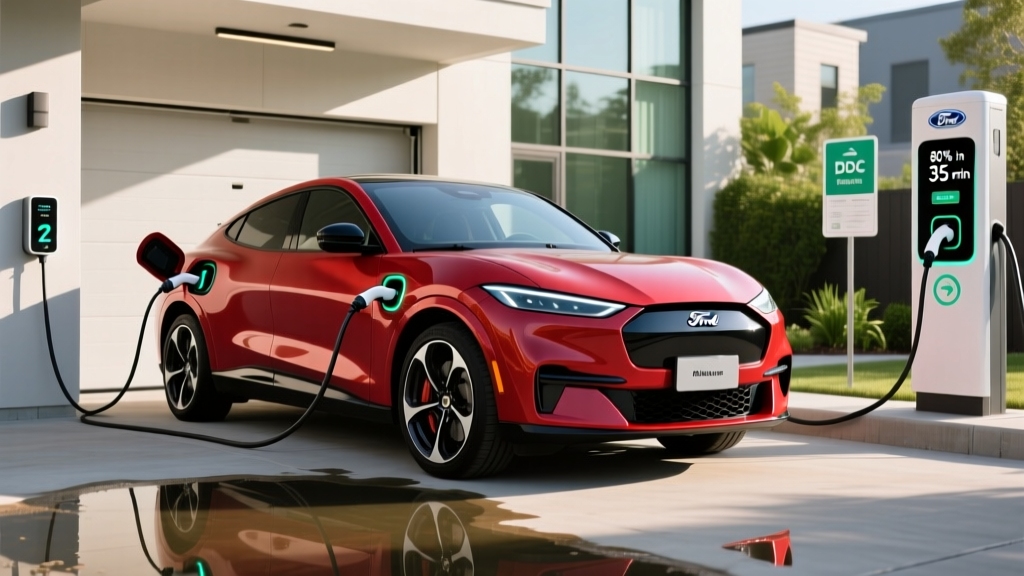
For home Level 2 charging: Nearly all Level 2 home chargers now ship with a NACS connector or offer it as the default option. If you drive a CCS1-equipped vehicle, confirm the charger includes a CCS1 plug or purchase a compatible adapter. J1772 (the older Level 2 standard) adapters are included with most NACS vehicles for backward compatibility.
Recommended Home Level 2 Chargers (2026)
Tesla Wall Connector (J3400/NACS)
- Power Output: 11.5 kW (48A) — requires 60A breaker
- Connector: NACS (J3400)
- Cable Length: 24 ft
- Smart Features: Wi-Fi, OTA updates, power sharing with 2nd unit, access control
- Price: ~$475
- Installation: Hardwired only (48A exceeds 50A receptacle limit)
ChargePoint Home Flex
- Power Output: Up to 12 kW (50A) — requires 60A breaker (configurable down to 16A)
- Connector: NACS or J1772 options
- Cable Length: 23 ft
- Smart Features: Wi-Fi, app scheduling, Alexa integration, energy tracking
- Price: ~$550–$650
- Installation: NEMA 14-50 plug or hardwired
Emporia Level 2 Smart Charger
- Power Output: Up to 11.5 kW (48A) — requires 60A breaker
- Connector: NACS or J1772
- Cable Length: 24 ft
- Smart Features: Wi-Fi, solar integration, real-time energy monitoring, load management
- Price: ~$400–$450
- Installation: Hardwired or NEMA 14-50
Grizzl-E Smart (United Chargers)
- Power Output: Up to 10 kW (40A) — requires 50A breaker
- Connector: NACS or J1772
- Cable Length: 24 ft
- Smart Features: Wi-Fi, OCPP support, adjustable amperage, extreme cold rated (-40°F)
- Price: ~$500–$600
- Installation: NEMA 14-50 plug or hardwired
Buyer's note: Choose your charger amperage based on your panel's available capacity, not just the maximum. A 40A charger on a 50A breaker is perfectly adequate for overnight charging of most EVs — a 75 kWh battery will go from 10–80% in roughly 6 hours at 9.6 kW, which is more than enough for daily needs.
Cost to Charge: Home vs. Public vs. Gas
The economic case for home charging is overwhelming. Here's a realistic cost comparison using 2026 national averages:
| Scenario | Rate | Cost Per Mile* | Monthly Cost (1,000 mi) |
|---|---|---|---|
| Home — Off-Peak TOU | $0.09–$0.14/kWh | $0.03–$0.04 | $30–$40 |
| Home — Standard Rate | $0.15–$0.20/kWh | $0.05–$0.06 | $50–$60 |
| Public Level 2 | $0.25–$0.49/kWh | $0.08–$0.15 | $80–$150 |
| DC Fast Charging | $0.35–$0.69/kWh | $0.11–$0.21 | $110–$210 |
| Gas Vehicle (28 MPG avg, $3.40/gal) | $3.40/gallon | $0.12 | $120 |
*Based on an EV averaging 3.0 miles per kWh (typical for a midsize crossover like the Model Y, Ioniq 5, or EV6). Efficiency varies: a Lucid Air achieves ~4.5 mi/kWh; a Rivian R1T achieves ~2.0 mi/kWh.
Home off-peak charging costs roughly one-quarter to one-third what you'd pay for gasoline per mile. Even exclusive DC fast charging is competitive with gas — but it's hard on your battery long-term and should be used sparingly for daily charging.
Safety, Code Compliance, and Inspection Requirements
Beyond the continuous-load breaker sizing, the NEC and your local electrical code require several additional safety provisions for EV charging installations:
- Dedicated circuit: Your EV charger must have its own dedicated breaker — it cannot share a circuit with other appliances or outlets (NEC 625.40).
- GFCI protection: NEC 2020 and later requires GFCI protection for all receptacles used for EV charging. However, many EVSE manufacturers and electricians recommend hardwired installations to avoid nuisance GFCI trips, since the EVSE itself has built-in ground-fault protection. Hardwired connections are exempt from the GFCI receptacle requirement under NEC 625.42.
- Outdoor rating: If your charger is installed outdoors (carport, driveway), the EVSE must carry a NEMA 4 or NEMA 4X weather rating, and any outdoor receptacle must be in an in-use weatherproof cover.
- Cable management: NEC 625.44 requires that the charging cable not create a tripping hazard. Plan your charger location so the cable reaches your vehicle's charge port without crossing walkways.
- Permit and inspection: Virtually all jurisdictions require an electrical permit for a new 240V circuit. Your installation must pass inspection before use. The permit typically costs $50–$200 and ensures a qualified inspector verifies code compliance.
Many homeowners install a NEMA 14-50 receptacle on a 50A breaker, then plug in a 40A continuous-load charger. While technically code-compliant (40A is 80% of 50A), some jurisdictions now require GFCI breakers for 14-50 receptacles used for EV charging, which can cost $100–$150 and are prone to nuisance tripping. A hardwired installation avoids this issue entirely and is the preferred approach for any charger above 32A.
Frequently Asked Questions
How much does it cost to install a home EV charger?
A straightforward Level 2 installation with an adequate existing panel typically costs $750–$1,600 all-in (charger, materials, labor, permit). If your wiring run is long (50+ feet from panel to garage), expect $1,200–$2,900. If you need a panel upgrade from 100A to 200A, total project cost can reach $3,050–$6,600. Always get a detailed quote that breaks out equipment, labor, and permit fees separately.
How fast will each charging level add range?
Level 1 (120V) adds 3–5 miles of range per hour — adequate only for PHEVs or very low daily mileage. Level 2 at 7.7 kW adds roughly 25 miles per hour; at 11.5 kW, roughly 37–40 miles per hour (varies by vehicle efficiency). DC fast charging at 150+ kW can add 100–200+ miles in 15–20 minutes, though the charge curve tapers significantly above 80% state of charge.
Which connector/charger is compatible with my EV?
For 2026 model-year vehicles, NACS (J3400) is now the dominant standard — Tesla, Ford, GM, Rivian, Hyundai, Kia, BMW, Volvo, and others use it natively. If you own an older CCS1 vehicle (pre-2025 VW ID.4, older Ioniq 5, etc.), you'll need a NACS-to-CCS adapter (~$200–$250) for Tesla Supercharger access and should select a home charger with a J1772 or CCS1 connector. CHAdeMO is effectively discontinued for new vehicles.
How much does charging cost per mile vs. gas?
Home off-peak charging costs approximately $0.03–$0.04 per mile — roughly one-quarter the $0.12/mile cost of a 28 MPG gas vehicle at $3.40/gallon. Standard-rate home charging runs $0.05–$0.06/mile. Exclusive public DC fast charging ($0.11–$0.21/mile) erases much of the savings advantage, which is why home charging access is the single most important factor in EV ownership economics.
What electrical upgrades might I need?
The most common upgrade is a panel replacement from 100A to 200A service ($1,500–$3,500), needed when your existing panel lacks capacity for a 40–60A dedicated circuit. Other potential upgrades include: replacing a Federal Pacific or Zinsco panel (known fire hazards, often required by insurers), adding a sub-panel in a detached garage ($800–$2,000), or trenching conduit for an underground run from house to detached structure. Your electrician's NEC Article 220 load calculation will determine exactly what's needed.
Always consult a licensed electrician for final specifications. Local code amendments may differ from the base NEC, and your AHJ has final authority on compliance. For the full NEC text, refer to the NFPA 70 (National Electrical Code). For EV efficiency and range data, check the EPA's fueleconomy.gov database.