Is EV Charging Cheaper Than Gas? The Short Answer
For most U.S. drivers charging at home on off-peak electricity rates, EV charging is significantly cheaper than gasoline — typically 40% to 60% less per mile. But the answer changes fast when you rely exclusively on public DC fast chargers, where rates in 2026 frequently rival or exceed the cost of fueling a 30 MPG gas car.
The real question isn't a simple yes or no. It's where you charge, when you charge, and what your electricity rate is. A homeowner in Washington state paying $0.10/kWh will see dramatically different economics than an apartment dweller in California paying $0.55/kWh at a public Electrify America station. Below, we run the exact numbers so you can calculate your own scenario.
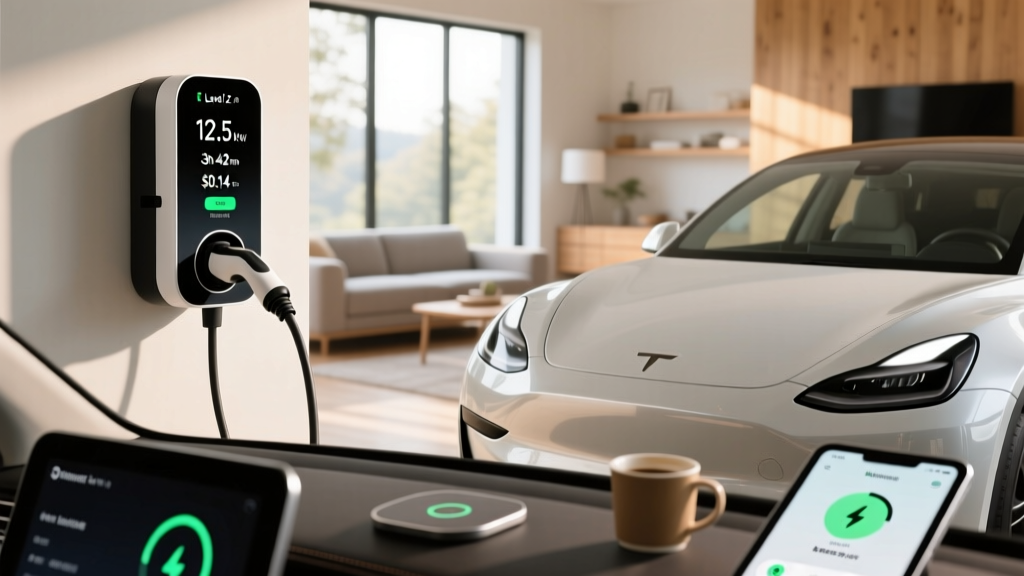
Before we run the math: kW (kilowatts) measures power — how fast energy flows into your car, like water pressure from a hose. kWh (kilowatt-hours) measures energy — the total amount stored in your battery, like gallons in a tank. You pay for kWh at the charger. Your charger's kW rating determines how quickly those kWh accumulate. Confusing the two is the most common EV literacy mistake new owners make.
EV Charging Cost Per Mile vs Gas: The Math
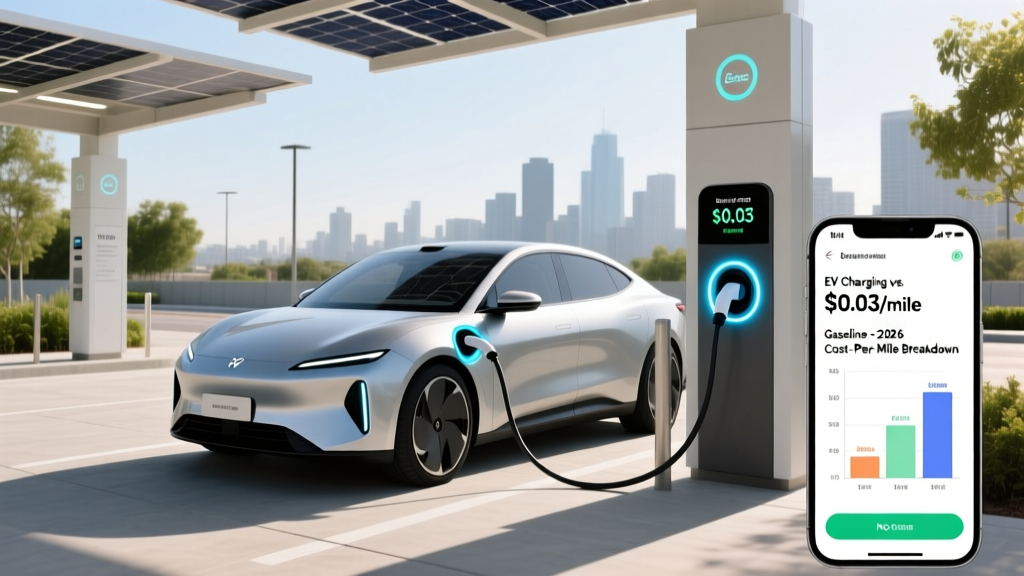
To compare apples to apples, we need a common metric: cost per mile. For EVs, that means dividing your electricity rate ($/kWh) by your vehicle's efficiency (miles per kWh). For gas cars, it means dividing the fuel price ($/gallon) by fuel economy (miles per gallon).
| Scenario | Rate / Price | Efficiency | Cost Per Mile | vs 30 MPG Gas |
|---|---|---|---|---|
| Home (national avg off-peak) | $0.16/kWh | 3.5 mi/kWh | $0.046 | -69% |
| Home (CA / Northeast peak) | $0.30/kWh | 3.5 mi/kWh | $0.086 | -43% |
| Public Level 2 (ChargePoint) | $0.35/kWh | 3.5 mi/kWh | $0.100 | -33% |
| DC Fast (EA / EVgo peak) | $0.55/kWh | 3.5 mi/kWh | $0.157 | +4% |
| Gas car (30 MPG combined) | $3.50/gal | 30 MPG | $0.117 | — |
| Gas car (25 MPG, truck/SUV) | $3.50/gal | 25 MPG | $0.140 | — |
The takeaway: Home charging is almost always cheaper than gas — often by a wide margin. Public DC fast charging at peak rates ($0.48–$0.65/kWh in major metros) can equal or exceed the per-mile cost of a 30 MPG gas car. If you can install a home Level 2 charger and use time-of-use (TOU) rates, EV fueling economics are overwhelmingly favorable. According to fueleconomy.gov, the average EV achieves 3–4 miles per kWh, making even moderately priced electricity a bargain compared to $3.50/gallon gasoline.
Charging Levels Explained: Speed, Power, and Range Added
EV charging happens at three distinct levels, each with different power delivery (measured in kW) and practical range recovery. Here's how they compare for a typical 2026 EV crossover with a 75–85 kWh battery:
| Level | Voltage / Power | Max kW | Miles of Range / Hour | 10–80% Time (75 kWh pack) | Best For |
|---|---|---|---|---|---|
| Level 1 | 120V / 12A | 1.4 kW | 3–5 mi/hr | ~37 hours | Overnight top-ups, PHEVs, low-mileage drivers |
| Level 2 (Home) | 240V / 32–48A | 7.7–11.5 kW | 25–44 mi/hr | 5–8 hours | Daily home charging, overnight full recharge |
| Level 2 (Public) | 208–240V / 32–80A | 7.7–19.2 kW | 25–70 mi/hr | 3–8 hours | Workplace, shopping, destination charging |
| DC Fast Charging | 400–800V DC | 50–350 kW | 150–1,000+ mi/hr (peak) | 18–45 minutes | Road trips, quick top-ups |
Charging curve reality check: DC fast chargers do not sustain peak kW for the entire session. A vehicle that advertises "250 kW peak" may only hold that rate between 10–30% state of charge (SoC), then taper progressively. A typical 2026 EV with a 75–85 kWh NMC battery at a 250 kW charger will charge from 10–80% in roughly 18–25 minutes, but 80–100% may take another 20+ minutes. This is why 10–80% is the standard metric — most road-trip strategies target that window.
For example, the 2026 Hyundai Ioniq 5 (84 kWh battery, 250 kW peak) achieves 10–80% in approximately 18 minutes at a capable charger, while the 2026 Ford Mustang Mach-E (91 kWh extended-range, 150 kW peak) takes roughly 38 minutes for the same window. Always check your specific vehicle's charge curve, not just the peak number.
Home EV Charger Installation: Costs, Requirements, and Gotchas
Installing a Level 2 home charger is where most EV owners unlock the biggest fuel savings. But the total cost varies enormously based on your home's electrical infrastructure. Here's the realistic breakdown.
Electrical Requirements
A standard Level 2 home charger requires a 240V dedicated circuit, similar to what an electric dryer or oven uses. The most common configurations in 2026:
- 32A circuit (7.7 kW): Requires a 40A breaker (NEC rule: circuit rated at 125% of continuous load). Sufficient for most daily driving — adds ~25 miles of range per hour.
- 40A circuit (9.6 kW): Requires a 50A breaker. The sweet spot for most homes, adding ~35 miles per hour.
- 48A circuit (11.5 kW): Requires a 60A breaker. Maximum practical home charging. Only useful if your EV's onboard charger supports 11.5 kW (many cap at 9.6–11.5 kW).
Panel Upgrade: The Hidden Cost
Many homes built before 2000 have 100A electrical panels. Adding a 40–60A EV circuit to an already-loaded 100A panel may require a panel upgrade to 200A, which is the single largest variable in installation cost. A licensed electrician will perform a load calculation to determine if your existing panel can handle the addition.
| Component | Simple Install (Near Panel) | Complex Install (Far Run) | With Panel Upgrade |
|---|---|---|---|
| Level 2 charger (hardwired or NEMA 14-50) | $400–$700 | $400–$700 | $400–$700 |
| Electrician labor (run circuit, mount, wire) | $300–$600 | $800–$2,000 | $800–$2,000 |
| Permit & inspection | $50–$200 | $50–$200 | $100–$300 |
| Panel upgrade (100A → 200A) | N/A | N/A | $1,500–$3,500 |
| Conduit, wiring, misc materials | $50–$150 | $200–$600 | $200–$600 |
| TOTAL ESTIMATED COST | $800–$1,650 | $1,450–$3,500 | $3,000–$7,100 |
Some utilities and states offer rebates of $250–$1,000 for home charger installation — check with your local utility. The federal Alternative Fuel Vehicle Refueling Property Credit covers up to 30% of equipment and installation costs (max $1,000) for qualifying installations in eligible census tracts, per IRS guidelines.
Safety and Code Considerations
- Dedicated circuit: NEC requires a dedicated breaker for EV charging — you cannot share the circuit with other appliances.
- GFCI protection: The 2020 NEC (and later) requires GFCI protection for outdoor receptacles used for EV charging. Hardwired installations may bypass this requirement depending on jurisdiction.
- Outdoor rating: If your charger is installed outdoors (driveway, carport), ensure the unit carries a NEMA 4 or IP65 weatherproof rating.
- NEMA 14-50 vs hardwired: A NEMA 14-50 outlet gives you portability (take the charger when you move), but some jurisdictions require GFCI breakers for receptacles, adding $100–$150. Hardwired installations are often simpler and cheaper from a code-compliance standpoint.
- Permit required: Virtually all jurisdictions require an electrical permit and inspection for a new 240V circuit. Skipping this risks insurance denial in the event of a fire.
Which Connector Is Compatible With Your EV?
The connector landscape shifted dramatically between 2023 and 2026. Tesla's North American Charging Standard (NACS) has been adopted by nearly every major automaker, but CCS1-equipped vehicles are still on the road and at many public stations. Here's what fits what:
| Connector | Native Vehicles | Max DC kW | Adapter Needed? |
|---|---|---|---|
| NACS (Tesla) | Tesla (all), Ford (2025+), GM (2025+), Rivian (2025+), Hyundai/Kia (2026+), Volvo/Polestar (2025+) | 250–350 kW | CCS→NACS adapter ($200–$250) for older CCS stations |
| CCS1 | Older VW ID.4, BMW i4/iX, Mercedes EQE/EQS, pre-2025 Hyundai/Kia, Stellantis | 150–350 kW | NACS→CCS adapter ($200–$300) for Tesla Superchargers |
| CHAdeMO | Nissan Leaf (legacy), Mitsubishi Outlander PHEV (legacy) | 50–100 kW | Limited adapters; network shrinking |
Practical advice: If you're buying a new EV in 2026, NACS-native is the clear standard going forward. Tesla's Supercharger network remains the most reliable DC fast-charging infrastructure in North America. If you own a CCS1 vehicle, purchase an official NACS-to-CCS adapter to access Superchargers. CHAdeMO is effectively a legacy standard — plan your road trips carefully if you drive a Leaf.
Recommended Home EV Chargers (2026)
Not all Level 2 chargers are equal. Below are widely regarded, code-compliant units with the specs that matter:
Tesla Wall Connector (Gen 4)
- Power: 11.5 kW (48A) max
- Connector: NACS native
- Cable length: 24 ft
- Smart features: Wi-Fi, OTA updates, load sharing, Tesla app scheduling
- Price: ~$475
- Best for: Tesla owners; NACS-native 2025+ Ford/GM/Rivian vehicles
ChargePoint Home Flex
- Power: Up to 12 kW (50A) configurable
- Connector: NACS or CCS1 (select at purchase)
- Cable length: 23 ft
- Smart features: Wi-Fi, Alexa, scheduling, energy tracking, utility integration
- Price: ~$550–$650
- Best for: Multi-EV households, utility TOU integration
Emporia Vue Smart EV Charger
- Power: Up to 11.5 kW (48A)
- Connector: NACS or J1772 (with adapter)
- Cable length: 24 ft
- Smart features: Wi-Fi, solar integration, whole-home energy monitoring via Emporia Vue panel
- Price: ~$400–$500
- Best for: Solar-equipped homes, budget-conscious buyers
All three units above carry UL certification, support hardwired or plug-in (NEMA 14-50) installation, and are rated for indoor/outdoor use (NEMA 4). Always verify the unit's amperage matches your circuit breaker sizing (breaker = 125% of charger amperage for continuous loads).
5-Year Fuel Cost Projection: EV vs Gas
Let's put the per-mile numbers into a 5-year ownership scenario. We'll assume 12,000 miles/year (the U.S. average per FHWA data) and compare a typical 2026 EV crossover (3.5 mi/kWh) to a 28 MPG gas compact SUV.
| EV (Home, $0.16/kWh) | Gas SUV (28 MPG, $3.50/gal) | Difference | |
|---|---|---|---|
| Annual fuel cost | $549 | $1,500 | -$951/yr |
| 5-year fuel cost | $2,743 | $7,500 | -$4,757 |
Over five years, a home-charging EV owner saves roughly $4,750 in fuel costs compared to a 28 MPG gas vehicle. That savings alone can offset the cost of a home charger installation and still leave money on the table. Even against a more efficient 35 MPG hybrid, the EV saves approximately $2,750 over five years at these rates.
However, factor in these offsetting costs for a complete picture:
- Home charger installation: $800–$3,500 (one-time)
- EV insurance premium: Typically 15–25% higher than an equivalent gas vehicle (varies by insurer and state)
- Tire replacement: EVs wear tires 20–30% faster due to instant torque and higher vehicle weight
Frequently Asked Questions
How much does it cost to install a home EV charger?
A straightforward Level 2 installation (short wire run, adequate panel capacity) costs $800–$1,650 including the charger, electrician labor, permit, and materials. Complex installations with long conduit runs cost $1,450–$3,500. If your home needs a panel upgrade from 100A to 200A, total costs can reach $3,000–$7,100. Always get a load calculation from a licensed electrician before committing.
How fast will each charging level add range?
Level 1 (120V) adds 3–5 miles of range per hour — adequate for PHEVs or drivers covering under 30 miles daily. Level 2 (240V, 40A) adds roughly 30–35 miles per hour, fully recharging most EVs overnight in 6–8 hours. DC fast charging at 150–250 kW can add 150–250+ miles in 20 minutes, but only within the 10–80% SoC window before the charge curve tapers.
Which connector/charger is compatible with my EV?
For 2026 model-year vehicles, check the manufacturer spec sheet. Tesla, Ford (2025+), GM (2025+), Rivian, Hyundai/Kia (2026+), and Volvo/Polestar use NACS natively. Older VW, BMW, Mercedes, and pre-2025 Hyundai/Kia models use CCS1. Nissan Leaf uses CHAdeMO (legacy). Adapters are available to cross-connect most combinations, but verify wattage compatibility — some adapters limit DC fast-charge speed.
Is EV charging cheaper than gas if I only use public chargers?
Often no. Public DC fast chargers in 2026 average $0.40–$0.60/kWh, which translates to $0.11–$0.17 per mile for a typical EV. A 30 MPG gas car at $3.50/gallon costs $0.117 per mile. If public charging is your only option, the cost advantage narrows or disappears entirely. Some public Level 2 chargers (workplaces, grocery stores) offer free or low-cost charging — seek these out for supplemental top-ups.
What electrical upgrades might I need?
The most common upgrade is a panel capacity increase from 100A to 200A, required when your existing panel lacks headroom for a new 40–60A circuit. Homes built after 2005 typically have 200A panels and can accommodate an EV charger without a panel upgrade. Your electrician will perform an NEC Article 220 load calculation. Some utilities offer "make-ready" programs that cover the cost of wiring from the utility to your meter panel — ask your provider.
Does cold weather affect EV charging costs?
Yes, indirectly. Cold temperatures reduce battery efficiency by 20–30% and slow DC fast-charge speeds unless the battery is preconditioned. This means you'll consume more kWh per mile in winter (pushing up your cost per mile) and spend more time at public chargers. Preconditioning your battery before a DC fast-charge session — most EVs do this automatically when you navigate to a charger — mitigates the speed penalty.
Bottom line: EV charging is cheaper than gas when you charge at home on reasonable electricity rates — often by $900+ per year. Public DC fast charging erases much of that advantage. Before buying an EV, confirm you can install a Level 2 charger at home, check your utility's time-of-use rates, and get an electrician's load assessment. That preparation is the difference between saving thousands on fuel and paying gas-equivalent rates at every public charger. For official efficiency data on any vehicle, always cross-reference fueleconomy.gov.