The cable connecting your EV to its power source is the most overlooked component in electric ownership — yet it dictates how fast you charge, where you can plug in, and whether you wake up to a full battery or a frustrating morning detour. With the industry-wide shift to the North American Charging Standard (NACS) now in full swing for 2026 model-year vehicles, choosing the right EV charging cable and home charging equipment requires more attention than it did even two years ago.
This guide breaks down every cable type, connector, and charging speed you need to know, along with real installation costs, electrical requirements, and equipment picks for your garage or driveway.
Charging Levels Explained: How Fast Will Each Add Range?
Before picking a cable or charger, you need to understand the three charging levels. Speed is measured in kW (kilowatts), which represents power — the rate at which energy flows into your battery. The battery's capacity is measured in kWh (kilowatt-hours) — the total energy it stores. A 75 kWh battery charged at 7.7 kW takes roughly 10 hours from empty to full. Confusing kW with kWh is the single most common mistake new EV owners make.
| Level | Voltage | Power (kW) | Miles of Range Per Hour | Best For |
|---|---|---|---|---|
| Level 1 | 120V AC | 1.2 – 1.9 kW | 3 – 5 mi/hr | Overnight top-ups, PHEVs, emergencies |
| Level 2 | 240V AC | 3.3 – 19.2 kW | 12 – 75 mi/hr | Daily home charging, workplace, destinations |
| DC Fast Charging | 400V – 900V DC | 50 – 350+ kW | 150 – 1,000+ mi/hr (peak) | Road trips, rapid top-ups away from home |
Most EV owners do the vast majority of their charging at home on Level 2. A 7.7 kW (32-amp) Level 2 charger adds roughly 28–32 miles of range per hour of charging — enough to fully replenish a 75 kWh battery overnight. DC fast charging is reserved for road trips and quick stops; it bypasses the vehicle's onboard charger and feeds DC current directly to the battery.
Connector Compatibility: NACS, CCS1, and CHAdeMO in 2026
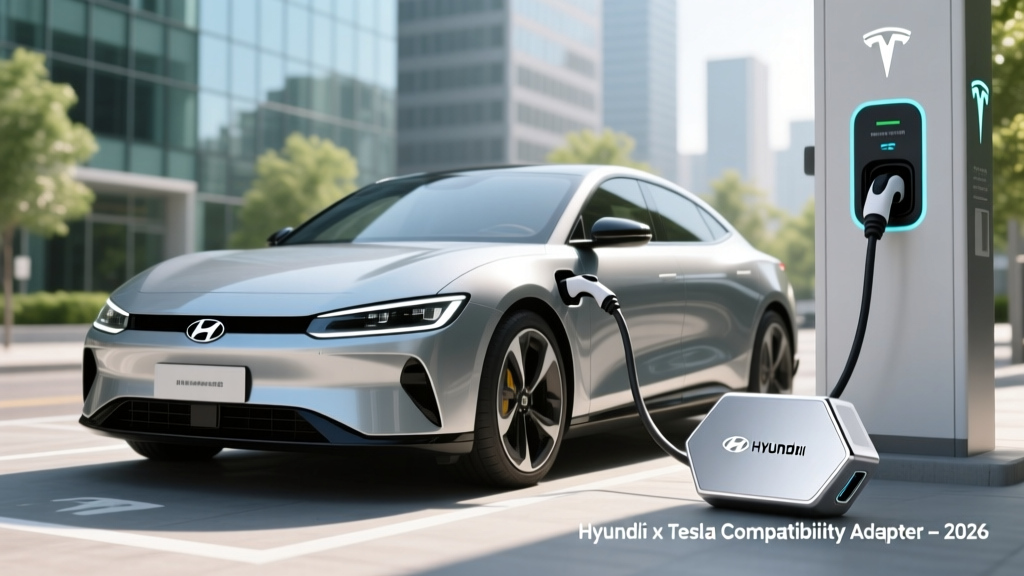
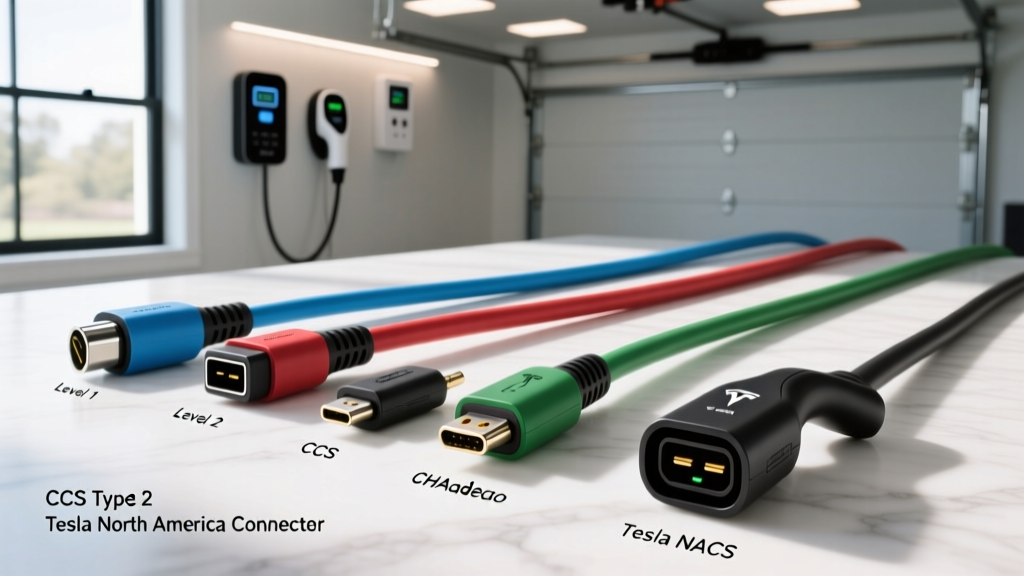
The connector on the end of your EV charging cable determines which vehicles and public stations you can use. As of 2026, the North American Charging Standard (NACS) — originally developed by Tesla — has become the dominant connector for new EVs, with nearly every major automaker adopting it. Here's where each brand stands:
| Connector | Automakers Using It | Adapter Needed? |
|---|---|---|
| NACS (J3400) | Tesla, Ford, GM, Rivian, Volvo, Polestar, Mercedes-Benz, Nissan, Fisker, Honda (2026+), Hyundai/Kia (2026+) | CCS1-to-NACS adapter for legacy CCS vehicles at NACS Superchargers |
| CCS1 (Combo) | Legacy models from VW, BMW, Hyundai/Kia (pre-2026), Stellantis, older Ford/GM | NACS-to-CCS1 adapter needed at Tesla Superchargers |
| CHAdeMO | Nissan Leaf (pre-2026), Mitsubishi Outlander PHEV (older models) | Limited adapters; network is shrinking |
If you own a 2026 model-year vehicle from Ford, GM, Rivian, or most other major brands, your car has a NACS port natively. Tesla owners have always used NACS. If you're driving a 2024–2025 CCS1-equipped vehicle, you'll likely need a Tesla-approved CCS1-to-NACS adapter (roughly $150–$250) to access the Supercharger network, which now welcomes non-Tesla EVs at many locations.
CHAdeMO is effectively a legacy standard in North America. Electrify America and other networks still maintain some CHAdeMO stalls, but new installations overwhelmingly feature NACS and CCS1. If you drive a Nissan Leaf with CHAdeMO, plan your public charging around networks that still support it.
Home Charger Installation: Electrical Requirements and Real Costs
Installing a Level 2 home charger is where most EV owners invest the most upfront — and where costs vary the most based on your home's electrical infrastructure. Here's what's involved:
Electrical Requirements
A typical Level 2 home charger requires a dedicated 240V circuit, similar to what powers an electric dryer or oven. The most common configurations:
- 40-amp circuit / 32-amp continuous charging (7.7 kW): The most popular setup. Sufficient for overnight charging of most EVs with 60–100 kWh batteries.
- 50-amp circuit / 40-amp continuous (9.6 kW): Faster charging; recommended for larger batteries (Ford F-150 Lightning, Rivian R1T) or households with two EVs sharing one charger.
- 60-amp circuit / 48-amp continuous (11.5 kW): Maximum Level 2 speed supported by most EVs with 48A onboard chargers (Tesla Model Y, Model 3, Rivian).
- 80-amp circuit / 64-amp continuous (15.2+ kW): Specialty high-power chargers like the Tesla Wall Connector at max config; requires a 100-amp breaker and heavier-gauge wiring.
Panel Upgrade: The Hidden Cost
Many older homes have 100-amp or 150-amp main electrical panels that are already near capacity. Adding a 40–60 amp dedicated EV circuit may exceed your panel's headroom. A panel upgrade to 200 amps typically costs $1,500–$3,000 on its own. Some homes may qualify for a load-management device (like the Emporia Smart Load Management system) that dynamically shares capacity between your EV charger and other appliances, potentially avoiding a panel upgrade altogether.
| Cost Component | Simple Install (Panel Nearby) | Complex Install (Panel Upgrade + Long Run) |
|---|---|---|
| Level 2 charger equipment | $350 – $650 | $350 – $650 |
| Electrician labor (240V circuit) | $400 – $800 | $1,200 – $2,500 |
| Electrical permit | $50 – $150 | $50 – $200 |
| Panel upgrade (if needed) | $0 | $1,500 – $3,000 |
| Wiring materials (conduit, wire) | $50 – $150 | $200 – $500 |
| Total Estimated Cost | $850 – $1,750 | $3,300 – $6,850 |
Always hire a licensed electrician familiar with EV charger installations. According to the National Electrical Contractors Association, EV-specific installations require proper wire gauge (typically 6 AWG copper for 50A circuits), a dedicated breaker, and compliance with NEC Article 625 for EV charging systems.
Cost to Charge: EV Charging Cable Economics vs. Gas
The cost advantage of EV charging depends heavily on where and when you plug in. Here's a breakdown of real-world $/kWh scenarios and how they translate to cost per mile:
| Charging Scenario | Avg $/kWh | Cost Per Mile (3 mi/kWh EV) | Equivalent Gas MPG at $3.50/gal |
|---|---|---|---|
| Home, off-peak utility rate | $0.08 – $0.12 | $0.03 – $0.04 | 88 – 117 MPG |
| Home, standard residential rate | $0.14 – $0.18 | $0.05 – $0.06 | 58 – 70 MPG |
| Public Level 2 (ChargePoint, etc.) | $0.25 – $0.40 | $0.08 – $0.13 | 27 – 44 MPG |
| DC Fast Charging (Electrify America, EA Pass) | $0.35 – $0.55 | $0.12 – $0.18 | 19 – 29 MPG |
| DC Fast Charging (Tesla Supercharger, non-member) | $0.28 – $0.40 | $0.09 – $0.13 | 27 – 39 MPG |
Home charging on an off-peak rate delivers the strongest economics — roughly one-quarter the cost per mile of a 30 MPG gas vehicle at $3.50/gallon. However, exclusive reliance on DC fast charging can push your per-mile cost close to that of an efficient gas car. The data from fueleconomy.gov consistently shows that EVs average 3–4 miles per kWh, making home charging the clear financial winner.
Many utilities offer time-of-use (TOU) plans that discount electricity during overnight hours (typically 11 PM – 6 AM). Setting your EV or charger to charge only during off-peak windows maximizes savings. Smart chargers with scheduling features automate this process.
Charging Time Examples: What to Expect for Common Battery Sizes
Charging time depends on battery capacity (kWh), the charger's power output (kW), and your vehicle's onboard charger limit. DC fast charging also follows a charge curve — peak kW rates are only sustained between roughly 10–50% state of charge (SoC), then taper significantly above 80% to protect battery health.
| Vehicle Example | Battery (kWh) | Level 2 @ 7.7 kW (0–100%) | Level 2 @ 11.5 kW (0–100%) | DC Fast 10–80% |
|---|---|---|---|---|
| Tesla Model 3 (2026) | ~60 (LFP) / ~75 (NMC) | 8–10 hours | 5–6.5 hours | ~20–25 min (peak 250 kW) |
| Hyundai Ioniq 5 (2026) | ~77.4 | 10 hours | 6.7 hours | ~18 min (800V, peak 350 kW) |
| Ford F-150 Lightning (2026) | ~131 (Extended Range) | 17 hours | 11.4 hours | ~40 min (peak 150 kW) |
| Chevrolet Equinox EV (2026) | ~85 | 11 hours | 7.4 hours | ~30 min (peak 150 kW) |
Note the Hyundai Ioniq 5's 800V architecture allows it to sustain higher charge rates longer on a 350 kW DC fast charger, achieving a 10–80% charge in roughly 18 minutes. The F-150 Lightning's massive 131 kWh battery takes longer even at comparable peak rates because there's simply more energy to move. On Level 2, plan for overnight charging — that's by design. You plug in when you get home and wake up full.
Best Home EV Chargers and Charging Cables for 2026
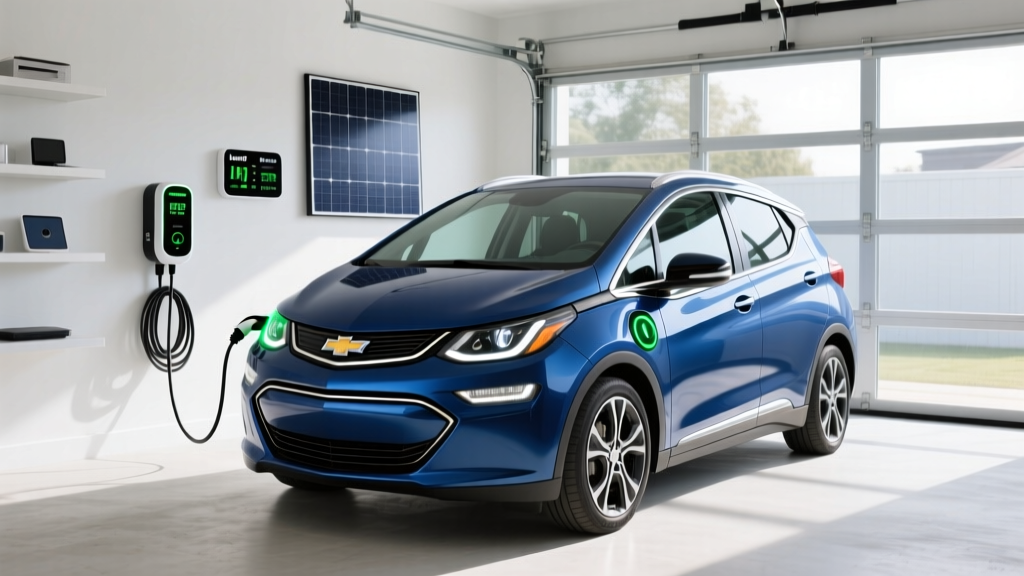
When selecting a home charger (officially called Electric Vehicle Supply Equipment, or EVSE), the cable is integrated into the unit for hardwired or plug-in (NEMA 14-50) installations. Here are top-performing models across different needs:
Tesla Wall Connector (Gen 4)
- Power Output: Up to 11.5 kW (48A) on a 60A circuit
- Connector: NACS (native); CCS1 adapter available separately
- Cable Length: 24 feet
- Smart Features: Wi-Fi, scheduling, energy tracking, OTA updates, load sharing between multiple units
- Price: ~$475
- Best For: Tesla owners and NACS-equipped 2026 vehicles; best value per kW
Emporia Vue EV Charger
- Power Output: Up to 11.5 kW (48A) on a 60A circuit
- Connector: J1772 (use adapter for NACS vehicles) or NACS version available
- Cable Length: 24 feet
- Smart Features: Whole-home energy monitoring integration, solar-aware charging, load management, scheduling
- Price: ~$400
- Best For: Solar panel owners; homes needing load management to avoid panel upgrades
ChargePoint Home Flex (2nd Gen)
- Power Output: Up to 12 kW (50A) on a 60A circuit; adjustable down to 16A
- Connector: NACS or J1772 (configurable)
- Cable Length: 23 feet
- Smart Features: Alexa integration, scheduling, charge history, flexible amperage dial
- Price: ~$550
- Best For: Households wanting adjustable amperage to match existing panel capacity
Grizzl-E Smart (United Chargers)
- Power Output: Up to 10 kW (40A) on a 50A circuit
- Connector: J1772 (NACS adapter available)
- Cable Length: 24 feet
- Smart Features: OCPP-compatible, app scheduling, outdoor-rated (NEMA 4), extreme cold tested to -40°F
- Price: ~$450
- Best For: Cold-climate outdoor installations; rugged, no-frills reliability
For portable charging cables (the Level 1 cord that ships with most EVs or aftermarket mobile connectors), expect 1.2–1.9 kW on a standard 120V outlet. The Tesla Mobile Connector (~$200) and Lectron V-BOX J1772/NACS portable charger (~$280, up to 12A/240V with NEMA 14-50 adapter) are reliable options for travel and emergency use. Portable units are not a substitute for a dedicated Level 2 home installation if you drive more than 30 miles daily.
Safety, Code, and Installation Best Practices
EV charging involves sustained high-current draw over many hours — far more demanding than typical household appliances. Following electrical code isn't optional; it protects your home and your vehicle.
- Dedicated circuit: NEC Article 625 requires EV chargers to be on a dedicated circuit not shared with other appliances. This prevents overloading and tripped breakers.
- GFCI protection: The 2023 NEC update (adopted by most jurisdictions by 2026) requires GFCI (Ground Fault Circuit Interrupter) protection for all EV charging outlets. Hardwired installations may have different GFCI requirements — your electrician will advise based on local code.
- Outdoor rating: If your charger is installed outside or in an unenclosed carport, choose a unit rated NEMA 4 (weatherproof). All recommended chargers above meet this standard.
- Wire gauge: A 50-amp circuit requires at minimum 6 AWG copper wire; a 60-amp circuit requires 4 AWG. Undersized wiring is a fire hazard and will fail inspection.
- Permit and inspection: Virtually all jurisdictions require a permit for new 240V circuit installations. The permit ensures a certified inspector verifies the work. Budget $50–$200 for the permit fee.
- NEMA 14-50 vs. hardwired: A NEMA 14-50 outlet gives you flexibility to unplug and take your charger when you move. Hardwired installations eliminate the outlet as a failure point and may be required for circuits above 50 amps in some jurisdictions.
For detailed code requirements, the National Fire Protection Association's NEC resources provide the baseline standards that local inspectors enforce.
Frequently Asked Questions
How much does it cost to install a home EV charger?
A straightforward Level 2 installation with an existing 200-amp panel and short wire run typically costs $850–$1,750 including equipment, electrician labor, and permit. If your home needs a panel upgrade to 200 amps or has a long wire run (garage far from the panel), costs can range from $3,300–$6,850. Always get at least two quotes from licensed electricians.
How fast will each charging level add range?
Level 1 (120V) adds 3–5 miles per hour — suitable for PHEVs with small batteries but impractical for full EVs. Level 2 (240V) at 7.7 kW adds roughly 28–32 miles per hour, and at 11.5 kW adds roughly 42–48 miles per hour. DC fast charging at 150+ kW can add 150–300+ miles in 20–30 minutes, though speed tapers above 80% SoC.
Which connector and charger is compatible with my EV?
Check your vehicle's charge port. 2026 model-year vehicles from Tesla, Ford, GM, Rivian, Volvo, Honda, and Hyundai/Kia use NACS. Older (2024–2025) models from VW, BMW, and pre-transition Hyundai/Kia use CCS1. For home Level 2 charging, a NACS-equipped charger works with all new NACS vehicles directly; CCS1 vehicles need a J1772-to-CCS adapter or a J1772 charger with a CCS adapter.
How much does charging cost per mile vs. gas?
Home charging on off-peak electricity ($0.08–$0.12/kWh) costs $0.03–$0.04 per mile — equivalent to a gas car getting 88–117 MPG at $3.50/gallon. Even standard residential rates ($0.14–$0.18/kWh) deliver $0.05–$0.06/mile, equivalent to 58–70 MPG. Public DC fast charging at $0.35–$0.55/kWh costs $0.12–$0.18/mile, closer to a 19–29 MPG gas vehicle.
What electrical upgrades might I need?
The most common upgrade is a panel capacity increase from 100A or 150A to 200A ($1,500–$3,000). You may also need a new dedicated 240V circuit with proper wire gauge (6 AWG for 50A, 4 AWG for 60A), a GFCI breaker, and a permit. In some cases, a smart load-management device can avoid a panel upgrade by dynamically sharing capacity between the EV charger and high-draw appliances like HVAC or electric ranges.
Do I need a smart charger or is a basic one fine?
A basic ("dumb") charger works perfectly for charging — it delivers power and that's it. Smart chargers add scheduling (charge only during off-peak hours), energy monitoring, load management, and remote control via an app. If your utility offers time-of-use rates, a smart charger pays for itself through off-peak scheduling. Most quality chargers in the $400–$550 range include smart features at no significant premium.
Can I use a NACS charger with my older CCS1 EV?
Yes, with an adapter. Several manufacturers sell NACS-to-J1772 or NACS-to-CCS1 adapters ($100–$250) that let you use a NACS-connector home charger with a CCS1 vehicle. Tesla also sells a CCS1 adapter for its Wall Connector. Verify adapter compatibility with your specific vehicle before purchasing.