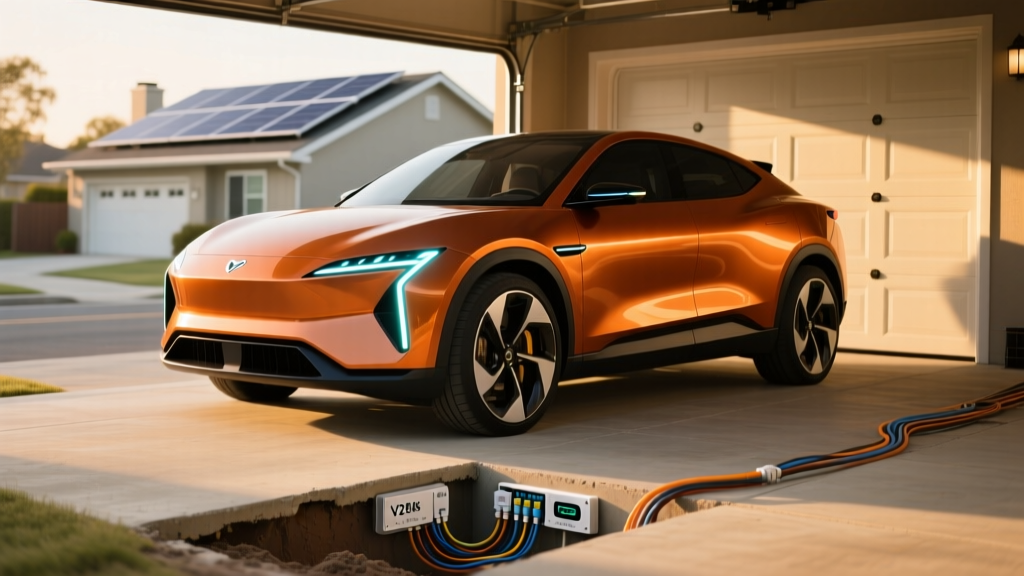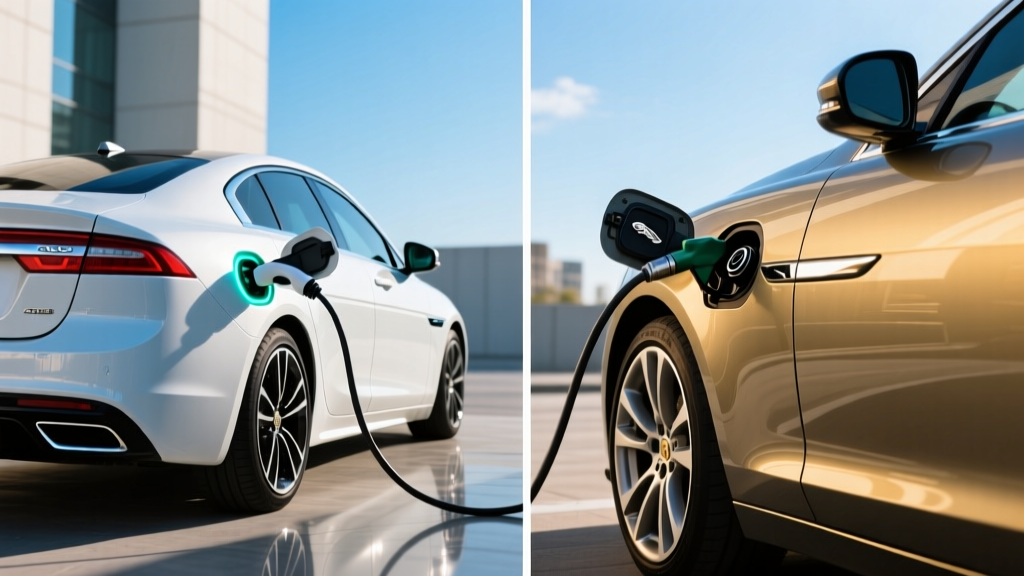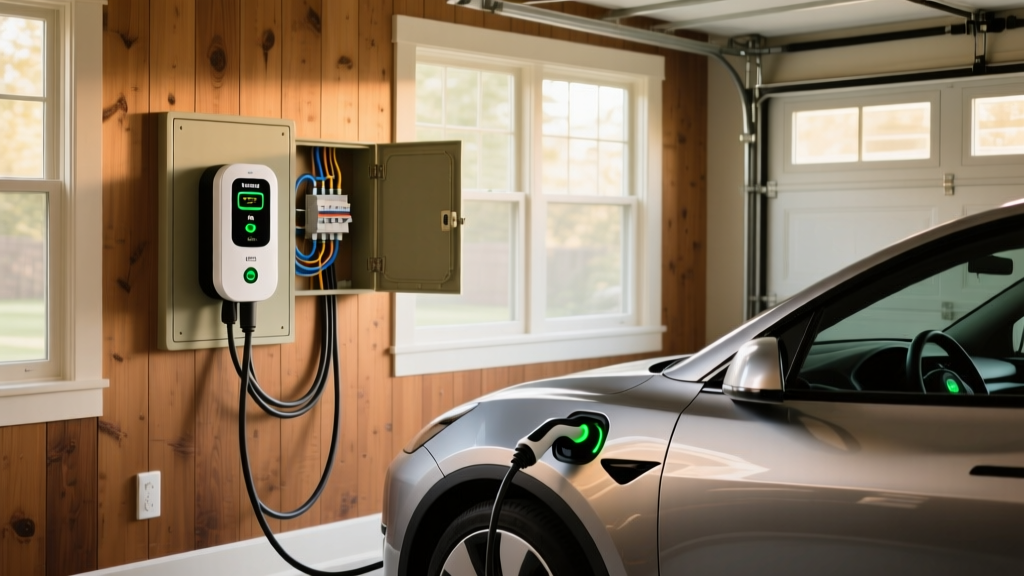
If your house was built in the 1980s, you're not alone — roughly 20% of U.S. homes date from that decade. And while a 1980s charger for your phone is a relic, a 1980s electrical panel can be a genuine bottleneck when you plug in a modern electric vehicle. The typical 1980s home shipped with a 100-amp or 150-amp service panel designed for the loads of that era: a refrigerator, a few lights, maybe a window AC unit. A Level 2 EV charger draws continuous 240V power at 32 to 48 amps — the equivalent of running two electric dryers simultaneously, for hours on end.
This guide walks through exactly what it takes to add a home EV charger to a 1980s-era home: the panel capacity math, real installation costs including the dreaded panel upgrade, connector compatibility in the NACS-dominant world of 2026, and specific charger models that work well on older electrical systems.
EV Charging Levels Explained: kW, Miles Per Hour, and What Each Needs
Before sizing your electrical work, you need to understand the three charging levels. The critical distinction: kW (kilowatts) measures power — how fast energy flows into your car at any given moment. kWh (kilowatt-hours) measures energy — how much total capacity your battery holds. Think of kW as the diameter of the hose, and kWh as the size of the bucket.
| Level | Voltage | Max Power (kW) | Miles of Range Added/Hour | Typical Use | Electrical Circuit Needed |
|---|---|---|---|---|---|
| Level 1 | 120V | 1.2–1.9 kW | 3–5 miles | Overnight trickle; PHEVs | Standard 15A or 20A outlet |
| Level 2 | 240V | 3.3–19.2 kW | 12–75 miles | Daily home charging; workplace | 240V dedicated, 20A–80A circuit |
| DC Fast | 400–800V DC | 50–350 kW | 150–1,200 miles (equivalent rate) | Road trips; commercial stations | Not applicable for home |
For a 1980s home, Level 2 is the practical target. Level 1 will technically work — you can plug your EV's included mobile connector into any standard 120V outlet — but at 1.4 kW, replenishing a 75 kWh battery from 20% to 80% takes roughly 32 hours. That's fine for a plug-in hybrid with a 15 kWh battery. For a full-size BEV, it's impractical as a primary strategy.
A typical 2026 EV like the Hyundai Ioniq 5 (84 kWh usable battery, NMC chemistry) or Tesla Model Y Long Range (78 kWh, NMC) needs about 7.7 to 11.5 kW of Level 2 power to fully recharge overnight in 7–10 hours. That requires a dedicated 240V circuit at 40A or 50A.
The 1980s Electrical Panel Problem: Capacity, Headroom, and Upgrade Reality
Here's the math that determines whether your 1980s home can handle an EV charger without a panel upgrade:
The National Electrical Code (NEC) Article 220 requires a load calculation before adding a significant continuous load. Your electrician will total the existing loads — HVAC, water heater, kitchen circuits, lighting — and compare that to your panel's rated amperage. NEC 210.20(A) requires continuous loads (anything running 3+ hours, which includes EV charging) to be sized at 125% of the actual draw. A 40A charger therefore needs a 50A breaker and wire rated for 50A.
Most 1980s homes have either 100A or 150A main service. A 100A panel with an electric range, electric dryer, and central AC is likely already near capacity. Adding a 40A EV charger on top would exceed the panel's safe continuous capacity. A 150A panel has more headroom, but a load calc is still mandatory.
Signs your 1980s panel may need an upgrade:
- 100A main breaker (very common for early-80s builds)
- Federal Pacific (Stab-Lok) or Zinsco panels — these are known fire hazards and should be replaced regardless of EV charging
- Breakers that trip regularly under normal loads
- No available spaces (knockouts) for a new double-pole breaker
- Aluminum branch wiring (some late-70s and early-80s homes used aluminum, which has higher resistance and different termination requirements)
If you have a Federal Pacific or Zinsco panel, consider the upgrade mandatory — insurance companies increasingly require replacement, and no licensed electrician will add a 50A continuous load to a panel with documented failure modes.
Home EV Charger Installation Costs: The Full Breakdown
Installation costs for a 1980s home vary enormously based on whether a panel upgrade is needed. Here's the realistic range based on 2025–2026 electrician quotes across U.S. markets:
| Component | No Panel Upgrade | With 200A Panel Upgrade |
|---|---|---|
| EV charger hardware (Level 2, 40–48A) | $350–$700 | $350–$700 |
| Electrical permit | $50–$200 | $100–$300 |
| Electrician labor (run 240V circuit, mount charger) | $400–$1,200 | $800–$1,500 |
| Wire and conduit materials (50 ft run typical) | $150–$400 | $150–$400 |
| Panel upgrade to 200A (if needed) | N/A | $2,000–$4,500 |
| Utility service drop upgrade (if needed for 200A) | N/A | $500–$2,000 (sometimes utility-covered) |
| Total estimated cost | $950–$2,500 | $3,900–$9,400 |
The wide range reflects regional labor rates, the distance from your panel to the charger location (longer wire runs cost more in copper and conduit), and whether your utility charges for a service drop upgrade. Some utilities cover the service drop cost when you upgrade to 200A — call your utility before getting quotes.
Cost-saving alternatives for 1980s panels:
- Install a lower-amperage charger. A 32A (7.7 kW) charger on a 40A circuit draws significantly less than a 48A unit. For overnight charging, 7.7 kW adds roughly 30 miles of range per hour — enough to fully replenish most EVs in 8–10 hours.
- Use a smart load-management device. Products like the Emporia Load Management Controller or Tesla's built-in load-sharing can throttle the charger when other high-draw appliances are running, keeping total panel load within limits without an upgrade.
- Install a 240V NEMA 14-50 outlet instead of a hardwired charger. This uses the same circuit but lets you use your EV's mobile connector, saving $200–$400 on charger hardware.
Connector Compatibility: NACS, CCS1, CHAdeMO, and Adapter Needs in 2026
The connector landscape has consolidated dramatically since 2023, when Ford, GM, Rivian, Volvo, and most other automakers adopted Tesla's North American Charging Standard (NACS). Here's where things stand for 2026 model-year vehicles:
| Connector | Brands Using It (Native) | Home Charger Availability | Adapter Needed? |
|---|---|---|---|
| NACS (Tesla-style) | Tesla, Ford, GM, Rivian, Volvo, Polestar, Mercedes, Hyundai, Kia (2025+), Nissan (2025+) | Widely available from Tesla, Emporia, ChargePoint, Wallbox | None for NACS vehicles |
| CCS1 | Hyundai/Kia (2024 and earlier), VW ID.4 (2024 and earlier), BMW iX (2024 and earlier), legacy models | Available from ChargePoint, Emporia, JuiceBox | CCS-to-NACS adapter ($200–$300) for Tesla Supercharger access |
| CHAdeMO | Nissan Leaf (discontinued after 2025), Mitsubishi Outlander PHEV (legacy) | Limited new charger options | CHAdeMO-to-NACS adapters available but rare |
If you're buying a new EV in 2026, it almost certainly has a NACS port. Buy a NACS-connector home charger. If you own a 2023–2024 CCS1 vehicle (like a Hyundai Ioniq 5 or VW ID.4 from those years), you can either buy a CCS1-connector charger or buy a NACS charger and use a NACS-to-CCS adapter for home charging. For DC fast charging on the road, CCS1 vehicles can access Tesla Superchargers using the Magic Dock adapter built into many Supercharger stalls or a purchased CCS-to-NACS adapter.
Source: Tesla NACS specification page and manufacturer charging documentation.
Equipment Recommendations: Level 2 Chargers for Older Homes
For a 1980s electrical system, the ideal home charger balances adequate charging speed with manageable amperage draw. Here are four models well-suited to older panels, based on reliability data, smart features, and electrical flexibility:
Emporia Vue Level 2 EV Charger
Power: Up to 48A (11.5 kW) on a 60A circuit, adjustable down to 16A for panel-limited homes
Connector: NACS or J1772 (configurable)
Cable length: 24 ft
Smart features: Wi-Fi, scheduling, solar integration, real-time load monitoring via Emporia Vue panel monitor
Price: $399
Why it works for 1980s homes: The amperage is software-adjustable from 16A to 48A without swapping hardware. If your panel can only spare 30A today, set it to 24A (5.8 kW) and increase it later if you upgrade. The integrated load monitoring pairs with the Emporia Vue energy monitor to auto-throttle if total home load approaches panel capacity.
ChargePoint Home Flex (NACS)
Power: Up to 50A (12 kW) on a 60A circuit, adjustable via DIP switches to 16A/24A/32A/40A/48A/50A
Connector: NACS (2025+ model), J1772 (legacy)
Cable length: 23 ft
Smart features: Wi-Fi, ChargePoint app scheduling, Alexa integration, utility demand-response programs
Price: $549
Why it works for 1980s homes: Hardware DIP-switch adjustment means your electrician sets the max amperage at install to match your circuit. UL-listed, outdoor-rated (NEMA 4), and compatible with most utility off-peak programs.
Tesla Wall Connector (Gen 3)
Power: Up to 48A (11.5 kW) on a 60A circuit
Connector: NACS (native)
Cable length: 24 ft
Smart features: Wi-Fi, over-the-air updates, Tesla app integration, power-sharing with a second Wall Connector on the same circuit, load-sharing with Tesla Powerwall
Price: $475
Why it works for 1980s homes: The power-sharing feature lets you install two Wall Connectors on a single 60A circuit — they dynamically split available power so you never overload the breaker. Ideal if you plan to add a second EV without a panel upgrade. Indoor/outdoor rated (NEMA 3R).
Wallbox Pulsar Plus (40A)
Power: 40A (9.6 kW) on a 50A circuit
Connector: NACS or J1772
Cable length: 25 ft
Smart features: Wi-Fi + Bluetooth, Wallbox app scheduling, Eco-Smart mode (charges only from solar surplus), Power Sharing between two units
Price: $499
Why it works for 1980s homes: Compact form factor (smallest in class), 40A is a practical ceiling for many 100A panels with moderate existing loads, and the solar-surplus mode is valuable if you have rooftop panels and want to avoid drawing grid power during peak hours.
Cost to Charge: $/kWh Scenarios and Cost Per Mile vs. Gas
The economics of EV charging depend heavily on where and when you charge. Here are realistic 2026 scenarios:
| Scenario | Cost per kWh | Vehicle Efficiency | Cost Per Mile | Equivalent Gas MPG at $3.50/gal |
|---|---|---|---|---|
| Home, off-peak (utility time-of-use rate) | $0.08–$0.12 | 3.0 mi/kWh (typical sedan) | $0.027–$0.040 | 88–130 MPGe |
| Home, standard residential rate | $0.13–$0.18 | 3.0 mi/kWh | $0.043–$0.060 | 58–81 MPGe |
| Home, high-cost state (CA, HI, MA) | $0.22–$0.35 | 3.0 mi/kWh | $0.073–$0.117 | 30–48 MPGe |
| Public Level 2 (ChargePoint, EVgo L2) | $0.20–$0.35 | 3.0 mi/kWh | $0.067–$0.117 | 30–52 MPGe |
| DC Fast Charging (Electrify America, Tesla Supercharger) | $0.30–$0.55 | 3.0 mi/kWh | $0.100–$0.183 | 19–35 MPGe |
| Gasoline comparison (30 MPG combined) | — | 30 MPG | $0.117 | 30 MPG |
The takeaway: home off-peak charging is dramatically cheaper than gas — typically 2.5 to 4 cents per mile vs. 11.7 cents per mile for a 30 MPG gas car at $3.50/gallon. But exclusive DC fast charging can cost more than gasoline per mile. This is why home Level 2 installation pays for itself: a driver covering 12,000 miles/year saves $900–$1,300 annually by charging at home on off-peak rates versus buying gas, recouping a $2,500 charger installation in roughly 2 years.
For source data on electricity rates and vehicle efficiency, see fueleconomy.gov EV technology comparison and the EIA average retail electricity prices.
Charging Time Examples: What to Expect with Common Battery Sizes
Charge time depends on battery capacity (kWh) and charger power (kW). Here are realistic 10% to 80% home charging times for popular 2026 EVs on a 48A (11.5 kW) Level 2 charger:
- Tesla Model Y Long Range (78 kWh usable): ~5.5 hours for 10–80% (~54.6 kWh needed ÷ 11.5 kW = 4.75 hours + ~10% charging-loss overhead)
- Hyundai Ioniq 5 (84 kWh usable, NMC): ~6 hours for 10–80%
- Ford F-150 Lightning Extended Range (131 kWh usable, NMC): ~9.5 hours for 10–80% — this truck genuinely needs 48A for practical overnight charging
- Chevrolet Equinox EV (85 kWh usable, NMC): ~6 hours for 10–80%
- Toyota RAV4 Plug-in Hybrid (18.1 kWh usable, NMC): ~1.3 hours for 10–80% — even a 32A charger fills this in under 2 hours
On DC fast chargers, the same vehicles charge much faster — but only up to ~80% SoC. Charge curves taper significantly above 80% to protect battery health. A Hyundai Ioniq 5 on a 350 kW Electrify America station peaks at ~240 kW and charges 10–80% in approximately 18 minutes. Above 80%, power drops to ~50 kW, and 80–100% takes an additional 25+ minutes. This is normal battery management behavior, not a fault.
Safety and Code Considerations for Older Homes
The NEC and local building codes impose specific requirements on EV charger installations. For a 1980s home, these are the items your electrician will address:
- Dedicated circuit: NEC 625.40 requires EV charging equipment to be on a dedicated branch circuit — no sharing with other outlets or appliances.
- GFCI protection: NEC 2020 and later require GFCI protection for 240V outlets used for EV charging (NEMA 14-50 receptacles). Hardwired chargers are exempt from the GFCI requirement but must still have ground-fault protection built into the unit. Many 1980s panels lack GFCI breakers — your electrician will install one.
- Outdoor rating: If your charger is installed outdoors (garage-less 1980s homes are common), the unit must be rated NEMA 3R or NEMA 4 for weather resistance. All chargers recommended above meet this standard.
- Wire gauge: A 50A circuit requires 6 AWG copper wire (THHN in conduit or NM-B cable). A 60A circuit requires 4 AWG copper. Aluminum wire is cheaper but requires larger gauge and specific terminations — not all older panels accept aluminum without modification.
- Permit and inspection: Virtually all jurisdictions require an electrical permit for a new 240V circuit. The inspection verifies wire gauge, breaker sizing, grounding, and GFCI compliance. Do not skip this — unpermitted work can void homeowners insurance and complicate a future home sale.
Frequently Asked Questions
How much does it cost to install a home EV charger in a 1980s house?
Without a panel upgrade, expect $950–$2,500 total (charger, permit, electrician labor, materials). If your 1980s home needs a 200A panel upgrade — common for 100A service with high existing loads — total cost rises to $3,900–$9,400. The panel upgrade itself typically runs $2,000–$4,500, plus potential utility service-drop fees of $500–$2,000.
How fast will each charging level add range?
Level 1 (120V): 3–5 miles of range per hour. Level 2 at 32A (7.7 kW): ~25 miles/hour. Level 2 at 48A (11.5 kW): ~37 miles/hour. DC fast charging at 150+ kW: 150–400+ miles in 20–30 minutes, depending on the vehicle's charge curve and battery state of charge.
Which connector and charger are compatible with my EV?
For 2025–2026 model-year EVs from Tesla, Ford, GM, Rivian, Hyundai, Kia, Volvo, Mercedes, and most others: NACS. For 2023–2024 models from Hyundai, Kia, VW, and BMW: CCS1 (use an adapter for Tesla Superchargers). For legacy Nissan Leaf: CHAdeMO. Match your home charger connector to your vehicle's native port.
How much does charging cost per mile vs. gas?
Home off-peak charging costs 3–4 cents per mile for a typical EV — roughly one-third the cost of gasoline at $3.50/gallon in a 30 MPG car (11.7 cents/mile). Public DC fast charging at $0.35–$0.55/kWh costs 10–18 cents per mile, which can exceed gasoline costs. Maximizing home charging is the key to EV cost savings.
What electrical upgrades might I need for a 1980s home?
The most common upgrade is a panel replacement from 100A to 200A ($2,000–$4,500). Federal Pacific or Zinsco panels must be replaced regardless of EV charging due to safety recalls. You may also need a utility service-drop upgrade, new grounding rods (1980s grounding often doesn't meet current code), and GFCI breakers not available in original panels. A licensed electrician's load calculation will determine exactly what's required.