Why an EV Charger With a Screen Still Matters in 2026
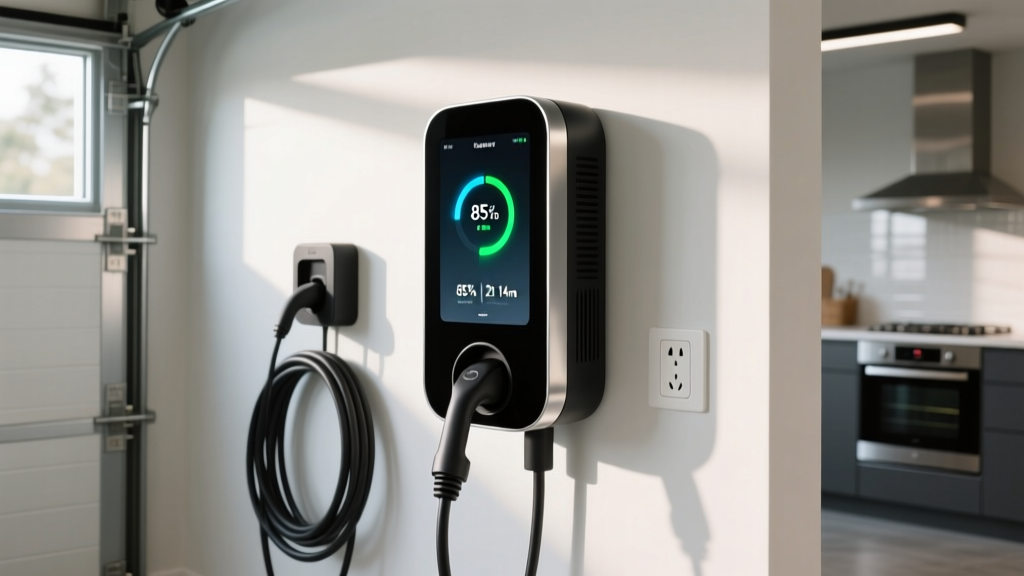
Most smart Level 2 home chargers have gone app-first, offloading status updates and controls to your phone. But for a growing segment of EV owners, an EV charger with a screen remains the gold standard. A built-in display gives you instant, glanceable feedback — state of charge percentage, current kW draw, session cost, and time remaining — without pulling out your phone, opening an app, or relying on Wi-Fi connectivity that may drop in a garage.
Whether you're charging a Tesla Model Y with its 75 kWh battery or a Ford F-150 Lightning with its 131 kWh extended-range pack, knowing exactly what's happening at the hardware level builds confidence. Screen-equipped chargers also tend to be favored by households with multiple drivers: anyone can walk up, read the display, and understand the session without needing app credentials.
This guide covers the best screen-equipped Level 2 chargers available in 2026, breaks down installation costs and electrical requirements, and gives you the exact numbers on charging speed, cost per mile, and connector compatibility.
Charging Levels Explained: Speeds, kW, and Miles Per Hour
Before choosing hardware, you need to understand the three charging tiers and what they deliver in real-world terms. The critical distinction: kW (kilowatts) measures power — how fast energy flows into your battery. kWh (kilowatt-hours) measures energy — the total capacity of your battery. Think of kW as the flow rate of a hose and kWh as the size of the bucket.
| Level | Voltage | Power (kW) | Miles of Range Added Per Hour | Typical Use |
|---|---|---|---|---|
| Level 1 | 120V AC | 1.2–1.9 kW | 3–5 mi/hr | Overnight top-ups, PHEVs, low-mileage drivers |
| Level 2 | 240V AC | 3.3–19.2 kW | 12–75 mi/hr | Home daily charging, workplace, public destinations |
| DC Fast Charge | 200–800V DC | 50–350 kW | 150–1,000+ mi/hr | Road trips, highway corridors, commercial fleets |
For most EV owners, a Level 2 home charger is the primary refueling method. A 48-amp (11.5 kW) Level 2 unit can fully replenish a Hyundai Ioniq 5's 77.4 kWh battery in roughly 7–8 hours, or add about 30–35 miles of range per hour of charging. That's more than enough to wake up with a full battery every morning, even after a 200-mile drive the day before.
Home Installation: Electrical Requirements, Costs, and Panel Gotchas
The sticker price of the charger itself is often the cheapest part of the equation. Professional installation by a licensed electrician is where costs add up — and where older homes frequently hit a wall.
Electrical Requirements for a Level 2 Charger
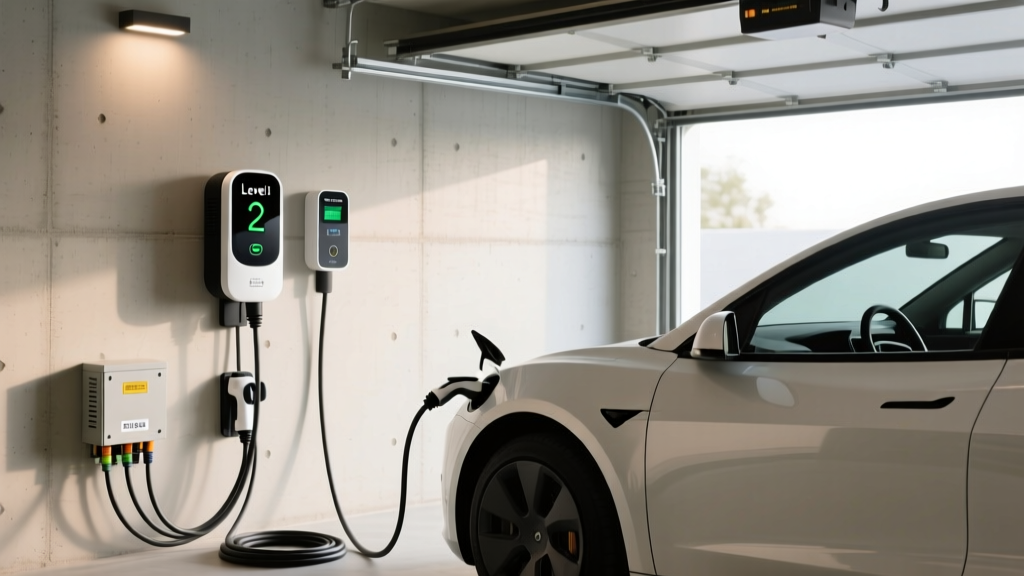
Most high-output Level 2 chargers require a dedicated 240V circuit. The circuit amperage must exceed the charger's rated draw by 25% per the National Electrical Code (NEC Article 625). Here's what that means in practice:
- 32-amp charger (7.7 kW): Requires a 40-amp breaker
- 40-amp charger (9.6 kW): Requires a 50-amp breaker
- 48-amp charger (11.5 kW): Requires a 60-amp breaker
Your home's electrical panel must have sufficient spare capacity to add this circuit. A typical modern home with a 200-amp panel usually has room. Older homes with 100-amp service — or panels already near capacity from HVAC, electric ranges, and dryers — may need a panel upgrade to 200 amps, which is the single largest variable in installation cost.
Installation Cost Breakdown
| Component | Low End | High End | Notes |
|---|---|---|---|
| Charger unit (Level 2, screen-equipped) | $400 | $750 | Varies by brand, kW output, cable length |
| Electrician labor | $500 | $2,000 | Depends on run length, conduit, wall type |
| Electrical permit | $50 | $250 | Required in most jurisdictions; varies by locality |
| Materials (conduit, wire, breaker) | $100 | $400 | Longer runs from panel to garage cost more |
| Panel upgrade (if needed) | $1,500 | $4,000 | Only if existing panel lacks capacity |
| Total (no panel upgrade) | $1,050 | $3,400 | |
| Total (with panel upgrade) | $2,550 | $7,400 |
The federal government and many utilities offer incentives that can offset these costs. The federal residential clean energy credit covers 30% of the cost of home EV charging equipment and installation (up to $1,000) through 2032, though eligibility depends on your census tract qualifying as a non-urban area. Check with your local utility as well — many offer rebates of $250–$500 for installing a smart Level 2 charger.
Connector Compatibility: NACS, CCS1, and Adapter Realities
The connector landscape has shifted dramatically since 2023, when Ford, GM, Rivian, and most other automakers committed to adopting the North American Charging Standard (NACS), originally developed by Tesla. By 2026, NACS is the dominant connector on new EVs sold in North America, but millions of CCS1-equipped vehicles remain on the road.
| Connector | Brands Using It (2026) | Adapter Needed? |
|---|---|---|
| NACS (Tesla-style) | Tesla, Ford, GM, Rivian, Volvo, Polestar, Mercedes-Benz, BMW, Hyundai/Kia (select) | None for NACS-native vehicles |
| CCS1 | Hyundai/Kia (older models), VW ID.4 (pre-2025), legacy BMW iX, Audi e-tron, older Ford/GM | CCS1-to-NACS adapter ($150–$250) for NACS chargers |
| CHAdeMO | Nissan Leaf (discontinued 2025), Mitsubishi Outlander PHEV (older) | CHAdeMO adapters rare; use public CHAdeMO stations |
If you drive a 2026 Ford Mustang Mach-E or Chevrolet Equinox EV, your vehicle has a native NACS port. If you own a 2023–2024 VW ID.4 or Hyundai Ioniq 5 from the pre-NACS transition era, you'll want a CCS1-to-NACS adapter (approximately $150–$250) to use NACS-equipped home chargers. Most screen-equipped Level 2 chargers sold in 2026 ship with a NACS connector, with CCS1 available as an option or via adapter.
Best EV Chargers With Screens: 2026 Comparison
We evaluated screen-equipped chargers on five criteria: power output, display quality and information density, cable length, smart features, and build quality. All units listed are hardwired or plug-compatible with NEMA 14-50 outlets, UL-listed, and rated for indoor/outdoor use.
Emporia Level 2 Smart EV Charger (with Display)
- Power output: 48 amps / 11.5 kW (240V)
- Connector: NACS (CCS1 adapter available)
- Cable length: 24 feet
- Display: 3.5" color LCD showing kW draw, session kWh, SoC estimate, cost, and time-to-full
- Smart features: Wi-Fi, energy monitoring via Emporia app, solar integration, scheduled charging, utility demand-response compatible
- Price: ~$449
- Best for: Solar-panel owners who want real-time energy flow visualization on the charger itself
ChargePoint Home Flex (with LCD Status Screen)
- Power output: Up to 50 amps / 12 kW (240V, adjustable via DIP switch)
- Connector: NACS or CCS1 (configurable at purchase)
- Cable length: 23 feet
- Display: Monochrome LCD with session status, kW, and LED ring indicator
- Smart features: Wi-Fi, Alexa integration, ChargePoint network access, flexible amperage settings
- Price: ~$649
- Best for: Households wanting adjustable amperage to match existing circuit capacity without a panel upgrade
Autel MaxiCharger Home (with Touchscreen)
- Power output: 40 amps / 9.6 kW (240V)
- Connector: NACS
- Cable length: 25 feet
- Display: 4.3" color touchscreen with session history, energy cost tracking, and diagnostics
- Smart features: Wi-Fi + Bluetooth, OTA firmware updates, RFID authentication for multi-driver homes, load balancing
- Price: ~$599
- Best for: Multi-driver households needing RFID access control and on-device session history
Grizzl-E Smart (with Integrated LED Display)
- Power output: 40 amps / 9.6 kW (240V)
- Connector: NACS (J1772 adapter included for legacy vehicles)
- Cable length: 24 feet
- Display: LED matrix display showing amps, kW, session time, and status codes
- Smart features: Wi-Fi, OCPP compatibility, adjustable output (16/24/32/40A), extreme cold rating (-40°F)
- Price: ~$549
- Best for: Cold-climate owners (Canada, northern US) who need reliable operation in sub-zero temperatures
Charging Cost: Home vs. Public vs. Gas Per Mile
One of the strongest arguments for home Level 2 charging is the cost advantage. Here's how the numbers break down for a typical midsize EV like the 2026 Tesla Model Y Long Range (EPA-estimated 330 miles of range, approximately 3.5 miles per kWh efficiency):
| Scenario | Rate | Cost for 300 Miles | Cost Per Mile |
|---|---|---|---|
| Home Level 2 (off-peak utility rate) | $0.10/kWh | $8.57 | $0.029 |
| Home Level 2 (national avg. residential) | $0.17/kWh | $14.57 | $0.049 |
| Public Level 2 (network pricing) | $0.30/kWh | $25.71 | $0.086 |
| DC Fast Charging (Electrify America, Tesla Supercharger avg.) | $0.40/kWh | $34.29 | $0.114 |
| Gas vehicle (28 MPG combined, $3.40/gal) | $3.40/gal | $36.43 | $0.121 |
Even at the national average residential electricity rate of $0.17/kWh, home charging costs less than half what gasoline costs per mile. At off-peak utility rates (available in most markets through time-of-use plans), the savings are even more dramatic — roughly one-quarter the cost of gasoline.
The screen on your charger makes this tangible: units like the Emporia and Autel display session cost in real time, letting you see exactly what each charge session costs without checking utility statements weeks later.
Real-World Charging Times: What to Expect With a Level 2 Screen Charger
Manufacturer-stated charging times assume ideal conditions. Real-world times vary based on battery chemistry, ambient temperature, and the vehicle's onboard charger capacity. Here's what to expect with a 48-amp (11.5 kW) Level 2 charger on popular 2026 EVs:
| Vehicle | Battery (usable kWh) | Onboard Charger Limit | Estimated 10–80% Time |
|---|---|---|---|
| Tesla Model Y Long Range | 75 kWh | 11.5 kW | ~4.5 hours |
| Ford Mustang Mach-E Extended Range | 91 kWh | 10.5 kW | ~6.0 hours |
| Hyundai Ioniq 5 (Long Range) | 77.4 kWh | 10.9 kW | ~5.0 hours |
| Chevrolet Equinox EV | 85 kWh | 11.5 kW | ~5.2 hours |
| Ford F-150 Lightning Extended Range | 131 kWh | 19.2 kW* | ~5.5 hours (with 80A charger) |
*The F-150 Lightning Extended Range supports up to 19.2 kW with its dual onboard chargers, but requires an 80-amp circuit and compatible charger — beyond the 48A units reviewed here.
A screen-equipped charger excels here: you can watch the kW draw taper as the battery approaches 80% SoC, a normal behavior dictated by the battery management system to protect cell health. This taper is invisible without a display — app-based chargers often just show "charging" without the granular power data.
Safety, Code, and Installation Best Practices
Level 2 EV chargers draw continuous, high-current loads for hours at a time. Proper installation is non-negotiable for safety and insurance compliance.
- Dedicated circuit: NEC Article 625 requires EV chargers to have their own dedicated circuit — no sharing with other outlets or appliances.
- GFCI protection: The 2023 NEC update requires GFCI protection for all EV charging receptacles. Hardwired installations may not require a GFCI breaker (the charger's internal protection suffices), but check local code amendments.
- Outdoor rating: If your charger is mounted outside or in an unconditioned garage, it must carry a NEMA 4 (or IP65+) weatherproof rating. All chargers listed above meet this standard.
- Permit and inspection: Most jurisdictions require an electrical permit for Level 2 charger installation. Skipping this can void your homeowner's insurance in the event of an electrical fire. Budget $50–$250 for the permit and plan for a post-install inspection.
- Cable management: A 24-foot cable drags on the garage floor and collects dirt, moisture, and road salt. Invest in a cable organizer or wall-mounted holster to extend cable life.
Always hire a licensed electrician familiar with NEC Article 625 (Electric Vehicle Charging System Equipment). Ask for a load calculation on your panel before committing to a specific amperage charger — this single step prevents costly change orders mid-install.
Frequently Asked Questions
How much does it cost to install a home EV charger?
For a typical Level 2 installation without a panel upgrade, expect to spend $1,050–$3,400 total, including the charger unit ($400–$750), electrician labor ($500–$2,000), permit ($50–$250), and materials ($100–$400). If your home requires a panel upgrade from 100A to 200A service, add $1,500–$4,000. The federal residential clean energy credit can cover 30% of equipment and installation costs (up to $1,000) if your census tract qualifies.
How fast will each charging level add range?
Level 1 (120V) adds 3–5 miles per hour. Level 2 (240V, 48A) adds roughly 30–35 miles per hour for a midsize EV. DC fast charging adds 150–1,000+ miles per hour at peak rates, though sustained rates taper significantly above 80% SoC. For daily driving, Level 2 home charging replenishes a full day's driving (30–50 miles) in 1–2 hours.
Which connector/charger is compatible with my EV?
If your EV is a 2025–2026 model from Tesla, Ford, GM, Rivian, Volvo, or Mercedes-Benz, it almost certainly uses the NACS connector. Older Hyundai, Kia, VW, and Audi EVs typically use CCS1. Check your vehicle's charge port or the EPA's fueleconomy.gov database for your specific model year. A CCS1-to-NACS adapter ($150–$250) bridges the gap for legacy vehicles on NACS chargers.
How much does charging cost per mile vs. gas?
Home charging at the national average residential rate ($0.17/kWh) costs roughly $0.05 per mile for a typical EV — about half the $0.12 per mile cost of a 28 MPG gas vehicle at $3.40/gallon. Off-peak home charging drops this to under $0.03 per mile. Public DC fast charging ($0.35–$0.48/kWh) narrows the gap but still undercuts gasoline in most markets.
What electrical upgrades might I need?
The most common upgrade is adding a 240V dedicated circuit with a 40–60 amp breaker. Homes with 100-amp electrical service or panels already near capacity may need a full panel upgrade to 200 amps ($1,500–$4,000). If your charger is far from the panel (e.g., a detached garage), expect higher conduit and wire costs. A licensed electrician's load calculation is the definitive answer — request one before purchasing a charger.
Is an EV charger with a screen worth the premium?
If you value at-a-glance session data, have multiple drivers in your household who don't all use the same app, or experience inconsistent Wi-Fi in your garage, a screen-equipped charger eliminates friction. The premium over a screenless smart charger is typically $50–$150 — a small fraction of total installation cost — and the display provides data (real-time kW draw, session cost, taper behavior) that helps you optimize charging habits and verify your utility rate plan is working as expected.