The Real Math: EV Charger vs Gas Pump in 2026
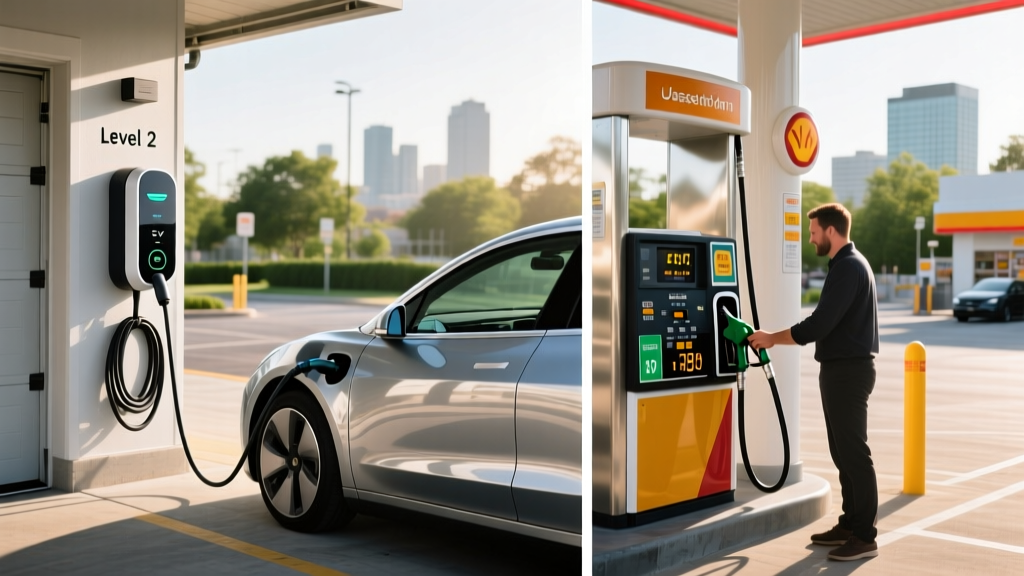
If you're searching "charger gas" you're likely weighing whether plugging in at home beats filling up at a gas station. The short answer: home Level 2 charging costs roughly $0.04–$0.06 per mile in most U.S. markets, versus $0.12–$0.18 per mile for a 28-MPG gas car at $3.50/gallon. But the full picture involves charging speeds, installation costs, connector compatibility, and the electrical reality of your garage panel. This guide breaks down every number you need to decide.
kW (kilowatts) = power, or how fast energy flows into your car — like water pressure from a hose.
kWh (kilowatt-hours) = energy, or how much your battery holds — like the size of the tank.
A 11.5 kW charger delivering power for 6 hours adds ~69 kWh of energy.
Charging Levels Explained: Speeds in kW and Miles Per Hour
Every EV sold in the U.S. charges at one of three levels. Here's what each delivers in real-world terms:
| Level | Voltage | Power (kW) | Miles of Range/Hour | Best For |
|---|---|---|---|---|
| Level 1 | 120V AC | 1.0–1.4 kW | 3–5 mi/hr | Overnight top-ups, PHEVs, low-mileage drivers |
| Level 2 | 240V AC | 7.2–19.2 kW | 25–75 mi/hr | Daily home charging, most EV owners' primary source |
| DC Fast Charge | 400–800V DC | 50–350 kW | 150–1,200 mi/hr | Road trips, quick top-ups away from home |
A few practical realities these numbers don't show:
- DC fast charging tapers above 80% SoC. A charger rated at 250 kW may only sustain that rate from 10–40% SoC, then gradually drop to 50 kW or lower as the battery fills. This is why manufacturers quote 10–80% times rather than 0–100%.
- Level 2 charging is limited by your car's onboard charger. Even if you install a 19.2 kW wall unit, a Tesla Model 3 (11.5 kW onboard charger) will only draw 11.5 kW. A Ford F-150 Lightning with an optional 19.2 kW onboard charger can use the full rate.
- Cold weather slows all charging — especially DC fast charging. Expect 20–40% slower charge rates below 32°F unless your vehicle has an active battery preconditioning system.
Charging Time Examples: 10–80% for Common Battery Sizes
| Vehicle | Battery (kWh usable) | Level 2 (11.5 kW) | DC Fast (peak) |
|---|---|---|---|
| Tesla Model Y LR (2026) | 75 kWh | ~4.5 hours | ~18 min at 250 kW peak |
| Hyundai Ioniq 5 (2026) | 77.4 kWh | ~7 hours (10.9 kW onboard) | ~18 min at 240 kW peak (800V) |
| Chevrolet Equinox EV (2026) | 85 kWh | ~5.5 hours (11.5 kW) | ~22 min at 190 kW peak |
| Ford F-150 Lightning Ext. Range | 131 kWh | ~7 hours (19.2 kW) | ~41 min at 150 kW peak |
| Toyota RAV4 PHEV (2026) | 18.1 kWh | ~2.5 hours (6.6 kW) | N/A (no DC fast charge) |
Home EV Charger Installation: Requirements, Costs & Panel Upgrades
A Level 2 home charger is where 80%+ of EV charging happens for most owners. Here's what's required and what it costs.
Electrical Requirements
Most residential Level 2 chargers require a 240V dedicated circuit — the same voltage as your electric dryer or oven. Common configurations:
- 40-amp circuit / 32-amp continuous draw: Delivers 7.7 kW. Works for most EVs and many existing 100A–150A panels.
- 50-amp circuit / 40-amp continuous: Delivers 9.6 kW. The most popular home setup.
- 60-amp circuit / 48-amp continuous: Delivers 11.5 kW. Common for Tesla Wall Connector. Requires adequate panel capacity.
- 80-amp circuit / 64-amp continuous: Delivers 15.4 kW. Needed for high-capacity trucks like the F-150 Lightning. Usually requires a 200A panel minimum.
Panel Upgrade: The Hidden Cost
Homes built before 1990 often have 100A or even 60A electrical panels. Adding a 40–60A EV circuit to an already-loaded panel may require a panel upgrade to 200A, which costs $1,500–$3,500 depending on your utility's requirements, trenching, and local code. A licensed electrician must perform a load calculation (NEC Article 220) to determine if your panel can handle the added circuit.
Permits and Code
Most jurisdictions require an electrical permit for a new 240V circuit ($50–$200). The installation must comply with NEC Article 625 (EV charging equipment). Key code requirements:
- Dedicated circuit with appropriate breaker sizing (125% of continuous load)
- GFCI protection for outdoor installations (NEC 2020+)
- NEMA 14-50 outlets must be installed with proper torque and strain relief
- Outdoor-rated (NEMA 4) enclosures for exterior installations
| Component | Simple Install (panel near garage) | Complex Install (long run / panel upgrade) |
|---|---|---|
| Level 2 Charger Equipment | $350–$700 | $500–$800 |
| Electrician Labor (2–6 hrs @ $100–$175/hr) | $200–$500 | $600–$1,500 |
| Materials (conduit, wire, breaker) | $50–$150 | $200–$500 |
| Permit Fee | $50–$100 | $100–$200 |
| Panel Upgrade (if needed) | $0 | $1,500–$3,500 |
| Total | $650–$1,450 | $2,900–$6,500 |
Source: U.S. Department of Energy Home Charging Guide. Costs vary significantly by region and home layout. Always get 2–3 quotes from licensed electricians.
Connector Compatibility: NACS, CCS1, and CHAdeMO
The charging connector landscape has shifted dramatically. As of 2026, nearly all new EVs sold in North America use the NACS (North American Charging Standard) connector, originally developed by Tesla. Here's what fits what:
| Connector | Brands Using It (2026 Models) | Adapter Needed? |
|---|---|---|
| NACS (native) | Tesla (all), Ford, GM, Rivian, Volvo, Polestar, Hyundai/Kia (2025+), BMW, Mercedes | No — direct plug at Tesla Superchargers and NACS-equipped public stations |
| CCS1 | Remaining 2024–2025 models still in inventory; some commercial EVs | NACS-to-CCS adapter (~$200) needed for Tesla Superchargers |
| CHAdeMO | Legacy Nissan Leaf (discontinued), Mitsubishi Outlander PHEV (older model years) | Limited public availability; CHAdeMO stations declining |
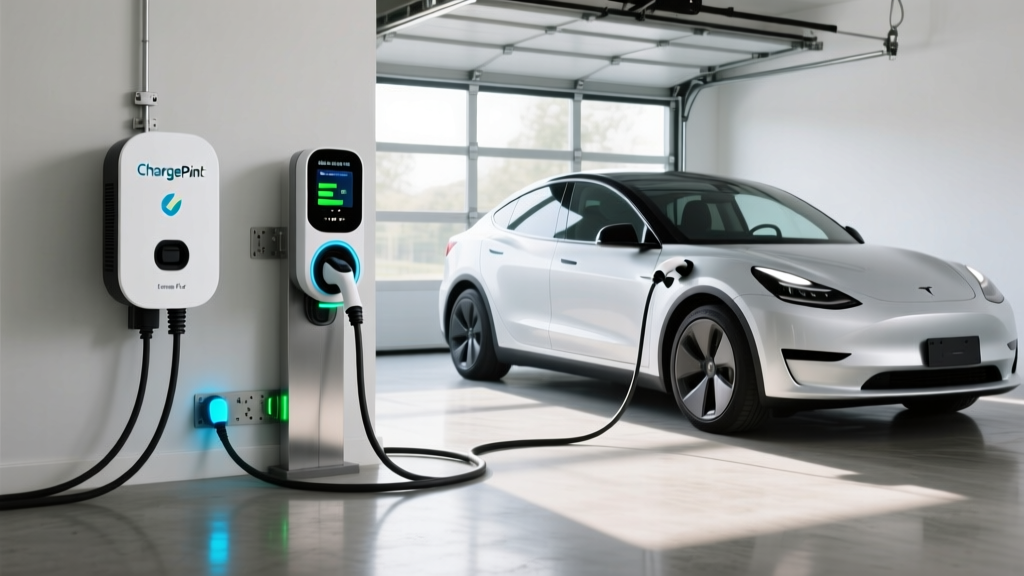
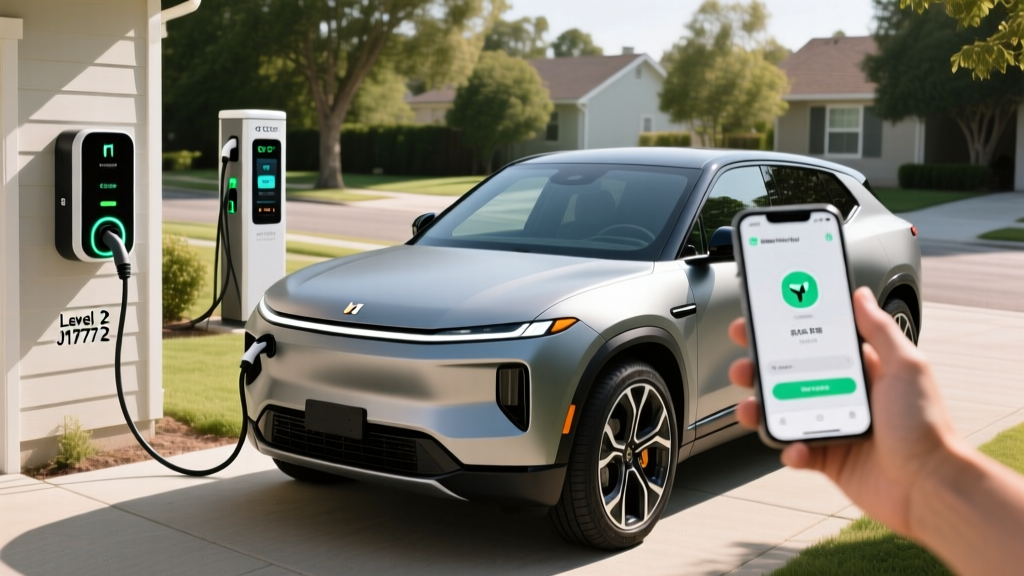
Home charger connector note: Level 2 home chargers sold in 2026 come with either a NACS plug or a J1772 plug (the legacy AC standard). If your car has NACS, buy a NACS-equipped home charger. If your car has J1772 (most pre-2025 non-Tesla EVs), buy a J1772 charger. Tesla's Wall Connector now ships with both NACS and J1772 adapter in the box.
Cost Per Mile: EV Charging vs Gasoline
This is where the "charger gas" comparison gets decisive. The cost gap depends on where and when you charge.
| Scenario | Rate | Cost per Mile* | Annual Fuel Cost (12,000 mi) |
|---|---|---|---|
| Home Level 2 — off-peak utility rate | $0.09/kWh | $0.027 | $324 |
| Home Level 2 — standard residential rate | $0.16/kWh | $0.048 | $576 |
| Home Level 2 — high-cost state (CA, HI, MA) | $0.30/kWh | $0.090 | $1,080 |
| Public Level 2 (ChargePoint, EVgo L2) | $0.25–$0.40/kWh | $0.075–$0.120 | $900–$1,440 |
| DC Fast Charging (Electrify America, Tesla) | $0.35–$0.55/kWh | $0.105–$0.165 | $1,260–$1,980 |
| Gas car (28 MPG avg) | $3.50/gallon | $0.125 | $1,500 |
*Based on 3.0 miles/kWh average EV efficiency (approx. 33 kWh/100mi). Source: EPA fueleconomy.gov.
• If you charge at home on off-peak rates, an EV costs 70–80% less per mile than a gas car.
• If you rely exclusively on DC fast charging at highway rates, costs approach or match gasoline.
• Most EV owners do 80%+ of charging at home, making the blended cost far below gas.
• Time-of-use (TOU) utility plans can cut home charging costs by 30–50%.
2026 Home EV Charger Recommendations
Based on power output, connector options, cable length, smart features, and build quality, here are the top Level 2 home chargers available now:
Tesla Wall Connector (Gen 4)
- Power: Up to 11.5 kW (48A on 60A circuit)
- Connector: NACS native + J1772 adapter included
- Cable: 24 feet
- Smart features: Wi-Fi, OTA updates, Tesla app scheduling, load sharing (pair two units on one circuit)
- Outdoor rating: NEMA 4
- Price: ~$450
- Best for: Tesla owners, mixed-fleet households, best value-to-power ratio
ChargePoint Home Flex (2nd Gen)
- Power: Up to 12 kW (50A adjustable via DIP switch, up to 12.5 kW on 60A circuit)
- Connector: NACS or J1772 (select at purchase)
- Cable: 23 feet
- Smart features: Wi-Fi, app with energy tracking, Alexa/Google Home, adjustable amperage to match panel capacity
- Outdoor rating: NEMA 4
- Price: ~$600–$700
- Best for: Non-Tesla EVs, adjustable amperage flexibility, robust app
Emporia Vue Level 2 Charger
- Power: Up to 11.5 kW (48A)
- Connector: J1772 (NACS adapter available separately)
- Cable: 24 feet
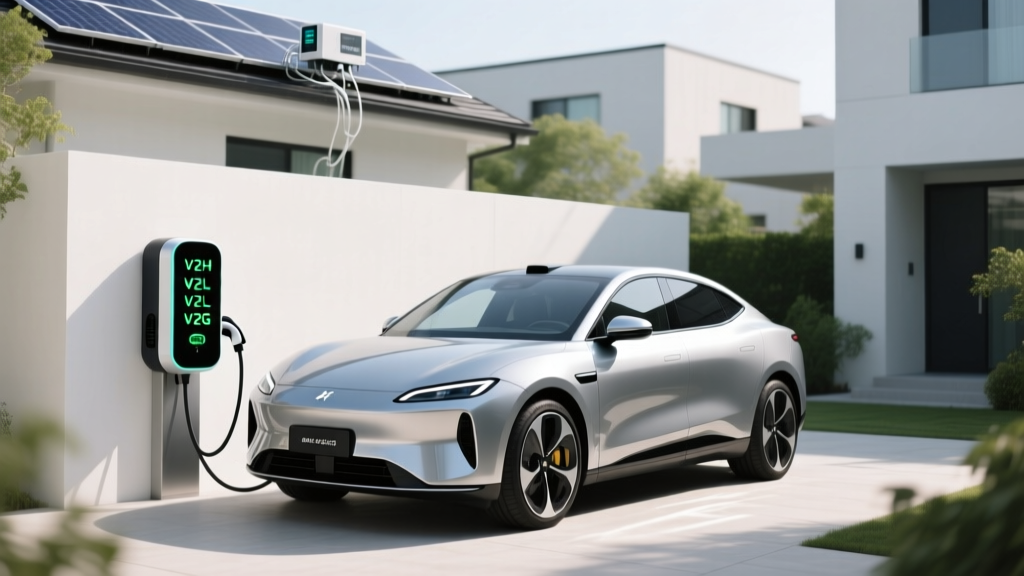
- Smart features: Integrates with Emporia Vue home energy monitor, solar-aware scheduling, V2H-ready (with compatible vehicle)
- Outdoor rating: NEMA 4
- Price: ~$400
- Best for: Solar homeowners, budget-conscious buyers, energy monitoring enthusiasts
Grizzl-E Smart (United Chargers)
- Power: Up to 10 kW (40A) or adjustable down
- Connector: J1772 or NACS (select at purchase)
- Cable: 24 feet
- Smart features: Wi-Fi, OCPP protocol support, extreme cold rated (-40°F)
- Outdoor rating: NEMA 4, aluminum enclosure
- Price: ~$500–$600
- Best for: Cold-climate owners, durability-focused buyers, Canadian-made
Safety, Code, and Common Installation Mistakes
EV charging draws high continuous current for hours — more than most household appliances. Cutting corners creates fire risk. Key safety considerations:
- Never use a standard 120V extension cord for Level 1 charging. Use only the OEM-supplied cord or a heavy-duty 12-gauge outdoor-rated cord, and plug directly into a dedicated outlet.
- NEMA 14-50 outlets require proper installation. The #1 cause of EV charging fires is poorly torqued or residential-grade 14-50 receptacles melting under continuous 40A load. Specify an industrial-grade receptacle (Hubbell 9450A or Bryant 9450FR) and have the electrician torque to spec.
- Hardwired is safer than plug-in. For circuits above 40A, hardwiring eliminates the outlet as a failure point. It also avoids the NEC requirement for GFCI breakers on 240V receptacles (which can cause nuisance tripping with some EVs).
- Check your utility's EV rate plans. Many utilities offer dedicated TOU (time-of-use) meters or EV-only rate plans that provide electricity at $0.06–$0.10/kWh overnight. This can pay for the charger installation within 2–3 years.
Public Charging: What to Expect in 2026
Public charging infrastructure has expanded significantly but remains uneven. Key networks and what they offer:
- Tesla Supercharger network: 30,000+ stalls in North America, now open to NACS-equipped non-Tesla EVs. 150–250 kW typical, with 350 kW V4 stalls at select locations. Reliability remains the industry benchmark at 99%+ uptime.
- Electrify America: 4,000+ DC fast chargers, 150–350 kW. CCS1 and NACS connectors available at newer stations. Reliability has improved but remains inconsistent at older sites.
- EVgo: 3,500+ public fast chargers, 50–350 kW. Strong urban coverage. Subscription plans reduce per-kWh cost.
- ChargePoint / Shell Recharge: Primarily Level 2 destination charging (retail, workplaces, hotels). 6.6–19.2 kW.
Real-world public charging tip: Use the PlugShare or A Better Route Planner app to check station status, connector availability, and user-reported reliability before driving to a charger.
Frequently Asked Questions
How much does it cost to install a home EV charger?
A straightforward Level 2 installation (short wire run, adequate panel capacity) costs $650–$1,450 including equipment, electrician labor, materials, and permit. If your home needs a panel upgrade from 100A to 200A, total costs can reach $2,900–$6,500. Always get a load calculation from a licensed electrician before committing.
How fast will each charging level add range?
Level 1 (120V) adds 3–5 miles per hour. Level 2 (240V) adds 25–75 miles per hour depending on amperage and your car's onboard charger. DC fast charging adds 150–1,200+ miles per hour at peak rates, but sustained rates taper significantly above 80% state of charge.
Which connector/charger is compatible with my EV?
For 2026 models: Tesla, Ford, GM, Rivian, Hyundai, Kia, BMW, and most others now use NACS. Older non-Tesla EVs (2024 and earlier) may still have CCS1. Nissan Leaf uses CHAdeMO. Check your vehicle's charge port or owner's manual. For home chargers, match the connector to your car — or buy a unit that includes adapters.
How much does charging cost per mile vs gas?
Home charging on an average U.S. electricity rate ($0.16/kWh) costs about $0.048/mile — roughly 60% less than a 28-MPG gas car at $3.50/gallon ($0.125/mile). Off-peak utility rates can drop EV cost to $0.027/mile. Public DC fast charging at $0.45/kWh costs ~$0.135/mile, roughly matching gasoline.
What electrical upgrades might I need?
The most common upgrade is a panel capacity increase from 100A to 200A ($1,500–$3,500). You may also need: a new dedicated 240V circuit with appropriate breaker, conduit runs from panel to garage, and possibly a utility service upgrade if your home's incoming service is undersized. An electrician's load calculation (NEC Article 220) determines this before any work begins.
Is there a tax credit for home charger installation?
The federal Alternative Fuel Vehicle Refueling Property Credit (IRC §30C) was reinstated for 2023–2032 and covers 30% of home charging equipment and installation costs, up to $1,000. However, it's only available in eligible census tracts (low-income or non-urban areas). Check the IRS §30C page for current eligibility rules and consult a tax professional.
This guide reflects 2026 pricing and infrastructure data. Electricity rates, charger pricing, and network availability vary by location. Always verify specifications with the charger manufacturer and consult a licensed electrician for installation.