Understanding EV Charger Types: The Three Levels
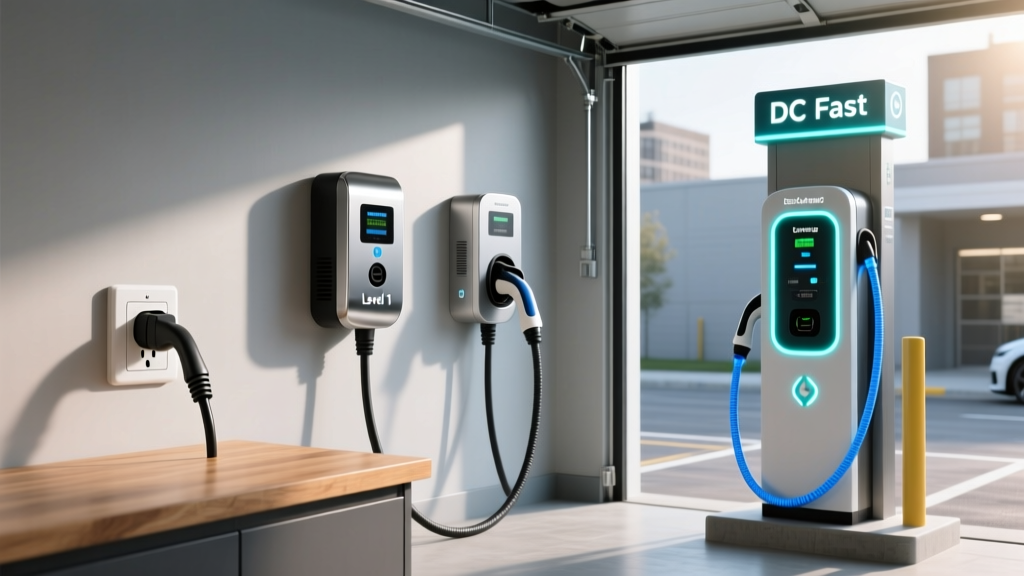
Every EV owner needs to navigate three distinct charging levels, each defined by its power delivery in kilowatts (kW). The confusion between kW (power, or how fast energy flows) and kWh (energy, or how much your battery holds) is the single most common mistake new EV buyers make. A 10 kW charger delivering power for one hour adds 10 kWh to your battery. Keep that relationship in mind as we break down each level.
| Level | Voltage | Power (kW) | Miles of Range Per Hour | Typical 10–80% Time | Best For |
|---|---|---|---|---|---|
| Level 1 | 120V AC | 1.2–1.9 kW | 3–5 mi/hr | 40–70+ hours | Overnight top-ups, PHEVs, low-mileage drivers |
| Level 2 | 240V AC | 3.3–19.2 kW | 12–75 mi/hr | 3–10 hours | Daily home charging, workplace, destinations |
| DC Fast Charge | 400–800V DC | 50–350+ kW | 150–1,200+ mi/hr | 15–45 minutes | Road trips, rapid top-ups, commercial fleets |
Level 1 charging uses a standard household 120V outlet and the portable cord that ships with most EVs. It's adequate for plug-in hybrids with small batteries (10–20 kWh) or BEV owners who drive under 30 miles daily and can leave the car plugged in for 12+ hours. For a 75 kWh battery like the one in a Ford F-150 Lightning extended-range, Level 1 is essentially unusable for full recharges—it would take over 50 hours.
Level 2 is the practical baseline for BEV ownership. A 48-amp (11.5 kW) home charger replenishes roughly 35–45 miles of range per hour, meaning most EVs with 250–320 miles of EPA range can fully recharge overnight in 6–8 hours. This is the level most homeowners install, and it's the focus of the installation section below.
DC fast charging bypasses the vehicle's onboard charger entirely, sending direct current straight to the battery at much higher power. Peak rates of 250–350 kW are now common on vehicles built on 800V architectures (Hyundai Ioniq 5, Kia EV6, Porsche Taycan, Genesis GV60). However, peak kW is not sustained kW—every battery's charge curve tapers significantly above 80% State of Charge to protect cell health. A "20-minute 10–80%" claim is realistic for modern 800V vehicles at compatible chargers, but charging from 80–100% may take another 20–30 minutes at sharply reduced power.
Home EV Charger Installation: Electrical Requirements and Costs
Installing a Level 2 home charger involves more than plugging in a box. Most homes need a dedicated 240V circuit—similar to what an electric dryer or oven uses—run from your main electrical panel to the charger location. The National Electrical Code (NEC) requires that the circuit be rated for 125% of the charger's continuous draw. A 48-amp charger therefore requires a 60-amp breaker and appropriate wire gauge (typically 6 AWG copper for runs under 100 feet).
Electrical Panel Capacity
Your home's electrical panel is the first constraint. Modern homes often have 200-amp service, which usually accommodates a 60-amp EV circuit without issue. Older homes with 100-amp service may need a panel upgrade to 200 amps—a significant added expense. A licensed electrician will perform a load calculation (per NEC Article 220) to determine whether your panel has headroom. Signs you may need an upgrade: your panel is already near capacity with existing appliances, you have a fuse box instead of breakers, or your service is 100A or less.
| Component | Simple Install (Panel Nearby) | Complex Install (Long Run / Panel Upgrade) |
|---|---|---|
| Level 2 charger hardware | $350–$650 | $350–$750 |
| Electrician labor (2–6 hours @ $75–$150/hr) | $200–$500 | $600–$1,500 |
| Materials (wire, conduit, breaker) | $50–$150 | $200–$600 |
| Electrical permit | $50–$150 | $50–$200 |
| Panel upgrade (if needed) | Not required | $1,500–$3,500 |
| Total Estimated Cost | $650–$1,450 | $2,700–$6,550 |
The wide range reflects real-world variability. A garage install where the panel is on the same wall as the charger, with a short wire run, can be completed for under $1,000 total. A charger mounted on an exterior wall 80 feet from the panel, requiring conduit runs through an attic and a new sub-panel, can easily exceed $3,000—even without a full service upgrade. Always get 2–3 quotes from licensed electricians and verify they pull the required local permit. Unpermitted work can void homeowner's insurance claims and cause problems at resale.
Safety and Code Considerations
Key NEC and safety requirements for home EV charger installs:
- Dedicated circuit: The EV charger must have its own breaker—no sharing with other outlets or appliances.
- GFCI protection: NEC 2020 and later requires Ground Fault Circuit Interrupter protection for all EV supply equipment, whether hardwired or plug-in (NEMA 14-50 receptacle). Many modern chargers have built-in GFCI; confirm with your electrician.
- Outdoor rating: If the charger is installed outdoors, both the unit and any receptacle must carry a NEMA 4 or NEMA 4X weather-resistance rating.
- Hardwired vs. plug-in: Hardwired chargers (directly connected to the circuit) eliminate the receptacle as a failure point and are generally recommended for permanent installations. Plug-in units using a NEMA 14-50 outlet offer portability but require the receptacle to be properly torqued—loose 14-50 outlets have been linked to overheating incidents.
- Cable management: Ensure the charging cable doesn't create a trip hazard and isn't run across driveways where vehicles could damage it.
Connector Compatibility: NACS, CCS, and CHAdeMO in 2026
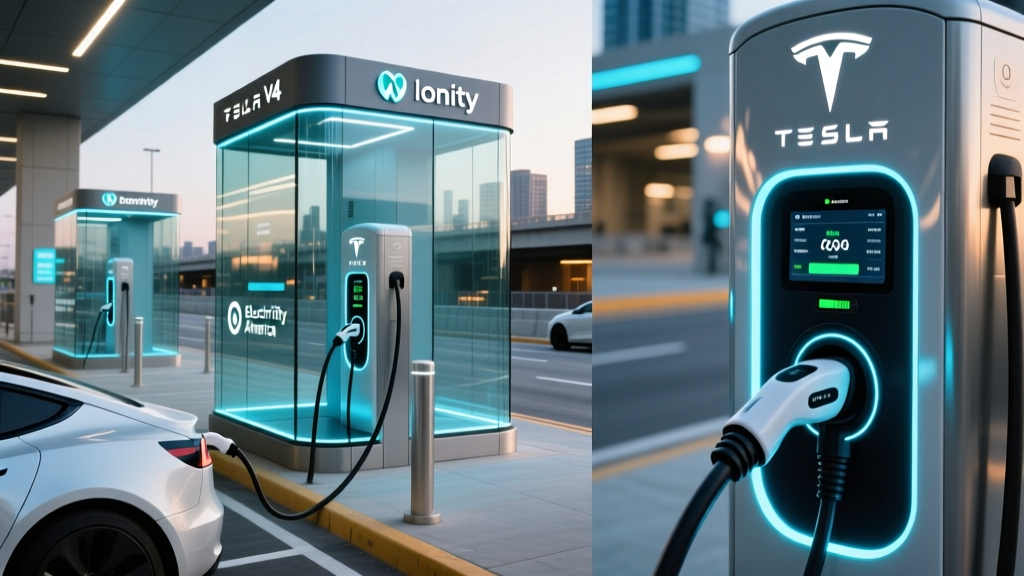
The North American EV charging landscape has undergone a massive consolidation around the North American Charging Standard (NACS), originally developed by Tesla and now adopted by nearly every major automaker. Here's where things stand for DC fast charging connectors:
| Connector | Brands Using It (2026) | Adapter Needed? |
|---|---|---|
| NACS (Tesla plug) | Tesla, Ford, GM, Rivian, Volvo, Polestar, Mercedes-Benz, BMW, Hyundai, Kia, Genesis, Nissan (new models) | CCS-to-NACS adapter for older CCS vehicles accessing Superchargers |
| CCS1 (Combined Charging System) | Volkswagen, Audi (some), Stellantis/Jeep, legacy models from brands transitioning to NACS | NACS-to-CCS adapter for accessing Tesla Superchargers |
| CHAdeMO | Nissan Leaf (discontinued, legacy only), Mitsubishi Outlander PHEV (legacy) | Not readily adaptable; declining infrastructure |
For Level 2 (AC) home and destination charging, the standard J1772 connector remains universal across all non-Tesla EVs. Tesla vehicles ship with a J1772 adapter, and most third-party Level 2 chargers use the J1772 plug. Newer "universal" or "Magic Dock"-equipped chargers from networks like Electrify America and EVgo are beginning to offer both NACS and CCS from a single cable, but this rollout is still in progress.
If you own a CCS-equipped vehicle (model years 2022–2025 from Ford, GM, Rivian, etc.) and want to use the Tesla Supercharger network, you'll need a CCS-to-NACS adapter. Ford and GM provide these to eligible owners; aftermarket adapters from brands like Lectron and A2Z are available for $150–$250. Always verify that any adapter is UL-listed or certified to relevant safety standards before purchasing.
Charging Cost Per Mile: Home vs. Public vs. Gas
One of the strongest economic arguments for EV ownership is lower fueling cost per mile—but the savings depend heavily on where and when you charge. Electricity prices vary widely by region and rate structure, while gasoline prices fluctuate with global markets.
| Scenario | Rate | Cost Per Mile* | Annual Fuel Cost (12,000 mi) |
|---|---|---|---|
| Home Level 2 (off-peak utility rate) | $0.08–$0.12/kWh | $0.024–$0.040 | $288–$480 |
| Home Level 2 (standard residential rate) | $0.14–$0.20/kWh | $0.042–$0.064 | $504–$768 |
| Public Level 2 (workplace/destination) | $0.20–$0.35/kWh | $0.060–$0.112 | $720–$1,344 |
| DC Fast Charging (public network) | $0.30–$0.55/kWh | $0.090–$0.176 | $1,080–$2,112 |
| Gasoline vehicle (28 MPG combined) | $3.40/gallon | $0.121 | $1,457 |
| Gasoline vehicle (22 MPG combined, truck/SUV) | $3.40/gallon | $0.155 | $1,855 |
*EV cost per mile calculated using 0.32 kWh/mile, a realistic average for midsize crossover EVs like the Tesla Model Y, Hyundai Ioniq 5, and Ford Mustang Mach-E. Efficiency varies by vehicle—see fueleconomy.gov for model-specific kWh/100mi figures.
The takeaway is clear: EV owners who charge primarily at home on off-peak or time-of-use rates spend roughly 70–80% less per mile than a comparable gas vehicle. Those who rely exclusively on DC fast charging at public stations may see costs approach or even exceed gasoline, depending on local utility and network pricing. This is why home Level 2 access is the single most important factor in EV ownership economics.
Many utilities offer EV-specific time-of-use (TOU) plans that drop rates to $0.06–$0.10/kWh during overnight hours (typically 10 PM – 6 AM). Enrolling in a TOU plan and scheduling your charger to run during off-peak windows maximizes savings. Some utilities also offer rebates of $200–$500 for installing a smart Level 2 charger—check with your local provider.
Charging Time Examples: What to Expect with Real Battery Sizes
Charging time depends on three variables: battery capacity (kWh), charger power output (kW), and the vehicle's onboard charger limit (for AC) or charge-curve profile (for DC). Here are realistic examples:
Level 2 Home Charging (48A / 11.5 kW)
- Tesla Model Y Long Range (75 kWh usable): 0–100% in ~7 hours
- Hyundai Ioniq 5 (77.4 kWh usable): 0–100% in ~7.5 hours
- Ford F-150 Lightning Extended Range (131 kWh usable): 0–100% in ~12–13 hours (note: the Lightning's onboard charger maxes at 19.2 kW with an 80A circuit, reducing time to ~8 hours on a larger circuit)
- Toyota RAV4 Prime PHEV (18.1 kWh usable): 0–100% in ~2.5 hours on a 240V/16A (3.6 kW) circuit
DC Fast Charging (10–80%)
- Hyundai Ioniq 5 at 350 kW charger: ~18 minutes (800V architecture sustains high power to ~60% SoC, then tapers)
- Tesla Model Y at V3 Supercharger (250 kW): ~22–25 minutes
- Ford Mustang Mach-E at 150 kW charger: ~38–45 minutes
- Chevrolet Equinox EV at 150 kW charger: ~30–35 minutes
A critical nuance: DC fast-charging speeds are governed by the battery's charge curve, not just the charger's peak kW rating. Most EVs hit their advertised peak rate only between roughly 10–40% State of Charge. Above 50%, power begins to taper; above 80%, it drops sharply to protect battery longevity. This is why manufacturers quote 10–80% times rather than 0–100%. On a road trip, plan to charge in the 10–80% window and move on—waiting to fill from 80–100% at a DC fast charger is usually slower than driving to the next station.
Recommended Home EV Chargers
Based on reliability, features, and value, these are standout Level 2 home chargers for 2026:
ChargePoint Home Flex
- Power output: Up to 12 kW (50A) on a 60A circuit; configurable down to 16A for smaller panels
- Connector: J1772 (NACS adapter available)
- Cable length: 23 feet
- Smart features: Wi-Fi, app scheduling, Alexa integration, utility demand-response programs, energy tracking
- Price: ~$550–$650
- Best for: Most homeowners; flexible amperage accommodates older panels
Emporia Level 2 EV Charger
- Power output: Up to 11.5 kW (48A) on a 60A circuit
- Connector: J1772
- Cable length: 24 feet
- Smart features: Wi-Fi, app control, solar-integration with Emporia Vue energy monitor, load management
- Price: ~$350–$400
- Best for: Budget-conscious buyers and homes with solar panels
Tesla Wall Connector
- Power output: Up to 11.5 kW (48A) on a 60A circuit
- Connector: NACS (native Tesla plug; J1772 adapter included for non-Tesla EVs)
- Cable length: 24 feet
- Smart features: Wi-Fi, OTA updates, power sharing between multiple units, Tesla app integration
- Price: ~$475
- Best for: Tesla owners and multi-EV households (power-sharing reduces panel load)
Grizzl-E Smart
- Power output: Up to 10 kW (40A) on a 50A circuit
- Connector: J1772
- Cable length: 24 feet
- Smart features: OCPP-compatible, app control, adjustable amperage
- Price: ~$450–$500
- Best for: Cold climates (rated to -40°F), outdoor installations, Canadian-built durability
When selecting a charger, prioritize UL listing (or equivalent ETL certification), a minimum 2-year warranty, and Wi-Fi connectivity for scheduling and monitoring. Hardwired installation is preferred over NEMA 14-50 plug-in for permanent setups—it eliminates a common failure point and satisfies NEC GFCI requirements without a separate breaker with integrated GFCI (which can be costly and prone to nuisance tripping).
Federal and Utility Incentives for Home Charger Installation
The federal Alternative Fuel Vehicle Refueling Property Credit (IRC §30C) covers 30% of the cost of home EV charger equipment and installation, up to a maximum credit of $1,000. This credit applies to both the charger hardware and the electrician's labor for the dedicated circuit. However, it's subject to census-tract eligibility—the property must be located in a qualifying area as defined by the IRS. Check the IRS website or consult a tax professional to confirm eligibility for your address.
Beyond the federal credit, many state governments, municipalities, and electric utilities offer additional rebates:
- Utility rebates: $200–$500 for purchasing a smart Level 2 charger, often bundled with TOU rate enrollment
- State incentives: Vary widely—some states (e.g., California, Colorado, New York) offer $500–$1,500 in additional rebates for charger installation, especially for income-qualified households
- Panel upgrade assistance: A handful of programs cover partial panel-upgrade costs to enable EV charging in older homes
Always verify incentive availability before purchasing, as programs frequently have limited funding pools and specific equipment requirements (e.g., ENERGY STAR certification, Wi-Fi capability).
Frequently Asked Questions
How much does it cost to install a home EV charger?
A straightforward Level 2 installation with the electrical panel nearby typically costs $650–$1,450 including equipment, electrician labor, materials, and permit. Complex installations with long wire runs, conduit work, or a required panel upgrade to 200A can range from $2,700 to $6,550. Always get multiple quotes from licensed electricians and ensure they pull the required local electrical permit.
How fast will each charging level add range?
Level 1 (120V) adds 3–5 miles of range per hour. Level 2 (240V, 48A) adds 30–45 miles per hour for most EVs. DC fast charging at 150–350 kW can add 150–1,200+ miles per hour at peak rates, though power tapers significantly above 80% State of Charge. Real-world charging speed depends on battery size, chemistry, temperature, and the vehicle's charge-curve profile.
Which connector or charger is compatible with my EV?
For home Level 2 charging, all non-Tesla EVs use the J1772 connector; Tesla vehicles use NACS and include a J1772 adapter. For DC fast charging, the 2026 landscape is dominated by NACS (Tesla, Ford, GM, Rivian, Hyundai, Kia, and most others) and CCS1 (Volkswagen, some legacy models). CHAdeMO is effectively obsolete. If your vehicle has CCS and you want Tesla Supercharger access, you'll need a CCS-to-NACS adapter ($150–$250).
How much does EV charging cost per mile compared to gas?
Home charging on off-peak rates costs approximately $0.03–$0.04 per mile—roughly 70–75% less than a 28 MPG gasoline vehicle at $3.40/gallon ($0.12/mile). Standard residential rates ($0.14–$0.20/kWh) yield $0.04–$0.06 per mile. Exclusive reliance on public DC fast charging ($0.30–$0.55/kWh) costs $0.09–$0.18 per mile, which can approach or exceed gasoline costs. Home charging access is the key to maximizing EV fuel savings.
What electrical upgrades might I need for a home charger?
The most common upgrade is a panel capacity increase from 100A to 200A service ($1,500–$3,500) if your existing panel lacks headroom for a dedicated 60A circuit. Other potential upgrades include replacing a Federal Pacific or Zinsco panel (known safety hazards), adding a sub-panel if the main panel is far from the charger location, or upgrading service entrance conductors. A licensed electrician's load calculation will determine exactly what's needed. Homes built after 2000 with 200A service rarely need upgrades.
Can I charge my EV with a regular household outlet?
Yes—Level 1 charging uses a standard 120V/15A or 120V/20A outlet and adds 3–5 miles of range per hour. This works for PHEVs with small batteries or BEV owners who drive under 30 miles daily and can plug in for 12+ hours. For a typical 75 kWh BEV battery, a full Level 1 recharge takes 40–60+ hours, making it impractical as a primary charging solution for most battery-electric vehicles.
Is a hardwired charger better than a plug-in NEMA 14-50?
For permanent installations, hardwired is generally preferred. It eliminates the receptacle as a potential failure point (loose or improperly torqued 14-50 outlets have caused overheating), simplifies NEC GFCI compliance, and avoids the cost of a GFCI breaker ($100–$200). A NEMA 14-50 plug-in setup offers portability—you can take the charger when you move—but requires a properly installed, commercial-grade receptacle torqued to specification. If you choose plug-in, have the electrician verify the receptacle is rated for continuous 40A+ loads.