Choosing the right ev charger type hinges on three numbers: how many miles you drive daily, how many amps your electrical panel can spare, and what connector your vehicle uses. In 2026, the North American Charging Standard (NACS) has largely unified the market, but legacy CCS1 and CHAdeMO vehicles still need adapters for Tesla Superchargers and many new public networks. Below is a spec-driven walkthrough of every charger type available to U.S. buyers, with real install costs, charge times for common battery sizes, and the electrical upgrades you may need before plugging in.
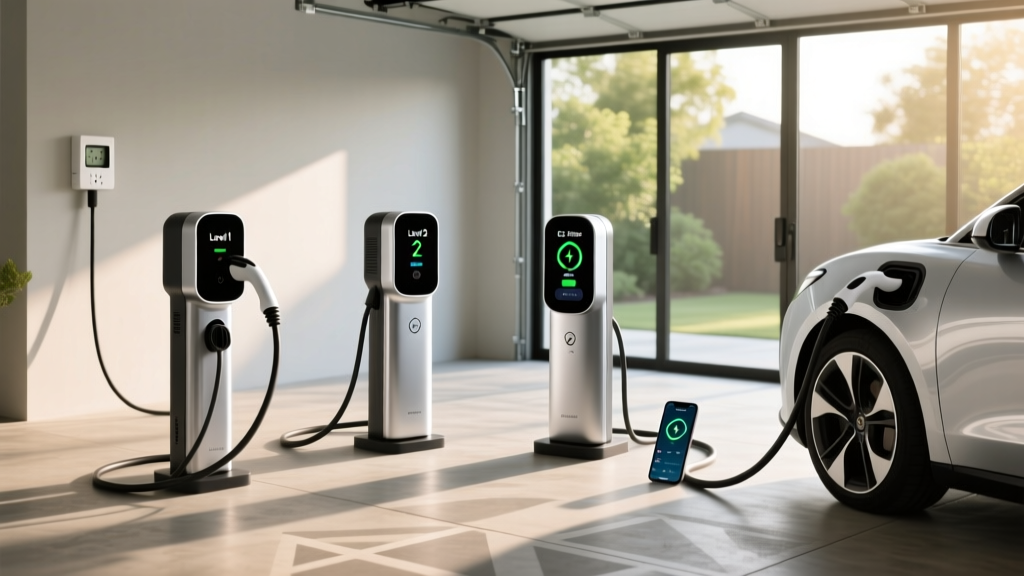
Level 1, Level 2, and DC Fast Charging: What Each EV Charger Type Delivers
The single most important distinction in EV charging is between kW (kilowatts, the rate of power flow) and kWh (kilowatt-hours, the total energy stored in your battery). A 10 kW charger running for one hour adds roughly 10 kWh of energy. A 75 kWh battery charged from 10% to 80% (52.5 kWh) on that 10 kW unit takes about 5.25 hours. Confusing kW with kWh is the most common EV literacy gap—keep them separate and every other spec falls into place.
| Level | Voltage | Typical kW | Miles of Range Added per Hour | Best Use Case |
|---|---|---|---|---|
| Level 1 | 120V AC | 1.2–1.8 kW | 3–5 mi/hr | Overnight top-up for PHEVs or low-mileage BEV drivers |
| Level 2 | 240V AC | 3.3–19.2 kW | 12–60 mi/hr | Daily home charging; workplace; destination |
| DC Fast (Level 3) | 400–800V DC | 50–350 kW | 150–1,000+ mi/hr (peak) | Road trips; rapid top-ups; 10–80% in 15–40 min |
How Fast Will Each Charging Level Add Range?
Below are charge-time estimates for three representative battery sizes commonly found in 2026 models. Times assume starting at 10% SoC and charging to 80%, with a preconditioned battery at moderate ambient temperature (65–75°F).
| Battery (usable kWh) | Example Vehicle | Level 1 (1.4 kW) | Level 2 (11.5 kW / 48A) | Level 2 (19.2 kW / 80A) | DC Fast (150 kW peak) | DC Fast (250 kW peak) |
|---|---|---|---|---|---|---|
| ~60 kWh | Chevrolet Equinox EV | ~30 hrs | ~3.6 hrs | ~2.2 hrs | ~28 min | ~22 min |
| ~80 kWh | Hyundai Ioniq 5 | ~40 hrs | ~4.9 hrs | ~2.9 hrs | ~25 min (800V arch) | ~18 min |
| ~100 kWh | Ford F-150 Lightning Ext. Range | ~50 hrs | ~6.1 hrs | ~3.6 hrs | ~40 min | ~30 min |
For context, the average American drives roughly 37 miles per day according to FHWA data. A Level 2 home charger at 11.5 kW replenishes that daily commute in under two hours of plug-in time—meaning most EV owners never need DC fast charging for daily use.
Connector Compatibility: NACS, CCS1, and CHAdeMO in 2026
The connector landscape has consolidated dramatically since Ford, GM, Rivian, Volvo, and most other major automakers adopted the North American Charging Standard (NACS) starting in the 2025 model year. As of 2026, nearly all new BEVs sold in the U.S. ship with a native NACS port. However, hundreds of thousands of CCS1-equipped vehicles from 2019–2024 model years remain on the road, and Nissan Leaf owners still use CHAdeMO.
| Connector | Native Brands (2026) | Adapter Needed For | Public Network Access |
|---|---|---|---|
| NACS (Tesla standard) | Tesla, Ford, GM, Rivian, Volvo, Polestar, Mercedes, Hyundai/Kia (new), BMW, VW | CCS1 adapter (rare, for legacy non-NACS DC stations) | Tesla Supercharger, Electrify America (NACS stalls), EVgo, ChargePoint |
| CCS1 | Legacy models (2019–2024 Ford, GM, VW, Hyundai/Kia, BMW, etc.) | NACS adapter for Supercharger access (provided by automaker or ~$200 aftermarket) | Electrify America, EVgo, ChargePoint, non-Tesla networks |
| CHAdeMO | Nissan Leaf (discontinued after 2025 MY); no new 2026 models | No NACS adapter available; limited network future | Declining; some Electrify America and EVgo stalls retain CHAdeMO |
Adapter note for CCS1 owners: Most automakers that switched to NACS offered a complimentary NACS adapter to existing CCS1 vehicle owners through 2024–2025. If you're buying a used CCS1 EV in 2026, confirm whether the adapter is included or budget ~$200–$250 for one. Tesla's Supercharger network now serves NACS-native vehicles plus CCS1 vehicles with approved adapters, dramatically expanding route options.
Home Installation: Electrical Requirements, Panel Upgrades, and Costs
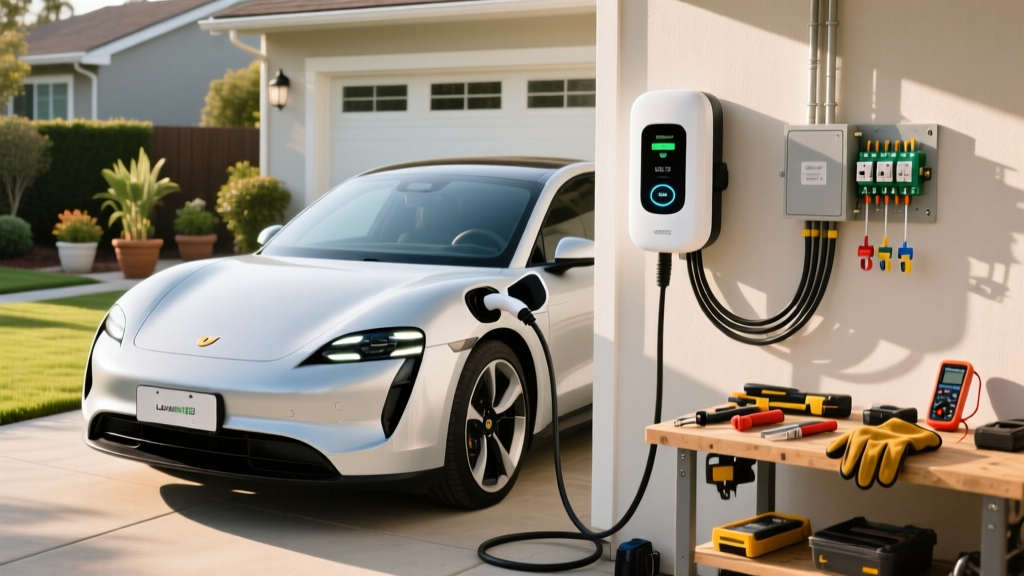
A Level 2 home charger is the single biggest quality-of-life upgrade for EV ownership. But installation cost varies enormously based on your home's electrical infrastructure. Here's what determines your price.
Core Electrical Requirements
- Circuit amperage: A 48A charger requires a dedicated 60A breaker (NEC code mandates chargers run at no more than 80% of circuit capacity). A 32A charger needs a 40A breaker.
- Voltage: 240V AC, single-phase (standard U.S. residential split-phase service).
- Wire gauge: 6 AWG copper for 60A circuits; 4 AWG for runs over 50 feet or in high-temperature conduits.
- GFCI protection: NEC 2023/2026 requires GFCI breakers for EV receptacles (NEMA 14-50 outlets); hardwired units often exempt from GFCI breaker requirement, which is one reason hardwiring is preferred.
- Outdoor rating: If your charger mounts outside, it must carry a NEMA 4 or NEMA 4X rating for weather resistance.
Do You Need a Panel Upgrade?
This is the cost wildcard. Most homes built after 1990 have a 200A main service panel. A licensed electrician will perform a load calculation (NEC Article 220) to determine whether your panel has capacity for a new 60A circuit. If your panel is already near capacity—common in homes with electric ranges, dryers, HVAC, and hot tubs—you may need:
- A panel upgrade from 100A or 150A to 200A ($1,500–$3,500)
- A service upgrade from 100A to 200A at the meter ($2,500–$5,000+)
- A smart load-management device (e.g., Emporia Smart Load Center or Span panel integration) that dynamically shares amps between the EV charger and other heavy loads ($300–$800 for the device, plus install)
| Component | Simple Install (panel has capacity, short run) | Moderate Install (longer run, conduit) | Complex Install (panel upgrade needed) |
|---|---|---|---|
| Level 2 Charger (hardware) | $350–$700 | $350–$700 | $350–$700 |
| Electrician labor | $300–$600 | $600–$1,500 | $800–$1,500 |
| Permit & inspection | $50–$200 | $50–$200 | $50–$300 |
| Panel/service upgrade | $0 | $0 | $1,500–$5,000 |
| Materials (wire, conduit, breaker) | $100–$250 | $200–$500 | $200–$600 |
| Total Estimated Cost | $800–$1,750 | $1,200–$2,900 | $2,900–$8,100 |
Federal Tax Credit for Home Charging Equipment
The IRS §30C Alternative Fuel Vehicle Refueling Property Credit covers 30% of home charger hardware and installation costs, up to $1,000. This credit applies to equipment placed in service in 2026, but it is nonrefundable (it can reduce your tax liability to zero but won't generate a refund beyond that) and is subject to census-tract eligibility requirements—rural and low-income census tracts qualify, while many suburban tracts may not. Verify your address eligibility at irs.gov or consult a tax professional before budgeting around this credit.
Cost to Charge: Home vs. Public vs. Gas
The economic case for home charging is overwhelming. Here's how the per-mile cost breaks down across scenarios, using a vehicle with an efficiency of 3.0 miles per kWh (roughly the EPA combined figure for a Hyundai Ioniq 5 or Tesla Model Y).
| Scenario | Cost per kWh | Vehicle Efficiency | Cost Per Mile | Annual Cost (12,000 mi) |
|---|---|---|---|---|
| Home Level 2 (national avg. residential rate) | $0.16/kWh | 3.0 mi/kWh | $0.053 | $640 |
| Home Level 2 (off-peak TOU rate) | $0.08/kWh | 3.0 mi/kWh | $0.027 | $320 |
| Public Level 2 (network pricing) | $0.28/kWh | 3.0 mi/kWh | $0.093 | $1,120 |
| DC Fast Charging (network avg.) | $0.42/kWh | 3.0 mi/kWh | $0.140 | $1,680 |
| Gasoline vehicle (28 MPG combined, $3.40/gal) | — | 28 MPG | $0.121 | $1,457 |
Key takeaway: Home-charged EVs cost roughly 4–5 cents per mile, versus 12+ cents per mile for a comparable gas car. Even exclusive DC fast charging at $0.42/kWh only slightly exceeds gasoline cost per mile—and most EV owners do 85–95% of their charging at home. Time-of-use (TOU) plans from your utility can slash home charging costs further by shifting charging to overnight off-peak windows.
For the latest average electricity rates by state, EIA data provides monthly updated residential pricing.
Recommended Home EV Chargers for 2026
The following units represent the strongest options across common use cases. All are NACS-native or available with NACS connectors for 2026 vehicles; CCS1 versions remain available for legacy vehicles.
Tesla Wall Connector (Gen 4)
- Power Output: Up to 11.5 kW (48A) on a 60A circuit; Wi-Fi–enabled load sharing supports two units on one circuit
- Connector: Native NACS; also compatible with non-Tesla NACS vehicles
- Cable Length: 24 ft
- Smart Features: Wi-Fi updates, power-sharing, Tesla app scheduling, integration with Tesla Powerwall
- Price: ~$425
- Best For: Tesla owners and NACS-native vehicle buyers who want a clean, reliable, no-frills unit
ChargePoint Home Flex (2nd Gen)
- Power Output: Configurable from 16A to 80A (3.8–19.2 kW); auto-adjusts to available circuit
- Connector: NACS or CCS1 (select at purchase); NACS adapter included for J1772 units
- Cable Length: 23 ft
- Smart Features: Wi-Fi, ChargePoint app with detailed session data, Alexa/Google Home integration, TOU scheduling, works with most utility demand-response programs
- Price: ~$550–$650 depending on connector
- Best For: Households with mixed connector needs or those who want granular energy tracking and utility program integration
Emporia Level 2 EV Charger
- Power Output: Up to 11.5 kW (48A) on a 60A circuit
- Connector: NACS or J1772 (with included NACS adapter)
- Cable Length: 24 ft
- Smart Features: Deep integration with Emporia Vue home energy monitor, solar-aware charging (charge only when excess solar is produced), TOU scheduling, real-time cost tracking
- Price: ~$400
- Best For: Solar-equipped homes and energy-monitoring enthusiasts who want to maximize self-consumption
Grizzl-E Smart (United Chargers)
- Power Output: Up to 10 kW (40A) on a 50A circuit
- Connector: NACS or J1772
- Cable Length: 24 ft
- Smart Features: OCPP-compatible (works with utility programs), adjustable amperage via DIP switches, -40°F rated for extreme cold, NEMA 4X outdoor enclosure included
- Price: ~$450
- Best For: Cold-climate installations and outdoor mounts where durability matters more than app polish
Safety, Code, and Best Practices
EV charging involves sustained high-current draw for hours—unlike any other household appliance. Follow these non-negotiable guidelines:
- Dedicated circuit: Your Level 2 charger must be on its own dedicated breaker. Sharing a circuit with a dryer, oven, or HVAC unit is a code violation and fire risk.
- Hardwire vs. plug: Hardwired installs (no plug) are preferred for 48A+ chargers. NEMA 14-50 receptacles are acceptable for 40A or lower chargers, but NEC 2023+ requires GFCI breakers on receptacles used for EV charging—these breakers cost $100–$200 and can nuisance-trip. Hardwired units avoid this requirement.
- Continuous-load derating: NEC treats EV charging as a continuous load (3+ hours). A 48A charger requires a 60A breaker (48 ÷ 0.8 = 60). Never undersize the breaker.
- Cable management: Use a holster or cable reel to keep the cord off the ground. Dragging cables across concrete accelerates insulation wear.
- Surge protection: In regions with frequent lightning or utility switching surges, a whole-panel surge protective device (SPD, ~$150–$300 installed) protects your charger and vehicle onboard charger from voltage spikes.
- Outdoor mounting: Ensure the unit carries a NEMA 4 (splash-resistant) or NEMA 4X (corrosion-resistant) rating. All recommended units above meet this standard.
Frequently Asked Questions
How much does it cost to install a home EV charger?
A straightforward Level 2 install on an existing 200A panel with a short wire run typically costs $800–$1,750 all-in (charger + electrician + permit). If your panel needs upgrading to accommodate the new circuit, total costs can range from $2,900 to $8,100 depending on whether a full service upgrade is required. Always get a load calculation from a licensed electrician before budgeting.
How fast will each charging level add range?
Level 1 (120V) adds 3–5 miles of range per hour—adequate for plug-in hybrids with small batteries but impractical for full BEVs. Level 2 (240V) adds 12–60 miles per hour depending on amperage, covering daily driving needs in a few hours. DC fast charging adds 150–1,000+ miles per hour at peak, delivering a 10–80% charge in 15–40 minutes depending on the vehicle's charge architecture and battery size.
Which connector/charger is compatible with my EV?
If you're buying a new 2026 BEV from Tesla, Ford, GM, Rivian, Hyundai, Kia, BMW, Mercedes, or Volvo, your vehicle has a NACS port. Buy a NACS-compatible home charger. If you own a 2019–2024 model-year EV with a CCS1 port, you can still use CCS1 home chargers or purchase a NACS adapter for Supercharger access. CHAdeMO (Nissan Leaf) has no viable adapter path to NACS and public charging access is declining.
How much does charging cost per mile vs. gas?
Home charging at the national average residential rate (~$0.16/kWh) costs roughly 5 cents per mile in a 3 mi/kWh EV—about 60% less than a 28 MPG gas car at $3.40/gallon (12 cents/mile). Off-peak TOU rates can push EV fuel cost below 3 cents per mile. Even public DC fast charging at $0.42/kWh roughly matches gasoline cost per mile.
What electrical upgrades might I need?
The most common upgrade is a panel capacity increase. If your existing service panel is 100A or 150A and already serves heavy loads (electric heat, dryer, range, hot tub), adding a 60A EV circuit may exceed its capacity. A panel upgrade to 200A costs $1,500–$3,500; a full service upgrade from the utility meter can cost $2,500–$5,000+. A smart load-management device can sometimes avoid a panel upgrade by dynamically sharing capacity between the EV charger and other appliances.
Can I use a standard 120V outlet to charge my EV?
Yes, but slowly. Level 1 charging via a standard 120V/15A outlet delivers roughly 1.2–1.4 kW, adding 3–5 miles of range per hour. This works for plug-in hybrids with 25–40 miles of electric range, or BEV owners who drive under 30 miles daily and can charge for 10–12 hours overnight. Ensure the outlet is on a dedicated circuit and in good condition—sustained 12A draw for hours can overheat worn receptacles.
Is a NACS adapter safe for my CCS1 vehicle at Superchargers?
Yes, when using an automaker-approved or certified adapter (e.g., the Ford or GM-provided NACS adapter). These adapters include proper communication protocol translation between CCS1 vehicle software and NACS charger hardware. Avoid uncertified third-party adapters, which may lack proper thermal or communication safeguards.