Why Electric Truck Owners Need a Dedicated Home Charger
Electric trucks like the Ford F-150 Lightning, Chevrolet Silverado EV, and Rivian R1T carry battery packs ranging from 98 kWh to over 200 kWh — roughly double or triple the capacity of a typical EV sedan. That massive battery is great for towing and range, but it creates a charging challenge: plugging into a standard 120V wall outlet (Level 1) adds roughly 2–4 miles of range per hour, meaning a full charge on a 131 kWh F-150 Lightning Extended Range pack could take over 70 hours. For any electric truck owner who drives more than 30 miles a day, a dedicated Level 2 home charger isn't optional — it's essential infrastructure.
This guide breaks down exactly what you need to install a Level 2 charger for your electric truck, what it costs, which equipment performs best, and how charging costs compare to gassing up a comparable ICE pickup.
Charging Levels Explained: Speed, Power, and What Each Adds
Before choosing equipment, you need to understand the three charging levels available to EV truck owners. Power is measured in kW (kilowatts) — the rate of energy flow — while battery capacity is measured in kWh (kilowatt-hours) — the total energy stored. Confusing these two is the most common EV literacy mistake.
| Level | Voltage | Max Power (kW) | Miles of Range/Hour | Best For |
|---|---|---|---|---|
| Level 1 | 120V AC | 1.4–1.9 kW | 2–5 mi/hr | Overnight top-up, PHEVs, emergencies |
| Level 2 | 240V AC | 7.2–19.2 kW | 20–70 mi/hr | Daily home charging, electric trucks |
| DC Fast Charge | 400–800V DC | 50–350 kW | 150–800+ mi/hr | Road trips, highway corridors |
Real-world note: Miles-per-hour figures assume average efficiency of 2.0–2.5 mi/kWh for electric trucks. Actual rates vary with ambient temperature, battery preconditioning state, and where you are on the charge curve. DC fast charging slows significantly above 80% state of charge (SoC) — a 350 kW peak rarely sustains beyond 10–20% SoC.
How Much Does It Cost to Install a Home EV Charger for a Truck?
Home Level 2 charger installation costs vary widely depending on your home's electrical panel capacity, the distance from panel to charger location, and local permit requirements. Here's a realistic breakdown based on 2025–2026 national averages:
| Cost Component | Typical Range | Notes |
|---|---|---|
| Level 2 Charger Unit | $400–$750 | 40A–48A hardwired or NEMA 14-50 plug-in |
| Electrician Labor | $500–$2,000 | Depends on run distance, conduit, wall penetration |
| Electrical Permit | $50–$250 | Required in most jurisdictions; varies by municipality |
| Panel Upgrade (if needed) | $1,500–$4,500 | 200A service upgrade for older 100A panels |
| Total (no panel upgrade) | $950–$3,000 | Most homes with 200A service fall here |
| Total (with panel upgrade) | $2,450–$7,500 | Common in pre-2000 homes |
Electrical Requirements for Truck Charging
Most electric trucks benefit from a 48A charger on a dedicated 60A 240V circuit. The National Electrical Code (NEC) requires circuits to be rated at 125% of continuous load, so a 48A charger needs a 60A breaker. The Ford F-150 Lightning's onboard charger accepts up to 19.2 kW (80A) on higher trims with the optional dual onboard charger, but most trucks accept 11.5 kW (48A) as standard.
Panel upgrade gotcha: If your home has a 100A main panel — common in homes built before 2000 — adding a 60A EV circuit may exceed your panel's capacity. An electrician will perform a load calculation per NEC Article 220. If you're already running central AC, an electric oven, and a dryer, you'll likely need a 200A service upgrade. Budget $2,000–$4,500 for this, and factor in utility coordination time (2–6 weeks in some areas).
Safety and Code Considerations
- Dedicated circuit: Your EV charger must have its own breaker — never share a circuit with other appliances.
- GFCI protection: NEC 2020+ requires GFCI breakers for outdoor receptacles; hardwired installations may exempt you from this in some jurisdictions.
- Outdoor rating: If mounting in a garage-adjacent carport or exterior wall, ensure the charger carries a NEMA 4 (weatherproof) rating.
- Cable management: For truck-height mounting, a 25-foot cable ensures reach to the charge port regardless of parking orientation.
- Permit and inspection: Skipping the permit risks insurance claim denial if an electrical fire occurs. Most permits cost $50–$250 and inspections take 1–2 weeks.
Which Connector Does Your Electric Truck Use?
The connector landscape shifted dramatically between 2023 and 2026, with most automakers adopting the North American Charging Standard (NACS) — originally developed by Tesla. Here's the current compatibility picture for electric trucks:
| Truck Model | Native Connector | Adapter Needed? | DC Fast Network Access |
|---|---|---|---|
| Ford F-150 Lightning (2025+) | NACS | No | Tesla Supercharger + CCS networks |
| Ford F-150 Lightning (2022–2024) | CCS1 | CCS-to-NACS adapter (included by Ford) | Supercharger via adapter + CCS |
| Chevrolet Silverado EV | NACS | No | Tesla Supercharger + CCS networks |
| Rivian R1T | NACS (2025+) | No (CCS adapter included) | Tesla Supercharger + CCS |
| Tesla Cybertruck | NACS | No | Tesla Supercharger exclusively |
| GMC Sierra EV | NACS | No | Tesla Supercharger + CCS networks |
For home Level 2 charging, most chargers now ship with a NACS connector. If you own an older CCS1-equipped truck, you'll either need a CCS-to-NACS adapter or a charger with a CCS1 plug. Most public Level 2 stations still use J1772, so keep a J1772-to-NACS adapter in the truck for destination charging.
Best Home EV Chargers for Electric Trucks in 2026
We selected these based on power output, cable length (critical for trucks parked in driveways), smart scheduling features, and build quality. All units support NACS natively or via included adapter.
ChargePoint Home Flex (NACS)
- Power: Up to 12 kW (50A) on 240V
- Connector: NACS (native)
- Cable length: 23 feet
- Smart features: Wi-Fi, app scheduling, Alexa integration, energy reporting
- Installation: Hardwired or NEMA 14-50 plug
- Price: ~$599
Verdict: Best all-rounder for truck owners. The 23-foot cable reaches most driveway configurations, and adjustable amperage (16A–50A) lets you match your circuit.
Grizzl-E Smart (NACS)
- Power: Up to 11.5 kW (48A)
- Connector: NACS
- Cable length: 24 feet
- Smart features: Wi-Fi, OCPP protocol, energy dashboard, over-the-air updates
- Installation: Hardwired or NEMA 14-50
- Price: ~$549
Verdict: Best value for high-amperage charging. Built in Canada with a -40°F operating range — ideal for cold-climate truck owners.
Emporia Level 2 EV Charger
- Power: Up to 11.5 kW (48A)
- Connector: NACS (2025+ models)
- Cable length: 24 feet
- Smart features: Wi-Fi, solar integration, time-of-use scheduling, energy monitoring with whole-home panel integration
- Installation: Hardwired or NEMA 14-50
- Price: ~$399
Verdict: Best budget smart charger. Pairs with the Emporia Vue energy monitor for detailed cost tracking — useful if your utility offers time-of-use rates.
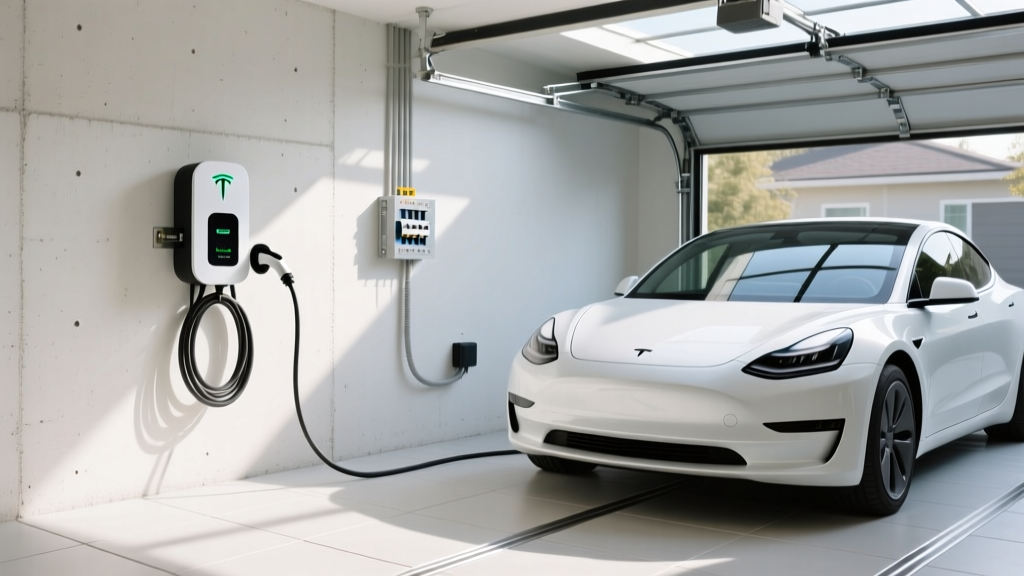
Tesla Wall Connector (NACS)
- Power: Up to 11.5 kW (48A) on single-phase; supports power sharing between two units
- Connector: NACS (native)
- Cable length: 24 feet
- Smart features: Wi-Fi, OTA updates, power sharing, access control
- Installation: Hardwired only
- Price: ~$475
Verdict: Best for Tesla Cybertruck owners and anyone wanting a clean, minimalist install. Power sharing lets two chargers split one 60A circuit — useful for two-truck households.
Charging Time Examples for Common Electric Truck Batteries
Electric truck batteries are large. Here's how long common models take to charge from 10% to 80% at various power levels. We use 10–80% because charging slows dramatically above 80% SoC to protect battery health — the charge curve taper means the last 20% can take as long as the first 80%.
| Truck | Battery (kWh usable) | Level 2 @ 11.5 kW (48A) | Level 2 @ 19.2 kW (80A) | DC Fast (peak kW) |
|---|---|---|---|---|
| Ford F-150 Lightning (Std Range) | 98 kWh | ~6.0 hours | ~3.6 hours | ~44 min @ 150 kW peak |
| Ford F-150 Lightning (Ext Range) | 131 kWh | ~8.0 hours | ~4.8 hours | ~41 min @ 210 kW peak |
| Chevrolet Silverado EV (4WT) | 200 kWh | ~12.2 hours | ~7.3 hours | ~70 min @ 350 kW peak |
| Rivian R1T (Dual-Motor Max) | 141 kWh | ~8.6 hours | N/A (48A onboard) | ~45 min @ 220 kW peak |
| Tesla Cybertruck (AWD) | 123 kWh | ~7.5 hours | N/A (48A onboard) | ~35 min @ 250 kW peak |
Cold-weather reality check: At temperatures below 32°F, expect Level 2 charging speeds to drop 15–30% due to battery thermal management draw. DC fast charging in sub-freezing weather can add 10–20 minutes to 10–80% times unless you precondition the battery via the truck's app before arriving at the charger.
Cost Per Mile: Charging an Electric Truck vs. Gas
The economics of electric truck ownership depend heavily on where and when you charge. Here's a cost comparison using the Ford F-150 Lightning Extended Range (EPA combined: 2.0 mi/kWh, or ~70 MPGe) versus the 2026 Ford F-150 3.5L EcoBoost (EPA combined: 20 MPG).
| Scenario | Cost per kWh / Gallon | Cost per Mile (EV Truck) | Cost per Mile (Gas Truck) |
|---|---|---|---|
| Home charging (off-peak TOU rate) | $0.10/kWh | $0.050/mi | $0.175/mi (@ $3.50/gal) |
| Home charging (standard rate) | $0.16/kWh | $0.080/mi | $0.175/mi |
| Public Level 2 (ChargePoint, EVgo) | $0.35/kWh | $0.175/mi | $0.175/mi |
| DC Fast Charging (Electrify America) | $0.48/kWh | $0.240/mi | $0.175/mi |
| Tesla Supercharger (average) | $0.32/kWh | $0.160/mi | $0.175/mi |
Key takeaway: Home charging at off-peak rates delivers a 71% fuel cost advantage over gas. But exclusive reliance on DC fast charging actually exceeds the cost of gasoline per mile. For truck owners who tow or drive 400+ miles weekly, home charging infrastructure isn't just convenient — it's the economic foundation of EV ownership.
Federal Tax Credit for Home Charger Installation
The IRS §30C Alternative Fuel Vehicle Refueling Property Credit covers 30% of home EV charger equipment and installation costs, up to $1,000. To qualify, the charger must be installed at your primary residence and placed in service during the tax year. Eligibility is subject to census-tract requirements — the credit is currently limited to installations in non-urban or low-income census tracts. Check the IRS tool or consult a tax professional to confirm your address qualifies.
Practical Decision Framework: What Setup Do You Actually Need?
Choose a 48A (11.5 kW) NACS charger if:
- Your truck has a 48A onboard charger (most standard trims)
- You drive under 150 miles/day and charge overnight
- Your panel has capacity for a 60A dedicated circuit
- Budget: ~$550–$650 equipment + $800–$2,000 installation
Choose an 80A (19.2 kW) charger if:
- You own an F-150 Lightning with the optional dual onboard charger
- You regularly deplete the battery below 30% and need faster recovery
- Your panel supports a 100A dedicated circuit (or you're upgrading to 200A+ service)
- Budget: ~$750–$1,200 equipment + $1,500–$3,000 installation
Skip the panel upgrade and use a 32A (7.7 kW) charger if:
- You have a 100A panel with no room for a 60A breaker
- You drive under 80 miles/day and can tolerate slower overnight charging
- You want to avoid the $2,000–$4,500 panel upgrade cost
Frequently Asked Questions
How much does it cost to install a home EV charger for an electric truck?
Most homeowners with a 200A electrical panel pay between $950 and $3,000 total (equipment + electrician + permit). If your home has an older 100A panel that needs upgrading, total costs range from $2,450 to $7,500. The §30C federal tax credit can offset up to $1,000 of that cost if your census tract qualifies.
How fast will each charging level add range to my electric truck?
Level 1 (120V) adds 2–5 miles per hour — too slow for daily truck use. Level 2 (240V, 48A) adds roughly 25–35 miles per hour, enough to fully recharge overnight. DC fast charging adds 150–800+ miles per hour at peak, but sustained rates taper significantly after 80% SoC. Real-world DC fast sessions average 100–200 miles added in 20–30 minutes for most electric trucks.
Which connector/charger is compatible with my electric truck?
As of 2025–2026, most new electric trucks (F-150 Lightning, Silverado EV, Sierra EV, Rivian R1T, Cybertruck) use the NACS connector natively. Earlier model-year F-150 Lightnings (2022–2024) use CCS1 but received a Ford-provided CCS-to-NACS adapter for Supercharger access. For home Level 2 charging, buy a NACS charger unless your truck specifically requires CCS1.
How much does charging an electric truck cost per mile vs gas?
At home on off-peak electricity ($0.10/kWh), an F-150 Lightning costs about $0.05/mile to fuel — 71% less than a gas F-150 at $3.50/gallon ($0.175/mile). At public DC fast chargers ($0.48/kWh), the EV costs $0.24/mile — more than gas. The economic case for electric trucks depends almost entirely on reliable home charging access.
What electrical upgrades might I need for a truck charger?
The most common upgrade is a 200A panel replacement for homes with 100A service ($1,500–$4,500). You'll also need a dedicated 60A breaker (for a 48A charger) with appropriately sized 6 AWG copper wire. If your garage is far from the panel (over 50 feet), expect higher conduit and wire costs. Some utilities require a separate meter or time-of-use enrollment for EV circuits — check with your provider before installation.
Can I use a NEMA 14-50 outlet instead of hardwiring?
Yes, a NEMA 14-50 outlet (50A, 240V) supports up to 40A continuous charging — adequate for most truck owners. The advantage is portability: you can unplug and take the charger when you move. However, some jurisdictions now require GFCI breakers for 14-50 outlets under NEC 2020, which can add $150–$300 and occasionally cause nuisance tripping. Hardwired installations bypass this issue and support higher amperage (up to 48A or 80A).
Will charging my truck at home affect my electricity bill significantly?
Charging a 131 kWh F-150 Lightning from 20% to 80% at home ($0.14/kWh national average) costs roughly $11. If you drive 1,200 miles/month at 2.0 mi/kWh, you'll use about 600 kWh — adding approximately $84/month to your electric bill. That compares to ~$210/month in gasoline for the same distance at 20 MPG and $3.50/gallon. Net savings: roughly $126/month or $1,512/year before any time-of-use optimization.
Sources: EPA efficiency data from fueleconomy.gov; IRS §30C credit rules from irs.gov; manufacturer charging specifications from Ford, GM, Rivian, and Tesla press sites.