Choosing the right EV charger trim for your home is one of the most consequential decisions you'll make as an electric vehicle owner. The wrong choice means waking up to an undercharged battery; the right one means effortless daily driving that costs a fraction of gasoline. But the EV charging landscape is littered with confusing specs — kW vs. kWh, NACS vs. CCS, 240V vs. 120V — and installation costs that can range from a simple outlet plug-in to a full electrical panel upgrade.
This guide breaks down every charger trim available to US EV owners in 2026, pairs each with real-world charging speeds and costs, and gives you the exact numbers you need to budget a home installation — including the panel upgrade scenario that catches many older-home buyers off guard.
The Three Charger Trims: Level 1, Level 2, and DC Fast Charging
Every EV charger falls into one of three trims, defined by voltage, amperage, and power delivery (measured in kilowatts, or kW). Understanding the distinction between kW (power — the rate of energy flow) and kWh (energy — the total capacity stored in your battery) is essential. Think of kW as the width of the pipe and kWh as the size of the tank you're filling.
| Charging Level | Voltage | Power (kW) | Miles of Range Added per Hour | Typical Use Case |
|---|---|---|---|---|
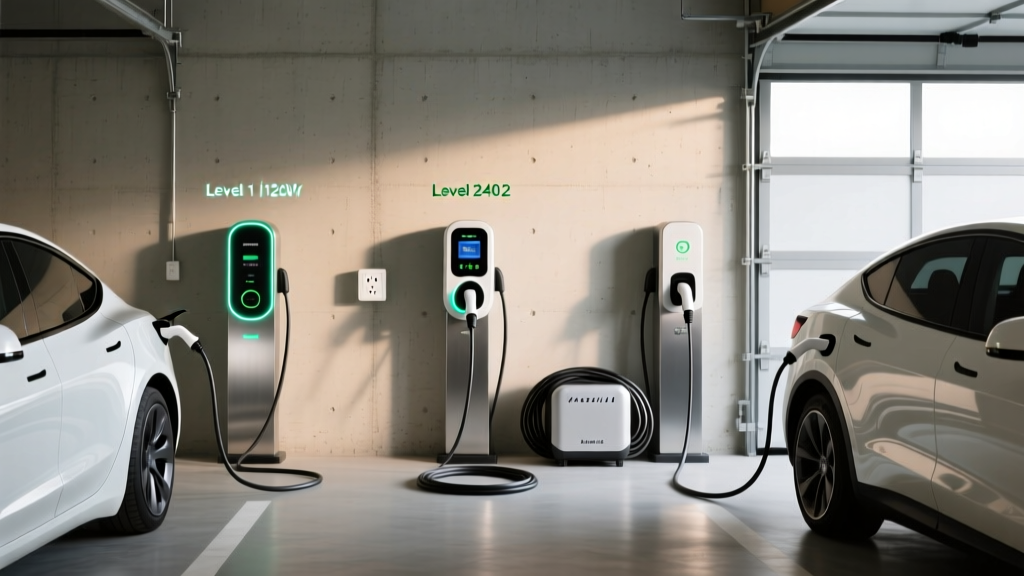
| Level 1 | 120V AC | 1.2–1.9 kW | 3–5 miles | Overnight trickle, PHEV top-ups |
| Level 2 | 240V AC | 3.3–19.2 kW | 12–75 miles | Primary home and workplace charging |
| DC Fast Charging | 400–800V DC | 50–350+ kW | 150–1,000+ miles (equivalent) | Road trips, commercial fleets |
Level 1: The Baseline Trim
Level 1 charging uses a standard 120V household outlet and delivers roughly 1.2 to 1.9 kW. For a vehicle with a 75 kWh battery like the Tesla Model Y Long Range, a full Level 1 charge from empty would take approximately 45–60 hours. That's impractical for most BEV owners but perfectly adequate for PHEVs with smaller batteries (10–20 kWh) that only need 30–40 miles of electric range restored overnight.
Level 2: The Daily-Driver Standard
Level 2 runs on 240V — the same voltage as your electric dryer — and delivers between 3.3 kW (16A) and 19.2 kW (80A). Most home installations use a 40A or 48A circuit, yielding 9.6 kW or 11.5 kW respectively. At 11.5 kW, a 75 kWh battery charges from 10% to 80% in roughly 5 to 6 hours — easily replenishing a full day's driving overnight. According to fueleconomy.gov, Level 2 charging is the recommended primary method for home BEV ownership.
DC Fast Charging: The Road-Trim Option
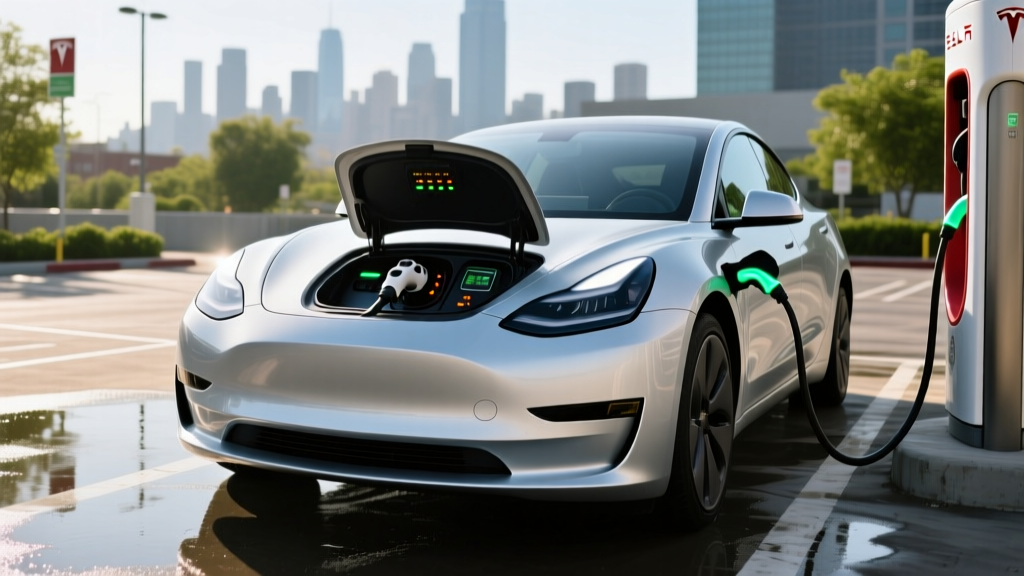
DC fast chargers bypass the vehicle's onboard charger and deliver direct current at 50 kW to over 350 kW. A Hyundai Ioniq 5 with its 800V architecture can accept up to 240 kW, charging from 10–80% in approximately 18 minutes under ideal conditions. However, DC fast charging is not designed for daily home use — it requires commercial-grade electrical infrastructure and is found at public stations along highways and retail corridors.
Home EV Charger Installation: Electrical Requirements and Costs
The single biggest variable in home charging is installation cost, which depends entirely on your home's electrical panel capacity, the distance from panel to charger location, and local permitting requirements. Here's what you need to know before calling an electrician.
Electrical Panel and Circuit Requirements
A typical Level 2 home charger requires a dedicated 240V circuit. The National Electrical Code (NEC) requires that continuous loads — which includes EV charging — use no more than 80% of the circuit's rated capacity. That means:
- A 40A circuit supports up to 32A continuous draw (7.7 kW)
- A 50A circuit supports up to 40A continuous draw (9.6 kW)
- A 60A circuit supports up to 48A continuous draw (11.5 kW)
Your home's electrical panel must have enough spare capacity to support this new circuit. Most modern 200A panels can accommodate a 40–60A EV circuit without issue. Older homes with 100A or 150A panels may require a panel upgrade — a significant added cost.
Installation Cost Breakdown
| Cost Component | Simple Install (Panel Adjacent) | Moderate Install (50–80 ft Run) | Complex Install (Panel Upgrade Needed) |
|---|---|---|---|
| Level 2 Charger Equipment | $350–$700 | $350–$700 | $350–$700 |
| Electrician Labor (Licensed) | $300–$600 | $600–$1,200 | $800–$1,500 |
| Electrical Materials (Conduit, Wire, Breaker) | $100–$250 | $250–$600 | $300–$700 |
| Permit and Inspection | $50–$200 | $50–$200 | $50–$200 |
| Panel Upgrade (if needed) | $0 | $0 | $1,500–$3,500 |
| Total Estimated Cost | $800–$1,750 | $1,250–$2,700 | $3,000–$6,600 |
Permitting and Code Considerations
Most US jurisdictions require an electrical permit for a new 240V circuit. Your electrician typically pulls this permit, and a local inspector will verify the installation meets NEC requirements. Key code points include:
- Dedicated circuit: The EV charger must have its own breaker — no sharing with other appliances.
- GFCI protection: NEC 2020 and later require GFCI protection for all 240V receptacles used for EV charging in garages and outdoor locations. Hardwired chargers may be exempt in some jurisdictions.
- Outdoor rating: If your charger is installed outdoors, both the unit and any receptacle must carry a NEMA 3R or NEMA 4 weather-resistance rating.
- Cable management: Some localities require cord organizers or retractors to prevent tripping hazards in shared driveways or sidewalks.
Connector Compatibility: NACS, CCS1, CHAdeMO, and Adapters
The EV industry is undergoing a major connector transition. As of 2026, the North American Charging Standard (NACS) — originally developed by Tesla — has become the dominant connector for new vehicles, while CCS1 remains common on vehicles sold between 2018 and 2024. Here's how the landscape breaks down by brand:
| Connector Type | Brands Using It (New Vehicles) | Home Charger Availability | Adapter Needed? |
|---|---|---|---|
| NACS (Tesla/J3400) | Tesla, Ford, GM, Rivian, Volvo, Polestar, Hyundai, Kia, BMW, Mercedes, Nissan | Tesla Wall Connector, ChargePoint Home Flex (NACS), Emporia Vue | CCS-to-NACS adapters available (~$150–$250) for legacy CCS vehicles |
| CCS1 | Legacy models (2018–2024 VW ID.4, Ford Mustang Mach-E pre-2025, etc.) | ChargePoint Home Flex (CCS), JuiceBox (discontinued but supported), Grizzl-E | NACS-to-CCS adapters available for new NACS chargers |
| CHAdeMO | Nissan Leaf (legacy), Mitsubishi Outlander PHEV (older trims) | Limited; most new home chargers do not offer CHAdeMO cables | No widely available CHAdeMO-to-NACS adapter for DC charging |
What this means for your charger purchase: If you're buying a new EV in 2026, it almost certainly uses NACS. Buy a NACS-equipped home charger. If you own a 2020–2024 model with CCS1, you can either purchase a CCS1 home charger or buy a NACS charger with a CCS adapter — a future-proof choice if you plan to switch to a NACS vehicle later.
How Much Does EV Charging Actually Cost Per Mile?
One of the strongest arguments for home charging is cost. Electricity prices vary by state and time of day, but the per-mile cost of EV charging consistently undercuts gasoline. Here's a realistic comparison using 2026 national averages:
| Charging Scenario | Rate | Vehicle Efficiency | Cost Per Mile |
|---|---|---|---|
| Home Level 2 (Off-Peak / Time-of-Use) | $0.08–$0.14/kWh | 3.0 mi/kWh (e.g., Tesla Model 3) | $0.03–$0.05 |
| Home Level 2 (Standard Rate) | $0.14–$0.20/kWh | 3.0 mi/kWh | $0.05–$0.07 |
| Public Level 2 (ChargePoint, EVgo L2) | $0.20–$0.35/kWh | 3.0 mi/kWh | $0.07–$0.12 |
| DC Fast Charging (Electrify America, Tesla Supercharger) | $0.30–$0.55/kWh | 3.0 mi/kWh | $0.10–$0.18 |
| Gasoline (30 MPG Combined, $3.40/gal) | $3.40/gallon | 30 mi/gal | $0.11 |
| Gasoline (25 MPG Combined, $3.40/gal) | $3.40/gallon | 25 mi/gal | $0.14 |
At home off-peak rates, charging a Tesla Model 3 (approximately 26–30 kWh per 100 miles) costs roughly $0.03–$0.05 per mile — about one-third the cost of a 30 MPG gasoline vehicle. Even at DC fast-charging rates during road trips, EV charging costs are comparable to or slightly below gasoline on a per-mile basis.
Many utilities offer time-of-use (TOU) plans that discount electricity during overnight hours (typically 11 PM – 6 AM). Programming your charger to start during these windows maximizes savings. According to the IRS, the federal Alternative Fuel Vehicle Refueling Property Credit (§30C) may also cover up to 30% of home charging equipment and installation costs (capped at $1,000) for eligible taxpayers in qualifying census tracts — check your eligibility with a tax professional.
Charging Time Examples: What to Expect by Battery Size
Charging time depends on three variables: battery capacity (kWh), charger power output (kW), and the vehicle's onboard charger limit. Here are real-world charging times for common EV battery sizes:
| Vehicle (Battery Size) | Level 1 (1.4 kW) | Level 2 — 7.7 kW (32A) | Level 2 — 11.5 kW (48A) | DC Fast 10–80% |
|---|---|---|---|---|
| Toyota RAV4 Prime PHEV (18.1 kWh) | ~12 hours | ~2.2 hours | ~1.5 hours | N/A (no DC port) |
| Tesla Model 3 RWD (57.5 kWh usable) | ~40 hours | ~6.5 hours | ~4.5 hours | ~25 min (170 kW peak) |
| Hyundai Ioniq 5 (77.4 kWh usable) | ~54 hours | ~9 hours | ~6 hours | ~18 min (240 kW peak, 800V) |
| Ford F-150 Lightning Ext. Range (131 kWh usable) | ~90+ hours | ~15 hours | ~10 hours | ~41 min (150 kW peak) |
Best Home EV Chargers by Trim: Equipment Recommendations
The home charger market has matured significantly. Here are proven Level 2 units organized by feature set and price point, all current as of 2026:
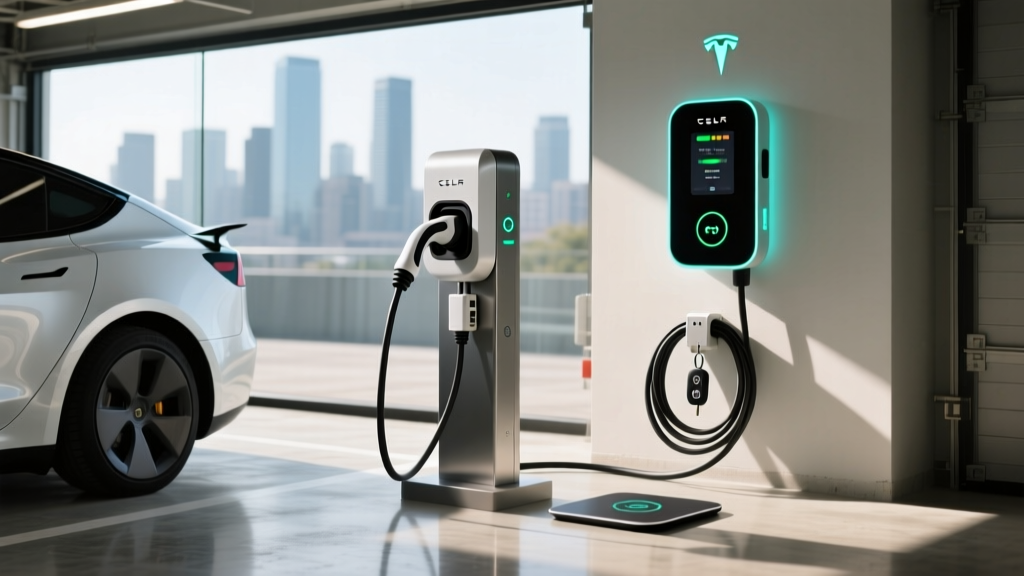
Tesla Wall Connector (NACS) — $420
- Power Output: Up to 11.5 kW (48A) on a 60A circuit
- Connector: NACS native; CCS adapter included in-box for non-Tesla vehicles
- Cable Length: 24 feet
- Smart Features: Wi-Fi enabled, Tesla app scheduling, power sharing between two units on one circuit, OTA firmware updates
- Best For: Tesla owners and NACS-vehicle buyers who want seamless integration. The included CCS adapter makes it the most versatile single charger on the market.
ChargePoint Home Flex (NACS or CCS1) — $550–$650
- Power Output: Up to 12 kW (50A) on a 60A circuit; configurable down to 16A for lower-capacity panels
- Connector: Available in NACS or CCS1 configurations
- Cable Length: 23 feet
- Smart Features: ChargePoint app with detailed session data, Alexa integration, flexible amperage DIP-switch settings, scheduled charging, utility demand-response compatible
- Best For: Households with mixed EV brands or those who want granular energy tracking. The configurable amperage is ideal for homes with limited panel capacity.
Emporia Vue Smart EV Charger (NACS) — $350–$400
- Power Output: Up to 11.5 kW (48A) on a 60A circuit
- Connector: NACS
- Cable Length: 24 feet
- Smart Features: Integrates with Emporia Vue whole-home energy monitor, real-time solar-production matching (charge only when solar is generating), app-based scheduling and cost tracking
- Best For: Solar-panel owners who want to maximize self-consumption. The solar-matching feature ensures your EV charges on renewable energy when available, reducing grid draw.
Grizzl-E Smart (CCS1) — $450–$550
- Power Output: Up to 10 kW (40A) on a 50A circuit
- Connector: CCS1
- Cable Length: 24 feet
- Smart Features: Wi-Fi connectivity, OCPP protocol support (compatible with utility demand-response programs), configurable amperage, built-in circuit breaker
- Best For: CCS1-vehicle owners who want a durable, Canadian-built unit rated to -40°F for extreme cold climates. The integrated breaker adds a layer of safety for outdoor installations.
Safety, Code Compliance, and Smart Features That Matter
Beyond raw power output, the charger trims worth considering share several safety and convenience features:
- UL listing: Only purchase chargers that carry a UL (Underwriters Laboratories) or ETL listing mark. Uncertified chargers from unknown brands may lack critical safety protections and can void your homeowner's insurance coverage in the event of an electrical fire.
- Hardwired vs. plug-in: Plug-in chargers (NEMA 14-50 receptacle) offer portability — you can take the charger when you move. Hardwired units eliminate the receptacle (and its GFCI requirement in many jurisdictions) and may allow higher amperage on the same circuit. Hardwired is generally preferred for permanent installations.
- Load management: Some chargers (like the Tesla Wall Connector with Power Sharing and the Emporia Vue) can dynamically adjust charging speed based on your home's real-time electrical load. This prevents panel overload without requiring a service upgrade.
- Energy Star certification: Energy Star–rated chargers meet standby-power efficiency standards, drawing less than 1W when idle. Over years of ownership, this reduces phantom energy costs.
- Cable management and holster: A wall-mounted holster or cable retractor keeps your garage organized and prevents cable damage from being run over or stepped on.
For outdoor installations, verify that the charger carries at minimum a NEMA 4 rating (protection against splashing water and ice formation). In coastal or high-humidity areas, a NEMA 4X rating (additional corrosion resistance) is worth the premium.
Frequently Asked Questions
How much does it cost to install a home EV charger?
A straightforward Level 2 installation with the electrical panel nearby typically costs $800–$1,750 including equipment, labor, and permit. If the panel is 50–80 feet away, expect $1,250–$2,700. If your home needs a panel upgrade from 100A to 200A, total costs can reach $3,000–$6,600. Always get at least two quotes from licensed electricians.
How fast will each charging level add range?
Level 1 (120V) adds 3–5 miles of range per hour. Level 2 (240V, 48A) adds 30–45 miles per hour for most EVs. DC fast charging can add 150–300+ miles in 20–30 minutes depending on the vehicle's peak acceptance rate. See the charging-levels table above for exact figures.
Which connector and charger is compatible with my EV?
If your EV is a 2025 or 2026 model, it almost certainly uses the NACS connector (J3400 standard). Vehicles from 2018–2024 may use CCS1. The Nissan Leaf and older Mitsubishi PHEVs use CHAdeMO. Check your vehicle's charge port or owner's manual, then match your home charger's connector accordingly. Adapters are available for most NACS/CCS combinations.
How much does EV charging cost per mile compared to gas?
Home charging at off-peak rates costs approximately $0.03–$0.05 per mile — roughly one-third the cost of a 30 MPG gasoline car at $3.40/gallon ($0.11/mile). Even public DC fast charging at $0.40/kWh works out to about $0.13/mile, still competitive with gasoline for most vehicles. See the cost-per-mile table above for detailed scenarios.
What electrical upgrades might I need for a Level 2 charger?
You'll need a dedicated 240V circuit (40A–60A) with sufficient panel capacity. Homes with 100A panels or panels already near capacity may require an upgrade to 200A service ($1,500–$3,500). Alternatively, you can opt for a lower-amperage charger (24A–32A) that draws less from the panel — a practical solution if your daily driving needs are modest. A licensed electrician can perform a load calculation to determine your exact requirements. For more on electrical safety standards, consult the National Fire Protection Association's NEC guidelines.