Understanding the 2026 EV Charger Tax Credit
The federal Alternative Fuel Vehicle Refueling Property Credit (Section 30C) remains available in 2026 for homeowners installing qualified EV charging equipment. This credit covers up to 30% of the cost of purchasing and installing a home EV charger, with a maximum credit of $1,000 per year.
Unlike the vehicle purchase credit (Section 30D), the charger credit has no income caps and no MSRP limits on the equipment. However, it does have specific requirements about the charger's capabilities and installation standards that you must meet to qualify.
Section 30C Eligibility Requirements:
- Charger must be new (not used equipment)
- Must be installed at your primary or secondary residence in the United States
- Equipment must meet NEC (National Electrical Code) standards
- Must be installed by a qualified electrician with proper permits
- Charger must have a minimum power output of 3.3 kW (Level 2 or higher)
- Credit equals 30% of combined equipment + installation costs, up to $1,000
Charging Levels Explained: Speed and Range Addition
Before calculating your tax credit benefit, understand what each charging level delivers in practical terms. Here's how fast each option adds range to your EV:
| Charging Level | Power Output | Voltage/Amperage | Miles Added Per Hour | Typical Use Case |
|---|---|---|---|---|
| Level 1 | 1.4-1.9 kW | 120V / 12-16A | 3-5 miles | Overnight trickle charge, PHEVs |
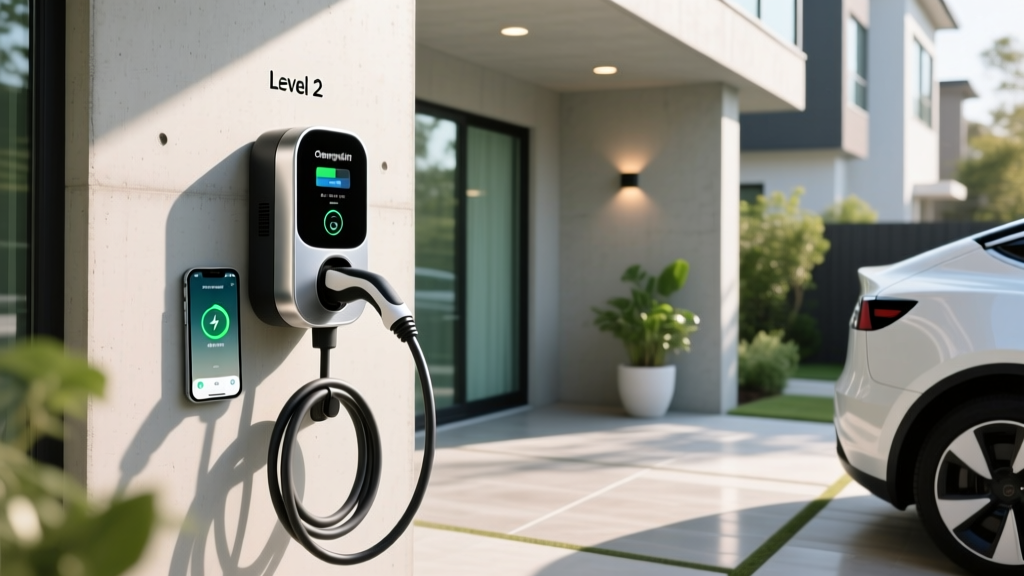
| Level 2 | 3.3-19.2 kW | 240V / 16-80A | 12-75 miles | Home daily charging (tax credit eligible) |
| DC Fast Charge | 50-350 kW | 400-800V DC | 150-1,200+ miles | Road trips, public stations |
Real-world charging time examples: A 75 kWh battery (like a Tesla Model Y or Ford Mustang Mach-E) charging from 10-80% takes approximately 8-10 hours on a 7.7 kW Level 2 charger, 4-5 hours on a 15.4 kW unit, and 18-25 minutes at a 150 kW DC fast charger (with charging curve taper above 80% SoC).
Home Charger Installation: Costs and Electrical Requirements
The total cost to install a Level 2 home charger typically ranges from $800 to $2,500, depending on your home's electrical infrastructure. Here's the breakdown:
| Component | Cost Range | Notes |
|---|---|---|
| Level 2 Charger Equipment | $300-$700 | 32A-48A smart chargers with WiFi |
| Electrician Labor | $400-$1,200 | Depends on run distance from panel |
| Electrical Permit | $50-$200 | Required for code compliance and tax credit |
| Panel Upgrade (if needed) | $1,500-$3,500 | For homes with 100A service or full panels |
| Total (no panel upgrade) | $800-$2,100 | Qualifies for 30% tax credit |
| Total (with panel upgrade) | $2,300-$5,600 | Panel upgrade not credit-eligible |
Electrical Requirements for Level 2 Chargers
A 40-amp Level 2 charger (the most common size) requires a dedicated 50-amp circuit at 240 volts. This means:
- Circuit capacity: 50A breaker (80% continuous load rule means 40A actual draw)
- Wire gauge: 6 AWG copper for runs under 50 feet; 4 AWG for longer runs
- Panel capacity: Your main electrical panel must have at least 50 amps of available capacity
- GFCI protection: Required by NEC 2020 and later for garage/outdoor installations
Panel upgrade warning: Homes built before 2000 often have 100-amp or 150-amp main panels that may be near capacity. Adding a 50A EV circuit could require a $1,500-$3,500 panel upgrade to 200A service. This cost is not eligible for the tax credit, but the charger and its direct installation are.
Connector Compatibility: NACS, CCS, and CHAdeMO
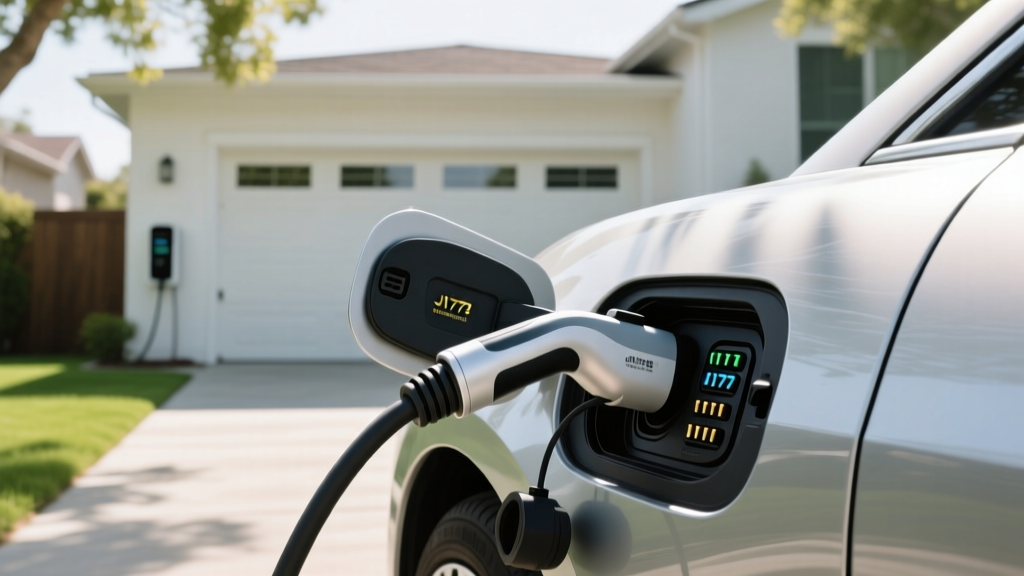
The charging connector landscape has consolidated significantly by 2026, but you still need to match your charger to your vehicle:
| Connector Type | Compatible Brands (2026) | Adapter Needed? |
|---|---|---|
| NACS (Tesla) | Tesla, Ford, GM, Rivian, Volvo, Polestar, Mercedes | No for Tesla; yes for others using CCS-native chargers |
| CCS1 | Hyundai, Kia, BMW, VW, Audi, older Ford/GM | Yes if using NACS-only home charger |
| CHAdeMO | Nissan Leaf (legacy), Mitsubishi | Yes for NACS/CCS chargers (limited availability) |
2026 reality: Most new EVs sold in North America now use NACS, and home chargers are available with native NACS connectors. If you own a CCS-equipped vehicle, purchase a CCS-to-NACS adapter ($150-$250) or choose a charger with a CCS connector. CHAdeMO vehicles are increasingly rare and adapters are expensive ($400+).
Cost to Charge: Home vs. Public vs. Gas
One of the strongest arguments for home charging is the dramatic cost advantage over both public charging and gasoline. Here's the real math:
| Charging/Fueling Method | Cost per kWh/Gallon | Vehicle Efficiency | Cost Per Mile |
|---|---|---|---|
| Home (off-peak utility rate) | $0.12/kWh | 3.5 miles/kWh (typical EV) | $0.034 |
| Home (standard rate) | $0.18/kWh | 3.5 miles/kWh | $0.051 |
| Public Level 2 (ChargePoint, etc.) | $0.35/kWh | 3.5 miles/kWh | $0.100 |
| DC Fast Charge (Electrify America) | $0.48/kWh | 3.5 miles/kWh | $0.137 |
| Gasoline (28 MPG vehicle) | $3.50/gallon | 28 miles/gallon | $0.125 |
| Gasoline (22 MPG truck/SUV) | $3.50/gallon | 22 miles/gallon | $0.159 |
Annual savings example: Driving 12,000 miles per year, home charging at $0.15/kWh costs approximately $514, while fueling a 25 MPG gas car at $3.50/gallon costs $1,680. That's $1,166 in annual fuel savings, which pays back a $1,500 charger installation in just 16 months.
Recommended Level 2 Chargers for 2026
ChargePoint Home Flex (48A)
- Power: 11.5 kW (48A)
- Connector: NACS or CCS (selectable)
- Cable length: 23 feet
- Smart features: WiFi, app scheduling, utility integration
- Price: $549
- Tax credit eligible: Yes
Emporia Level 2 EV Charger (48A)
- Power: 11.5 kW (48A)
- Connector: NACS native
- Cable length: 24 feet
- Smart features: WiFi, energy monitoring, solar integration
- Price: $399
- Tax credit eligible: Yes
Grizzl-E Smart (40A)
- Power: 9.6 kW (40A)
- Connector: NACS or J1772 (CCS adapter included)
- Cable length: 24 feet
- Smart features: OCPP compatible, adjustable amperage
- Price: $449
- Tax credit eligible: Yes
Safety and code considerations: All recommended chargers are UL-listed, NEMA 4-rated for outdoor use, and include GFCI protection. Ensure your electrician pulls a permit—this is required both for code compliance and to document eligibility for the Section 30C tax credit.
Frequently Asked Questions
How much does it cost to install a home EV charger?
Expect $800-$2,100 for a standard Level 2 installation if your electrical panel has sufficient capacity. If you need a panel upgrade from 100A to 200A service, add $1,500-$3,500. The charger equipment and direct installation costs qualify for a 30% federal tax credit (up to $1,000).
How fast will each charging level add range?
Level 1 (120V) adds 3-5 miles per hour. Level 2 (240V, 40A) adds 25-35 miles per hour depending on your EV's onboard charger capacity. DC fast charging can add 150-1,200+ miles per hour but is only available at public stations and tapers significantly above 80% state of charge.
Which connector/charger is compatible with my EV?
Check your vehicle's charge port: Tesla, Ford, GM, Rivian, and most 2025+ EVs use NACS. Hyundai, Kia, BMW, and older Ford/GM models use CCS1. Nissan Leaf uses CHAdeMO. Purchase a charger with the matching connector or buy an adapter ($150-$400 depending on type).
How much does charging cost per mile vs gas?
Home charging at average utility rates costs $0.04-$0.06 per mile. Public Level 2 charging costs $0.10-$0.12 per mile. DC fast charging costs $0.13-$0.18 per mile. A 25 MPG gas vehicle at $3.50/gallon costs $0.14 per mile. Home charging is typically 60-70% cheaper than gasoline.
What electrical upgrades might I need?
Most homes need a dedicated 50-amp circuit for a 40A charger. If your main panel is 100A or near capacity, you may need a $1,500-$3,500 upgrade to 200A service. Homes built after 2005 typically have sufficient capacity. Your electrician will assess this during the site visit.
Can I claim the tax credit if I rent my home?
No. The Section 30C credit is only available for chargers installed at a residence you own. Renters cannot claim this credit, but landlords who install chargers may be eligible.
For official IRS guidance on the Alternative Fuel Vehicle Refueling Property Credit, visit IRS.gov Section 30C. For EV efficiency and range data, consult fueleconomy.gov.