The EV Charger Tax Credit 2025: What You Can Actually Claim
The federal Alternative Fuel Vehicle Refueling Property Credit (IRS Form 8911) remains available for home EV charging equipment installed through December 31, 2032. If you purchased and installed a qualified home EV charger in 2025 — or plan to in 2026 — you may be eligible for a tax credit worth 30% of the cost of the charger and its installation, up to $1,000. This is distinct from the §30D vehicle purchase credit; it applies specifically to the charging hardware and the electrical work to connect it.
But eligibility is not automatic. The Inflation Reduction Act added geographic and sourcing requirements that trip up many filers. Here is what the IRS actually requires:
- Credit amount: 30% of equipment + installation costs, capped at $1,000 per tax year for residential property.
- Location requirement: The charger must be installed at your primary residence located in an eligible census tract — generally rural areas or low-income communities as defined by the IRS. Suburban and urban tracts may not qualify.
- Placed in service: The charger must be new (not previously used) and installed and operational in the tax year you claim it.
- Nonrefundable credit: This credit reduces your tax liability dollar-for-dollar but cannot exceed what you owe. If your tax liability is below $1,000, the unused portion does not carry forward.
- Documentation: Keep receipts for the charger hardware and electrician labor. File IRS Form 8911 with your return.
The census-tract requirement is the biggest catch. The IRS provides a lookup tool based on the 2020 census to determine whether your address qualifies. Many homeowners in dense metro areas will find their tract is ineligible, while rural and some suburban locations do qualify. Always verify your specific address before counting on the credit. A tax professional can confirm eligibility for your situation.
Understanding EV Charging Levels: kW, Speeds, and Real-World Range Added
Before choosing equipment, you need to understand the three charging levels available to EV owners. The critical distinction: kW (kilowatts) measures power — how fast energy flows into your battery. kWh (kilowatt-hours) measures energy — the total capacity stored in your battery, like gallons in a fuel tank. A 19.2 kW charger delivers energy faster than a 7.2 kW charger, filling the same kWh battery in less time.
| Level | Voltage | Power (kW) | Miles of Range Added per Hour | Typical Use Case |
|---|---|---|---|---|
| Level 1 | 120V AC | 1.2–1.4 kW | 3–5 mi/hr | Overnight top-ups, PHEVs, low-mileage drivers |
| Level 2 | 240V AC | 3.3–19.2 kW | 14–75 mi/hr | Home daily charging, workplace, public destinations |
| DC Fast Charge | 400–900V DC | 50–350 kW | 150–1,000+ mi/hr (peak) | Road trips, highway corridors, commercial fleets |
Level 1 uses a standard household 120V outlet and the portable cord that came with your EV. It adds roughly 3–5 miles of range per hour — enough for plug-in hybrids with 25–40 miles of electric range, but painfully slow for a full battery electric vehicle (BEV) with a 75–100 kWh battery. A full charge from 10% could take 3–4 days on a large-battery BEV.
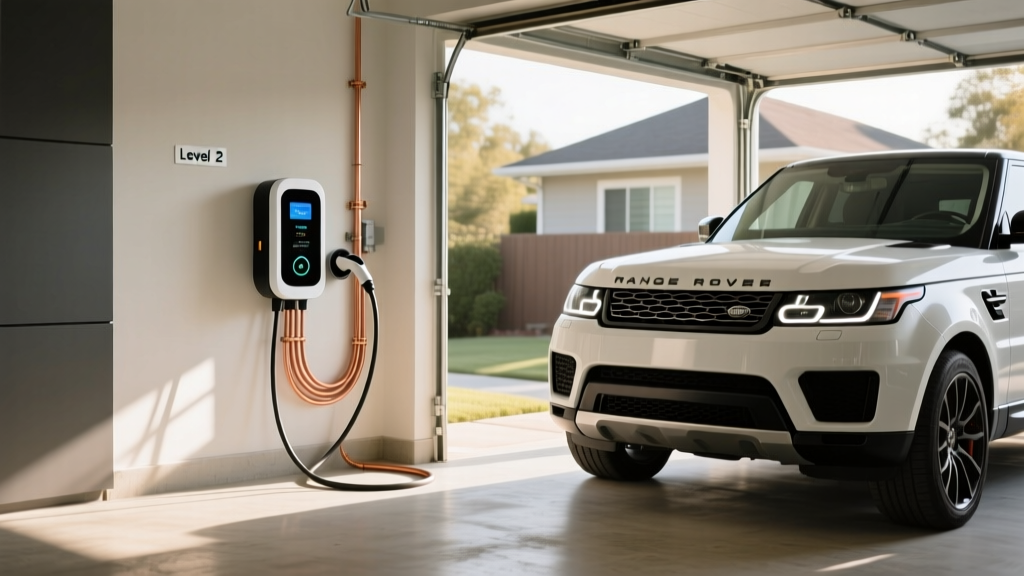
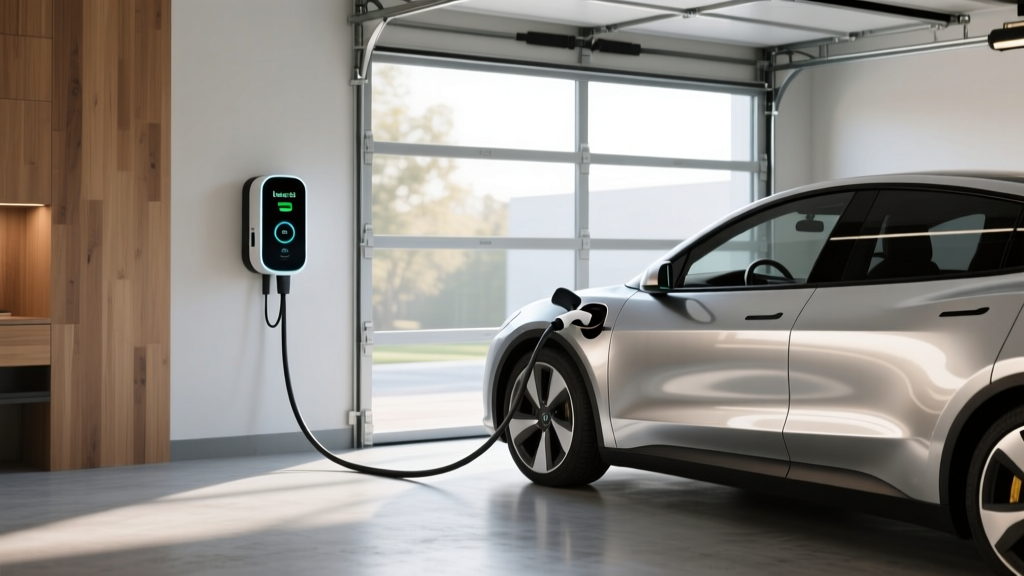
Level 2 is the standard for home charging. A 48-amp (11.5 kW) Level 2 station on a 240V circuit adds roughly 35–45 miles of range per hour, depending on your vehicle's onboard charger capacity and efficiency. Most BEVs recover a full day's driving (30–40 miles) in under an hour of Level 2 charging. This is the sweet spot for overnight charging at home.
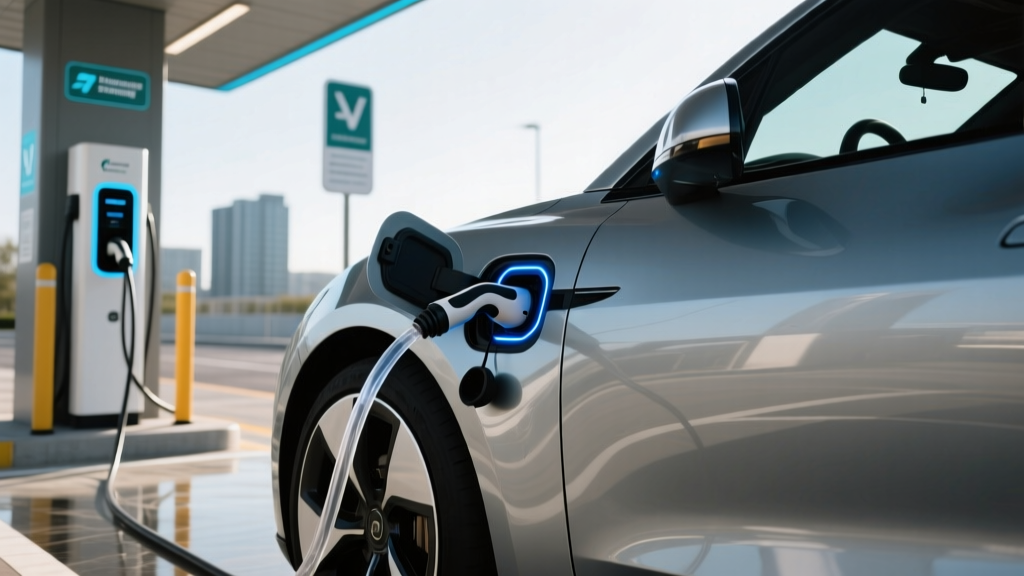
DC Fast Charging bypasses the vehicle's onboard charger and feeds DC current directly into the battery. Peak rates of 150–350 kW can add 100–200 miles in 15–20 minutes. However, charge speed is not linear: batteries accept peak power only at low states of charge (typically 10–30%), then taper significantly above 80% to protect cell health. A "10–80% in 18 minutes" claim means the final 20% may take another 20–30 minutes.
Home EV Charger Installation: Electrical Requirements and Cost Breakdown
A Level 2 home charger requires a dedicated 240V circuit, similar to what powers an electric dryer or oven. The most common residential setup is a 240V / 48-amp circuit on a 60-amp breaker (electrical code requires the breaker to be rated at 125% of the continuous load). This supports chargers delivering up to 11.5 kW — enough for nearly every EV on the market.
Here is what a realistic installation looks like in terms of cost:
| Component | Low Estimate | High Estimate | Notes |
|---|---|---|---|
| Level 2 charger hardware (hardwired or NEMA 14-50 plug) | $350 | $700 | 40A–48A Wi-Fi-enabled stations |
| Electrician labor (run new 240V circuit, mount station) | $400 | $1,500 | Varies by run length from panel to garage |
| Permit and inspection fees | $50 | $250 | Required by most local jurisdictions |
| Electrical panel upgrade (if needed) | $1,500 | $3,500 | Older 100A panels often need upgrade to 200A |
| Total (no panel upgrade) | $800 | $2,450 | Most homes with adequate panel capacity |
| Total (with panel upgrade) | $2,300 | $5,950 | Homes with older or maxed-out 100A panels |
The panel upgrade is the hidden cost that surprises many homeowners. If your home has a 100-amp electrical panel — common in houses built before the 1990s — adding a 60-amp breaker for an EV charger may push the panel past its rated capacity. Upgrading to a 200-amp panel costs $1,500–$3,500 on average and may be required by your local electrical inspector. Some utilities offer rebates that offset panel-upgrade costs; check with your provider.
Alternatives to a full panel upgrade:
- Lower-amperage charger: A 24-amp or 32-amp charger on a 30A or 40A breaker draws less from the panel while still adding 18–25 miles per hour — adequate for most daily needs.
- Smart load-management devices: Products like the NeoCharge Smart Splitter or Span Drive Panel allow two devices (e.g., dryer and EV charger) to share a single 240V circuit, switching between them so only one runs at a time. This avoids a panel upgrade in some cases.
- 120V/240V dual-voltage portable chargers: Some portable units (e.g., the Emporia J1772 portable) can plug into a NEMA 14-50 outlet at 32A/240V or a standard 120V outlet at 12A — useful for renters or those delaying a full install.
Which Connector Is Compatible with Your EV?
The North American charging connector landscape shifted significantly in 2023–2025 when most major automakers adopted the North American Charging Standard (NACS), originally developed by Tesla. Here is where each brand stands as of 2026:
| Connector | Brands Using It (Native) | Adapter Needed? |
|---|---|---|
| NACS (Tesla-style) | Tesla (all models), Ford, GM, Rivian, Volvo, Polestar, Mercedes-Benz, Nissan (new Ariya refresh), Honda (2026+), BMW (2026+) | CCS1→NACS adapter for older CCS vehicles at Tesla Superchargers; NACS→CCS adapter for NACS vehicles at legacy CCS stations |
| CCS1 (Combo) | Hyundai, Kia, Volkswagen, Subaru, Stellantis (Chrysler/Jeep/Dodge), Toyota (bZ4X), some older Ford/GM models | CCS1→NACS adapter ($200–$300) required for Tesla Supercharger access |
| CHAdeMO | Nissan Leaf (legacy), Mitsubishi Outlander PHEV (legacy) | Limited adapters; CHAdeMO infrastructure is declining |
What this means for home charging: Level 2 home chargers use the J1772 connector (for CCS1 vehicles) or the NACS connector (for Tesla and NACS-adopted vehicles). Most charger manufacturers now offer both connector options. If you own a CCS1 vehicle today but plan to switch to a NACS vehicle later, buy a charger with a J1772 connector and use a NACS-to-J1772 adapter (approximately $150–$250), or choose a charger with a swappable connector head.
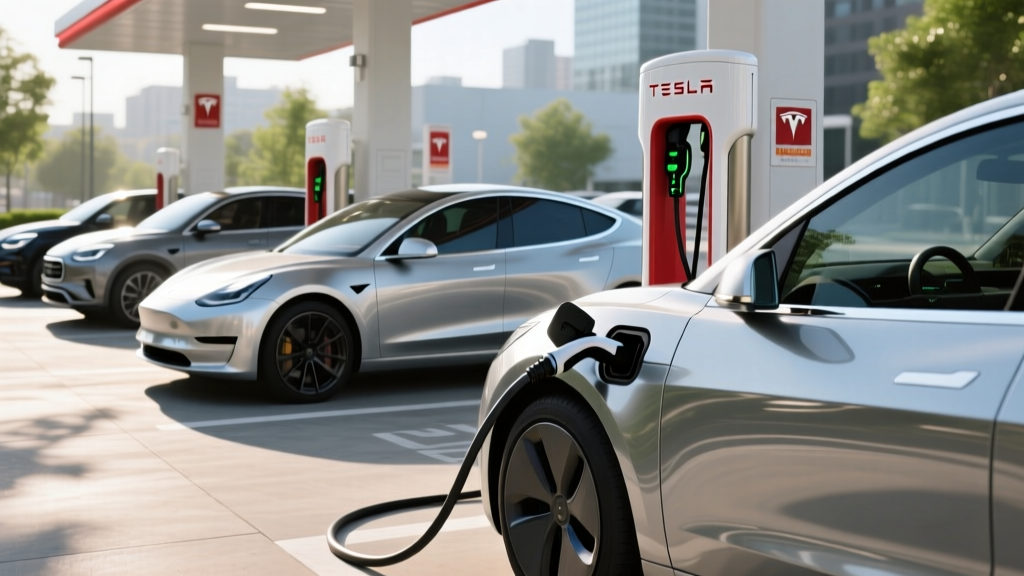
DC fast charging connectors follow the same split: NACS at Tesla Superchargers and an expanding number of non-Tesla networks, CCS1 at Electrify America, EVgo, and other legacy networks. Adapters bridge the gap but add cost and a small efficiency penalty.
Level 2 Charger Equipment Recommendations
These are proven Level 2 home stations we recommend based on reliability, features, and value. All are Wi-Fi-enabled for scheduling, energy monitoring, and utility demand-response programs.
Emporia Vue Level 2 EV Charger
- Power output: 48A / 11.5 kW (hardwired) or 40A / 9.6 kW (NEMA 14-50 plug)
- Connector: J1772 (CCS1 vehicles)
- Cable length: 24 feet
- Smart features: Energy monitoring via Emporia app, solar integration, scheduled charging, utility demand-response compatible
- Outdoor rating: NEMA 4 (indoor/outdoor)
- Price: ~$399
Best for: Budget-conscious buyers who want detailed energy tracking and solar-charging integration. The hardwired version delivers full 48A; the plug-in version is limited to 40A.
ChargePoint Home Flex
- Power output: Up to 50A / 12 kW (adjustable from 16A to 50A via DIP switches)
- Connector: J1772 (CCS1 vehicles)
- Cable length: 23 feet
- Smart features: ChargePoint app scheduling, Alexa integration, utility program support, adjustable amperage to match your circuit
- Outdoor rating: NEMA 4
- Price: ~$699
Best for: Flexibility. The adjustable amperage means you can install it on a 20A to 60A breaker depending on your panel capacity, then upgrade later without replacing the unit.
Tesla Wall Connector
- Power output: 48A / 11.5 kW (hardwired, 60A breaker)
- Connector: NACS (native Tesla and NACS-adopted vehicles)
- Cable length: 24 feet
- Smart features: Wi-Fi updates, power-sharing between two Wall Connectors on one circuit, Tesla app integration
- Outdoor rating: NEMA 3R (indoor/outdoor, limited dust protection)
- Price: ~$475
Best for: Tesla owners and drivers of NACS-equipped Ford, GM, and Rivian vehicles. The power-sharing feature is ideal for two-EV households with limited panel capacity.
Grizzl-E Smart
- Power output: 40A / 9.6 kW (NEMA 14-50) or 48A / 11.5 kW (hardwired)
- Connector: J1772
- Cable length: 24 feet
- Smart features: OCPP-compatible, works with multiple smart-charging apps, load balancing
- Outdoor rating: IP67 (fully sealed, extreme weather rated to -40°F)
- Price: ~$499
Best for: Cold-climate installations and outdoor mounting. The IP67 rating and Canadian engineering make this one of the most rugged chargers on the market.
Charging Cost per Mile: Home Electricity vs. Gasoline
One of the strongest financial arguments for home charging is the cost-per-mile advantage over gasoline. The exact savings depend on your local electricity rate, whether you charge during off-peak hours, and your vehicle's efficiency (measured in kWh per 100 miles or miles per kWh).
| Scenario | Rate | Cost per Mile (Efficient EV, 3.0 mi/kWh) | Cost per Mile (Gas Car, 30 MPG) |
|---|---|---|---|
| Home off-peak (time-of-use rate) | $0.09/kWh | $0.030/mi | $0.117/mi (at $3.50/gal) |
| Home standard rate (national avg.) | $0.17/kWh | $0.057/mi | $0.117/mi |
| Public Level 2 (network pricing) | $0.30/kWh | $0.100/mi | $0.117/mi |
| DC Fast Charging (Electrify America, EVgo) | $0.48/kWh | $0.160/mi | $0.117/mi |
Key takeaway: Home charging at off-peak or even standard residential rates is dramatically cheaper than gasoline — roughly $0.03 to $0.06 per mile versus $0.12 per mile for a 30 MPG gas car at $3.50/gallon. That translates to annual fuel savings of $900–$1,350 for a driver covering 12,000 miles per year.
However, frequent DC fast charging at public rates ($0.40–$0.55/kWh) can push EV per-mile costs above gasoline. This is why home charging access is the single biggest factor in EV ownership economics. If you cannot charge at home, a plug-in hybrid may make more financial sense than a full BEV.
Real-world charging time examples (10–80% state of charge):
- 75 kWh battery (e.g., Tesla Model 3 Long Range) on a 48A / 11.5 kW Level 2 charger: ~4.5 hours (adds ~52.5 kWh)
- 84 kWh battery (e.g., Hyundai Ioniq 5) on a 48A / 11.5 kW Level 2 charger: ~5.1 hours
- 100 kWh battery (e.g., Ford F-150 Lightning Extended Range) on a 48A / 11.5 kW Level 2 charger: ~6.1 hours
- 75 kWh battery on a 150 kW DC fast charger: ~22–28 minutes (10–80%), with significant taper above 80%
Safety, Electrical Code, and Installation Best Practices
EV charging draws sustained high current for hours — unlike a dryer or oven that cycles on and off. This makes proper installation critical for long-term safety.
- Dedicated circuit: Your Level 2 charger must be on its own dedicated breaker. Sharing a circuit with other appliances is a code violation unless using a certified load-management device.
- GFCI protection: The 2020 National Electrical Code (NEC 625.54) requires GFCI (ground-fault circuit interrupter) protection for all EV charging outlets. Hardwired installations may not require a GFCI breaker in all jurisdictions, but plug-in (NEMA 14-50) installations do. GFCI breakers add $50–$150 to the installation cost.
- NEMA 14-50 outlet quality: If using a plug-in charger, specify a commercial-grade NEMA 14-50 receptacle (e.g., Hubbell or Bryant brand). Residential-grade outlets from big-box stores have been linked to overheating and melting under sustained EV charging loads. Expect to pay $30–$60 for a quality receptacle.
- Outdoor rating: If your charger is mounted outdoors, it must carry at least a NEMA 3R rating (rain protection) or NEMA 4 (weatherproof, hose-down rated). All recommended chargers above meet this standard.
- Permit and inspection: Most jurisdictions require an electrical permit for a new 240V circuit. The inspection ensures correct wire gauge, breaker sizing, grounding, and GFCI compliance. Skipping the permit risks insurance denial in the event of an electrical fire.
- Wire gauge: A 48A charger on a 60A breaker typically requires 6 AWG copper wire (THHN in conduit) or 4 AWG for longer runs. Your electrician will calculate the correct gauge based on run length and local code.
Frequently Asked Questions
How much does it cost to install a home EV charger?
A typical Level 2 home charger installation costs $800–$2,450 if your electrical panel has sufficient capacity. This includes $350–$700 for the charger, $400–$1,500 for electrician labor, and $50–$250 for permits. If your home needs a panel upgrade from 100A to 200A, add $1,500–$3,500, bringing the total to $2,300–$5,950. The federal EV charger tax credit can offset 30% of these costs up to $1,000 if your home is in an eligible census tract.
How fast will each charging level add range?
Level 1 (120V) adds 3–5 miles per hour. Level 2 (240V, 48A) adds 35–45 miles per hour depending on vehicle efficiency. DC fast charging at 150–350 kW can add 150–1,000+ miles per hour at peak, but real-world sessions average 100–200 miles in 20–30 minutes due to charge-curve taper above 80% state of charge.
Which connector/charger is compatible with my EV?
If you drive a Tesla, Ford, GM, Rivian, Volvo, or Polestar from 2025 onward, your vehicle uses the NACS connector. If you drive a Hyundai, Kia, Volkswagen, or Toyota EV, it uses CCS1 (J1772 for Level 2). Buy a home charger with the matching connector, or use an adapter ($150–$300). CHAdeMO is limited to older Nissan Leaf and Mitsubishi models and has declining infrastructure support.
How much does charging cost per mile vs. gas?
Home charging at the national average electricity rate ($0.17/kWh) costs approximately $0.05–$0.06 per mile for an efficient EV. A comparable gas car at 30 MPG and $3.50/gallon costs about $0.12 per mile. That's a 50–55% fuel cost reduction with home charging. Off-peak rates ($0.09/kWh) push EV costs down to $0.03/mile — a 75% savings. Public DC fast charging ($0.48/kWh) costs roughly $0.16/mile, which is more expensive than gasoline.
What electrical upgrades might I need?
Homes with a 200-amp electrical panel usually have enough capacity for a 60-amp EV charger circuit without upgrades. Homes with older 100-amp panels often need a panel upgrade to 200A, costing $1,500–$3,500. Alternatives include installing a lower-amperage charger (24A–32A on a 30A–40A breaker) or using a smart load-splitting device that shares an existing 240V circuit with a dryer or oven. A licensed electrician can assess your panel's available capacity during a site visit.
Do I qualify for the EV charger tax credit if I live in a city?
Possibly, but it depends on your specific census tract. The Inflation Reduction Act limits the credit to equipment installed in eligible census tracts — typically rural or low-income communities. Many urban and suburban addresses do not qualify. Use the IRS census-tract lookup tool or consult a tax professional to confirm eligibility before relying on the credit. State and utility rebates may be available regardless of federal eligibility.
Disclaimer: Tax credit eligibility depends on individual circumstances, current IRS rules, and your location. Consult a qualified tax professional and review IRS guidance on the Alternative Fuel Vehicle Refueling Property Credit before making purchasing decisions. Electrical installation should always be performed by a licensed electrician in compliance with local codes. Equipment prices and specifications reflect 2026 market data and are subject to change.