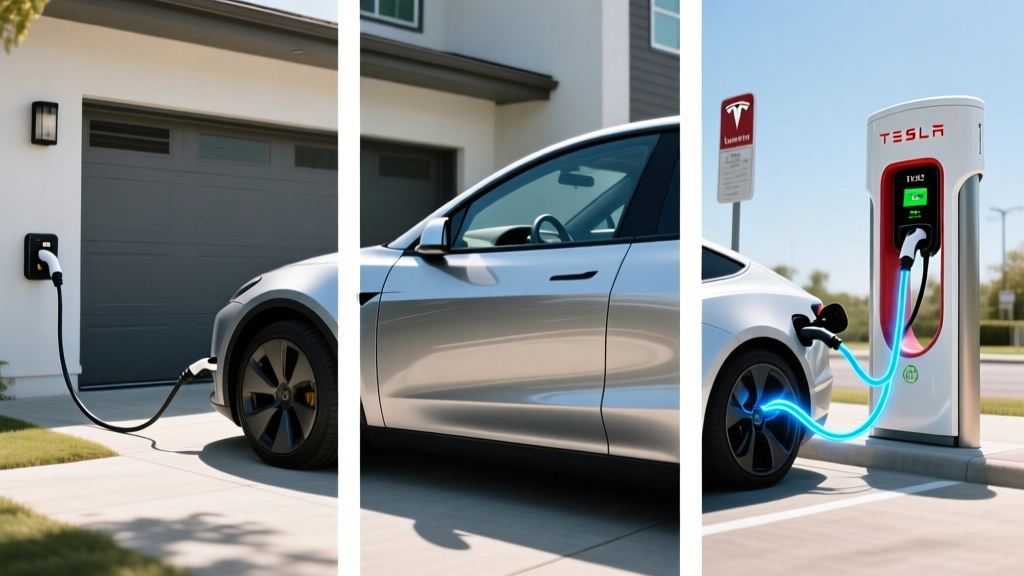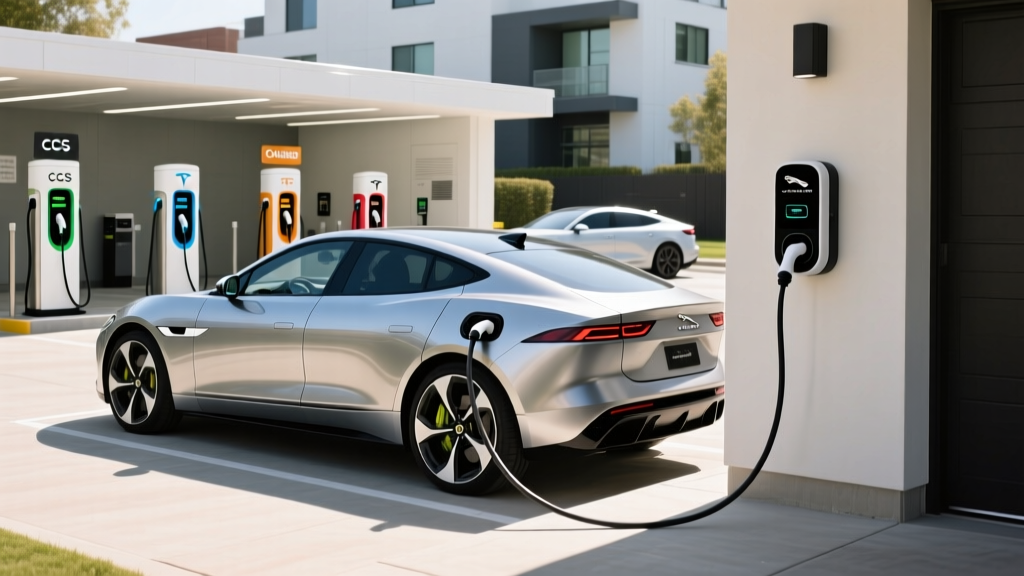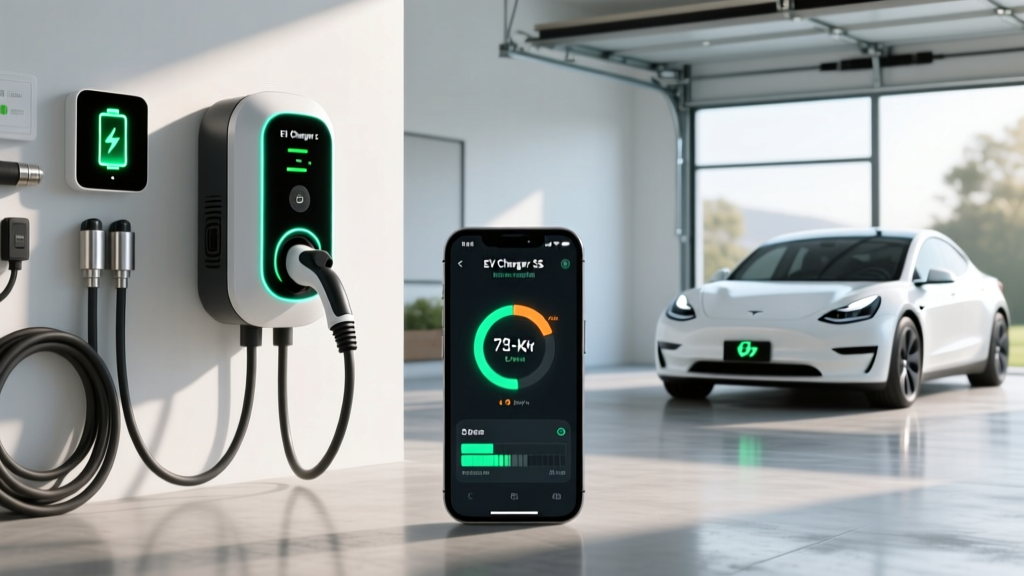
Understanding EV Charger Speeds: Level 1, Level 2, and DC Fast Charging
The term "charger SS" in the EV world typically refers to charging system specifications — the combination of power delivery (measured in kilowatts, or kW), connector type, and electrical infrastructure that determines how quickly your electric vehicle replenishes its battery (measured in kilowatt-hours, or kWh). Before selecting any charging equipment, you need to understand the three tiers of EV charging available in 2026.
kW vs. kWh — the critical distinction: kW (kilowatts) measures the rate of energy delivery — think of it as the width of a pipe. kWh (kilowatt-hours) measures the total energy stored in your battery — the size of the tank. A 48 kW charger delivers energy roughly four times faster than a 12 kW charger, filling the same battery in a quarter of the time.
| Level | Voltage | Power (kW) | Miles of Range Added Per Hour | Typical Use Case |
|---|---|---|---|---|
| Level 1 | 120V AC | 1.2–1.9 kW | 3–5 miles | Overnight trickle; PHEV-friendly |
| Level 2 | 240V AC | 7.2–19.2 kW | 20–70 miles | Home daily charging; workplace |
| DC Fast Charge (DCFC) | 400–800V DC | 50–350 kW | 150–1,000+ miles (equivalent rate) | Road trips; highway corridors |
For a real-world example: a Tesla Model Y Long Range (75 kWh usable battery, EPA 310 miles) charging on a 48 kW Level 2 circuit will go from 10% to 80% state of charge in roughly 55–65 minutes. That same vehicle on a 250 kW DC fast charger (like a V4 Supercharger) will achieve 10–80% in approximately 15–18 minutes, though the charge curve tapers significantly above 80% to protect battery longevity.
Most BEV owners find that a Level 2 home charger rated at 48 amps (delivering up to 11.5 kW on a 60-amp dedicated circuit) covers 95% of their needs, adding roughly 40–44 miles of range per hour — enough to fully replenish even large batteries overnight.
Home EV Charger Installation: Electrical Requirements and Costs
Installing a Level 2 home charger is the single highest-impact upgrade an EV owner can make. But costs vary enormously depending on your home's electrical panel capacity, the distance from panel to charger location, and local permit requirements.
Electrical Requirements
A 48-amp Level 2 charger requires a dedicated 60-amp, 240-volt circuit (the National Electrical Code requires circuits to be rated at 125% of continuous load — 48A × 1.25 = 60A). Your home's main electrical panel must have sufficient spare capacity to accommodate this load.
Panel upgrade reality: Many homes built before 2000 have 100-amp or 125-amp main panels. Adding a 60-amp EV circuit to an already-loaded 100A panel often requires upgrading to a 200-amp service — a significant expense. Homes with modern 200A panels typically have enough headroom, but a licensed electrician must perform a load calculation to confirm.
| Component | Cost Range | Notes |
|---|---|---|
| Level 2 charger hardware (smart, 48A) | $400–$750 | Wi-Fi enabled, NACS or J1772/NACS combo |
| Electrician labor (standard install) | $500–$1,500 | Depends on panel-to-charger distance, wall type |
| Electrical permit | $50–$250 | Varies by municipality |
| Panel upgrade (if needed) | $1,500–$3,500 | 100A → 200A service upgrade |
| Conduit/wiring materials | $100–$400 | Longer runs = higher cost |
| Total (no panel upgrade) | $1,050–$2,900 | Most homes with adequate panel capacity |
| Total (with panel upgrade) | $2,550–$6,400 | Older homes needing service upgrade |
Safety and Code Considerations
NEC Article 625 governs EV charging installations. Key requirements include:
- Dedicated circuit: Your EV charger must be on its own breaker — not shared with other appliances
- GFCI protection: Required for outdoor installations and recommended for garages in many jurisdictions
- Outdoor rating: If mounted outside, the unit must carry a NEMA 4 or NEMA 4X weatherproof rating
- Strain relief: Cable management to prevent cord damage from vehicle weight or weather
Always hire a licensed electrician familiar with NEC 625. Permits and inspections aren't optional — they protect you and are required for any utility rebates or the federal residential energy credit (up to $1,000 for EV charger hardware and installation through 2032 under IRS §25E, subject to census-tract eligibility).
Connector Compatibility: NACS, CCS1, and CHAdeMO in 2026
The connector landscape has consolidated significantly since 2024, when Ford, GM, Rivian, Volvo, and others adopted the North American Charging Standard (NACS), originally developed by Tesla. By 2026, NACS is the dominant connector for new BEVs sold in North America, though CCS1-equipped vehicles from earlier model years remain on the road.
| Connector | Brands Using It | Home Charger Availability | Adapter Needed? |
|---|---|---|---|
| NACS (Tesla standard) | Tesla, Ford, GM, Rivian, Volvo, Polestar, Hyundai (2025+), Kia (2025+), BMW (2026+) | Tesla Wall Connector, ChargePoint Home Flex (NACS), Emporia Vue (NACS) | No — native on new vehicles |
| CCS1 (Combo) | VW ID.4 (pre-2026), Hyundai Ioniq 5 (pre-2025), Kia EV6 (pre-2025), legacy models | ChargePoint Home Flex (J1772+CCS), Grizzl-E Smart | NACS-to-CCS adapter for Supercharger access (~$200–$250) |
| CHAdeMO | Nissan Leaf (all years), Mitsubishi Outlander PHEV | Limited new equipment | No direct NACS adapter; CHAdeMO stations declining |
For home Level 2 charging, the physical connector matters less at Level 2 because most chargers use a J1772 plug with a NACS adapter included in-box (or vice versa). At DC fast-charging stations, however, your vehicle's native port determines which networks you can access without adapters. As of 2026, Tesla Superchargers with Magic Dock adapters serve CCS1 vehicles, and Electrify America stations increasingly offer NACS cables alongside CCS1.
Charging Cost Per Mile: EV vs. Gas
One of the strongest economic arguments for EV ownership is fuel cost — but the savings depend heavily on where and when you charge. Here's a realistic breakdown using a 2026 Chevrolet Equinox EV (319 miles EPA, ~3.2 mi/kWh efficiency) compared to a 2026 Honda CR-V AWD (29 MPG combined).
| Scenario | Cost per kWh / Gallon | Cost Per Mile | Annual Cost (12,000 mi) |
|---|---|---|---|
| Home charging (off-peak TOU rate) | $0.12/kWh | $0.038 | $450 |
| Home charging (standard rate) | $0.18/kWh | $0.056 | $675 |
| Public Level 2 (workplace/mall) | $0.25–$0.40/kWh | $0.078–$0.125 | $938–$1,500 |
| DC fast charging (road trip) | $0.35–$0.55/kWh | $0.109–$0.172 | $1,313–$2,063 |
| Gasoline (CR-V, $3.50/gal, 29 MPG) | $3.50/gal | $0.121 | $1,448 |
The data is clear: home-charged EVs at off-peak rates cost roughly one-quarter to one-third what gasoline costs per mile. Even exclusive DC fast charging at premium rates roughly matches gas costs. Most EV owners who charge at home 85–90% of the time save $800–$1,200 annually on fuel. According to fueleconomy.gov, EVs average 100–130 MPGe combined, translating to 3.0–3.8 mi/kWh depending on the model.
Charging Time Examples: 10–80% for Common Battery Sizes
EV charging isn't linear. Batteries accept maximum power (peak kW) only at low states of charge (typically 10–40%). Above 60%, the charge curve tapers significantly to manage cell temperature and prevent lithium plating. Here's what 10–80% charging looks like for popular 2026 models at different charger types:
| Vehicle (Battery Size) | 48A Level 2 (11.5 kW) | 150 kW DCFC | 250 kW DCFC | 350 kW DCFC |
|---|---|---|---|---|
| Tesla Model 3 LR (75 kWh, NMC) | ~4.5 hrs | ~28 min | ~18 min | ~18 min (vehicle max ~250 kW) |
| Ford F-150 Lightning Ext. (131 kWh, NMC) | ~8.5 hrs | ~55 min | ~41 min | ~41 min (vehicle max ~155 kW) |
| Hyundai Ioniq 5 (84 kWh, NMC, 800V) | ~5.5 hrs | ~30 min | ~18 min | ~18 min (vehicle max ~240 kW) |
| Chevy Equinox EV (85 kWh, NMC) | ~5.5 hrs | ~35 min | ~28 min | ~28 min (vehicle max ~170 kW) |
Key insight: A vehicle's maximum charge acceptance rate is the bottleneck, not the charger. Plugging an F-150 Lightning (max ~155 kW DC) into a 350 kW Electrify America station doesn't charge it faster than a 150 kW station. Always check your vehicle's peak DC charge rate before paying premium prices for ultra-fast chargers you can't fully utilize.
Recommended Home EV Chargers for 2026
ChargePoint Home Flex (Gen 2)
- Power output: Up to 50 amps / 12 kW (requires 60A breaker)
- Connector: NACS native or J1772 with included NACS adapter
- Cable length: 23 feet
- Smart features: Wi-Fi, app scheduling, TOU rate optimization, Alexa/Google Home, energy tracking
- Price: $599–$699
- Best for: Most BEV owners wanting smart scheduling and detailed energy data
Tesla Wall Connector (Gen 3)
- Power output: Up to 48 amps / 11.5 kW (requires 60A breaker)
- Connector: NACS native
- Cable length: 24 feet
- Smart features: Wi-Fi, power sharing (link multiple units on one circuit), OTA updates, vehicle integration
- Price: $475
- Best for: Tesla owners or NACS-native vehicle owners who value simplicity and ecosystem integration
Emporia Vue Smart EV Charger
- Power output: Up to 48 amps / 11.5 kW (requires 60A breaker); adjustable down to 16A
- Connector: NACS or J1772 options
- Cable length: 24 feet
- Smart features: Solar integration, whole-home energy monitoring (with Vue panel sensor), TOU scheduling
- Price: $399–$499
- Best for: Solar-panel owners wanting to charge exclusively on excess production
Grizzl-E Smart
- Power output: Up to 40 amps / 9.6 kW (requires 50A breaker)
- Connector: J1772 (NACS adapter available)
- Cable length: 24 feet
- Smart features: Wi-Fi, OCPP compatible, extreme cold rating (-40°F), NEMA 4X outdoor
- Price: $449–$549
- Best for: Cold-climate and outdoor installations where durability matters most
When choosing a charger, prioritize amperage that matches your panel's spare capacity. A 48A charger on a 60A circuit is ideal for most homes, but if your panel is tight, a 32A or 40A unit on a smaller breaker still delivers 20–30 miles of range per hour — more than enough for overnight replenishment.
What Electrical Upgrades Might You Need?
Before purchasing a charger, have an electrician perform a NEC Article 220 load calculation on your panel. This determines whether your existing service can handle the EV circuit alongside existing loads (HVAC, electric oven, dryer, water heater).
Common upgrade scenarios:
- 200A panel with spare capacity: No upgrade needed — proceed with 48A charger installation ($1,050–$2,900 total)
- 200A panel near capacity: Options include installing a lower-amperage charger (32A on a 40A breaker), adding a smart panel load-management device ($200–$500) that throttles the charger when other loads spike, or upgrading to a higher-capacity panel
- 100A or 125A panel: Service upgrade to 200A is usually required ($1,500–$3,500) unless you opt for a 24A Level 2 charger on a 30A breaker — slower but functional
- No 240V outlet near parking: Electrician runs new conduit and wiring from panel to charger location — cost depends on distance and whether walls need to be opened
Some utility companies offer make-ready programs that cover the wiring and panel-upgrade costs, leaving the homeowner to pay only for the charger unit. Check with your local utility before scheduling work.
Frequently Asked Questions
How much does it cost to install a home EV charger?
A typical Level 2 home charger installation costs between $1,050 and $2,900 when your electrical panel has adequate capacity. If your home needs a panel upgrade from 100A to 200A service, expect total costs of $2,550 to $6,400. The charger hardware itself runs $400–$750 for quality smart units, with electrician labor and permits making up the remainder.
How fast will each charging level add range?
Level 1 (120V) adds 3–5 miles per hour. Level 2 (240V, 48A) adds 35–44 miles per hour depending on vehicle efficiency. DC fast charging adds the equivalent of 150–1,000+ miles per hour at peak rates, but is limited to short sessions (10–80% in 15–45 minutes) due to charge-curve tapering above 80%.
Which connector/charger is compatible with my EV?
If you own a 2025 or newer Tesla, Ford, GM, Rivian, Volvo, Hyundai, or Kia EV, your vehicle uses NACS. Older CCS1 vehicles (pre-2025 VW ID.4, pre-2025 Ioniq 5/EV6) require a NACS-to-CCS adapter for Tesla Supercharger access. Nissan Leaf uses CHAdeMO, a declining standard with limited future infrastructure. For home Level 2 charging, most modern chargers include adapters for cross-compatibility.
How much does charging cost per mile vs. gas?
Home charging at off-peak rates ($0.12/kWh) costs roughly $0.035–$0.04 per mile for a typical EV — about one-quarter the cost of gasoline at $3.50/gallon in a 29 MPG vehicle ($0.12/mile). Even public DC fast charging at $0.45/kWh ($0.14/mile) roughly matches gasoline costs. Annual savings for a home-charging EV driver average $800–$1,200.
What electrical upgrades might I need for a home charger?
Homes with 200A panels and spare breaker slots typically need no upgrades. Homes with 100A or 125A panels usually require a service upgrade ($1,500–$3,500). A licensed electrician must perform a NEC Article 220 load calculation to determine your panel's capacity. Smart load-management devices can sometimes avoid a full panel upgrade by dynamically sharing capacity between the EV charger and other high-draw appliances.