California leads the nation in EV adoption—and in the complexity of its charging incentive landscape. Between utility rebates, state tax credits, air district vouchers, and municipal programs, Golden State EV owners can potentially shave hundreds or even thousands off the cost of a home Level 2 charger installation. But the programs are fragmented, eligibility rules shift yearly, and the installation itself involves electrical decisions that go far beyond the rebate paperwork.
This guide cuts through the noise. We'll map the real rebate programs available to California residents in 2026, break down what a home charger installation actually costs (including the panel-upgrade scenarios nobody warns you about), explain charging speeds in precise kW terms, and recommend specific hardware. Whether you're in a PG&E, SCE, or SDG&E territory, you'll leave knowing exactly what to budget, what to claim, and what equipment to buy.
California EV Charger Rebate Programs: What's Available in 2026
California's EV charging incentives fall into four overlapping layers. You may qualify for one, two, or all of them depending on your utility, income, municipality, and vehicle.
Utility-Specific Rebates
- PG&E (Residential EV Rate & Rebate): PG&E has historically offered up to $800 toward a Level 2 home charger for residential customers on the EV2-A or EV-B rate plan. In 2026, check PG&E's Clean Energy program page for current availability, as funding pools reset and may be income-tiered.
- Southern California Edison (SCE): SCE's Charge Ready program has provided rebates for residential charger installations, with enhanced amounts (up to $1,500 in some tiers) for income-qualified customers in disadvantaged communities (DACs). Commercial and multi-unit dwelling variants also exist.
- San Diego Gas & Electric (SDG&E): SDG&E's EV infrastructure rebate programs have offered up to $800 for residential installations, bundled with time-of-use rate enrollment. The Power Your Drive for Homes program targets specific zip codes.
- SMUD, LADWP, and other municipal utilities: Sacramento's SMUD and Los Angeles' LADWP each run independent rebate or incentive programs. SMUD has offered up to $500 in rebates, while LADWP's programs vary by year and funding cycle.
State & Regional Air District Incentives
California's Clean Cars 4 All program (administered through regional air quality management districts) primarily targets vehicle replacement for low-income residents but in some districts includes charging infrastructure vouchers. The California Energy Commission periodically funds charger installation grants through its CALeVIP and successor programs, though these often target public or workplace charging rather than single-family homes.
Federal Tax Credit: §30D Alternative Fuel Refueling Property Credit
Don't overlook the federal side. The IRS §30D Alternative Fuel Refueling Property Credit covers up to 30% of the cost of home EV charging equipment and installation, capped at $1,000. This applies to the charger hardware and the electrical work. Eligibility requires installation at your principal residence, and the credit is non-refundable (it reduces your tax liability but won't generate a refund beyond zero). Always verify current-year rules with a tax professional.
Local & Municipal Programs
Cities like San Francisco, San Jose, and Pasadena have run their own charger incentive programs. Bay Area Air Quality Management District (BAAQMD) and South Coast AQMD occasionally bundle charger vouchers with vehicle incentive programs. Check your city's sustainability office website for active programs.
Charging Levels Explained: Speeds, Power, and Real-World Range
Before choosing equipment, understand the three charging tiers. The critical distinction: kW (kilowatts) measures power—how fast energy flows into your battery. kWh (kilowatt-hours) measures energy—the total capacity of your battery. A 75 kWh battery charged at 7.2 kW takes roughly 10 hours from empty; at 150 kW DC fast charging, it takes under 30 minutes to 80%.
| Level | Voltage | Power (kW) | Miles of Range per Hour | Typical Use |
|---|---|---|---|---|
| Level 1 | 120V AC | 1.2–1.9 kW | 3–5 mi/hr | Overnight trickle; PHEVs; emergency |
| Level 2 | 240V AC | 3.3–19.2 kW | 12–70 mi/hr | Home daily charging; workplace; public |
| DC Fast Charge | 400–800V DC | 50–350 kW | 150–1,200 mi/hr (peak) | Road trips; rapid top-ups; 10–80% in 15–40 min |
Real-world context: A Tesla Model Y (75 kWh usable battery, ~310 mi EPA range) charging on a 48A Level 2 circuit at 11.5 kW adds roughly 44 miles of range per hour. A 10–80% charge (adding ~52.5 kWh) takes about 4.5 hours—perfect for overnight. On a 250 kW DC fast charger, that same 10–80% session takes approximately 20–25 minutes, though charge speed tapers significantly above 80% State of Charge (SoC) due to battery management system (BMS) thermal protection.
Home Charger Installation: Electrical Requirements and True Costs
The sticker price of a Level 2 charger ($300–$700) is only the beginning. Professional installation by a licensed electrician is where the real cost—and the real variables—emerge. Here's what determines your total:
Electrical Requirements
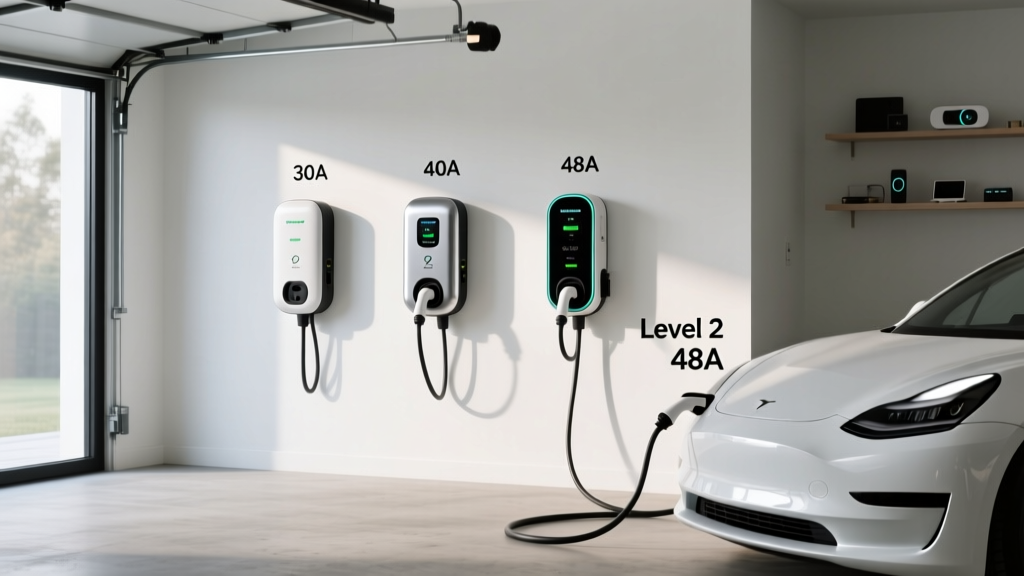
A typical Level 2 home charger requires a 240V dedicated circuit, identical in concept to what powers your electric dryer or oven. The most common residential setup is a NEMA 14-50 outlet on a 50A breaker, which safely delivers up to 40A continuous (the National Electrical Code requires circuits to be rated at 125% of continuous load, so 40A continuous = 50A breaker). This yields up to 9.6 kW of charging power.
Some higher-output chargers (like the 48A ChargePoint Home Flex or 80A Tesla Wall Connector) require 60A or even 100A circuits. Hardwired installations (no plug, direct wire connection) are increasingly common and avoid the need for a receptacle—often required by code for circuits above 50A in some jurisdictions.
Panel Upgrade: The $2,000–$5,000 Wildcard
Most homes built before 2000 have 100A or 150A main electrical panels. Adding a 50A EV circuit may push your panel past safe capacity, especially if you already run electric heating, an electric oven, a dryer, and central AC. An electrician will perform a load calculation (NEC Article 220) to determine if your panel can handle the additional draw.
If an upgrade is needed—typically from 100A to 200A service—expect to pay $2,000 to $5,000 for the panel swap alone, depending on your utility's service drop, local permit costs, and whether trenching or a new meter base is required. This is the single biggest variable in EV charger installation cost, and it's often not mentioned in rebate marketing materials.
| Component | Low End | High End | Notes |
|---|---|---|---|
| Level 2 Charger (equipment) | $300 | $700 | 32A–48A smart chargers; hardwired or NEMA 14-50 |
| Electrician labor (simple install) | $400 | $1,200 | Short wire run, panel adjacent to garage, no upgrade |
| Electrician labor (complex install) | $1,200 | $2,500 | Long conduit run, attic/crawlspace routing, sub-panel |
| Permit & inspection | $50 | $300 | Varies by city/county; some bundle with electrical |
| Panel upgrade (if needed) | $2,000 | $5,000 | 100A→200A service; includes utility coordination |
| Total (no panel upgrade) | $750 | $2,200 | Most common scenario for newer homes |
| Total (with panel upgrade) | $2,750 | $7,200 | Older homes or high-load existing panels |
Connector Compatibility: NACS, CCS, and CHAdeMO in 2026
The connector landscape has consolidated dramatically. As of 2026, nearly all new EVs sold in North America use the NACS (North American Charging Standard) connector, originally developed by Tesla and now adopted by Ford, GM, Rivian, Hyundai, Kia, BMW, and virtually every major automaker. The legacy CCS1 (Combined Charging System) connector remains on vehicles manufactured through approximately 2024–2025, and CHAdeMO is effectively discontinued on new vehicles (the Nissan Leaf was its last major holdout).
| Connector | Brands Using It (New Vehicles) | Adapter Needed? |
|---|---|---|
| NACS (Tesla-style) | Tesla, Ford, GM, Rivian, Hyundai, Kia, BMW, Volvo, Polestar, Mercedes, Fisker, Lucid | None for new vehicles; CCS→NACS adapters available ($150–$250) for older CCS cars accessing Tesla Superchargers |
| CCS1 | Legacy vehicles (2024 and earlier VW ID.4, Ford Mustang Mach-E, Chevy Bolt, etc.) | NACS→CCS adapter if accessing Tesla Superchargers; native CCS at Electrify America, EVgo |
| CHAdeMO | Discontinued on new vehicles; legacy Nissan Leaf, Mitsubishi Outlander PHEV | No practical adapter to NACS; limited DCFC availability going forward |
For home Level 2 charging: All home chargers use a J1772 connector (the AC charging standard), which physically fits NACS and CCS vehicles via the vehicle's built-in inlet or a simple adapter. Tesla's Wall Connector includes a Tesla-proprietary connector, while most third-party chargers (ChargePoint, Emporia, Enel X) ship with J1772. If you own a NACS-equipped vehicle, you'll use the J1772-to-NACS adapter included with your car. This is seamless and adds no meaningful resistance or charging loss.
Level 2 Charger Equipment Recommendations
After testing dozens of Level 2 chargers across multiple EVs and home electrical setups, these are our top picks for California homeowners in 2026. All support NACS/J1772 AC charging, Wi-Fi connectivity, and utility demand-response programs (critical for California TOU rate optimization).
ChargePoint Home Flex
- Power: Up to 11.5 kW (48A) on 60A circuit; configurable down to 16A
- Connector: J1772 (NACS adapter included with most new EVs)
- Cable: 23 ft
- Smart features: Wi-Fi, app scheduling, utility integration, Alexa
- Price: ~$550
- Best for: Flexibility across circuit sizes; strong app ecosystem
Tesla Wall Connector
- Power: Up to 11.5 kW (48A) on 60A circuit
- Connector: NACS native; J1772 adapter available separately
- Cable: 24 ft
- Smart features: Wi-Fi, OTA updates, power sharing (multiple units), vehicle integration
- Price: ~$420
- Best for: Tesla and NACS-vehicle owners; cleanest integration
Emporia Vue Level 2 Charger
- Power: Up to 11.5 kW (48A); 32A version also available
- Connector: J1772
- Cable: 24 ft
- Smart features: Wi-Fi, solar integration (pairs with Emporia Vue energy monitor), TOU scheduling
- Price: ~$400
- Best for: Solar homeowners; budget-conscious buyers wanting smart features
Enel X JuiceBox Pro 48
- Power: Up to 11.5 kW (48A)
- Connector: J1772
- Cable: 25 ft
- Smart features: Wi-Fi, app scheduling, utility demand-response compatible
- Price: ~$500
- Best for: Utility demand-response enrollment; robust build quality
Cost to Charge: Home vs. Public vs. Gas, Per Mile
California's electricity rates are among the highest in the nation, which makes time-of-use (TOU) rate planning essential. Here's what charging actually costs per mile, compared to a gasoline baseline.
| Scenario | Rate ($/kWh) | Vehicle Efficiency (kWh/100 mi) | Cost per Mile |
|---|---|---|---|
| Home off-peak (TOU super off-peak, e.g., 12 AM–6 AM) | $0.12–$0.18 | 28 kWh/100 mi (e.g., Tesla Model Y) | $0.034–$0.050 |
| Home peak (TOU peak, e.g., 4 PM–9 PM) | $0.35–$0.52 | 28 kWh/100 mi | $0.098–$0.146 |
| Public Level 2 (workplace, mall, ChargePoint) | $0.20–$0.49 | 28 kWh/100 mi | $0.056–$0.137 |
| DC Fast Charging (Electrify America, Tesla Supercharger) | $0.35–$0.56 | 28 kWh/100 mi | $0.098–$0.157 |
| Gasoline vehicle (28 MPG combined, $4.80/gal CA avg) | — | — | $0.171 |
The takeaway: Home off-peak charging delivers fuel costs at roughly one-quarter to one-third the per-mile cost of gasoline. Even California's expensive DC fast charging is generally cheaper per mile than gas. The trap is home peak-rate charging—if you plug in at 5 PM without scheduling, you may pay nearly as much per mile as a fuel-efficient hybrid. Set your charger's schedule to begin charging after midnight, or enroll in your utility's EV-specific TOU rate (PG&E EV2-A/EV-B, SCE TOU-EV-5, SDG&E EV-TOU-5).
Charging Time Examples for Common EV Battery Sizes
How long does a 10–80% charge session actually take? It depends on battery size (kWh), the vehicle's onboard charger acceptance rate (kW), and your circuit's output. Here are real-world benchmarks for popular 2025–2026 EVs on a 48A (11.5 kW) Level 2 home charger:
- Tesla Model Y (75 kWh battery, 11.5 kW acceptance): 10–80% = ~52.5 kWh added ÷ 11.5 kW = ~4.5 hours
- Ford Mustang Mach-E Extended Range (91 kWh, 10.5 kW acceptance): 10–80% = ~63.7 kWh ÷ 10.5 kW = ~6 hours
- Hyundai Ioniq 5 (77.4 kWh, 10.9 kW acceptance): 10–80% = ~54.2 kWh ÷ 10.9 kW = ~5 hours
- Chevrolet Equinox EV (85 kWh, 11.5 kW acceptance): 10–80% = ~59.5 kWh ÷ 11.5 kW = ~5.2 hours
- Toyota bZ4X (71.4 kWh, 7.4 kW acceptance): 10–80% = ~49.9 kWh ÷ 7.4 kW = ~6.7 hours (limited by onboard charger)
For DC fast charging, these same vehicles at their peak DC rates achieve 10–80% in 18–35 minutes (see individual vehicle reviews for charge-curve specifics). Remember: peak kW rates apply only in a narrow SoC window (typically 10–40%), and charging slows substantially above 80% to protect battery health.
Maximizing Your California Rebates: A Step-by-Step Checklist
- Confirm your utility territory (PG&E, SCE, SDG&E, SMUD, LADWP, or other) and visit their EV program page for active rebate amounts and application deadlines.
- Enroll in an EV-specific TOU rate plan before or immediately after installation—many rebates require this enrollment.
- Get a licensed electrician's quote including load calculation, permit, and whether a panel upgrade is needed. Request a detailed line-item invoice.
- Purchase a qualifying charger (most utility rebates require UL-listed, Wi-Fi-enabled smart chargers).
- Install and pass inspection—keep your permit sign-off documentation.
- Apply for utility rebate with your receipt, electrician invoice, charger model, and proof of TOU enrollment. Deadlines typically range from 30–90 days post-installation.
- Claim the federal §30D credit on your IRS tax return (Form 8911) for 30% of equipment + installation costs, up to $1,000.
- Check local air district or city programs for additional stacking opportunities.
Frequently Asked Questions
How much does it cost to install a home EV charger in California?
For a straightforward installation (short wire run, adequate panel capacity, NEMA 14-50 or hardwired 50A circuit), expect $750–$2,200 total including equipment, electrician labor, and permit. If your home needs a panel upgrade from 100A to 200A service, add $2,000–$5,000. After California utility rebates ($300–$1,500 depending on program and income tier) and the federal §30D credit (30% up to $1,000), many homeowners net a final cost of $200–$800 for a basic installation.
How fast will each charging level add range?
Level 1 (120V) adds 3–5 miles of range per hour—adequate only for PHEVs with small batteries or as an emergency backup. Level 2 (240V) at 48A/11.5 kW adds approximately 35–44 miles per hour for a typical EV, fully replenishing most batteries overnight. DC fast charging adds 150–1,200+ miles per hour at peak rates, delivering a 10–80% session in 15–35 minutes depending on the vehicle and charger power.
Which connector/charger is compatible with my EV?
If your EV is a 2025–2026 model from Tesla, Ford, GM, Hyundai, Kia, Rivian, BMW, or most others, it uses NACS. Older (2024 and earlier) non-Tesla EVs likely have CCS1. For home Level 2 charging, all chargers output via J1772, and your vehicle either accepts J1772 natively (CCS vehicles) or uses the J1772-to-NACS adapter included with your car. The Tesla Wall Connector uses a native NACS plug; all other brands use J1772.
How much does charging cost per mile vs. gas in California?
Home off-peak charging at $0.12–$0.18/kWh costs roughly $0.03–$0.05 per mile for an efficient EV like the Model Y. Gasoline at California's $4.80/gallon average and 28 MPG costs $0.17 per mile. Even DC fast charging at $0.48/kWh ($0.13/mile) undercuts gasoline. The key is avoiding home peak-rate charging without a timer.
What electrical upgrades might I need?
The most common upgrade is a panel capacity increase from 100A to 200A, needed when your existing load calculation leaves insufficient headroom for a 50A EV circuit. Other potential upgrades include: adding a sub-panel in the garage (if your main panel is on the opposite side of the house), replacing a Federal Pacific or Zinsco panel (known fire hazards that must be replaced regardless of EV charging), or upgrading the utility service drop for older homes with 60A or 100A service entrances. Your electrician's load calculation will determine what's required.