Why California EV Owners Are Rushing to Claim Charger Rebates
If you drive an electric vehicle in California and you're still relying on a standard 120V wall outlet to charge overnight, you're leaving money—and miles—on the table. California's patchwork of utility, municipal, and state-level EV charger rebate programs can offset anywhere from $300 to $2,000 of the cost of purchasing and installing a Level 2 home charging station. But navigating eligibility, understanding what your home's electrical panel can actually support, and choosing the right equipment requires more than a quick Google search.
This guide breaks down every layer: the rebate landscape in 2026, what a real installation costs before and after incentives, the electrical upgrades you might face, and which chargers actually deliver reliable daily performance. We'll use exact numbers—kW, kWh, dollars, and minutes—because vague promises don't help you make a $1,500 decision.
Understanding Charging Levels: Speeds That Actually Matter
Before chasing rebates, you need to know what you're buying. EV charging falls into three categories, each defined by its power delivery in kilowatts (kW). Remember: kW measures the rate of energy flow (power), while kWh measures the total energy stored in your battery (capacity). A 60 kWh battery charged at 7.2 kW takes roughly 8.3 hours from empty to full—simple math, but frequently confused.
| Level | Voltage | Power (kW) | Miles of Range Added per Hour | Typical Use |
|---|---|---|---|---|
| Level 1 | 120V AC | 1.2–1.4 kW | 3–5 mi/hr | Emergency/top-off, PHEVs |
| Level 2 | 240V AC | 3.3–19.2 kW | 12–75 mi/hr | Daily home & workplace charging |
| DC Fast (Level 3) | 400–800V DC | 50–350 kW | 150–1,000+ mi/hr (peak) | Road trips, highway corridors |
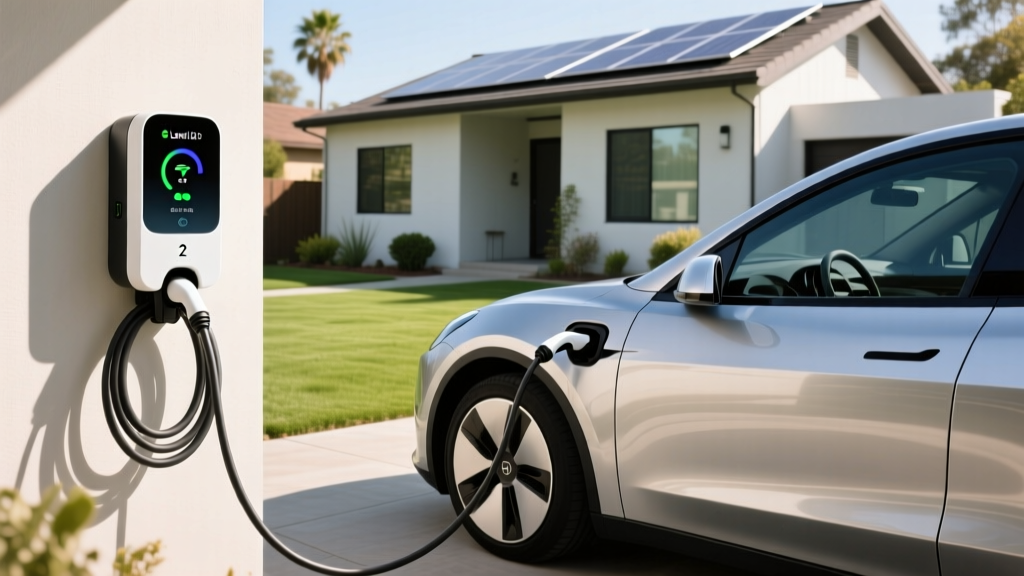
For home installation, Level 2 is the target. Most residential setups deliver 7.2 kW (30A circuit) to 11.5 kW (50A circuit), which replenishes a typical 75 kWh battery pack from 10% to 80% in 5 to 7 hours—perfectly aligned with an overnight charging window.
EV Charger Rebate California: What's Available in 2026
California doesn't have one single statewide rebate. Instead, incentives stack from multiple sources—your utility, your air district, and occasionally municipal programs. Here's the landscape as of early 2026:
Utility Rebates
- PG&E: Offers up to $1,000 toward Level 2 charger purchase and installation for residential customers on EV rate plans. Income-qualified customers in disadvantaged communities may receive up to $2,000 including panel upgrades.
- SCE (Southern California Edison): The Charge Ready program provides rebates of $500–$1,500 depending on charger type and whether you're in a designated clean-air community.
- SDG&E: Offers up to $1,250 for residential Level 2 installation, with additional incentives for customers who enroll in time-of-use (TOU) rate plans.
- SMUD (Sacramento): Up to $500 rebate for Energy Star-certified smart chargers.
- LADWP: Up to $500 rebate for qualified Level 2 chargers, plus a $250 bonus for installation in multi-unit dwellings.
Air District and Municipal Incentives
Several California air quality management districts (AQMDs) offer supplemental rebates. The Bay Area AQMD's Charge! program and the San Joaquin Valley APCD have historically provided $500–$1,000 additional incentives, particularly for residents in high-pollution zones. These programs often have income caps and equipment certification requirements.
Federal Tax Consideration: The §30C Alternative Fuel Infrastructure Credit
The federal §30C credit covers 30% of the cost of home EV charging equipment and installation, up to $1,000, but it's subject to census-tract eligibility restrictions and has specific sourcing requirements. This can stack with California utility rebates in eligible areas, but consult a tax professional to confirm your eligibility based on your specific address and income.
- Confirm your utility territory and active program (funding runs out periodically)
- Verify charger is on your utility's approved equipment list
- Check if your census tract qualifies for the federal §30C credit
- Retain all receipts: equipment, electrician labor, permit fees
- Apply for utility rebate within the required window (typically 90–180 days post-install)
- File IRS Form 8911 for the federal credit with your tax return
How Much Does It Cost to Install a Home EV Charger?
The honest answer: anywhere from $600 to $4,500, depending entirely on your home's electrical infrastructure. Here's what drives that range:
| Component | Simple Install (Panel Nearby) | Complex Install (Panel Upgrade Needed) |
|---|---|---|
| Level 2 Charger (hardware) | $350–$700 | $350–$700 |
| Electrician labor (2–4 hrs simple / 8–16 hrs complex) | $400–$800 | $1,200–$2,500 |
| Electrical permit | $50–$150 | $50–$200 |
| Panel upgrade (100A → 200A, if needed) | $0 | $1,500–$3,000 |
| Conduit/wiring (long runs over 50 ft) | $0–$100 | $200–$600 |
| Total before rebates | $800–$1,750 | $3,300–$7,000 |
| Total after typical CA rebate ($1,000) | $0–$750 | $2,300–$6,000 |
When You'll Need a Panel Upgrade
Homes built before 1990 often have 100-amp electrical panels. Adding a 40A or 50A dedicated circuit for an EV charger can push total household load beyond the panel's safe capacity—especially if you also run electric dryers, ovens, and central AC. A licensed electrician will perform a load calculation (NEC Article 220) to determine if your panel can handle the additional draw. If not, a 200A panel upgrade is a one-time investment that also future-proofs your home for solar, battery storage, or a second EV.
Which Connector and Charger Is Compatible with Your EV?
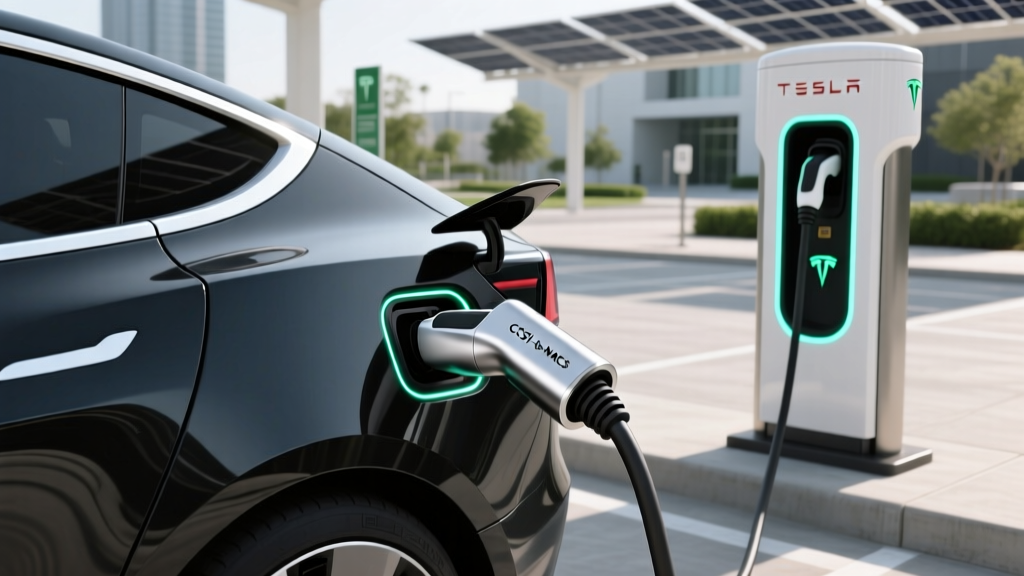
California's connector landscape has shifted dramatically. Tesla's North American Charging Standard (NACS) is now the dominant connector for new vehicles sold in 2025 and beyond, while CCS1 remains on many 2020–2024 models. Here's what you need to know:
| Connector | Native Vehicle Brands | Home Charger Availability |
|---|---|---|
| NACS (Tesla standard) | Tesla (all years), Ford, GM, Rivian, Volvo, Polestar, Hyundai/Kia (2025+), Honda (2025+) | Tesla Wall Connector, Lectron Vortex, Emporia V2 (NACS version) |
| CCS1 | VW ID.4 (2024 and earlier), BMW iX (2024 and earlier), some legacy models | ChargePoint Home Flex, Enel X JuiceBox (legacy), Grizzl-E |
| CHAdeMO | Nissan Leaf (legacy only, discontinued for 2026) | Very limited home options; adapter required |
Adapter strategy: If you own a CCS1-equipped EV but want a NACS charger (or vice versa), adapters from Lectron and Tesla ($150–$250) handle the conversion for Level 2 AC charging. However, native matching is always preferable for reliability and warranty coverage.
Level 2 Charger Equipment Picks for California Homes
Based on real-world reliability, smart features, and value, here are three chargers that California EV owners consistently rate highest in 2026:
Best Overall: Tesla Wall Connector (Gen 4)
- Power Output: Up to 11.5 kW (48A)
- Connector: NACS (native), CCS adapter available
- Cable Length: 24 feet
- Smart Features: Wi-Fi, OTA updates, power sharing (link up to 6 units on one circuit), Tesla app integration
- Price: ~$475
- Best For: Tesla owners and NACS-equipped Ford/GM/Rivian drivers who want the cleanest integration
Best Universal: ChargePoint Home Flex
- Power Output: Up to 12 kW (50A, adjustable down to 16A)
- Connector: CCS1 or NACS (order specific version)
- Cable Length: 23 feet
- Smart Features: Wi-Fi, Alexa/Google integration, scheduled charging, detailed energy reporting, works with most utility demand-response programs
- Price: ~$599–$699
- Best For: Multi-EV households, utility TOU optimization, renters who may move (portable hardwired/NEMA options)
Best Budget: Emporia Vue Level 2 Charger
- Power Output: Up to 11.5 kW (48A)
- Connector: NACS or J1772 (CCS via adapter)
- Cable Length: 24 feet
- Smart Features: Wi-Fi, integrates with Emporia whole-home energy monitor, solar-aware charging, TOU scheduling
- Price: ~$399
- Best For: Budget-conscious buyers, solar homeowners who want charger-to-panel integration
How Much Does Charging Cost Per Mile vs. Gas?
California's electricity rates are among the highest in the nation, but even at peak rates, electrons beat gasoline on a per-mile basis. The key variable is when and where you charge:
| Scenario | Rate | Cost per kWh | Cost per Mile (at 3.5 mi/kWh) |
|---|---|---|---|
| Home off-peak (TOU 12am–6am) | PG&E EV2-A rate | $0.12–$0.15 | $0.034–$0.043 |
| Home peak (summer 4pm–9pm) | PG&E EV2-A rate | $0.45–$0.55 | $0.13–$0.16 |
| Public Level 2 (ChargePoint, EVgo) | Typical CA public | $0.35–$0.55 | $0.10–$0.16 |
| DC Fast Charging (Electrify America, Tesla Supercharger) | Typical CA DCFC | $0.40–$0.65 | $0.11–$0.19 |
| Gasoline (28 MPG combined, $4.65/gal CA avg) | ICE vehicle baseline | — | $0.166 |
At off-peak home rates, an EV costs roughly $0.04 per mile to "fuel"—less than one-quarter the cost of a 28 MPG gas car at California pump prices. Even at peak summer rates, you're nearly breaking even with gasoline, and most smart chargers can be scheduled to charge exclusively during off-peak windows.
For a driver covering 12,000 miles per year, off-peak home charging costs approximately $480 annually versus $1,992 for gasoline—a savings of over $1,500 per year, or $7,500 over five years. That alone can pay for the charger installation many times over.
Charging Time Examples: What to Expect with Common Battery Sizes
Charging time depends on three factors: battery capacity (kWh), charger power output (kW), and your vehicle's onboard charger limit. Here are real-world 10% to 80% charging times for popular California EVs on a 48A (11.5 kW) Level 2 circuit:
| Vehicle | Battery (usable kWh) | Onboard Charger Limit | 10%–80% Time |
|---|---|---|---|
| Tesla Model Y Long Range | 75 kWh | 11.5 kW | ~4.5 hours |
| Chevrolet Equinox EV 3RS | 85 kWh | 11.5 kW | ~5.1 hours |
| Hyundai Ioniq 5 (Long Range) | 77.4 kWh | 10.9 kW | ~4.7 hours |
| Ford Mustang Mach-E (Extended Range) | 91 kWh | 10.5 kW | ~6.1 hours |
| BMW i4 eDrive40 | 81.5 kWh | 11 kW | ~5.2 hours |
| Toyota bZ4X | 64 kWh | 7.2 kW | ~6.2 hours |
Safety, Code, and Installation Best Practices
California follows the 2022 National Electrical Code (NEC) with state amendments. Your installation must meet these requirements:
- Dedicated circuit: Your EV charger must be on its own dedicated breaker—no sharing with laundry, HVAC, or other appliances.
- GFCI protection: NEC 2022 Article 625.54 requires GFCI protection for all receptacle-outlet EV charging. Hardwired installations may have different requirements depending on local jurisdiction.
- Outdoor rating: If your charger is mounted outdoors (carport, driveway, exterior wall), it must carry a NEMA 4 or IP65 rating for weather resistance. All three chargers recommended above meet this standard.
- Breaker sizing: NEC requires the breaker to be rated at 125% of the continuous load. A 40A charger requires a 50A breaker; a 48A charger requires a 60A breaker.
- Wire gauge: A 50A circuit typically requires 6 AWG copper wire; a 60A circuit requires 4 AWG. Longer runs may need upsizing to prevent voltage drop.
Always hire a licensed, insured California electrician (C-10 electrical contractor license). Verify their license at the California Contractors State License Board website before signing a contract.
Frequently Asked Questions
How much does it cost to install a home EV charger in California?
A straightforward installation with an adequate electrical panel typically costs $800–$1,750 (equipment, electrician, and permit combined). If your home needs a 200A panel upgrade, expect $3,300–$7,000 total. California utility rebates of $500–$2,000 can significantly reduce your out-of-pocket cost.
How fast will each charging level add range?
Level 1 (120V) adds 3–5 miles of range per hour. Level 2 (240V, typical home install) adds 12–50 miles per hour depending on amperage. DC fast charging can add 150–1,000+ miles per hour at peak, but is intended for road trips, not daily use, and charging speed tapers significantly above 80% state of charge.
Which connector/charger is compatible with my EV?
Check your vehicle's charge port. Most 2025+ EVs sold in California use NACS (Tesla's connector). Vehicles from 2020–2024 may use CCS1. The Nissan Leaf uses CHAdeMO. Match your charger's connector to your vehicle, or plan for a $150–$250 adapter. When in doubt, the ChargePoint Home Flex and Tesla Wall Connector cover the vast majority of vehicles with proper configuration.
How much does charging cost per mile vs. gas in California?
At off-peak home rates ($0.12–$0.15/kWh), EV charging costs roughly $0.04 per mile. At California's average gas price of $4.65/gallon, a 28 MPG vehicle costs $0.17 per mile. Home-charged EVs save $1,500+ per year for a typical 12,000-mile driver. Public DC fast charging at $0.40–$0.65/kWh narrows the gap to roughly break-even with gasoline.
What electrical upgrades might I need for a home EV charger?
The most common upgrade is a panel replacement from 100A to 200A service ($1,500–$3,000), necessary when your existing panel can't handle the additional 40–50A continuous load. You may also need conduit runs if your garage is far from the panel, or a sub-panel if you're adding multiple chargers. A licensed electrician will perform a NEC Article 220 load calculation to determine exactly what's required.
Can I claim both a California utility rebate and the federal tax credit?
Yes, in many cases. The federal §30C Alternative Fuel Vehicle Refueling Property Credit covers 30% of charger hardware and installation costs up to $1,000, subject to census-tract eligibility. This can stack with utility rebates from PG&E, SCE, SDG&E, or your local provider. Confirm eligibility with a tax professional and check your census tract at the DOE's eligibility tool before purchasing.
Is a smart charger worth the extra cost over a basic unit?
For California EV owners on time-of-use rate plans, absolutely. Smart chargers with Wi-Fi and scheduling features can automatically restrict charging to off-peak hours (typically midnight to 6 AM), when rates are $0.12–$0.15/kWh instead of $0.45–$0.55/kWh. That difference can save $400–$800 per year on electricity alone, paying for the smart charger premium within the first year. Smart chargers also enable utility demand-response programs that offer additional bill credits.