Plymouth EV Charging: What Every Local Driver Needs to Know
Whether you're in North Plymouth, near Cordage Park, or closer to Route 3A, setting up reliable EV charging at your Plymouth home is the single biggest ownership upgrade you can make. Public chargers fill a gap, but Level 2 home charging delivers the lowest cost per mile, the most convenience, and eliminates the daily friction of hunting for open stalls. This guide covers the electrical realities, real installation costs, connector compatibility, and the best hardware available for Plymouth-area homes in 2026.
Plymouth's housing stock includes everything from historic Colonials near Plymouth Rock to newer builds off Route 25. That variety matters: older homes often have 100-amp electrical panels that may need upgrading before adding a 240V EV circuit, while newer construction typically has the 200-amp service headroom to support a 48-amp dedicated charger. Understanding where your home falls on that spectrum will determine your install budget.
Charging Levels Explained: Speeds, Power, and Real-World Range Added
The EV charging ecosystem breaks into three tiers. The critical distinction to internalize: kW (kilowatts) measures power — how fast energy flows into your battery. kWh (kilowatt-hours) measures energy — how much your battery stores. Think of kW as the flow rate of a hose, and kWh as the size of the bucket. You'll see kW used for charger speed and kWh used for battery capacity throughout this guide.
| Level | Voltage | Power (kW) | Range Added/Hour | Best For |
|---|---|---|---|---|
| Level 1 | 120V AC | 1.0–1.4 kW | 3–5 miles | Overnight trickle; PHEVs with small batteries |
| Level 2 | 240V AC | 3.3–19.2 kW | 12–75 miles | Daily home charging; the standard for BEVs |
| DC Fast | 400–800V DC | 50–350 kW | 150–1,000+ miles (peak) | Road trips; quick top-ups away from home |
Real-world charging time examples (10–80% State of Charge):
- 60 kWh battery (e.g., Nissan Ariya, base Hyundai Ioniq 5): ~8 hours on a 7.7 kW Level 2 charger; ~18–22 minutes on a 150 kW DC fast charger (with preconditioning).
- 84 kWh battery (e.g., Ford F-150 Lightning Extended Range): ~10.5 hours on a 7.7 kW Level 2; ~25–35 minutes on a 150 kW DC fast charger.
- 100 kWh battery (e.g., Tesla Model S, Rivian R1S Large Pack): ~12.5 hours on 7.7 kW; ~30–45 minutes on 250 kW DC fast charger (architecture dependent).
Note that DC fast charging does not sustain peak power across the full session. Charge curves taper significantly above 80% SoC to protect battery chemistry — a 250 kW peak charger may average closer to 80–120 kW across a 10–80% session. That's why manufacturers and reviewers quote 10–80% times rather than 0–100%.
How Much Does It Cost to Install a Home EV Charger in Plymouth?
Installation cost is where Plymouth homeowners see the widest variance. A straightforward install in a newer home with a 200-amp panel and a short conduit run to the garage might total under $1,000. An older home needing a panel upgrade and a long underground trench could exceed $5,000. Here's the realistic breakdown:
| Component | Low Estimate | High Estimate | Notes |
|---|---|---|---|
| Level 2 Charger Unit | $300 | $750 | 32A–48A smart charger, hardwired or NEMA 14-50 plug |
| Electrical Permit | $50 | $150 | Plymouth Building Department; varies by job complexity |
| Electrician Labor (240V/40–50A circuit) | $400 | $1,200 | Depends on panel proximity, conduit run length, wall material |
| Panel Upgrade (100A → 200A, if needed) | $1,500 | $3,500 | Common in pre-1980 Plymouth homes; includes new panel + labor |
| Conduit & Wiring Materials | $100 | $400 | Longer runs from panel to garage or exterior wall increase cost |
| Total (no panel upgrade) | $850 | $2,500 | Typical for homes with adequate 200A service |
| Total (with panel upgrade) | $2,350 | $6,000 | Older homes or those adding solar/heat pump circuits |
Massachusetts incentives to check: The Massachusetts Department of Environmental Protection (MassDEP) periodically offers residential charging rebates through programs like MASS EVIP. Eversource and National Grid (Plymouth's utility providers) have historically offered off-peak charging incentives and occasional make-ready rebates. Check current availability at mass.gov EV incentives before scheduling your install.
A licensed electrician should evaluate your panel's available amperage. A 48-amp charger requires a 60-amp dedicated circuit (the National Electrical Code requires continuous loads to be derated to 80% of breaker capacity). If your 200-amp panel is already near capacity with HVAC, electric range, and dryer loads, your electrician may recommend a load-management device like the Emporia Load Management System rather than a full panel upgrade — these units throttle charger draw when other major appliances activate, potentially saving you $2,000+.
Connector Compatibility: NACS, CCS1, and CHAdeMO in 2026
The connector landscape has consolidated significantly. Tesla's North American Charging Standard (NACS) is now the dominant connector in North America, with Ford, GM, Rivian, Volvo, Hyundai, and most major manufacturers adopting it for new vehicles. Here's where things stand for 2026 model-year EVs:
| Connector | Brands Using It (2026) | Home Charger Availability |
|---|---|---|
| NACS (Tesla/J3400) | Tesla, Ford, GM, Rivian, Volvo, Polestar, Hyundai (Ioniq 5/6 2025+), Nissan (Ariya 2025+) | Tesla Wall Connector, Emporia, ChargePoint Home Flex (NACS variant) |
| CCS1 | VW (ID.4), BMW (iX, i4), Kia (EV6/EV9 2024), legacy Hyundai/Kia models | ChargePoint Home Flex, Emporia, JuiceBox (discontinued but supported) |
| CHAdeMO | Nissan Leaf (legacy, production ended); Mitsubishi Outlander PHEV (legacy) | Limited home options; mostly public DC stations |
Adapter situation: CCS-to-NACS adapters are widely available from Tesla and third-party manufacturers (Lectron, A2Z) for $150–$250, enabling CCS-equipped EVs to use Tesla Superchargers. NACS-to-CCS adapters also exist for home charging flexibility. If you own a CCS vehicle but plan to upgrade to NACS in the future, buy a charger with a swappable connector or a NACS unit with a CCS adapter.
For Plymouth homes, the practical recommendation: install a hardwired NACS charger if your current or next EV uses NACS. If you drive a CCS vehicle and plan to keep it, a ChargePoint Home Flex with CCS connector remains a strong choice. A NEMA 14-50 outlet (instead of hardwiring) gives you the flexibility to swap charger units in the future, though hardwired installations allow higher amperage (48A hardwired vs. 40A on a 14-50 outlet) and eliminate GFCI nuisance tripping.
Cost to Charge: Home vs. Public vs. Gas in Plymouth
Charging economics depend heavily on where and when you plug in. Plymouth residents served by Eversource typically pay residential electricity rates between $0.25–$0.32/kWh depending on the season and rate plan. Off-peak overnight rates can drop significantly with time-of-use plans.
| Scenario | Rate ($/kWh) | Cost to Add 200 Miles* | Cost Per Mile |
|---|---|---|---|
| Home Level 2 (off-peak overnight) | $0.18–$0.22 | $12.60–$15.40 | $0.063–$0.077 |
| Home Level 2 (standard rate) | $0.28 | $19.60 | $0.098 |
| Public Level 2 (ChargePoint, EVgo L2) | $0.35–$0.49 | $24.50–$34.30 | $0.123–$0.172 |
| DC Fast Charging (Electrify America, Tesla Supercharger) | $0.38–$0.56 | $26.60–$39.20 | $0.133–$0.196 |
| Gas vehicle (27 MPG avg, $3.45/gal) | — | $25.56 | $0.128 |
*Based on 3.5 miles/kWh efficiency (typical midsize BEV like Hyundai Ioniq 5 or Tesla Model Y). Actual efficiency varies by vehicle, temperature, and driving style.
Home overnight charging at off-peak rates delivers roughly half the per-mile cost of gasoline. Even at standard residential rates, EVs undercut gas on a per-mile basis. The cost advantage shrinks at public DC fast chargers — which is exactly why home charging is the financial backbone of EV ownership. If your daily driving is under 40 miles (the Plymouth average for commuters to Boston, per Census data), a single overnight Level 2 session covers multiple days of driving for under $3.
Source for efficiency data: fueleconomy.gov — check your specific vehicle's kWh/100mi rating for a personalized calculation.
Best Home EV Chargers for Plymouth Homes: 2026 Equipment Picks
These are the chargers we recommend based on reliability, power output, smart features, and connector availability. All units listed support NACS or offer NACS/CCS configurability.
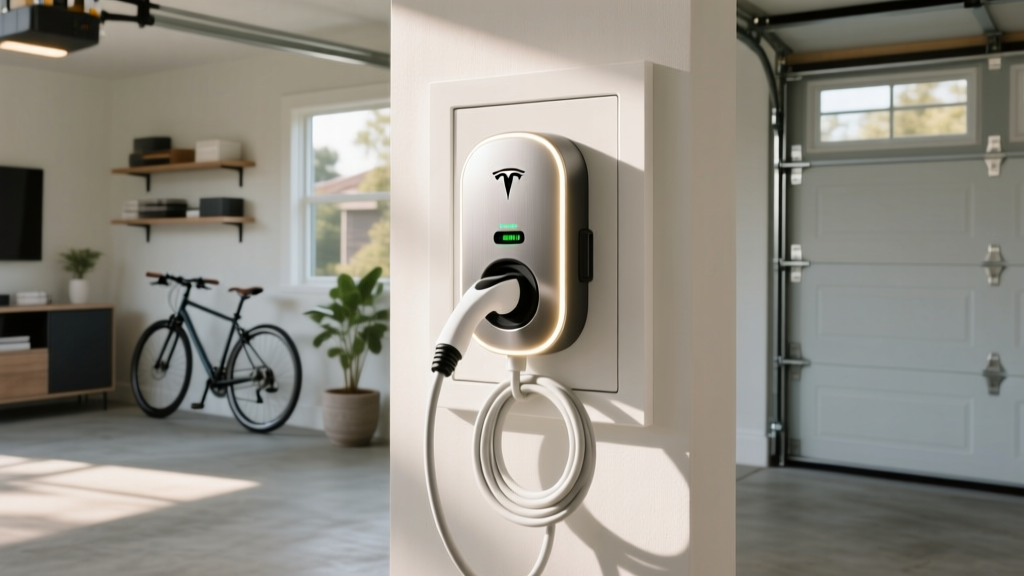
1. Tesla Wall Connector (Gen 4) — Best Overall Value
- Power Output: 48A (11.5 kW) hardwired on a 60A circuit
- Connector: NACS native
- Cable Length: 24 feet
- Smart Features: Wi-Fi, OTA firmware updates, Tesla app integration, power-sharing (link two units on one circuit), scheduled charging
- Price: ~$420 (unit only)
- Best for: Tesla owners and NACS-adopting EV owners who want a no-fuss, high-output charger at a low equipment price. Does not include a NEMA 14-50 plug option — must be hardwired by an electrician.
2. ChargePoint Home Flex (2025 Refresh) — Best for Flexibility
- Power Output: Up to 50A (12 kW) hardwired; 40A (9.6 kW) on NEMA 14-50
- Connector: Available in NACS or CCS1; field-swappable
- Cable Length: 23 feet
- Smart Features: ChargePoint app, Alexa integration, amperage adjustment via app (dial down to match your circuit), energy tracking, scheduled/managed charging
- Price: ~$550–$650
- Best for: Households that may switch between CCS and NACS vehicles, or renters who want a plug-in unit (14-50) they can take when they move.
3. Emporia Level 2 EV Charger — Best Budget Smart Charger
- Power Output: 48A (11.5 kW) hardwired; 40A (9.6 kW) on NEMA 14-50
- Connector: NACS or J1772 (with adapter for CCS)
- Cable Length: 24 feet
- Smart Features: Emporia app, real-time energy monitoring (pairs with Emporia Vue whole-home monitor), solar integration, scheduled charging, load management
- Price: ~$350–$400
- Best for: Budget-conscious buyers who still want full smart features and energy monitoring. Excellent pairing for homes with solar panels.
4. Grizzl-E Smart — Most Durable / Cold-Weather Pick
- Power Output: 40A (9.6 kW) on NEMA 14-50; 48A hardwired
- Connector: J1772 (CCS-compatible via adapter) or NACS
- Cable Length: 24 feet
- Smart Features: Wi-Fi, OCPP protocol, adjustable amperage, EV Energy app integration
- Price: ~$500–$550
- Best for: Plymouth's cold, wet winters. Built in Canada with an aluminum enclosure rated to -40°F. One of the most ruggedly built chargers on the market.
Electrical Requirements, Safety, and Code Considerations
Plymouth follows the Massachusetts Electrical Code (based on the NEC with state amendments). Here's what your installation must satisfy:
- Dedicated circuit: Your Level 2 charger requires its own dedicated 240V circuit — it cannot share a circuit with your dryer, oven, or HVAC. A 48-amp charger needs a 60-amp breaker; a 32-amp charger needs a 40-amp breaker.
- Wire gauge: 6 AWG copper for 40–50A circuits; 4 AWG copper for 60A circuits. Aluminum wire is permitted at larger gauges but requires different sizing.
- GFCI protection: NEC 2020+ requires GFCI protection for outlets used for EV charging (NEMA 14-50). However, many EV chargers have built-in ground-fault protection, and hardwired installations avoid the nuisance-tripping issues that have plagued GFCI breakers paired with certain charger models. Discuss this with your electrician.
- Outdoor rating: If mounting on an exterior wall or in an uncovered carport, the charger must carry a NEMA 4 (weatherproof) rating. All four chargers recommended above meet this standard.
- Permit and inspection: Plymouth requires an electrical permit for any new 240V circuit. Your electrician pulls the permit; the town inspector verifies the work. Do not skip this step — unpermitted electrical work can void home insurance claims and complicate future home sales.
Panel upgrade reality check: Many Plymouth homes built before 1985 have 100-amp panels. Adding a 60-amp EV circuit to an already-loaded 100A panel is unsafe and code-violating. Options include a full panel upgrade to 200A ($1,500–$3,500), installing a load-management device that throttles charger power when other loads are active, or stepping down to a 32-amp charger on a 40-amp breaker — which still delivers ~25 miles of range per hour, enough for most daily needs.
Plymouth Public Charging: Filling the Gaps
While home charging handles daily needs, Plymouth's public charging infrastructure covers road trips and apartment dwellers without garage access. Key local options include:
- Tesla Superchargers: The closest Supercharger stations to Plymouth are in Wareham and along Route 6 corridors, offering 150–250 kW DC fast charging for NACS-equipped vehicles.
- Electrify America / EVgo: DC fast chargers at shopping centers along Route 44 and in nearby Kingston provide 50–350 kW CCS charging. Expect pricing around $0.43–$0.56/kWh.
- Level 2 public chargers: ChargePoint and EV Connect stations are available at Plymouth's shopping plazas, the waterfront area, and some workplace locations. These are useful for topping up during errands but too slow for a primary charging strategy.
For apartment and condo dwellers in Plymouth without home-charging access, Massachusetts' EVIP program has supported multi-unit dwelling charging installations. Check with your property manager and current state incentive availability.
Frequently Asked Questions
How much does it cost to install a home EV charger in Plymouth, MA?
A typical Level 2 home charger installation in Plymouth costs $850–$2,500 if your home has a 200-amp electrical panel with available capacity. If your home needs a panel upgrade (common in pre-1980s construction), expect $2,350–$6,000 total. The equipment itself (a quality smart charger) runs $350–$650; the remainder is electrician labor, permit, and materials.
How fast will each charging level add range to my EV?
Level 1 (120V standard outlet) adds 3–5 miles per hour — adequate only for plug-in hybrids or very low daily mileage. Level 2 (240V home charger at 48A/11.5 kW) adds roughly 35–45 miles per hour for a typical midsize BEV, easily replenishing a full day's driving in 1–2 hours. DC fast charging at 150 kW can add 150+ miles in 15–20 minutes, but availability and cost make it a road-trip tool, not a daily solution.
Which connector does my EV need?
For 2026 model-year vehicles, most new EVs from Tesla, Ford, GM, Rivian, Volvo, and Hyundai use the NACS connector. Volkswagen, BMW, and some 2024–2025 Kia models still use CCS1. The Nissan Leaf (now discontinued) used CHAdeMO. Check your vehicle's charge port or owner's manual. If you drive a CCS vehicle but want access to Tesla Superchargers, a CCS-to-NACS adapter ($150–$250) solves this for public DC charging.
How much does EV charging cost per mile compared to gas?
Charging at home at Plymouth's typical off-peak electricity rate of $0.18–$0.22/kWh costs approximately $0.06–$0.08 per mile in a midsize BEV. A comparable gas vehicle at 27 MPG and $3.45/gallon costs about $0.13 per mile. Home charging cuts fuel costs roughly in half. Public DC fast charging at $0.43–$0.56/kWh narrows the gap to $0.13–$0.20 per mile, which is why home charging is the economic foundation of EV ownership.
What electrical upgrades might my Plymouth home need?
Homes with 100-amp electrical panels (common in pre-1985 construction) typically need a panel upgrade to 200 amps before adding a 48-amp EV charger circuit — this costs $1,500–$3,500. Alternatives include installing a smart load-management device that shares capacity between the charger and other appliances, or choosing a lower-amperage charger (32A on a 40A breaker) that draws less from the panel. A licensed electrician should perform a load calculation before you commit to equipment.