You bought the EV. You ordered a Level 2 home charger. You plugged it into your dryer outlet or had a handyman wire it up over the weekend. Everything works — until your insurance adjuster asks for the permit number after a panel fire, or your city inspector flags the unpermitted 240V circuit during a home sale. Suddenly, your charger isn't just unpermitted — it's effectively outlawed, and you're on the hook for retroactive fines, rewiring, and denied claims.
The term "charger outlaw" isn't just colorful slang in EV forums. It describes a growing class of home EV charging setups that violate the National Electrical Code (NEC), local amendments, or utility interconnection rules. With EV adoption crossing 12% of new-car sales in the U.S. by early 2026, code enforcement is catching up to the DIY shortcuts that early adopters took. Here's how to make sure your home charging setup is legal, safe, and insurable — and what it actually costs to do it right.
What Makes an EV Charger an "Outlaw"?
An outlaw charger is any EV charging equipment installed in violation of applicable electrical codes, permitting requirements, or manufacturer instructions. The most common violations we see in the field:
- No permit pulled: Most jurisdictions require an electrical permit for any new 240V circuit, including EV charger installations. Skipping this is the #1 violation.
- Undersized circuit breaker: The NEC requires the breaker to be rated at 125% of the charger's continuous load. A 40-amp (9.6 kW) charger needs a 50-amp breaker — not a 40-amp one.
- Non-GFCI protection where required: NEC 2020 and later require GFCI protection for all 125V and 250V receptacles used for EV charging in garages and outdoors.
- Dryer-outlet sharing: Plugging a Level 2 charger into an existing 30-amp dryer outlet (NEMA 14-30) without a dedicated circuit or smart load-management device violates continuous-load rules.
- Unlisted or counterfeit equipment: Chargers purchased from unauthorized sellers on marketplace sites that lack UL or ETL listing. These fail insurance inspections and may void homeowner policies.
- Missing hardwired disconnect: Hardwired chargers over 60 amps require a local disconnect switch within sight of the unit per NEC 625.
The consequences aren't theoretical. Insurance carriers increasingly request electrical permits and inspection certificates when processing claims related to home electrical fires. An unpermitted charger installation can result in a denied claim, leaving you personally liable for $50,000+ in fire damage. Municipalities are also adding EV charger checks to point-of-sale home inspections in states like California, Colorado, and Massachusetts.
Charging Levels Explained: kW, Speeds, and Real-World Range
Before we get into code compliance, let's ground the discussion in what each charging level actually delivers. Remember: kW (kilowatts) measures power — the rate at which energy flows. kWh (kilowatt-hours) measures energy — the total amount stored in your battery. Think of kW as the width of a pipe and kWh as the size of the tank.
| Level | Voltage | Power (kW) | Miles of Range Added/Hour | Typical Use |
|---|---|---|---|---|
| Level 1 | 120V AC | 1.2–1.9 kW | 3–5 miles | Overnight trickle; PHEVs; emergencies |
| Level 2 | 240V AC | 3.3–19.2 kW | 12–70 miles | Daily home/work charging; most common |
| DC Fast Charge | 400–800V DC | 50–350 kW | 150–1,200+ miles | Road trips; 10–80% in 15–40 min |
Charging time examples for a typical 75 kWh usable battery (e.g., Tesla Model Y, Hyundai Ioniq 5):
- Level 1 (1.4 kW): 10% to 80% in roughly 37 hours — impractical for BEVs, fine for a PHEV with a 15 kWh battery.
- Level 2 at 7.7 kW (32A, most common home setup): 10% to 80% in about 6.8 hours — a full overnight charge.
- Level 2 at 11.5 kW (48A): 10% to 80% in about 4.5 hours — faster, requires a 60A circuit.
- DC Fast Charge at 150 kW peak: 10% to 80% in approximately 22–28 minutes, depending on the vehicle's charge curve. Note that peak kW is sustained only between roughly 10–50% SoC; above 80%, the rate tapers sharply to protect battery health.
Home Installation: Electrical Requirements, Costs, and Panel Gotchas
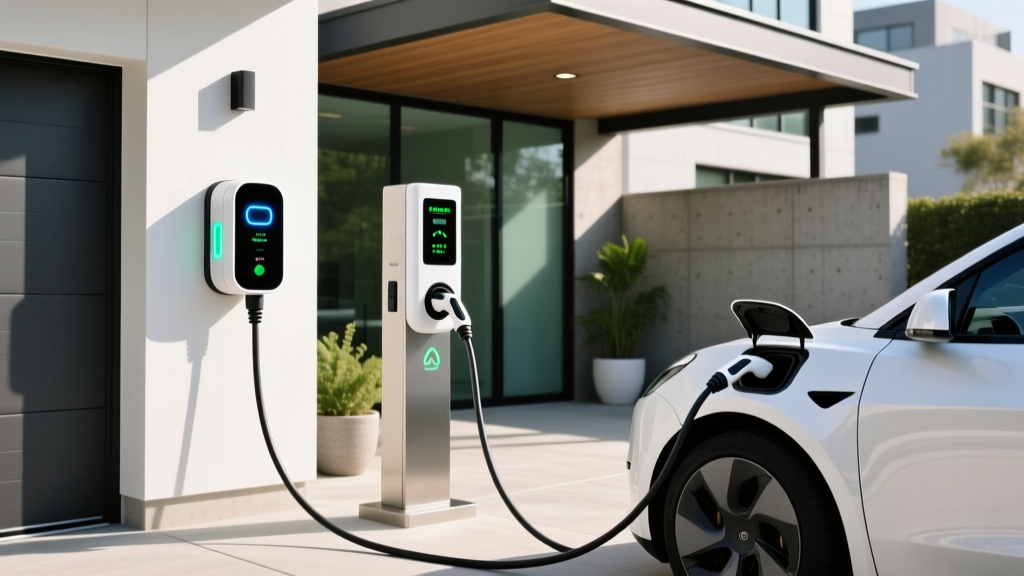
Here's where most "charger outlaw" situations originate. A proper Level 2 home charger installation involves four cost components, and skipping any one of them creates code and safety risk.
| Component | Low End | High End | Notes |
|---|---|---|---|
| Charger equipment (Level 2, 40–48A) | $300 | $750 | UL/ETL-listed; smart Wi-Fi models cost more |
| Electrician labor (run 240V circuit) | $400 | $1,500 | Depends on distance from panel, wall/ceiling runs |
| Electrical permit | $50 | $250 | Varies by municipality; some bundle with inspection |
| Panel upgrade (if needed) | $1,500 | $4,000+ | 100A → 200A service upgrade; older homes common |
| Total (no panel upgrade) | $750 | $2,500 | Typical range for most homes |
| Total (with panel upgrade) | $2,250 | $6,500+ | Older homes with 100A service |
The Panel Upgrade Reality Check
If your home has a 100-amp electrical panel — common in homes built before 1990 — you may not have enough spare capacity for a 40–60 amp EV circuit. A licensed electrician will perform a load calculation per NEC Article 220 to determine if your panel can handle the added continuous load. If it can't, you're looking at a service upgrade to 200A, which costs $1,500–$4,000 depending on your utility's requirements, trenching distance, and local labor rates.
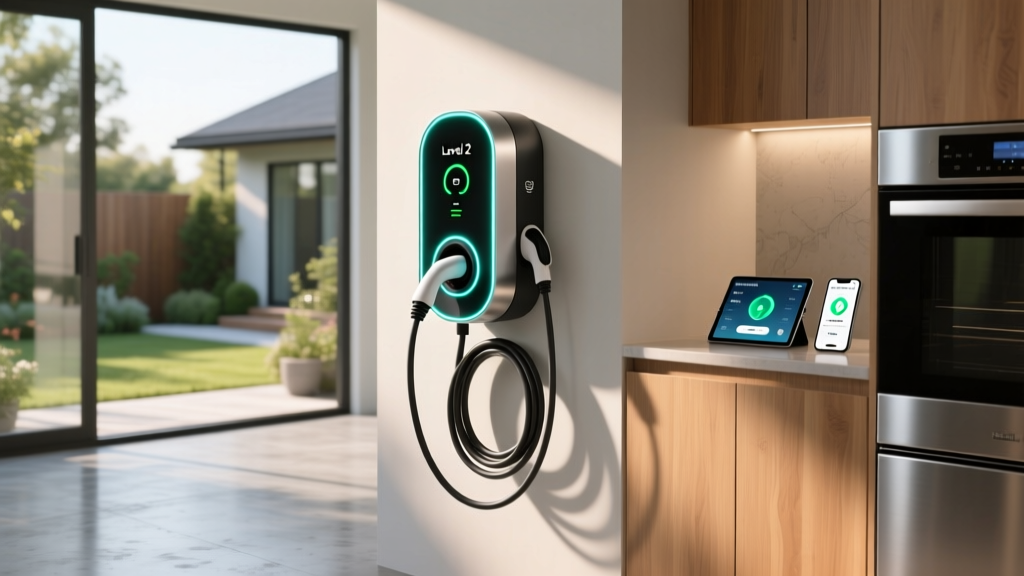
Workaround: Some smart chargers (like the Emporia Vue-integrated systems or the Wallbox Pulsar Plus with Power Boost) offer dynamic load management, which monitors your home's real-time power draw and throttles the charger to avoid overloading the panel. This can let you install a charger on a 100A panel without upgrading — but it still requires a permit and a licensed electrician to set up correctly.
What Your Electrician Needs to Do Right
- Dedicated circuit: Your Level 2 charger must have its own dedicated breaker — no sharing with other appliances.
- Correct wire gauge: A 48A charger on a 60A breaker requires 6 AWG copper wire (or 4 AWG aluminum). Undersized wire is a fire hazard.
- GFCI breaker: Required by NEC 625 for receptacle-based (plug-in) installations. Hardwired units may be exempt depending on local code amendments.
- Outdoor rating: If your charger is mounted outside, the enclosure, receptacle, and wiring method must be rated for wet locations (NEMA 3R or 4).
- Disconnect within sight: Hardwired chargers rated above 60A require a local shutoff switch. Most home units at 48A don't trigger this, but check your local amendments.
Connector Compatibility: NACS, CCS1, CHAdeMO, and Adapter Realities
As of 2026, the North American connector landscape has largely consolidated around NACS (North American Charging Standard), the connector Tesla pioneered and which Ford, GM, Rivian, Volvo, Hyundai, and most other automakers have adopted for new vehicles starting with 2025 model years. But millions of CCS1-equipped EVs remain on the road, and CHAdeMO persists on older Nissan Leaf and Mitsubishi models.
| Connector | Brands (2026 New Vehicles) | Home Charging | Public DC Fast Charging |
|---|---|---|---|
| NACS (Tesla standard) | Tesla, Ford, GM, Rivian, Hyundai, Kia, Volvo, Polestar, BMW, Mercedes-Benz, Lucid, Subaru | NACS wall connector or adapter | Tesla Supercharger network + NACS-equipped EA, EVgo stations |
| CCS1 (Combined Charging System) | VW (some), older stock; most brands have transitioned | J1772 (Level 2) + CCS (DC) | Electrify America, EVgo, ChargePoint — widely available |
| CHAdeMO | Nissan (discontinued for new models after 2025) | J1772 (Level 2) | Declining availability; legacy stations |
For home Level 2 charging, the connector story is simpler. All EVs sold in the U.S. accept J1772 for AC Level 2 charging — or NACS, which includes the same AC pins. If you buy a NACS-equipped wall connector (like the Tesla Wall Connector), it will natively charge Teslas and all new NACS-adopting vehicles. CCS1 vehicles can use a NACS-to-J1772 adapter (approximately $100–$200) for home AC charging.
For public DC fast charging, CCS1-equipped vehicles need a NACS-to-CCS adapter to access the Tesla Supercharger network. Tesla sells an official adapter, and third-party options are available — but ensure any adapter is UL-listed to avoid the "outlaw" problem at the charger end. Unlisted adapters can overheat at high DC currents and may void warranty coverage.
Charging Cost Per Mile: Home vs. Public vs. Gas
The economics of EV charging depend heavily on where and when you charge. Let's compare real costs for a vehicle averaging 3.0 miles per kWh (typical for a mid-size crossover like the Model Y or Ioniq 5) against a gas car averaging 28 MPG combined.
| Scenario | Rate | Cost/kWh | Cost Per Mile |
|---|---|---|---|
| Home — off-peak utility rate | $0.09–$0.14/kWh | $0.12 avg | $0.04 |
| Home — standard residential rate | $0.14–$0.22/kWh | $0.18 avg | $0.06 |
| Public Level 2 (ChargePoint, etc.) | $0.25–$0.49/kWh | $0.35 avg | $0.12 |
| DC Fast Charge (Electrify America, EVgo) | $0.35–$0.65/kWh | $0.48 avg | $0.16 |
| Tesla Supercharger (member rate) | $0.25–$0.38/kWh | $0.32 avg | $0.11 |
| Gas car (28 MPG, $3.40/gal) | — | — | $0.12 |
The takeaway: Home charging at off-peak rates is roughly one-third the cost per mile of gasoline. Even public DC fast charging at premium rates is comparable to or slightly above gas cost per mile. If you charge primarily at home — which roughly 80% of EV owners do, according to fueleconomy.gov data — your annual "fuel" cost for 12,000 miles drops from ~$1,440 (gas) to ~$480–$720 (home electricity).
Utility time-of-use (TOU) plans are key to maximizing savings. Most utilities offer off-peak rates between 10 PM and 6 AM. Smart chargers with scheduling features (ChargePoint Home Flex, Wallbox Pulsar Plus, Emporia Level 2) can automatically start charging during these windows.
Equipment Picks: 2026's Top Home Level 2 Chargers
Every charger below is UL or ETL listed — the baseline requirement for code compliance and insurance validity. We've excluded gray-market and unlisted units regardless of price.
Tesla Wall Connector (Gen 4)
- Power output: 11.5 kW (48A) on a 60A circuit
- Connector: NACS native
- Cable length: 24 feet
- Smart features: Wi-Fi, OTA updates, power sharing (link two units on one circuit), access control
- Price: ~$475
- Best for: Tesla and NACS-adopting EVs; cleanest install with NACS-native vehicles
ChargePoint Home Flex
- Power output: Up to 12 kW (50A) on a 60A circuit; configurable down to 16A for smaller circuits
- Connector: J1772 (NACS adapter included in 2026 refresh)
- Cable length: 23 feet
- Smart features: Wi-Fi, app scheduling, TOU optimization, Alexa integration, flexible amperage DIP-switch config
- Price: ~$550–$650
- Best for: Mixed-connector households; renters who may move (adjustable amperage adapts to new panel)
Wallbox Pulsar Plus (Gen 2)
- Power output: Up to 11.5 kW (48A) on a 60A circuit
- Connector: J1772 or NACS (model-dependent)
- Cable length: 25 feet
- Smart features: Wi-Fi + Bluetooth, Power Boost load management (pairs with meter to avoid panel overload), solar integration
- Price: ~$500–$600
- Best for: Homes with 100A panels (Power Boost avoids costly upgrade); solar-panel owners
Emporia Level 2 Smart Charger
- Power output: Up to 11.5 kW (48A)
- Connector: J1772 or NACS
- Cable length: 24 feet
- Smart features: Deep integration with Emporia Vue energy monitor, real-time circuit-level load tracking, TOU automation
- Price: ~$400–$500
- Best for: Budget-conscious buyers who want whole-home energy visibility
Federal and State Incentives for Home Charger Installation
The federal §30C Alternative Fuel Vehicle Refueling Property Credit offers a tax credit of up to 30% of the cost of home EV charger equipment and installation, capped at $1,000, for installations in eligible census tracts (primarily rural and low-income communities, as defined by the IRS). This credit was extended through 2026 under current law. Check the IRS §30C page for tract eligibility and filing requirements.
Many states and utilities stack additional incentives on top:
- Utility rebates: $200–$500 off equipment or installation is common. Some utilities (PG&E, ConEdison, Xcel Energy) offer free or discounted Level 2 chargers with enrollment in TOU rate plans.
- State programs: California's CC4A, New York's Charge Ready NY, and Colorado's EV charging tax credit can offset $250–$1,500 of installation costs. Consult your state energy office for current availability.
- Panel upgrade assistance: A growing number of utilities offer panel-upgrade rebates ($500–$1,000) when bundled with an EV charger install, recognizing the grid modernization benefit.
Always confirm incentive availability before purchasing — program funding can exhaust mid-year, and eligibility rules (income caps, primary residence requirements, approved equipment lists) vary by jurisdiction.
Frequently Asked Questions
How much does it cost to install a home EV charger?
A typical Level 2 home charger installation costs $750–$2,500 when no panel upgrade is needed, covering equipment ($300–$750), electrician labor ($400–$1,500), and the permit ($50–$250). If your home needs a panel upgrade from 100A to 200A service, add $1,500–$4,000, bringing the total to $2,250–$6,500+. Always get at least two quotes from licensed, EV-experienced electricians.
How fast will each charging level add range?
Level 1 (120V) adds 3–5 miles per hour. Level 2 at 7.7 kW adds ~25–30 miles per hour; at 11.5 kW, expect ~40–50 miles per hour. DC fast charging can add 150–300+ miles in 20–30 minutes, depending on the vehicle's peak charge rate and the station's output. These figures assume a vehicle efficiency of roughly 3 mi/kWh; larger, less efficient vehicles (trucks, large SUVs) will see lower miles-per-hour rates.
Which connector and charger is compatible with my EV?
For 2026 model-year vehicles, most new EVs use NACS for both AC and DC charging. Vehicles from 2019–2024 primarily use CCS1 (with J1772 for AC). The Nissan Leaf uses CHAdeMO for DC. For home Level 2 charging, all vehicles accept J1772 or NACS AC charging. Check your vehicle's charge port or owner's manual, and consult the EPA's fueleconomy.gov database for model-specific connector data.
How much does charging cost per mile compared to gas?
Home charging at off-peak rates averages $0.04 per mile, versus $0.12 per mile for a 28 MPG gas car at $3.40/gallon. Even standard residential rates (~$0.18/kWh) deliver $0.06/mile — half the cost of gas. Public DC fast charging at $0.48/kWh averages $0.16/mile, which is higher than gas but used infrequently on road trips. Annual savings for 12,000 miles of primarily home charging: $720–$960 per year.
What electrical upgrades might I need?
The most common upgrade is a panel service increase from 100A to 200A, required when your existing panel lacks spare capacity for a 40–60A EV circuit. Other potential upgrades include: replacing a Federal Pacific or Zinsco panel (known fire hazards, often required replacement regardless of EV), adding a whole-home surge protector (recommended to protect both the charger and vehicle electronics), or upgrading the meter socket if your utility requires a meter upgrade for the added load. A licensed electrician's load calculation will determine exactly what's needed.
Can I install an EV charger myself to save money?
Technically, you can — if you're a qualified electrician. For everyone else, DIY 240V installations carry serious risks: fire, electrocution, code violations, insurance denial, and voided charger warranties. Most charger manufacturers explicitly state that installation must be performed by a licensed electrician to maintain the warranty. The labor savings aren't worth the liability. Pull the permit, hire the professional, and keep the inspection certificate for your records and home resale documentation.
Sources: fueleconomy.gov (EPA efficiency data), IRS §30C credit guidelines, National Electrical Code (NFPA 70, Article 625 — Electric Vehicle Charging System Equipment).