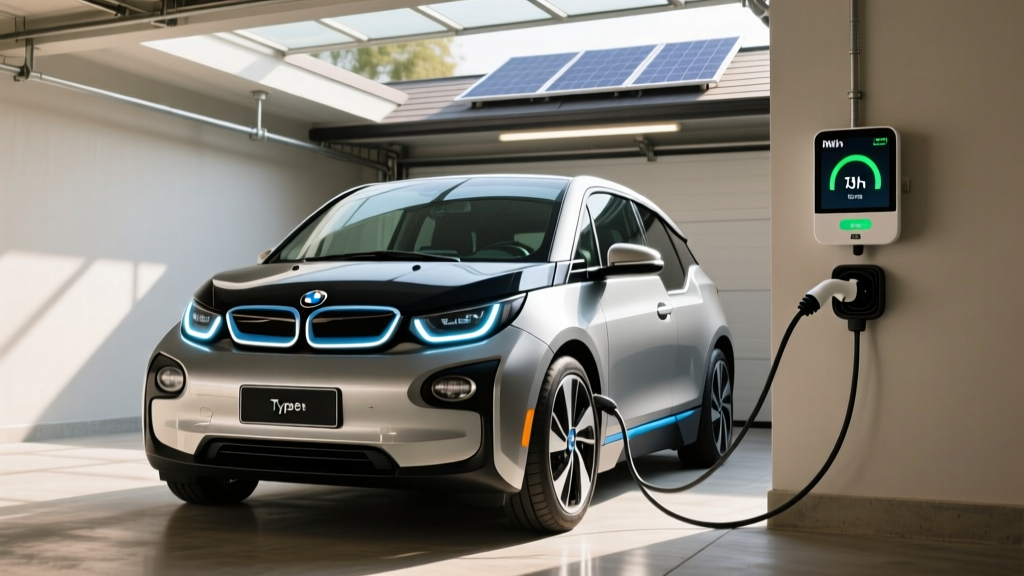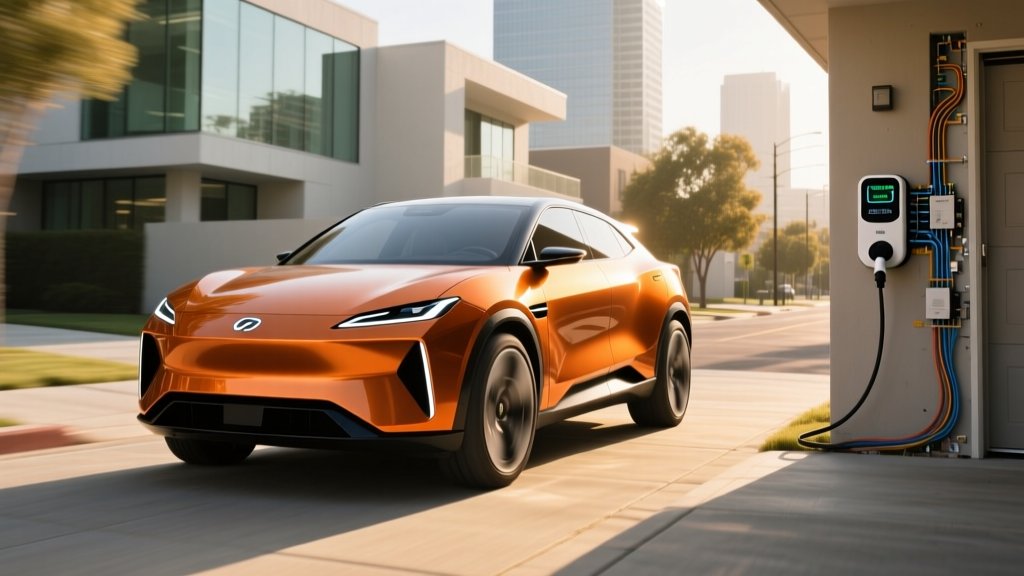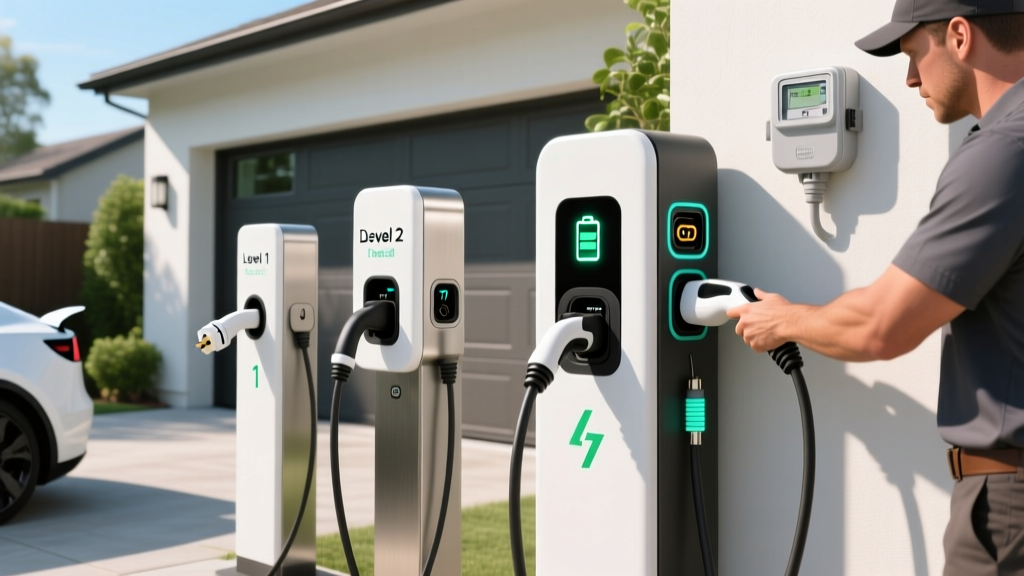
If you're shopping for your first electric vehicle—or looking to optimize your current EV's charging setup—understanding EV charger levels is the single most important piece of the ownership puzzle. The difference between plugging into a standard wall outlet and using a dedicated 240V circuit can mean the difference between waking up to 4 miles of added range versus 30 miles. This guide breaks down every charging tier with exact speeds, real-world costs, and the electrical realities of home installation.
EV Charger Levels: Speeds and Range Added Per Hour
Before we get into the numbers, let's clear up the most common confusion in EV terminology: kW (kilowatts) measures power—how fast energy flows into your battery. kWh (kilowatt-hours) measures energy—the total capacity of your battery, like gallons in a gas tank. A 75 kWh battery charged at 11.5 kW takes roughly 6.5 hours from empty to full (minus charging-curve taper). Mixing these up will lead to wildly wrong expectations.
| Level | Voltage / Amps | Max Power (kW) | Miles of Range Per Hour | Best Use Case |
|---|---|---|---|---|
| Level 1 | 120V / 12A | 1.4 kW | 3–5 mi/hr | Overnight top-up for PHEVs or low-mileage commutes |
| Level 2 (Home) | 240V / 32–48A | 7.7–11.5 kW | 25–44 mi/hr | Daily home charging for all BEVs |
| Level 2 (Public/Commercial) | 208–240V / 48–80A | 11.5–19.2 kW | 36–60 mi/hr | Workplace, apartments, destination charging |
| DC Fast Charge (Level 3) | 400–800V DC | 50–350 kW | 150–1,200+ mi/hr (peak) | Road trips, highway corridors, quick top-ups |
A critical reality check on DC fast charging: peak kW is not sustained kW. A vehicle rated for 250 kW peak charging will typically only hold that rate between roughly 10% and 30% State of Charge (SoC), then taper progressively. A "10-80% in 18 minutes" claim assumes ideal battery temperature and preconditioning. In cold weather (below 40°F), expect 10-80% times to stretch 30-50% longer unless your vehicle actively preconditions the battery—and even then, the first few minutes will be slower.
How Fast Will Each Charging Level Add Range? Real-World Examples
Let's translate these rates into practical charging times using two common battery sizes: a 60 kWh pack (like the base Tesla Model 3 or Chevrolet Equinox EV) and an 85 kWh pack (like the Ford F-150 Lightning Extended Range or Hyundai Ioniq 5 Long Range).
60 kWh Battery (EPA range ~250–270 miles)
- Level 1 (1.4 kW): 0–100% in ~43 hours. Adds roughly 40 miles overnight (10 hours).
- Level 2 at 48A (11.5 kW): 0–100% in ~5.2 hours. 10–80% in approximately 3.5 hours.
- DC Fast at 150 kW peak: 10–80% in ~22 minutes (with preconditioning, taper accounted).
- DC Fast at 250 kW peak: 10–80% in ~18 minutes (vehicles like Model 3/Model Y on V3 Superchargers).
85 kWh Battery (EPA range ~300–330 miles)
- Level 1 (1.4 kW): 0–100% in ~61 hours. Effectively unusable for daily BEV charging.
- Level 2 at 48A (11.5 kW): 0–100% in ~7.4 hours. 10–80% in approximately 5 hours.
- DC Fast at 250 kW peak: 10–80% in ~25 minutes (Hyundai Ioniq 5 with 800V architecture actually peaks closer to 240 kW and achieves 10–80% in ~18 min).
- DC Fast at 350 kW peak: 10–80% in ~16 minutes (Porsche Taycan, Audi e-tron GT with 800V systems).
Home EV Charger Installation: Electrical Requirements and Costs
Most EV owners find that a Level 2 home charger is the backbone of their ownership experience. According to the U.S. Department of Energy, over 80% of EV charging happens at home. Here's what a Level 2 installation actually requires—and what it costs.
Electrical Requirements for Level 2
A Level 2 charger requires a 240V dedicated circuit, the same voltage as your electric dryer or oven. The amperage determines your charging speed:
- 32A circuit (40A breaker): Delivers 7.7 kW. Adequate for most EVs and the minimum recommended for battery-electric vehicles.
- 40A circuit (50A breaker): Delivers 9.6 kW. Good for larger batteries (80+ kWh).
- 48A circuit (60A breaker): Delivers 11.5 kW. Maximum for most single-phase residential panels. Ideal for trucks and large SUVs.
The National Electrical Code (NEC) requires that continuous loads (like EV charging) use no more than 80% of a circuit's rated capacity. That's why a 48A charger requires a 60A breaker.
Panel Upgrade: The Hidden Cost
Homes built before 2000 often have 100A or 150A main electrical panels. Adding a 60A EV circuit to an already-loaded panel may require a panel upgrade to 200A, which is one of the most expensive variables in EV charger installation. A licensed electrician will perform a load calculation to determine if your panel can handle the additional draw. If you're already running electric heat, a tankless water heater, and an electric range, a panel upgrade is likely.
| Component | Typical Range | Notes |
|---|---|---|
| Level 2 Charging Equipment (hardwired or plug-in) | $300–$700 | Smart Wi-Fi-enabled units from ChargePoint, Emporia, Wallbox |
| Electrician Labor (simple install, panel nearby) | $500–$1,200 | Short conduit run, no panel upgrade, accessible garage |
| Electrician Labor (complex install) | $1,200–$3,000 | Long conduit runs, trenching, attic crawls, detached garage |
| Electrical Panel Upgrade (100A/150A → 200A) | $2,000–$4,500 | Required when existing panel lacks capacity; includes permit |
| Permit and Inspection | $50–$300 | Varies by municipality; some jurisdictions waive for EV installs |
| Total (No Panel Upgrade) | $850–$2,500 | Most homes with 200A panels and garage-adjacent install |
| Total (With Panel Upgrade) | $3,000–$6,500 | Older homes, high-load panels, or complex routing |
Always get at least three quotes from licensed electricians who specifically list EV charger installation experience. Ask whether the quote includes the permit, the load calculation, and a final inspection. Some utilities offer rebates of $250–$1,000 for Level 2 installations—check with your local provider before scheduling work.
Connector Compatibility: NACS, CCS, and CHAdeMO
The connector landscape has consolidated significantly since 2024, when Ford, GM, Rivian, Volvo, and others adopted the North American Charging Standard (NACS), originally developed by Tesla. As of 2026, here's where things stand:
| Connector | Brands Using Natively | Adapter Needed For |
|---|---|---|
| NACS (Tesla-style) | Tesla, Ford (2025+), GM (2025+), Rivian (2025+), Volvo/Polestar (2025+), Hyundai/Kia (2026 select models) | None for Tesla Superchargers; CCS adapter needed for Electrify America, EVgo CCS stations |
| CCS1 (Combo) | Hyundai/Kia (pre-2026), Volkswagen, BMW, Mercedes, Stellantis, Honda, Subaru | NACS adapter required for Tesla Supercharger access ($200–$250 OEM adapter) |
| CHAdeMO | Nissan Leaf (discontinued 2025, used market only), Mitsubishi Outlander PHEV (older models) | CHAdeMO stations are being phased out; CCS or NACS adapter recommended |
What this means in practice: If you buy a 2026 Ford, GM, or Rivian, your vehicle charges natively at Tesla Superchargers—the most reliable and expansive DC fast-charging network in North America, with over 25,000 stalls. If you buy a Volkswagen ID.4 or BMW iX, you'll use CCS stations (Electrify America, EVgo) and can purchase an OEM NACS adapter to also access Superchargers. CHAdeMO infrastructure is shrinking rapidly; if you own a used Nissan Leaf, plan charging routes carefully.
Level 2 Equipment Picks: What to Buy in 2026
Not all Level 2 chargers are created equal. Here are three proven units we recommend based on reliability, smart features, and value:
Emporia Vue Level 2 Charger
- Power Output: 48A (11.5 kW) on 240V
- Connector: NACS or J1772 (selectable at purchase)
- Cable Length: 24 feet
- Smart Features: Wi-Fi, solar integration, scheduled charging, energy monitoring via Emporia app
- Installation: Hardwired only (no plug)
- Price: ~$399
Best for: Budget-conscious buyers who want full smart features and solar-aware charging. Hardwired install qualifies for some utility rebates that plug-in units don't.
ChargePoint Home Flex
- Power Output: Up to 50A (12 kW), configurable via dip switches (16A–50A)
- Connector: J1772 standard, NACS adapter available separately
- Cable Length: 23 feet
- Smart Features: Wi-Fi, Alexa/Google integration, ChargePoint app scheduling, utility demand-response programs
- Installation: NEMA 14-50 plug or hardwired
- Price: ~$699
Best for: Flexibility. The plug-in option means you can take it when you move, and the adjustable amperage lets you match your circuit capacity without buying a new unit.
Tesla Wall Connector (Gen 4)
- Power Output: 48A (11.5 kW)
- Connector: NACS native; J1772 adapter included for non-Tesla EVs
- Cable Length: 24 feet
- Smart Features: Wi-Fi, over-the-air updates, Tesla app integration, power sharing (link up to 6 units on one circuit)
- Installation: Hardwired only
- Price: ~$450
Best for: Tesla owners and households with mixed NACS/J1772 vehicles. The power-sharing feature is uniquely useful for multi-EV garages on limited panel capacity.
Cost to Charge: Per-Mile Economics vs. Gasoline
The financial case for EV charging hinges on where and when you charge. Here's a realistic breakdown comparing electricity costs against gasoline for a vehicle averaging 3.5 miles per kWh (the efficiency of a Tesla Model Y or Hyundai Ioniq 5) versus a comparable gas car at 28 MPG combined.
| Scenario | Rate | Cost Per Mile (EV) | Cost Per Mile (Gas, 28 MPG @ $3.40/gal) |
|---|---|---|---|
| Home Level 2 — Off-Peak Utility Rate | $0.11/kWh | $0.031/mi | $0.121/mi |
| Home Level 2 — Average Residential Rate | $0.17/kWh | $0.049/mi | $0.121/mi |
| Home Level 2 — High-Cost State (CA, HI) | $0.32/kWh | $0.091/mi | $0.121/mi |
| Public Level 2 (ChargePoint, EVgo) | $0.25–$0.40/kWh | $0.071–$0.114/mi | $0.121/mi |
| DC Fast Charging (EA, EVgo, Tesla) | $0.35–$0.55/kWh | $0.100–$0.157/mi | $0.121/mi |
The takeaway: home charging at off-peak rates makes EVs dramatically cheaper per mile than gasoline—roughly one-quarter the cost. However, if you rely exclusively on DC fast charging in high-cost states, you may actually pay more per mile than a fuel-efficient gas car. The economic advantage of EV ownership depends heavily on reliable home or workplace charging access.
For the most accurate comparison, check your utility's time-of-use (TOU) rates. Many utilities offer EV-specific plans with super off-peak rates between midnight and 6 AM, bringing your effective cost to $0.07–$0.10/kWh—less than $0.03 per mile.
Safety and Electrical Code Considerations
EV charging involves sustained high-current draw—often 8+ hours at full load. This is fundamentally different from the intermittent use of a dryer or oven. Key safety requirements include:
- Dedicated circuit: Your Level 2 charger must be on its own circuit, not shared with other appliances. This prevents breaker trips and reduces fire risk from sustained thermal loading.
- GFCI protection: The 2023 NEC revision (adopted by most states by 2026) requires GFCI (Ground Fault Circuit Interrupter) protection for all EV charging outlets rated 60A or less. Hardwired units may be exempt in some jurisdictions—confirm with your inspector.
- Outdoor rating: If your charger is installed outdoors, it must carry a NEMA 4 or NEMA 4X rating for weather resistance. All three units recommended above meet this standard.
- Conduit and wire gauge: A 60A circuit requires 4 AWG copper wire (or 3 AWG aluminum) in conduit. Your electrician will size this based on the run length—longer runs may require thicker wire to minimize voltage drop.
- Permit and inspection: Virtually all jurisdictions require an electrical permit for a new 240V circuit. The inspection ensures the work meets NEC standards. Skipping the permit risks insurance claim denial if an electrical fire occurs.
Never use extension cords with an EV charger, and never plug a Level 2 charger into a standard 120V outlet with an adapter. The sustained current draw demands properly rated wiring and connections.
Frequently Asked Questions
How much does it cost to install a home EV charger?
A straightforward Level 2 installation (240V, 48A, no panel upgrade, short conduit run) typically costs $850–$2,500 including equipment, electrician labor, and permit. If your home needs a panel upgrade from 100A or 150A to 200A, add $2,000–$4,500. Always get multiple quotes and confirm your electrician is experienced with EV-specific load calculations.
Which connector and charger is compatible with my EV?
Check your vehicle's charge port. If it's a 2025+ Ford, GM, Rivian, Volvo, or Polestar, you have a native NACS port and can charge at Tesla Superchargers without an adapter. If you drive a Volkswagen, BMW, Hyundai (pre-2026), or Honda, you have CCS1 and will need a NACS adapter (~$200–$250) to access Superchargers. For home Level 2 charging, any J1772 or NACS charger will work—NACS vehicles come with a J1772 adapter, and J1772 vehicles can use a NACS adapter.
How much does charging cost per mile compared to gas?
At a typical residential rate of $0.17/kWh and 3.5 mi/kWh efficiency, EV charging costs about $0.049/mile at home—roughly 60% less than a 28 MPG gas car at $3.40/gallon ($0.121/mile). Off-peak utility rates can push EV costs below $0.03/mile. However, exclusive DC fast charging at $0.45+/kWh can exceed gas costs on a per-mile basis.
What electrical upgrades might I need?
The most common and costly upgrade is a panel upgrade from 100A/150A to 200A ($2,000–$4,500) if your existing panel lacks capacity for a new 60A circuit. Other potential needs include: a new conduit run from the panel to the garage (if the panel is on the opposite side of the house), trenching for detached garages, or a sub-panel installation. An electrician's load calculation will identify all requirements before work begins.
Can I charge my EV on a regular 120V outlet?
Yes—this is Level 1 charging—but it adds only 3–5 miles of range per hour. For a 60 kWh battery, a full charge takes over 40 hours. Level 1 is practical for plug-in hybrids with small batteries (10–20 kWh) or as a backup for BEV owners who drive fewer than 30 miles daily. For any BEV with a battery over 50 kWh, Level 2 is strongly recommended.
Is DC fast charging bad for my battery?
Occasional DC fast charging has minimal impact on modern battery health, thanks to sophisticated thermal management systems. However, daily DC fast charging—especially at rates above 150 kW—can accelerate degradation by 1–3% over a battery's lifetime compared to exclusive Level 2 charging, according to data from Recurrent Auto. For daily charging, Level 2 remains the recommended approach; reserve DC fast charging for road trips.
Understanding EV charger levels is the foundation of confident electric vehicle ownership. A properly installed Level 2 home charger transforms the EV experience—you wake up every morning with a full battery, eliminate gas station visits, and pay a fraction of the per-mile cost of gasoline. Before you buy your next EV, confirm your home's electrical capacity, choose the right equipment, and factor installation costs into your total budget. The U.S. Department of Energy's fueleconomy.gov remains the best source for EPA-rated efficiency data to calculate your personal charging costs.