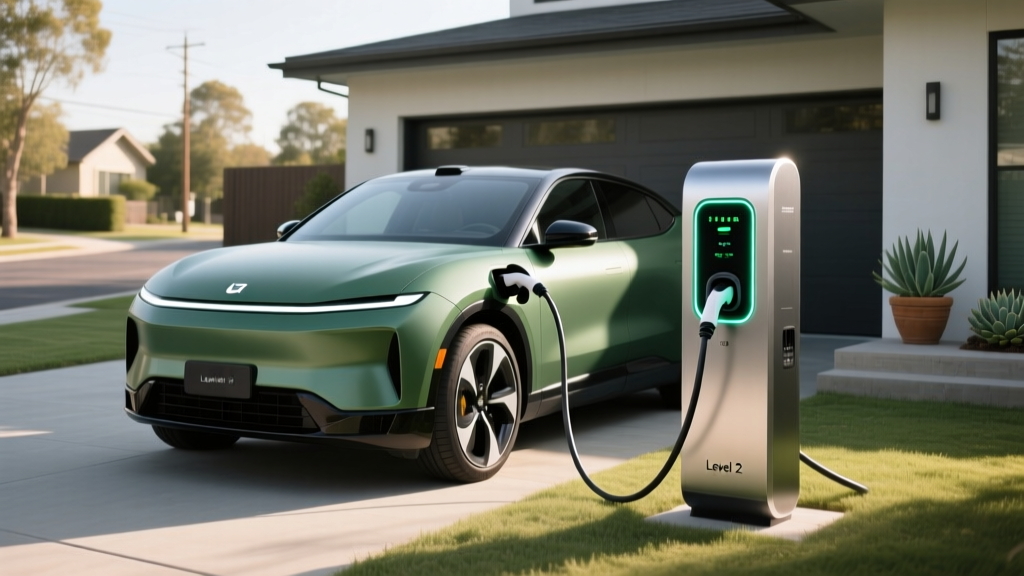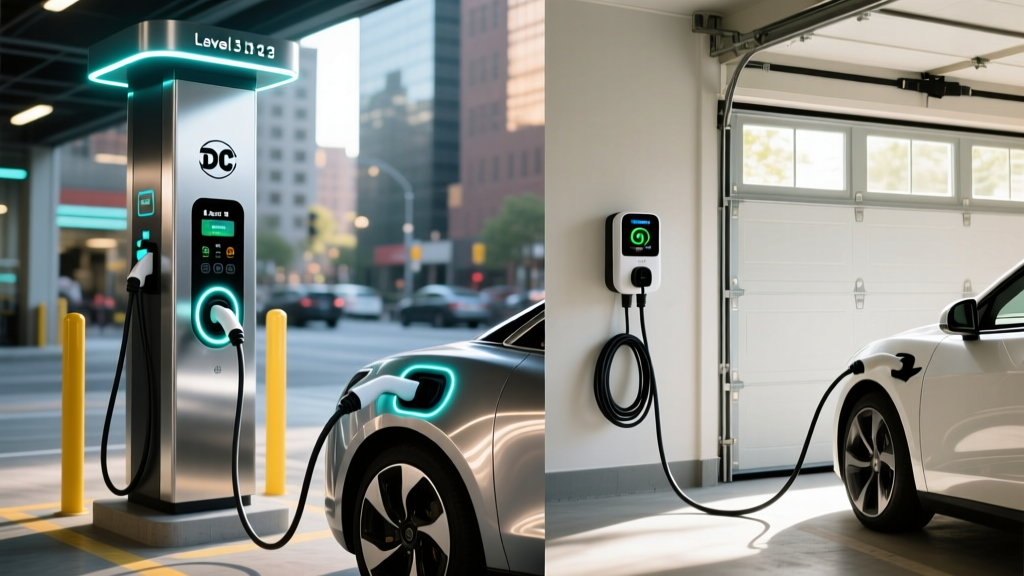
If you've searched for "EV charger Level 3" while researching electric vehicle charging, you've hit on one of the most misunderstood terms in the EV world. Level 3 charging — more accurately called DC Fast Charging (DCFC) — is the technology that makes road trips viable, adding hundreds of miles of range in 20 to 30 minutes. But unlike Level 1 and Level 2 chargers, Level 3 equipment is almost never a practical home installation. Here's what you actually need to know about charging speeds, where to find them, what they cost, and what you can install in your garage.
What Exactly Is an EV Charger Level 3?
The "Level 3" designation comes from the SAE J1772 standard's informal tier system for EV charging. Here's the critical distinction:
- Level 1 and Level 2 chargers deliver alternating current (AC) to the vehicle. The car's onboard charger converts AC to DC to store in the battery.
- Level 3 (DC Fast Charging) bypasses the onboard charger entirely, feeding direct current (DC) straight into the battery at much higher power levels.
This matters because kW (kilowatts) measures the rate of power delivery — think of it as how fast the "pump" flows — while kWh (kilowatt-hours) measures the total energy stored in your battery, like the size of the "tank." A Level 3 charger can push 50 kW to 350+ kW of power, whereas a home Level 2 unit typically delivers 7.2 to 19.2 kW.
Charging Levels Compared: Speed, Power, and Range Added
The table below shows what each charging level delivers in practical terms. "Miles per hour" figures assume an average EV efficiency of 3.0 to 3.5 miles per kWh — typical for vehicles like the Tesla Model Y, Hyundai Ioniq 5, or Ford Mustang Mach-E.
| Level | Power Source | Typical kW Output | Miles of Range Added Per Hour | 10–80% Charge Time (75 kWh Battery) | Where You'll Find It |
|---|---|---|---|---|---|
| Level 1 | 120V AC (standard outlet) | 1.2–1.9 kW | 3–6 mi/hr | 30–45+ hours | Any household outlet |
| Level 2 | 240V AC (dryer-style circuit) | 7.2–19.2 kW | 22–60 mi/hr | 4–8 hours | Home garage, workplaces, shopping centers |
| Level 3 (DCFC) | 400V–900V DC | 50–350+ kW | 150–1,000+ mi/hr (at peak) | 18–45 minutes | Highway corridors, dedicated stations |
Can You Install a Level 3 EV Charger at Home?
The short answer: almost never. Here's why:
- Power requirements: A 50 kW DC fast charger requires 480V three-phase commercial power — the kind of electrical service found at industrial facilities, not residences. Upgrading a home to three-phase service can cost $10,000 to $50,000+ and may not even be available from your utility.
- Equipment cost: A commercial DCFC unit costs $25,000 to $100,000+ before installation. A 350 kW unit from Electrify America or Ionity runs well into six figures.
- Demand charges: Utilities charge commercial customers "demand charges" based on peak power draw, which can add hundreds to thousands per month even with light use.
- Permitting and infrastructure: Most residential zoning doesn't permit commercial-grade charging equipment, and the physical footprint (cabinet, cooling, cable management) exceeds what a home garage can accommodate.
The practical solution for home charging is a Level 2 charger on a dedicated 240V circuit, which fully replenishes most EV batteries overnight and costs a fraction of DCFC infrastructure.
Home Level 2 Installation: Electrical Requirements and Costs
A Level 2 home charger is the backbone of practical EV ownership. Here's what an installation involves:
Electrical Specifications
- Voltage: 240V (same as an electric dryer or oven)
- Amperage: 32A to 80A circuit (most common: 40A or 48A circuit for a 32A or 40A charger, respectively — the National Electrical Code requires circuits rated at 125% of continuous load)
- Circuit: Dedicated — you cannot share the circuit with other appliances
- Wiring: Typically 6 AWG or 4 AWG copper wire, depending on amperage and run length
- Connection: Hardwired (recommended for outdoor and high-amperage installs) or NEMA 14-50 outlet (allows portability)
Installation Cost Breakdown
| Component | Low-End Estimate | High-End Estimate | Notes |
|---|---|---|---|
| Level 2 charger hardware | $300 | $750 | Smart WiFi-enabled units; basic units from ~$200 |
| Electrician labor | $400 | $1,500 | Depends on run length, wall type, conduit needs |
| Permit and inspection | $50 | $300 | Varies by municipality; some jurisdictions waive for EV |
| Electrical panel upgrade (if needed) | $1,500 | $4,000+ | Required if panel is at capacity or is 100A or less |
| Total (no panel upgrade) | $750 | $2,550 | Most common scenario for modern 200A homes |
| Total (with panel upgrade) | $2,250 | $6,550+ | Older homes with 100A or 150A service |
Safety and Code Requirements
- GFCI protection: NEC 2020 and later require GFCI (ground-fault circuit interrupter) protection for EV charging outlets. Hardwired installations may have different requirements depending on jurisdiction.
- Outdoor rating: If your charger is mounted outside or in an exposed garage bay, ensure it carries a NEMA 4 (weather-resistant) rating. Most quality Level 2 chargers are rated for outdoor use.
- Dedicated circuit: Never share the EV circuit with other loads. This is both a code requirement and a practical safety necessity.
- Permit: Always pull an electrical permit. Unpermitted work can void home insurance and create liability issues. The National Electrical Code (NEC) Article 625 governs EV charging installations.
Connector Compatibility: NACS, CCS, and CHAdeMO
When using Level 3 (DC fast) chargers in public, you need to know which connector your vehicle uses. The landscape has shifted dramatically as the North American Charging Standard (NACS), developed by Tesla, has become the dominant connector for new vehicles sold in North America.
| Connector | Brands Using It (2026 Models) | Network Access | Adapter Needed? |
|---|---|---|---|
| NACS (J3400) | Tesla (all), Ford, GM, Rivian, Volvo, Polestar, Hyundai, Kia (2025+), BMW, Mercedes-Benz | Tesla Supercharger network + growing NACS stations on EA, EVgo, ChargePoint | CCS-to-NACS adapter included or available from most automakers (~$150–$250) |
| CCS1 | Older VW ID.4, Audi e-tron (pre-2025), Chevrolet Bolt (discontinued), legacy models | Electrify America, EVgo, ChargePoint, Ionity | NACS-to-CCS adapter needed for Tesla Superchargers |
| CHAdeMO | Nissan Leaf (legacy only — no new models) | Declining network support; some EVgo and Electrify America stations | No adapter available to NACS/CCS; limited future access |
Key takeaway for 2026 buyers: If you're purchasing a new EV, it almost certainly uses NACS. If you own a CCS-equipped vehicle from 2022–2024, check with your automaker about a NACS adapter — Ford, GM, and Rivian have provided adapters to owners, and third-party options from companies like Lectron and A2Z are available. CHAdeMO owners face increasingly limited DCFC access and should plan routes carefully.
Level 3 Charging Times for Popular EVs (10–80%)
DC fast charging times vary enormously based on battery chemistry, thermal management, and the vehicle's maximum charge acceptance rate. Here are real-world 10–80% times for several popular 2026 models when connected to an appropriately rated Level 3 charger:
| Vehicle | Battery (kWh usable) | Peak DC Charge Rate | 10–80% Time | Charger Required |
|---|---|---|---|---|
| Hyundai Ioniq 5 (2026) | 84 kWh (NMC) | 240 kW | ~18 min | 350 kW station (800V architecture) |
| Tesla Model Y (2026) | 75 kWh (NMC/LFP) | 250 kW | ~25 min | V3/V4 Supercharger (250–350 kW) |
| Ford Mustang Mach-E (2026) | 91 kWh (NMC) | 150 kW | ~38 min | 150+ kW DCFC station |
| Chevrolet Equinox EV (2026) | 85 kWh (NMC) | 150 kW | ~35 min | 150+ kW DCFC station |
| Kia EV6 (2026) | 84 kWh (NMC) | 240 kW | ~18 min | 350 kW station (800V architecture) |
Charging Cost: Level 3 Public vs. Home Level 2 vs. Gas
One of the biggest ownership advantages of an EV is lower fuel cost — but only if you're charging at home. Public Level 3 charging can approach or even exceed gasoline costs per mile.
| Scenario | Rate | Cost Per kWh | Cost Per Mile (3 mi/kWh EV) | Cost to Add 200 Miles |
|---|---|---|---|---|
| Home Level 2 (off-peak utility rate) | Time-of-use plan | $0.08–$0.14 | $0.03–$0.05 | $5.30–$9.30 |
| Home Level 2 (standard rate) | Flat residential | $0.14–$0.20 | $0.05–$0.07 | $9.30–$13.30 |
| Public Level 2 (workplace/shopping) | Varies | $0.00–$0.25 | $0.00–$0.08 | $0.00–$16.70 |
| Public Level 3 (DCFC — Electrify America, EVgo) | Per kWh or per minute | $0.30–$0.55 | $0.10–$0.18 | $20.00–$36.70 |
| Tesla Supercharger (member rate) | Per kWh | $0.25–$0.38 | $0.08–$0.13 | $16.70–$25.30 |
| Gasoline (28 MPG avg at $3.30/gal) | Per gallon | N/A | $0.12 | $23.60 |
The economics are clear: Home Level 2 charging at off-peak rates delivers fuel costs roughly one-third to one-quarter of gasoline. Public DC fast charging, while convenient for road trips, costs roughly the same as — or more than — gasoline on a per-mile basis. The EV ownership cost advantage depends heavily on having reliable home or workplace charging access.
Best Home Level 2 EV Chargers for 2026
While Level 3 stays in the public domain, your home Level 2 charger is the workhorse you'll use daily. Here are top picks based on reliability, features, and value:
ChargePoint Home Flex
- Power: Up to 12 kW (50A) — configurable from 16A to 50A
- Connector: NACS (2025+ models) or J1772 (older stock)
- Cable length: 23 ft
- Smart features: WiFi, app scheduling, Alexa integration, energy reporting
- Indoor/Outdoor: NEMA 4 rated (outdoor safe)
- Price: ~$550–$650
Best for: Flexibility across circuit sizes and robust app ecosystem.
Tesla Wall Connector
- Power: Up to 11.5 kW (48A)
- Connector: NACS native
- Cable length: 24 ft
- Smart features: WiFi firmware updates, power sharing (link multiple units), Tesla app integration
- Indoor/Outdoor: NEMA 4 rated
- Price: ~$420–$475
Best for: Tesla owners seeking the most streamlined experience and multi-charger load sharing.
Emporia Vue Level 2 Charger
- Power: Up to 11.5 kW (48A)
- Connector: NACS or J1772
- Cable length: 24 ft
- Smart features: Deep energy monitoring via Emporia Vue panel integration, solar-aware charging, time-of-use scheduling
- Indoor/Outdoor: NEMA 4 rated
- Price: ~$400–$500
Best for: Homes with solar panels or those who want granular energy tracking.
Grizzl-E Smart
- Power: Up to 10 kW (40A)
- Connector: NACS or J1772
- Cable length: 24 ft
- Smart features: WiFi, OCPP compatibility, adjustable amperage via dip switches
- Indoor/Outdoor: NEMA 4 rated, -40°F operational rating
- Price: ~$450–$550
Best for: Extreme cold climates and budget-conscious buyers wanting a rugged, no-nonsense unit.
Frequently Asked Questions
How much does it cost to install a home EV charger?
A typical Level 2 home charger installation costs between $750 and $2,550 when no electrical panel upgrade is required. This includes the charger hardware ($300–$750), electrician labor ($400–$1,500), and permit fees ($50–$300). If your home needs a panel upgrade from 100A to 200A service, add $1,500 to $4,000+. Always get a load calculation from a licensed electrician before committing.
How fast will each charging level add range?
Level 1 (120V) adds roughly 3–6 miles of range per hour — adequate only for plug-in hybrids with small batteries or emergency top-ups. Level 2 (240V) adds 22–60 miles per hour depending on amperage, fully recharging most EVs overnight. Level 3 / DC Fast Charging adds 150–1,000+ miles per hour at peak, enabling 10–80% charges in 18–45 minutes depending on the vehicle and charger power.
Which connector or charger is compatible with my EV?
For 2026 model-year vehicles, the vast majority use the NACS (J3400) connector for both Level 2 and DC fast charging. This includes Tesla, Ford, GM, Hyundai, Kia, Rivian, BMW, and Volvo/Polestar. Older CCS-equipped EVs (2022–2024 models) may need a NACS-to-CCS adapter to access Tesla Superchargers. CHAdeMO is limited to the legacy Nissan Leaf and has declining infrastructure support. Check your vehicle's charge port or owner's manual to confirm.
How much does charging cost per mile vs. gas?
Home Level 2 charging at off-peak electricity rates ($0.08–$0.14/kWh) costs approximately $0.03–$0.05 per mile — roughly one-quarter the cost of gasoline at $3.30/gallon for a 28 MPG vehicle ($0.12/mile). However, public DC fast charging at $0.30–$0.55/kWh costs $0.10–$0.18 per mile, which can equal or exceed gasoline. The cost advantage of EV ownership is maximized with consistent home charging access. See the DOV EV cost comparison tool at fueleconomy.gov for vehicle-specific calculations.
What electrical upgrades might I need for a home charger?
The most common upgrade is ensuring your electrical panel has enough spare capacity for a dedicated 40A–50A circuit. Homes with 200A service and available breaker slots typically need only a new breaker and wiring run. Homes with 100A or 150A panels, or panels already near capacity, may require a full panel upgrade ($1,500–$4,000+). Alternatives include smart load-management devices (like the Emporia Smart Load Center) that dynamically share power between the EV charger and other circuits, or a dedicated sub-panel. A licensed electrician should perform a NEC-compliant load calculation to determine your specific needs.
Why can't I just install a Level 3 DC fast charger in my garage?
Level 3 chargers require 480V three-phase commercial power, draw 50–350+ kW of continuous power, and cost $25,000–$100,000+ for the equipment alone. Residential electrical service is single-phase 120V/240V and cannot support these loads without a complete service upgrade that most utilities won't provide to a residence. Additionally, commercial demand charges from utilities would add hundreds to thousands per month. The practical home solution is a Level 2 charger, which handles daily charging needs and is supplemented by public DCFC for road trips.
Is the federal tax credit available for home charger installation?
The IRS §30C Alternative Fuel Vehicle Refueling Property Credit covers 30% of home EV charger hardware and installation costs, up to $1,000. This credit is separate from the §30D new EV purchase credit. However, eligibility depends on the installation being in a qualifying census tract (generally rural or low-income areas). Check the IRS website or consult a tax professional for your specific situation, as qualifying tract maps and rules are subject to change.
Level 3 DC fast charging is essential technology for EV road-trip viability, but it's public infrastructure — not a home project. For daily driving, a properly installed Level 2 home charger on a dedicated 240V circuit delivers the convenience, cost savings, and battery-health benefits that make EV ownership work. Understand the distinction, invest in quality home equipment, and use DCFC for what it was designed for: getting you back on the highway quickly when you're far from home.