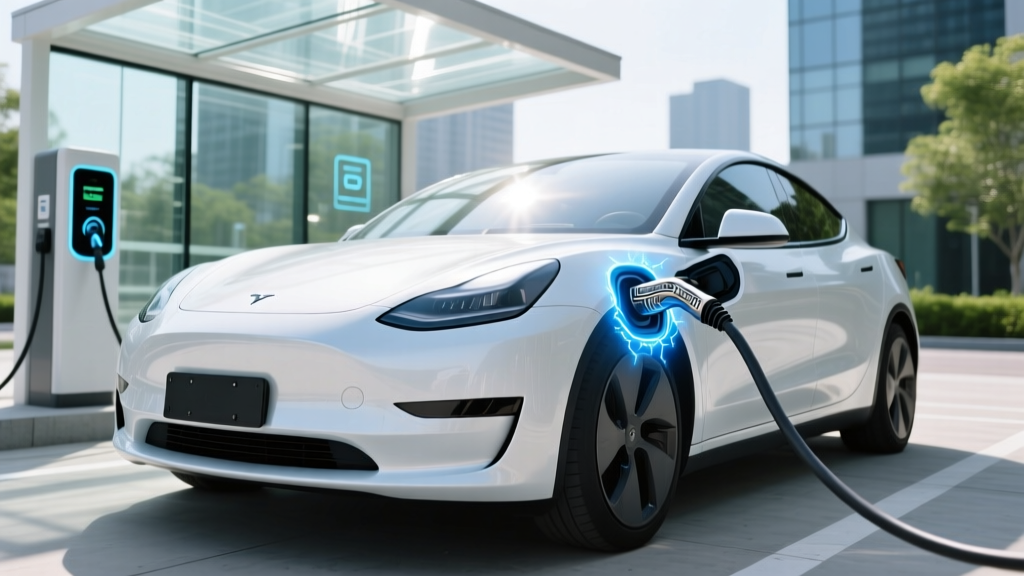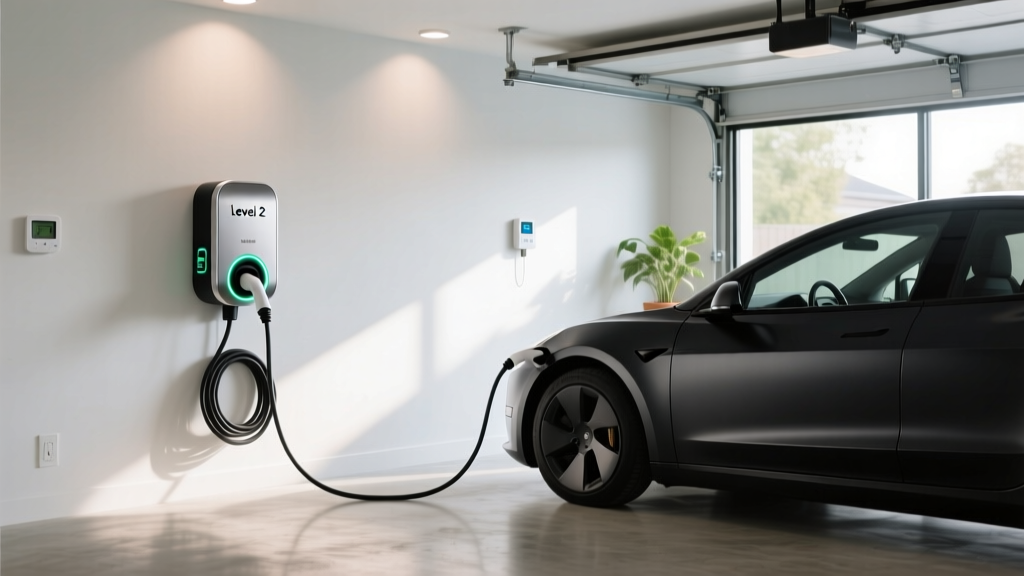
If you're shopping for an EV charger level 2 home charger, you're making the single biggest quality-of-life upgrade in electric vehicle ownership. A Level 2 unit delivers 15 to 50 miles of range per hour of charging — enough to replenish any daily commute overnight — and costs a fraction of public DC fast charging per mile. But the path from unboxing to plugging in involves real electrical work, connector choices that have shifted dramatically with the industry's move to NACS, and installation costs that can range from $500 to over $3,000 depending on your home's panel.
This guide breaks down exactly what each charging level delivers in kilowatts (kW) and miles per hour, what your electrical panel can handle, which connector your EV needs in 2026, what the real per-mile cost looks like versus gasoline, and which Level 2 chargers we recommend based on power output, cable length, smart features, and price.
Charging Levels Explained: kW, Miles Per Hour, and 10–80% Times
The first thing to understand is the difference between kW (kilowatts) and kWh (kilowatt-hours). kW measures power — the rate at which energy flows into your battery, like water pressure from a hose. kWh measures energy — the total capacity of your battery, like the size of the tank. A 75 kWh battery charged at 7.7 kW takes roughly 10 hours from empty to full. The same battery at 150 kW DC fast charging can hit 80% in about 25 minutes.
| Level | Voltage | Power (kW) | Miles of Range Added/Hour | Typical Use Case |
|---|---|---|---|---|
| Level 1 | 120V (standard outlet) | 1.0–1.4 kW | 3–5 miles/hour | Overnight top-off, PHEV owners |
| Level 2 | 240V (dryer-style outlet or hardwired) | 3.3–19.2 kW | 12–50+ miles/hour | Home daily charging, workplace |
| DC Fast Charging | 400V–900V DC | 50–350 kW | 150–1,000+ miles/hour (peak) | Road trips, rapid top-ups |
For most EV owners, a Level 2 home charger at 7.7 kW to 11.5 kW hits the sweet spot. Here's what that looks like with real battery sizes:
- Tesla Model Y (75 kWh usable, ~320 mi EPA): 0–80% on an 11.5 kW Level 2 takes about 5 hours. On a 250 kW Supercharger, 10–80% takes roughly 15–18 minutes (note: charge rate tapers significantly above 80% to protect battery health).
- Hyundai Ioniq 5 (77.4 kWh, ~303 mi EPA): 0–80% on 7.7 kW takes about 8 hours. On a 350 kW DC charger, 10–80% takes approximately 18 minutes thanks to its 800V architecture.
- Ford F-150 Lightning Extended Range (131 kWh, ~320 mi EPA): 0–80% on 11.5 kW takes roughly 9 hours. On a 150 kW DC charger, 15–80% takes about 45 minutes.
Level 1 charging (120V) is only practical for plug-in hybrids with small batteries (10–20 kWh) or BEV owners driving fewer than 30 miles daily. Anything beyond that, and you'll fall behind.
How Much Does It Cost to Install a Home EV Charger?
Installation cost is the most variable part of the equation. A simple plug-in setup on an existing 240V outlet might cost nothing beyond the charger itself, while a full panel upgrade with a long conduit run can exceed $4,000. Here's the breakdown for a typical hardwired Level 2 installation:
| Component | Low End | Typical | High End |
|---|---|---|---|
| Level 2 charger (equipment) | $250 | $450 | $700 |
| Electrician labor (2–6 hours) | $300 | $750 | $1,500 |
| Permit and inspection | $50 | $150 | $400 |
| Electrical panel upgrade (if needed) | $0 | $0 | $2,500 |
| Conduit/wiring materials (long runs) | $100 | $200 | $600 |
| Total (no panel upgrade) | $700 | $1,550 | $3,200 |
| Total (with panel upgrade) | $2,500 | $3,500 | $5,500 |
When You'll Need a Panel Upgrade
Homes with 100-amp electrical service — common in houses built before the 1990s — often cannot support a dedicated 40A or 50A circuit for EV charging alongside existing loads (HVAC, electric oven, dryer). A licensed electrician will perform a load calculation per NEC Article 220 to determine if your panel has headroom. If you need an upgrade to 200A service, expect to pay $1,500–$2,500 for the panel and labor. Some utilities offer rebates that offset this cost — check with your local provider.
If your panel is maxed out but you don't want to upgrade, consider a smart load-management device like the Emporia Load Management Controller or Span smart panel integration. These devices dynamically throttle your EV charger's draw when other high-load appliances kick on, keeping you under your panel's limit without a full upgrade.
Electrical Requirements: Voltage, Amperage, and Safety Codes
A Level 2 EV charger requires a 240-volt dedicated circuit, similar to what powers an electric dryer or oven. The amperage of that circuit determines your charging speed:
- 20A circuit → 16A continuous draw → 3.8 kW (~14 miles/hour)
- 30A circuit → 24A continuous draw → 5.8 kW (~21 miles/hour)
- 40A circuit → 32A continuous draw → 7.7 kW (~28 miles/hour)
- 50A circuit → 40A continuous draw → 9.6 kW (~35 miles/hour)
- 60A circuit → 48A continuous draw → 11.5 kW (~42 miles/hour)
The NEC (National Electrical Code) requires that continuous loads — and EV charging qualifies — cannot exceed 80% of the circuit's rated amperage. That's why a 40A circuit delivers 32A to the car, not 40A.
Safety and Code Must-Haves
- Dedicated circuit: Your EV charger must have its own breaker — no sharing with other outlets or appliances.
- GFCI protection: NEC 2020 and later requires ground-fault circuit interrupter protection for EV charging outlets. Hardwired installations may have different GFCI requirements depending on your local jurisdiction. Confirm with your electrician and inspector.
- NEMA 14-50 vs. hardwired: A NEMA 14-50 outlet (50A) gives you portability — you can unplug and take your charger when you move. Hardwired units skip the outlet and connect directly to the panel, which avoids the GFCI nuisance-tripping issues some owners report with 14-50 receptacles and can be rated for higher amperage.
- Outdoor rating: If your charger mounts outside, ensure it carries a NEMA 4 or NEMA 4X rating (weatherproof). All major chargers listed below meet this standard.
- Wire gauge: Your electrician will size wire to the circuit — typically 6 AWG copper for 50A, 4 AWG for 60A. Longer runs may require upsizing to prevent voltage drop.
Always hire a licensed electrician and pull a permit. Unpermitted electrical work can void your homeowner's insurance and create fire risk. According to the National Fire Protection Association, proper permitting and inspection is the best safeguard against electrical hazards.
Connector Compatibility: NACS, CCS1, and CHAdeMO in 2026
The connector landscape has shifted dramatically. As of 2026, the North American Charging Standard (NACS) — originally developed by Tesla — is the dominant connector for new EVs. Most automakers (Ford, GM, Rivian, Hyundai/Kia, BMW, and others) have transitioned to NACS for their 2025–2026 model-year vehicles. However, millions of CCS1-equipped EVs remain on the road, and CHAdeMO persists on older Nissan Leaf and Mitsubishi models.
| Connector | Brands Using It (New Vehicles) | Home Level 2 Charging | Adapter Needed? |
|---|---|---|---|
| NACS (J3400) | Tesla, Ford, GM, Rivian, Hyundai, Kia, BMW, Volvo, Polestar, others | NACS wall connector or adapter | Native for new models |
| CCS1 | Legacy models (2024 and earlier from most brands), some VW ID.4 | CCS1-compatible Level 2 (J1772) | NACS-to-CCS adapter if charger is NACS |
| CHAdeMO | Nissan Leaf (discontinued), Mitsubishi Outlander PHEV | J1772 for Level 2 | Rarely needed at home |
For home Level 2 charging, the practical distinction matters less than it does for DC fast charging. Most Level 2 chargers use the J1772 connector (which physically works with both CCS1 and, via adapter, NACS vehicles). If you own a 2025+ NACS-equipped vehicle, you can buy a NACS home charger (like the Tesla Wall Connector) or use a J1772 charger with a simple J1772-to-NACS adapter (typically $100–$180). Tesla also sells a NACS-to-J1772 adapter for using non-Tesla Level 2 chargers.
The connector choice matters far more for public DC fast charging, where CCS1 stations are increasingly being retrofitted with NACS cables and new installations default to NACS.
Cost to Charge: Home vs. Public vs. Gas Per Mile
One of the strongest arguments for home Level 2 charging is cost. Electricity prices vary by state and utility, but home charging is almost always cheaper than public DC fast charging — and both are cheaper than gasoline on a per-mile basis.
| Scenario | Rate | Cost per Mile (at 3 mi/kWh or 25 MPG) |
|---|---|---|
| Home Level 2 — off-peak (national avg.) | $0.13/kWh | $0.043 |
| Home Level 2 — standard rate (national avg.) | $0.17/kWh | $0.057 |
| Home Level 2 — California (avg. residential) | $0.30/kWh | $0.10 |
| Public Level 2 (ChargePoint, EVgo L2) | $0.25–$0.49/kWh | $0.08–$0.16 |
| DC Fast Charging (Tesla Supercharger, EA) | $0.32–$0.55/kWh | $0.11–$0.18 |
| Gasoline (25 MPG, $3.40/gal national avg.) | $3.40/gallon | $0.136 |
| Gasoline (25 MPG, $4.50/gal — CA/HI) | $4.50/gallon | $0.18 |
At the national average residential electricity rate of roughly $0.17/kWh (per U.S. EIA data), a typical EV achieving 3 miles per kWh costs about $0.057 per mile to charge at home — less than half the cost of gasoline at $3.40/gallon in a 25 MPG vehicle. Over 15,000 miles of annual driving, that's roughly $855 for home electricity versus $2,040 for gasoline — an annual savings of about $1,185.
The savings narrow in high-cost electricity states like California, but time-of-use (TOU) rate plans can restore the advantage. Many utilities offer off-peak rates of $0.08–$0.13/kWh between 9 PM and 6 AM, which is exactly when a Level 2 home charger runs. Schedule your charging through your EV's built-in timer or your charger's app to lock in the lowest rate.
Best Level 2 Home Chargers for 2026: Our Picks
We evaluated Level 2 chargers on five criteria: power output (kW), cable length, connector type, smart features (scheduling, load management, app control), and price. All picks below are UL-listed (or equivalent ETL-certified) for safety.
Best Overall: ChargePoint Home Flex
- Power: Up to 12 kW (50A circuit) — adjustable via DIP switch to 16A–50A
- Connector: J1772 (NACS adapter available separately)
- Cable: 23 feet
- Smart features: Wi-Fi, app scheduling, Alexa/Google Home, energy tracking, load sharing between two units
- Price: ~$549
- Best for: Flexibility across circuit sizes; works with virtually every EV via adapter
Best for Tesla/NACS Owners: Tesla Wall Connector
- Power: Up to 11.5 kW (48A on a 60A circuit)
- Connector: NACS native
- Cable: 24 feet
- Smart features: Wi-Fi, OTA firmware updates, power sharing between multiple units, Tesla app integration
- Price: ~$420
- Best for: Tesla owners and any 2025+ NACS-equipped EV (Ford, GM, Rivian, Hyundai/Kia)
Best Budget Pick: Emporia Vue Level 2 Charger
- Power: Up to 11.5 kW (48A)
- Connector: J1772
- Cable: 24 feet
- Smart features: Wi-Fi, real-time energy monitoring, scheduling, integrates with Emporia Vue home energy monitor
- Price: ~$349
- Best for: Cost-conscious buyers who want smart features and energy tracking without the premium price
Best for High-Power Needs: Grizzl-E Smart
- Power: Up to 10 kW (40A) — adjustable
- Connector: J1772
- Cable: 24 feet
- Smart features: OCPP-compatible (works with utility demand-response programs), app control, adjustable amperage
- Price: ~$449
- Best for: Canadian-built durability (rated to -40°F), OCPP utility integration, harsh-climate installations
A note on power: your EV's onboard charger determines how much AC power it can accept. Most 2025–2026 EVs accept 7.7 kW to 11.5 kW on Level 2. If your car maxes out at 7.7 kW (like some base-trim models), buying a 48A/11.5 kW charger won't charge it faster — but it future-proofs your installation for your next vehicle. The breaker and wire must match the charger's maximum circuit rating regardless.
Federal Tax Credit and Utility Rebates for Home Chargers
The federal Alternative Fuel Vehicle Refueling Property Credit (IRS Form 8911) can cover up to 30% of the cost of a home EV charger and its installation, capped at $1,000. However, eligibility depends on your census tract — the credit is only available in areas that do not meet EPA air quality standards or are designated as non-urban. Many suburban and rural areas qualify; dense urban cores often do not. Check your eligibility using the Alternative Fuels Data Center lookup tool.
Beyond the federal credit, many utilities offer rebates of $200–$500 for installing a smart Level 2 charger, and some provide free or discounted equipment. Check with your utility before purchasing — some rebate programs require specific charger models or participation in TOU rate plans.
Frequently Asked Questions
How fast will a Level 2 charger charge my EV overnight?
Most EVs with 60–80 kWh batteries will charge from 20% to 80% (roughly 180–240 miles of range) in 5–8 hours on a 7.7 kW to 11.5 kW Level 2 charger. That's more than enough for overnight replenishment. If you arrive home at 10 PM with 20% battery, you'll wake up at 6 AM above 80%.
Can I use a regular 120V outlet instead of installing a Level 2 charger?
Yes, but Level 1 charging at 1.2 kW adds only about 4 miles of range per hour. That's sufficient for PHEVs with small batteries or BEV owners driving under 30 miles daily. For a full-size EV with a 75+ kWh battery, Level 1 charging from 20% to 80% takes over 40 hours — impractical for most people.
Do I need a permit to install a home EV charger?
In most jurisdictions, yes. Electrical work on a dedicated 240V circuit typically requires a permit and inspection. Permit costs range from $50 to $400 depending on your municipality. Skipping the permit risks code violations, insurance claim denials, and complications when selling your home.
Will charging at home increase my electric bill significantly?
Driving 15,000 miles annually in an EV averaging 3 mi/kWh requires about 5,000 kWh per year. At the national average residential rate of $0.17/kWh, that adds roughly $850/year to your electric bill — or about $71/month. Compare that to $2,040/year in gasoline at 25 MPG and $3.40/gallon. Net savings are typically $1,000–$1,500 per year depending on your electricity rate and driving habits.
Should I get a plug-in (NEMA 14-50) or hardwired charger?
A NEMA 14-50 outlet gives you portability and the ability to use the outlet for other 240V equipment (welders, RV hookups). However, hardwired installations avoid the GFCI breaker nuisance-tripping that some EV owners experience with 14-50 receptacles, can support higher amperage (60A+), and may pass inspection more easily in jurisdictions with strict interpretations of NEC 625. If you don't plan to move the charger, hardwired is the more reliable choice.
What if my home only has 100-amp electrical service?
A 100A panel can often support a 20A or 30A Level 2 circuit (3.8–5.8 kW) if your other loads are modest — gas appliances help. Your electrician will perform a load calculation. If the math doesn't work, you have three options: upgrade to 200A service ($1,500–$2,500), install a smart load-management device that throttles the charger when other loads are high, or opt for a lower-amperage circuit that fits within your panel's capacity.