EV Charger Installation Cost in Malaysia: The Complete Homeowner & Business Guide
Electric vehicles are rapidly gaining traction across Malaysia, and one of the first questions every new EV owner asks is: how much does it cost to install an EV charger at home? Whether you drive a BYD Atto 3, a Tesla Model 3, or a locally popular model like the Ora Good Cat, having a dedicated home charging station transforms your ownership experience from inconvenient to effortless.
This comprehensive guide breaks down every element that contributes to the total cost of EV charger installation in Malaysia. From the charger unit itself to electrical upgrades, permits, labor, and ongoing maintenance, you will find transparent pricing, step-by-step processes, and expert safety advice — all in one place.
Quick Overview
Difficulty Level: Moderate to Advanced (professional installation strongly recommended)
Estimated Total Cost: RM 2,500 – RM 12,000+ depending on charger type, electrical upgrades & site conditions
Time Required: 4 – 8 hours for standard installation; 1 – 3 days if electrical panel upgrades are needed
Permits Required: Yes — approval from Suruhanjaya Tenaga (Energy Commission) & your local distribution licensee (TNB, SESB, or SEB)
If you are still deciding which charger to buy, check out our best EV home chargers roundup for top-rated options available in Malaysia.
Understanding EV Charger Types & Requirements in Malaysia
Before discussing costs, it is essential to understand the types of EV chargers available in the Malaysian market and the electrical requirements each one demands. The charger you choose will be the single biggest factor influencing your overall installation budget.
Level 1 Charging (Portable / Emergency)
Level 1 chargers plug into a standard 13A Malaysian household socket (BS 1363 / MS 589). They deliver approximately 1.4 kW to 2.3 kW of power and can add roughly 10 – 15 km of range per hour of charging. Most EVs sold in Malaysia include a Level 1 portable charger in the box.
- Installation cost: RM 0 – RM 500 (if a dedicated socket needs wiring)
- Electrical requirement: Standard 230V, 13A single-phase socket on a dedicated circuit
- Best for: Plug-in hybrids, occasional use, or emergency top-ups
Level 2 AC Wallbox Charging (Most Popular for Homes)
A Level 2 AC wallbox is the gold standard for home EV charging in Malaysia. These units typically deliver between 7 kW (single-phase) and 11 kW – 22 kW (three-phase) of power. They use a Type 2 connector (Mennekes), which is the standard across virtually all modern EVs sold in Malaysia.
- Installation cost: RM 2,500 – RM 8,000+ fully installed
- Electrical requirement: 230V single-phase (7 kW) or 400V three-phase (11 – 22 kW) with a dedicated 32A – 63A circuit breaker
- Best for: Daily home charging, overnight top-ups, full battery replenishment in 4 – 8 hours
Level 3 DC Fast Charging (Commercial / Fleet)
DC fast chargers deliver 30 kW to 350+ kW and are typically installed at commercial locations, petrol stations, and highway rest areas. These are rarely installed in residential settings due to their extreme power requirements and cost.
- Installation cost: RM 50,000 – RM 300,000+
- Electrical requirement: High-voltage three-phase supply, often requiring a dedicated substation or transformer upgrade
- Best for: Commercial operators, fleet depots, public charging networks
For a deeper comparison of connector types and charging speeds, visit our EV charging connectors explained guide.
Step-by-Step EV Charger Installation Process
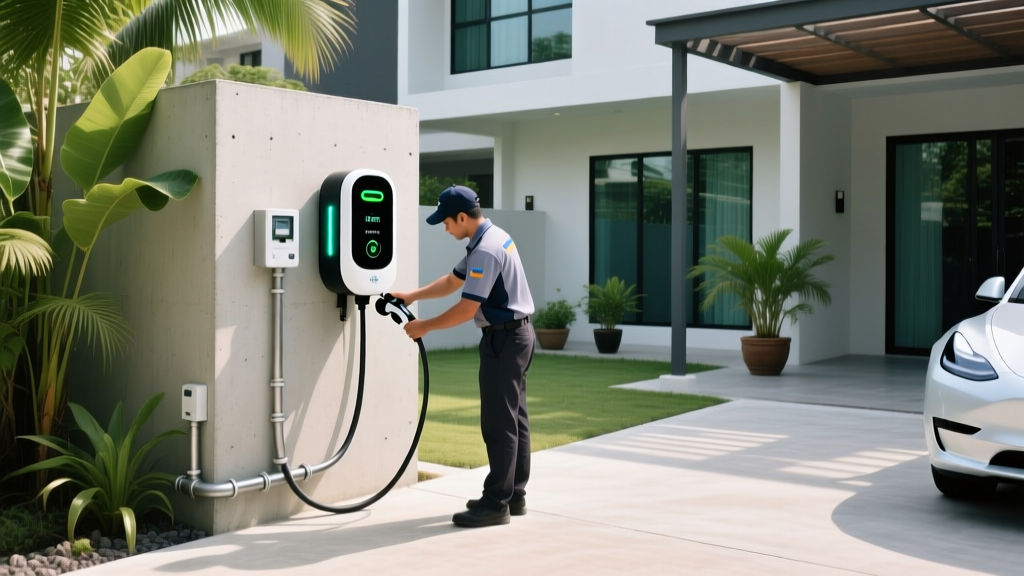
Installing a home EV charger in Malaysia is not simply a matter of mounting a box on your wall and plugging it in. The process involves several critical stages to ensure safety, regulatory compliance, and optimal performance.
Step 1: Site Assessment & Electrical Load Evaluation
A qualified electrician or the charger installer will visit your home to evaluate the following:
- The condition and capacity of your existing distribution board (DB)
- Whether your home has a single-phase or three-phase electrical supply
- Available spare capacity on your main circuit breaker (typically 60A – 100A for Malaysian homes)
- The distance between your DB and the proposed charger location (affects cable length and cost)
- Whether the charger will be installed indoors (car porch, garage) or outdoors (driveway, carport)
This assessment determines whether your existing electrical infrastructure can support the charger or if an upgrade is needed — a major cost variable we will discuss shortly.
Step 2: Choosing the Right Charger & Accessories
Based on the site assessment, your installer will recommend a suitable charger. Key considerations include:
- Power output: 7 kW single-phase is sufficient for most homes. If you have three-phase supply, an 11 kW or 22 kW charger can significantly reduce charging time.
- Smart features: Wi-Fi connectivity, app-based scheduling, RFID access control, and load balancing capabilities.
- Cable type: Tethered (built-in cable) versus untethered (socket only, you use your own cable).
- Weatherproofing: Outdoor installations require at least an IP54 or IP65 rated unit.
Explore our Wallbox Pulsar Plus review and Tesla Wall Connector review for two of the most popular home chargers in Malaysia.
Step 3: Electrical Wiring & Circuit Installation
This is where the bulk of the physical work happens:
- A dedicated circuit is run from your distribution board to the charger location using appropriately sized copper cable (typically 4mm² to 10mm² depending on amperage and distance).
- A residual current device (RCD) — specifically a Type A or Type B RCD — is installed for earth leakage protection, as required by Malaysian wiring regulations.
- A miniature circuit breaker (MCB) rated for the charger's amperage is added to your DB.
- The cable is routed through PVC conduit or trunking for protection and a clean appearance.
- The charger unit is mounted securely to the wall using the manufacturer's bracket system.
Step 4: Configuration & Testing
Once physically installed, the charger must be configured and tested:
- The charger is paired with your home Wi-Fi network (if smart-enabled)
- Charging current limits are set to match your electrical supply capacity
- Load balancing settings are configured if your charger supports dynamic load management
- A full earth continuity test, insulation resistance test, and functional test are performed
- The installer provides a test certificate and commissioning report
Permits, Inspections & Regulatory Compliance
Malaysia has clear regulations governing electrical installations, and EV charger installations are no exception. Skipping permits can result in fines, voided insurance claims, and serious safety hazards.
Suruhanjaya Tenaga (Energy Commission) Requirements
Under the Suruhanjaya Tenaga (Energy Commission of Malaysia), any permanent electrical installation that modifies your home's wiring must comply with the Electricity Supply Act 1990 and the Electricity Regulations 1994. Your installer must be a registered electrical contractor with Suruhanjaya Tenaga.
TNB (Tenaga Nasional Berhad) Notification
If your EV charger installation requires an upgrade to your electrical supply — for example, moving from a single-phase to a three-phase supply — you must apply to TNB (or SESB/SEB in Sabah and Sarawak) for a supply upgrade. This process involves:
- Submitting an application through the TNB portal or a registered electrical contractor
- Paying a connection charge (varies based on supply type and location, typically RM 500 – RM 3,000+)
- Waiting for TNB to install or upgrade your meter and incoming supply infrastructure
- Inspection by TNB before the new supply is energized
Local Authority (PBT) Considerations
For landed properties, local councils (such as DBKL, MBPJ, MBSJ, etc.) generally do not require separate permits for indoor EV charger installations. However, if you are installing an outdoor charger that involves structural modifications or is visible from the street, checking with your local authority is advisable.
For condominium and apartment residents, you will need written approval from your Joint Management Body (JMB) or Management Corporation (MC) before any installation work begins. Many condominiums have specific guidelines about common-area electrical modifications.
DIY vs. Professional Installation: What You Need to Know
The question of whether to install an EV charger yourself or hire a professional is one that comes up frequently in Malaysian EV communities. Let us break down both options honestly.
Why DIY Installation Is Strongly Discouraged
While it is technically possible for someone with advanced electrical knowledge to wire a charger, the risks far outweigh the potential savings:
- Legal liability: Unregistered electrical work violates the Electricity Supply Act 1990 and can result in prosecution.
- Insurance voidance: If a fire occurs and investigators trace it to an unpermitted EV charger installation, your home insurance claim will almost certainly be denied.
- Safety hazards: EV chargers draw sustained high currents (32A) for hours at a time. Improper connections can overheat, cause fires, or deliver lethal electric shocks.
- No warranty: Most charger manufacturers explicitly state that installation must be performed by a qualified electrician. DIY installation voids the product warranty.
- No certification: Without a registered contractor's test certificate, you cannot prove compliance to insurers, property buyers, or authorities.
Benefits of Professional Installation
- Compliance guaranteed: A registered contractor handles all Suruhanjaya Tenaga and TNB paperwork on your behalf.
- Safety assured: Proper cable sizing, RCD protection, and earthing are verified through standardized testing.
- Warranty protection: Both the charger warranty and the installation workmanship warranty remain valid.
- Load management: Professional installers can configure dynamic load balancing to prevent your main breaker from tripping when the charger and air-conditioning run simultaneously.
- Future-proofing: Experienced installers can recommend conduit sizing and cable routing that accommodates future upgrades.
The National Electrical Code (NEC) Article 625 — widely referenced as a global best practice for EV charging installations — mandates that EV supply equipment be installed by qualified personnel and connected to a dedicated branch circuit. While Malaysia follows its own standards (MS IEC 60364), the principle remains the same: professional installation is not optional, it is essential.
If you are comparing chargers before committing to an installation, our best EV home chargers guide compares the top models side by side.
Complete EV Charger Installation Cost Breakdown
Now let us get to the numbers. The following cost breakdown covers a typical residential Level 2 AC wallbox installation in Malaysia. Prices are presented in ranges to account for regional variations, brand differences, and site-specific factors.
1. Charger Unit Cost
| Charger Brand / Model | Power | Approximate Price (RM) |
|---|---|---|
| Generic / White-label (China OEM) | 7 kW | 800 – 1,500 |
| Schneider EVlink | 7 – 22 kW | 2,000 – 4,500 |
| Wallbox Pulsar Plus / Pulsar Max | 7 – 22 kW | 2,800 – 5,000 |
| Tesla Wall Connector (Gen 3) | 11 – 22 kW | 2,500 – 3,800 |
| ABB Terra AC | 7 – 22 kW | 3,000 – 5,500 |
| KEBA KeContact P30 / P40 | 11 – 22 kW | 3,500 – 6,000 |
2. Electrical Wiring & Materials
| Item | Estimated Cost (RM) |
|---|---|
| Copper cable (4mm² – 10mm², per meter) | 8 – 25 per meter |
| PVC conduit / trunking | 200 – 600 |
| MCB (32A – 63A) | 50 – 200 |
| RCD (Type A or Type B) | 150 – 600 |
| Isolator switch | 80 – 200 |
| Mounting bracket & hardware | 50 – 150 |
3. Labor & Professional Fees
| Service | Estimated Cost (RM) |
|---|---|
| Site assessment & consultation | 0 – 300 (often free with installation) |
| Standard installation labor (4 – 8 hours) | 500 – 1,500 |
| Testing & commissioning certificate | 200 – 500 |
| Suruhanjaya Tenaga registration / paperwork | 100 – 300 |
4. Optional Electrical Upgrades
| Upgrade | Estimated Cost (RM) |
|---|---|
| Single-phase to three-phase supply upgrade (TNB) | 1,500 – 5,000+ |
| Distribution board (DB) upgrade or replacement | 800 – 2,500 |
| Main breaker upgrade (60A to 100A) | 300 – 800 |
| Earthing system installation or upgrade | 500 – 2,000 |
| Load management system (dynamic load balancing) | 500 – 1,500 |
Total Estimated Cost Summary
| Scenario | Total Cost Range (RM) |
|---|---|
| Basic: Budget charger + short cable run + existing infrastructure | 2,500 – 4,000 |
| Standard: Mid-range charger + moderate cable run + RCD + standard labor | 4,000 – 7,000 |
| Premium: Premium charger + long cable run + DB upgrade + three-phase upgrade | 7,000 – 12,000+ |
For those interested in government incentives, the Malaysian government has periodically offered tax exemptions on EV charging equipment purchases. Check with your tax consultant or the Ministry of Finance Malaysia for current incentive programs that may offset your installation costs.
Essential Safety Tips for EV Charger Installations
Safety should never be compromised when dealing with high-current electrical installations. Here are the critical safety measures every Malaysian EV owner should insist on during installation and throughout the charger's lifetime.
Use the Correct Cable Size
Undersized cables are one of the most common causes of electrical fires in EV charging setups. A 32A charger requires a minimum of 6mm² copper cable for runs up to 15 meters. For longer runs, 10mm² cable is recommended to minimize voltage drop. Your installer must calculate the correct cable size based on the actual distance and load.
Install a Type A or Type B RCD
Standard Type AC RCDs (commonly found in Malaysian homes) may not detect the smooth DC residual currents that EV chargers can produce. A Type A RCD is the minimum requirement for EV charging circuits, while a Type B RCD offers the highest level of protection. The additional cost of RM 150 – 600 is a small price to pay for your family's safety.
Ensure Proper Earthing
Malaysian homes use the TT earthing system (earth rod). Your installer must verify that the earth electrode resistance is below the threshold specified in MS IEC 60364 — typically less than 10 ohms for a TT system. Poor earthing can render your RCD ineffective and create shock hazards.
Install an Isolator Switch
A local isolator switch should be installed within reach of the charger. This allows you to quickly disconnect power to the charger for maintenance, emergencies, or during electrical storms — a common occurrence in Malaysia.
Protect Against Water & Heat
Malaysia's tropical climate means your outdoor charger will face intense heat, heavy rain, and high humidity. Ensure your charger has at least an IP54 rating for outdoor installation (IP65 is preferred). The charger should be mounted under a sheltered area whenever possible, and all cable entries should be sealed with appropriate glanding to prevent moisture ingress.
Schedule Regular Inspections
Even after a perfect installation, components degrade over time. Schedule a professional inspection of your EV charger circuit every 2 – 3 years. The inspection should include tightening of all terminal connections, RCD trip testing, insulation resistance testing, and visual inspection of cables and conduit for damage.
Troubleshooting Common EV Charger Installation Issues
Even with professional installation, you may encounter issues during or after your EV charger setup. Here are the most common problems and their solutions.
Charger Will Not Power On
Possible causes: Tripped MCB or RCD, loose connection at the isolator switch, faulty wiring, or a defective charger unit.
Solution: Check your distribution board for tripped breakers. Reset the MCB and RCD. If the breaker trips again immediately, do not attempt to reset it repeatedly — call your installer to investigate a potential short circuit or earth fault.
Charging Speed Is Slower Than Expected
Possible causes: Charger configured to a lower current limit, voltage drop due to undersized or excessively long cables, the vehicle's onboard charger limiting the intake, or load balancing reducing current.
Solution: Verify the charger's configured current limit via its app or settings. Check your vehicle's maximum AC charging rate (many EVs are limited to 7 kW or 11 kW regardless of charger capacity). If voltage drop is suspected, have your installer measure the voltage at the charger terminals under load.
Main Breaker Trips When Charger Is Running
Possible causes: Total household load exceeds the main breaker capacity when the EV charger is running simultaneously with air-conditioners, water heaters, or other heavy appliances.
Solution: This is where dynamic load balancing becomes essential. A load management device monitors your home's total consumption in real time and automatically reduces the charger's current draw when other appliances are active. Alternatively, schedule charging during off-peak hours when household load is minimal.
Wi-Fi Connectivity Issues (Smart Chargers)
Possible causes: Weak Wi-Fi signal at the charger location, incompatible router settings, or firmware bugs.
Solution: Install a Wi-Fi range extender near the charger location. Ensure your router supports 2.4 GHz bands (many smart chargers do not support 5 GHz). Check for firmware updates through the charger's companion app.
Charger Displays an Error Code
Possible causes: Fault codes vary by manufacturer but commonly indicate earth faults, over-temperature conditions, communication errors, or over/under-voltage conditions.
Solution: Consult your charger's user manual for the specific error code. For persistent errors, contact the manufacturer's Malaysian support line or your installer. Do not attempt to open or repair the charger yourself.
For more help diagnosing charging problems, see our EV charging troubleshooting guide.
Frequently Asked Questions
Do I need TNB approval to install a home EV charger in Malaysia?
If you are installing a standard 7 kW single-phase charger and your existing electrical supply has sufficient spare capacity, you generally do not need a separate TNB approval — the installation simply needs to comply with Suruhanjaya Tenaga regulations and be performed by a registered electrical contractor. However, if you need to upgrade from a single-phase to a three-phase supply to support an 11 kW or 22 kW charger, you must apply to TNB (or SESB/SEB) for a supply upgrade, which involves additional fees and inspection.
Can I install an EV charger in my condominium or apartment in Malaysia?
Yes, but the process is more complex than for landed properties. You will need written approval from your Joint Management Body (JMB) or Management Corporation (MC). The installation must use your unit's individual electrical supply (not common-area power), and the cable routing must comply with building management rules. Some newer condominiums in Kuala Lumpur, Penang, and Johor Bahru are now being built with pre-installed EV charging infrastructure, which simplifies the process considerably. Always check with your building management before purchasing a charger.
How long does a typical home EV charger installation take in Malaysia?
A straightforward installation — where the charger is mounted on a wall close to the distribution board with no electrical upgrades needed — typically takes 4 to 8 hours. If cable routing is complex (for example, running cables through ceilings, across multiple floors, or along long driveway distances), the installation may take a full day. If a TNB supply upgrade is required (single-phase to three-phase), the overall timeline can extend to 2 – 6 weeks when you factor in TNB's processing and inspection schedule.
Is it cheaper to buy the charger separately and hire an electrician, or buy a bundled package?
Both approaches have merits. Bundled packages (charger + installation) from authorized dealers typically cost between RM 3,500 and RM 7,000 and offer the advantage of a single point of warranty responsibility. Buying the charger separately (for example, during an online sale) and hiring your own registered electrician can sometimes save RM 500 – RM 1,500, but you must ensure the electrician is experienced with EV charger installations and that the manufacturer's warranty terms allow third-party installation. Always verify that your electrician holds a valid registration with Suruhanjaya Tenaga.
Will installing an EV charger increase my TNB electricity bill significantly?
Your electricity cost will increase based on your charging habits, but EV charging at home is significantly cheaper than petrol. A typical EV with a 60 kWh battery charged from 20% to 80% (approximately 36 kWh) costs around RM 14 – 18 at the current TNB domestic tariff rate. This translates to roughly RM 0.04 – 0.07 per kilometer driven — compared to RM 0.25 – 0.40 per kilometer for a petrol vehicle. To minimize costs, charge during off-peak hours and consider whether you qualify for TNB's Time-of-Use (ToU) tariff, which offers lower rates during nighttime hours.
Ready to start your EV charging journey? Browse our best EV home chargers for Malaysian homes and read our complete guide to home EV charging for more tips on getting the most out of your setup.