What the EV Charger Funding Freeze Injunction Actually Means for You
If you've been following the rollout of federally funded charging stations under the National Electric Vehicle Infrastructure (NEVI) program, you've likely seen headlines about an EV charger funding freeze injunction that has stalled or redirected billions in planned infrastructure spending. Federal courts have issued injunctions blocking portions of the NEVI disbursement pipeline, and the practical result is fewer new public DC fast-charging corridors coming online in 2026 than originally projected.
For EV owners and shoppers, the implication is clear: reliance on home charging is more important than ever. Public fast-charging networks from Electrify America, EVgo, and Tesla Superchargers continue to operate and expand with private capital, but the pace of new rural and highway corridor builds has slowed. If you've been waiting for a federally funded station to appear near your commute, the injunction means you may be waiting longer.
The good news? Home Level 2 charging remains the most cost-effective, convenient, and reliable way to keep an EV fueled — and it's entirely within your control. This guide breaks down exactly what you need to install a home charger, what it costs, which equipment to buy, and how charging economics stack up against gasoline in 2026.
Charging Levels Explained: How Fast Does Each Add Range?
Before choosing equipment, you need to understand the three charging levels and what they deliver in real-world terms. Note that kW (kilowatts) measures power — the rate of energy delivery — while kWh (kilowatt-hours) measures energy — the total capacity stored in your battery. Think of kW as the width of a pipe and kWh as the size of the tank.
| Level | Voltage / Power | Miles of Range Per Hour | Best For |
|---|---|---|---|
| Level 1 (120V) | 120V AC / 1.2–1.9 kW | 3–5 mi/hr | Overnight top-ups, PHEVs, low-mileage drivers |
| Level 2 (240V) | 240V AC / 7.2–19.2 kW | 20–60 mi/hr | Daily home charging, most BEV owners |
| DC Fast Charging | 400–800V DC / 50–350 kW | 150–1,200+ mi/hr | Road trips, rapid top-ups away from home |
For context, a typical EV battery (75–100 kWh usable) charging on a 48-amp Level 2 circuit (11.5 kW) will add roughly 35–40 miles of range per hour. That means a full overnight session (8–10 hours) can replenish 280–400 miles — more than enough for virtually any daily driving pattern.
DC fast charging speeds vary dramatically by vehicle. A Hyundai Ioniq 5 with 800V architecture can peak at 240 kW and charge from 10–80% in approximately 18 minutes. A Chevrolet Equinox EV, limited to ~150 kW peak, takes closer to 30 minutes for the same 10–80% session. And charging always tapers above 80% State of Charge (SoC) to protect the battery — so that last 20% can take as long as the first 80%.
Home EV Charger Installation: Electrical Requirements and Costs
Installing a Level 2 home charger requires a dedicated 240-volt circuit, typically 40 to 60 amps, run from your main electrical panel to the charger location. Here's what that involves and what it costs.
Electrical Requirements
- Circuit: Dedicated 240V circuit, 40A or 50A breaker (some chargers support up to 60A)
- Wire gauge: 6 AWG copper for 50A circuits; 8 AWG for 40A (your electrician will specify)
- Panel capacity: Your main panel must have sufficient amperage headroom — typically 200A service for modern homes. Older homes with 100A panels may need a panel upgrade to 200A, which adds $1,500–$3,000+ to the project
- Permit: Most jurisdictions require an electrical permit ($50–$250) and a post-installation inspection
- GFCI protection: NEC 2020 and later require GFCI protection for EV charging circuits — many hardwired chargers handle this internally
- Outdoor rating: If installing outside, the charger must carry a NEMA 4 (weatherproof) rating
Installation Cost Breakdown
The total cost to install a home EV charger varies widely depending on your home's electrical infrastructure, the distance from panel to charger, and local labor rates. Here's a realistic breakdown based on 2026 national averages:
| Component | Low End | High End | Notes |
|---|---|---|---|
| Level 2 charger (hardware) | $300 | $700 | Smart Wi-Fi chargers, 40–48A |
| Electrician labor (standard install) | $400 | $1,200 | Depends on run length, wall type |
| Electrical permit | $50 | $250 | Varies by municipality |
| Panel upgrade (if needed) | $1,500 | $3,500 | 100A → 200A service upgrade |
| Conduit, wiring, misc. materials | $100 | $400 | Longer runs = more material |
| Total (no panel upgrade) | $850 | $2,550 | Most homes with 200A service |
| Total (with panel upgrade) | $2,350 | $6,050 | Older homes needing service upgrade |
The panel upgrade is the single biggest cost wildcard. If your home already has 200-amp service with open breaker slots, expect a straightforward install in the $850–$1,500 range. If you're in an older home with a 100-amp panel, budget for the upgrade — and get multiple electrician quotes before committing.
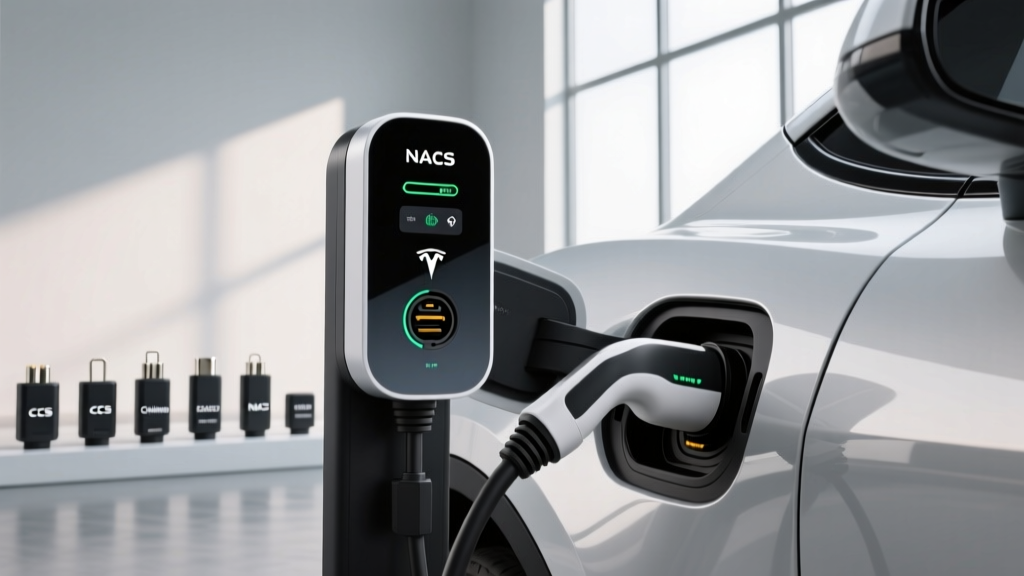
Connector Compatibility: NACS, CCS, and CHAdeMO
The connector landscape has consolidated significantly since Tesla opened its Supercharger network and the North American Charging Standard (NACS) was adopted as the industry standard. Here's where things stand for 2026-model EVs:
| Connector | Brands Using It (Native) | Home Charger Impact |
|---|---|---|
| NACS (J3400) | Tesla, Ford, GM, Rivian, Volvo, Polestar, Mercedes-Benz, Nissan (2025+), Honda, Fisker, BMW (2025+) | Buy a NACS-connector home charger or use a CCS-to-NACS adapter |
| CCS1 | Hyundai, Kia, Volkswagen, BMW (pre-2025), Stellantis, Subaru, Toyota (bZ series) | Buy a CCS1 (J1772 Combo) home charger; adapters available for NACS stations |
| CHAdeMO | Nissan Leaf (legacy only — discontinued after 2025 model year) | Limited new infrastructure; adapter needed for non-CHAdeMO stations |
For home Level 2 charging, most chargers ship with either a J1772 connector (which works with all CCS1 vehicles natively and NACS vehicles via adapter) or a NACS connector. If you own a 2025+ Ford, GM, or Rivian with a native NACS port, buy a NACS-terminated home charger. If you drive a Hyundai, Kia, or VW with CCS1, a standard J1772 charger works directly.
For DC fast charging on the road, NACS vehicles can access Tesla Superchargers natively. CCS1 vehicles increasingly need a NACS-to-CCS adapter (typically $150–$250) to use the growing number of NACS-equipped public stations. Check your vehicle manufacturer for an official adapter — Tesla sells one, and third-party options from Lectron and A2Z are widely available.
Charging Cost Per Mile: EV vs. Gasoline
One of the strongest arguments for home charging is cost. Electricity prices vary by state and utility, but even at national averages, EV charging undercuts gasoline significantly.
| Scenario | Rate | Cost Per Mile* | Annual Cost (12,000 mi) |
|---|---|---|---|
| Home Level 2 (off-peak, $0.12/kWh) | $0.12/kWh | $0.036 | $432 |
| Home Level 2 (standard, $0.17/kWh) | $0.17/kWh | $0.051 | $612 |
| Public Level 2 ($0.30/kWh) | $0.30/kWh | $0.090 | $1,080 |
| DC Fast Charging ($0.48/kWh) | $0.48/kWh | $0.144 | $1,728 |
| Gasoline car (28 MPG avg, $3.40/gal) | $3.40/gal | $0.121 | $1,457 |
*Based on an EV averaging 3.0 miles per kWh (approximately 112 MPGe combined). Gasoline figure based on EPA combined average for non-hybrid sedans/SUVs. Source: fueleconomy.gov, EIA electricity and gas price data.
The math is stark: home off-peak charging costs roughly one-third what gasoline does per mile. Even exclusive DC fast charging is roughly cost-competitive with gas — and most EV owners do 80%+ of their charging at home. The funding freeze injunction affecting public charger buildout makes this home-charging advantage even more relevant, since you can't count on cheap public infrastructure appearing in your area on a government timeline.
Recommended Home EV Chargers (2026)
Based on reliability, smart features, build quality, and value, here are the home Level 2 chargers we recommend for 2026:
ChargePoint Home Flex
- Power: Up to 12 kW (50A) on a 60A circuit, adjustable down to 16A
- Connector: J1772 (CCS1 native; NACS via adapter)
- Cable length: 23 ft
- Smart features: Wi-Fi, scheduling, energy tracking, Alexa integration
- Price: ~$550
- Best for: Flexibility across multiple vehicles and amperage settings
Tesla Wall Connector
- Power: Up to 11.5 kW (48A) on a 60A circuit
- Connector: NACS (native for Tesla, Ford, GM, Rivian 2025+)
- Cable length: 24 ft
- Smart features: Wi-Fi, OTA updates, power sharing between two units, load management
- Price: ~$475
- Best for: NACS-vehicle owners wanting a clean, high-output solution
Emporia Level 2 EV Charger
- Power: Up to 11.5 kW (48A) on a 60A circuit
- Connector: J1772
- Cable length: 24 ft
- Smart features: Wi-Fi, integration with Emporia Vue energy monitor, solar-aware scheduling, time-of-use optimization
- Price: ~$400
- Best for: Budget-conscious buyers with solar panels or TOU rate plans
Grizzl-E Smart
- Power: Up to 10 kW (40A) on a 50A circuit
- Connector: J1772 or NACS (selectable at purchase)
- Cable length: 24 ft
- Smart features: Wi-Fi, OCPP protocol, adjustable amperage, extreme-weather rated (-40°F)
- Price: ~$450
- Best for: Cold-climate owners and those wanting a rugged, repairable unit
All four chargers are hardwired (recommended for reliability and to avoid the need for a 240V NEMA 14-50 outlet on a GFCI breaker, which can nuisance-trip). If you prefer plug-in flexibility, the ChargePoint Home Flex and Grizzl-E offer NEMA 14-50 plug versions.
Charging Time Examples: 10–80% by Battery Size
How long does a real charging session take? Here are estimates for common 2026 EV battery sizes charging on a 48A (11.5 kW) Level 2 home circuit, from 10% to 80% State of Charge:
| Vehicle Example | Usable Battery (kWh) | 10–80% on 11.5 kW L2 | 10–80% on 150 kW DCFC |
|---|---|---|---|
| Tesla Model 3 Long Range | 75 kWh | ~4.5 hours | ~28 min |
| Hyundai Ioniq 5 (84 kWh pack) | 77.4 kWh | ~4.7 hours | ~18 min (800V arch.) |
| Ford F-150 Lightning (extended) | 131 kWh | ~8 hours | ~42 min |
| Chevrolet Equinox EV | 85 kWh | ~5.2 hours | ~30 min |
| BMW i4 eDrive40 | 81.5 kWh | ~5 hours | ~31 min |
Notice that even the largest battery (F-150 Lightning at 131 kWh) fully replenishes from 10–80% overnight on a Level 2 home charger. For daily driving of 30–60 miles, you'll typically plug in each evening and wake up fully charged — the EV equivalent of starting every day with a full tank.
The NEVI Funding Freeze Injunction: Context and What's Next
The NEVI program, established under the 2021 Bipartisan Infrastructure Law, allocated $5 billion over five years to build a national network of DC fast chargers along designated highway corridors. By early 2026, only a fraction of those funds had been disbursed, and legal challenges — including injunctions related to contracting procedures, domestic sourcing requirements, and state-level disputes over station placement — have further frozen disbursements.
What this means practically:
- Public charging deserts persist in rural areas and along some interstate corridors longer than planned
- Private networks (Tesla Supercharger, Electrify America, EVgo) continue expanding but prioritize high-traffic urban and suburban locations
- State-level incentives for home charger installation remain available in many states — check your utility and state energy office for current programs
- The federal 25C residential energy credit still covers 30% of home EV charger hardware and installation costs (up to $1,000) for eligible taxpayers in qualifying census tracts. Consult IRS guidance or a tax professional for your specific eligibility.
For EV buyers on the fence: don't wait for a public charger to appear near you. Invest in home Level 2 infrastructure, which pays for itself within 1–3 years through fuel savings alone in most scenarios.
Safety, Code, and Installation Best Practices
A few critical safety and code points that every EV owner should know before installation:
- Dedicated circuit: Your EV charger must have its own dedicated breaker — never share a circuit with a dryer, oven, or HVAC system
- Hardwired vs. plug-in: Hardwired installations are more reliable and avoid the NEC requirement for GFCI breakers on 240V receptacles (which can nuisance-trip with some chargers). We recommend hardwired unless you need portability
- Load management: If your panel is near capacity, consider a smart charger with load-management capability (like the Tesla Wall Connector's power-sharing feature or an Emporia system integrated with your home energy monitor) to dynamically limit draw
- Outdoor installation: Ensure the charger carries a NEMA 4 rating. All four chargers recommended above are outdoor-rated
- Permit and inspection: Skipping the permit may void your homeowner's insurance coverage for electrical fires. Always permit and inspect — it typically costs under $200 and protects your investment
- Electrician selection: Hire a licensed electrician experienced with EV charger installs. Ask about their familiarity with NEC Article 625 (Electric Vehicle Charging Equipment) and request a detailed quote covering wire run, breaker size, and permit
Frequently Asked Questions
How much does it cost to install a home EV charger?
A standard Level 2 home charger installation costs between $850 and $2,550 if your home already has 200-amp electrical service. If you need a panel upgrade from 100A to 200A, total costs can range from $2,350 to $6,050. The charger hardware itself costs $300–$700. The federal 25C tax credit may cover 30% of the cost (up to $1,000) if you're in an eligible census tract — consult the IRS 25C guidance for details.
How fast will each charging level add range?
Level 1 (120V) adds 3–5 miles per hour. Level 2 (240V, 40–50A) adds 20–40 miles per hour depending on vehicle efficiency. DC fast charging adds 150–1,200+ miles per hour but tapers significantly above 80% SoC. For most EV owners, Level 2 home charging overnight is more than sufficient to replenish daily driving.
Which connector is compatible with my EV?
If you drive a 2025+ Tesla, Ford, GM, Rivian, Volvo, Polestar, or Mercedes EV, your vehicle uses the NACS connector natively. Hyundai, Kia, Volkswagen, and most Stellantis models use CCS1 (J1772 Combo). For home charging, buy a charger matching your connector or use an adapter. For public DC fast charging, CCS1 vehicles increasingly need a NACS-to-CCS adapter to access the widest network.
How much does charging cost per mile compared to gas?
Home Level 2 charging at off-peak rates ($0.12/kWh) costs approximately $0.036 per mile — about one-third the cost of gasoline at $3.40/gallon and 28 MPG ($0.121/mile). Even standard-rate home charging ($0.17/kWh) costs about $0.051/mile. Public DC fast charging at $0.48/kWh is roughly cost-competitive with gas at $0.144/mile.
What electrical upgrades might I need for a home charger?
You need a dedicated 240V circuit with a 40A to 60A breaker. The most common upgrade is a panel service increase from 100A to 200A, which costs $1,500–$3,500 and is necessary in older homes without sufficient amperage headroom. Your electrician will perform a load calculation to determine if an upgrade is required. Some utilities offer rebates for panel upgrades when paired with EV charger installation.
Does the EV charger funding freeze injunction affect my home installation?
No. The injunction targets federal NEVI program disbursements for public DC fast-charging infrastructure — it does not affect private home charger installations, the federal 25C residential energy credit, state utility rebates, or your ability to purchase and install any Level 2 charger. The public charging networks you use on road trips (Tesla Supercharger, Electrify America, EVgo) are privately funded and unaffected by the NEVI injunction.