If you've seen headlines about EV charger fires, you're not alone in wondering whether plugging in at home is safe. The short answer, backed by incident data: EV charging equipment fires are exceedingly rare, and the vast majority trace back to improper installation, damaged cords, or uncertified hardware — not the vehicles or properly rated chargers themselves. This guide breaks down what the data actually shows, the electrical codes that protect you, and exactly how to spec and install a home Level 2 charger that meets every safety standard.
What the Data Actually Shows About EV Charger Fires
Let's separate headline fear from statistical reality. According to the National Fire Protection Association (NFPA), fires originating from EV charging equipment represent a tiny fraction of all residential electrical fires. Between 2018 and 2023, documented home fires caused specifically by EV supply equipment (EVSE) numbered in the low dozens nationally — compared to roughly 24,000 residential electrical fires per year from all causes.
For context, the National Highway Traffic Safety Administration (NHTSA) and multiple independent analyses have found that EVs are less likely to experience fires per 100,000 vehicles sold than internal combustion engine vehicles. When charging-related incidents do occur, investigations by fire marshals and the Consumer Product Safety Commission (CPSC) consistently point to:
- Extension cords and undersized wiring — using a 14-gauge household extension cord for continuous 12A Level 1 charging, which overheats over hours-long sessions
- Uncertified or counterfeit chargers — cheap, unlisted EVSE units purchased from overseas marketplaces lacking UL or ETL certification
- Damaged cables or connectors — frayed insulation, crushed cables, or corroded pins creating arcing points
- Improper circuit sizing — a 40A charger installed on a 40A breaker instead of the required 50A breaker (continuous loads must be derated to 80% of breaker capacity per NEC Article 210.20)
- Panel or wiring deficiencies — outdated Federal Pacific or Zinsco panels with known failure modes, aluminum branch wiring with loose terminations
Understanding Charging Levels: Speed, Power, and Safety Profile
Before specifying equipment, you need to understand the three charging levels and their electrical demands. Each level operates at different voltages and power levels, which directly determines the wiring, breaker, and safety requirements.
| Level | Voltage / Amperage | Max Power (kW) | Miles of Range Added Per Hour | Typical Use Case | 10–80% Time (75 kWh Battery) |
|---|---|---|---|---|---|
| Level 1 | 120V / 12A | 1.4 kW | 3–5 mi/hr | Overnight trickle; PHEVs; low-mileage drivers | ~38 hours (not practical) |
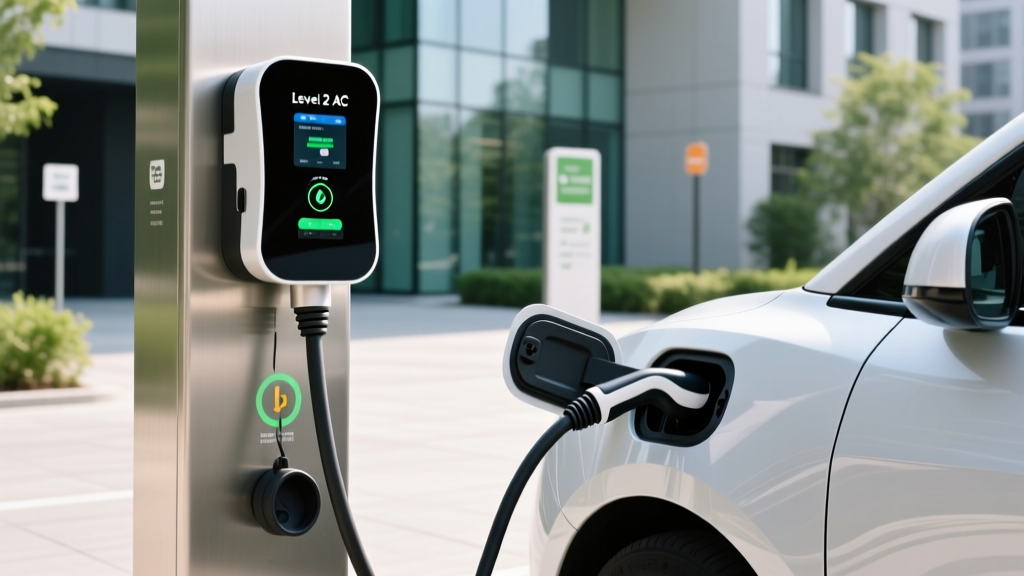
| Level 2 | 240V / 32A–48A | 7.7–11.5 kW | 25–44 mi/hr | Primary home charging; workplace | ~5.5–8 hours |
| DC Fast Charge | 400–800V DC | 50–350 kW | 180–1,000+ mi/hr | Road trips; commercial stations | 18–45 minutes (varies by vehicle) |
kW vs. kWh — the critical distinction: kW (kilowatts) measures the rate of energy transfer — like water pressure in a hose. kWh (kilowatt-hours) measures the total energy stored or delivered — like gallons in a bucket. A 75 kWh battery charged at 11.5 kW (Level 2) takes roughly 6.5 hours from empty to full. Confusing these two units is the single most common mistake in EV charging discussions.
From a safety standpoint, Level 1 is the lowest risk but also the most commonly abused — people plug into standard 120V outlets using extension cords not rated for continuous duty. Level 2 requires a dedicated 240V circuit installed by a licensed electrician, which inherently includes proper overcurrent protection, grounding, and code compliance. DC fast charging happens at commercial stations with industrial-grade equipment and is not relevant to home fire risk.
Home Charger Installation: Electrical Requirements, Costs, and Panel Upgrades
A safe Level 2 home charger installation is not a DIY project. It requires a dedicated circuit, correct breaker sizing, proper wire gauge, and a permit in virtually every US jurisdiction. Here's exactly what's involved and what it costs.
Electrical Specifications for Common Level 2 Chargers
| Charger Amperage | Power Output | Required Breaker Size | Minimum Wire Gauge (Copper) | Circuit Type |
|---|---|---|---|---|
| 32A | 7.7 kW | 40A | 8 AWG | Dedicated 240V |
| 40A | 9.6 kW | 50A | 6 AWG | Dedicated 240V |
| 48A | 11.5 kW | 60A | 6 AWG (or 4 AWG for long runs) | Dedicated 240V |
The NEC (National Electrical Code) Article 625 governs EV charging installations. The 80% continuous-load rule means a charger drawing 40A continuously must be on a breaker rated for at least 50A (40 ÷ 0.8 = 50). Skipping this rule is one of the primary causes of overheated breakers and, in worst cases, fires.
Installation Cost Breakdown
| Component | Simple Install (Panel Adjacent) | Complex Install (Long Run / Panel Upgrade) |
|---|---|---|
| Level 2 EVSE unit (hardwired or NEMA 14-50) | $350–$700 | $350–$700 |
| Electrical permit | $50–$150 | $50–$200 |
| Electrician labor (2–4 hrs simple; 6–12 hrs complex) | $300–$800 | $1,200–$3,000 |
| Wire, conduit, breaker, junction box | $100–$250 | $300–$800 |
| Electrical panel upgrade (if needed: 100A → 200A) | N/A | $1,500–$3,500 |
| Total estimated cost | $800–$1,900 | $3,400–$8,200 |
The panel upgrade gotcha: Homes built before 1990 often have 100A service panels. Adding a 50A or 60A EV circuit to a panel already near capacity (electric range, dryer, HVAC) may require upgrading to a 200A panel. This is the single biggest cost variable in home EV charger installation and the one most online guides gloss over. A licensed electrician will perform a load calculation per NEC Article 220 before recommending whether your existing panel can handle the added circuit.
Safety and Code Requirements That Prevent Fires
Every code-compliant installation includes these protections, which collectively make EV charger fires extraordinarily unlikely when followed:
- Dedicated circuit: Your EVSE must be on its own breaker — not shared with other appliances. This prevents overloading.
- GFCI protection: NEC 2020 and later require GFCI (Ground Fault Circuit Interrupter) protection for all EVSE outlets. Hardwired units may have GFCI built into the EVSE itself. GFCI detects current imbalances and cuts power in milliseconds, preventing shock and ground-fault fires.
- NEMA 14-50 receptacle orientation and rating: If using a plug-in charger rather than hardwired, the 14-50 outlet must be properly oriented (ground pin up per most manufacturers), torqued to spec, and on a correctly sized breaker. Industrial-grade receptacles (Hubbell, Bryant) are recommended over residential-grade ones for the thermal cycling that EV charging creates.
- Outdoor rating: Outdoor installations require EVSE units rated for wet locations (NEMA 4 or IP65). The connector holster should be positioned to prevent water ingress. Conduit and fittings must be rated for outdoor/wet use.
- Thermal monitoring: Quality EVSE units (ChargePoint, Emporia, Tesla Wall Connector) include internal temperature sensors that reduce charging current or shut down if internal components overheat.
Connector Compatibility: Which Charger Fits Your EV?
The connector landscape has shifted dramatically. As of 2025–2026, the North American Charging Standard (NACS, originally Tesla's proprietary connector) has become the dominant standard, with Ford, GM, Rivian, Volvo, Polestar, and most other automakers adopting it. CCS1 (Combined Charging System) remains on vehicles from Stellantis, Volkswagen (some models), and legacy inventory. CHAdeMO is effectively discontinued on new vehicles but persists on older Nissan Leaf and Mitsubishi models.
| Connector | Compatible Brands (New Vehicles) | Adapter Needed? | Home Charger Availability |
|---|---|---|---|
| NACS (Tesla / J3400) | Tesla, Ford, GM, Rivian, Volvo, Polestar, Hyundai (2025+), Kia (2025+), Mercedes | CCS-to-NACS adapters available ($150–$300) | Wide: Tesla Wall Connector, ChargePoint, Emporia, Grizzl-E (NACS models) |
| CCS1 (J1772 Combo) | VW (some), Stellantis/Jeep, BMW (2024 and earlier), Honda Prologue (GM-sourced uses NACS adapter) | NACS-to-CCS adapters available for Supercharger access | Wide: most legacy Level 2 chargers; ChargePoint, JuiceBox, Emporia |
| CHAdeMO | Nissan Leaf (2011–2025), Mitsubishi Outlander PHEV (older) | No practical adapter to NACS/CCS for DCFC | Limited; J1772 connector for Level 2 charging (CHAdeMO is DC-only) |
For home Level 2 charging, the connector matters less than you might think. All Level 2 chargers deliver power via the J1772 communication protocol, and the physical connector (NACS or J1772) is simply the plug shape. If you buy a NACS-equipped home charger and drive a CCS vehicle, a simple J1772-to-NACS adapter ($50–$100) solves the problem. The reverse is also true. The critical specs are power output (kW), cable length, and UL/ETL certification — not the plug shape.
Recommended Level 2 Home Chargers: Safety-Certified Picks
Every charger below is UL-listed or ETL-certified, includes thermal monitoring, and meets NEC Article 625 requirements. These are the units that, when properly installed, make ev charger fires a statistical non-issue.
Tesla Wall Connector (Gen 3, NACS)
- Power output: Up to 11.5 kW (48A on 60A breaker)
- Connector: NACS (J3400); J1772 adapter available
- Cable length: 24 ft
- Smart features: Wi-Fi, OTA updates, Power Sharing (link multiple units on one circuit), integrated cable management
- Thermal protection: Yes — internal sensors throttle current if overheating detected
- Outdoor rating: NEMA 4 (suitable for outdoor install)
- Price: ~$475
ChargePoint Home Flex (NACS or J1772)
- Power output: Up to 12 kW (50A on 60A breaker); adjustable down to 16A for smaller panels
- Connector: Available in NACS or J1772 configurations
- Cable length: 23 ft
- Smart features: Wi-Fi, app-based scheduling, energy tracking, Alexa integration, amperage adjustment via DIP switches
- Thermal protection: Yes
- Outdoor rating: NEMA 4
- Price: ~$550–$700
Emporia Vue Level 2 Charger
- Power output: Up to 11.5 kW (48A on 60A breaker)
- Connector: J1772 (NACS adapter included with newer units)
- Cable length: 24 ft
- Smart features: Wi-Fi, real-time energy monitoring via Emporia Vue panel integration, solar-aware charging, scheduling
- Thermal protection: Yes
- Outdoor rating: NEMA 4
- Price: ~$400–$500
Grizzl-E Smart (United Chargers)
- Power output: Up to 10 kW (40A on 50A breaker)
- Connector: J1772 or NACS
- Cable length: 24 ft
- Smart features: Wi-Fi, OCPP-compatible (works with utility demand-response programs), amperage adjustable
- Thermal protection: Yes — built in Canada, rated for -40°F operation
- Outdoor rating: NEMA 4, aluminum enclosure
- Price: ~$450–$550
What to avoid: Any charger sold on Amazon, AliExpress, or eBay that lacks a UL or ETL listing mark. These uncertified units may lack thermal sensors, proper ground-fault protection, or adequate wire gauge internally. They are the hardware most associated with the small number of actual EV charger fire incidents. Look for the UL or ETL mark on the product and verify it on UL's certification directory.
Cost to Charge: Per-Mile Economics vs. Gas
Beyond safety, one of the strongest arguments for home Level 2 charging is cost. Here's how charging at home compares to gas on a per-mile basis.
| Scenario | Rate | Cost Per kWh | Cost Per Mile | Annual Cost (12,000 mi) |
|---|---|---|---|---|
| Home charging (national avg. residential) | $0.16/kWh | $0.16 | $0.046 | $552 |
| Home charging (off-peak TOU rate) | $0.08–$0.10/kWh | $0.09 | $0.026 | $312 |
| Public Level 2 (ChargePoint, EVgo L2) | $0.25–$0.49/kWh | $0.37 | $0.106 | $1,272 |
| DC Fast Charging (Electrify America, Tesla Supercharger) | $0.35–$0.56/kWh | $0.48 | $0.137 | $1,644 |
| Gasoline (28 MPG combined, $3.30/gal) | $3.30/gal | N/A | $0.118 | $1,414 |
Even at public DC fast-charging rates, EVs typically cost less per mile than a 28 MPG gas car. At home off-peak rates, the savings are dramatic — roughly $1,100/year compared to gasoline. These figures align with data from fueleconomy.gov, where you can look up the specific MPGe and kWh/100mi ratings for any EV model.
Common Fire-Risk Mistakes and How to Avoid Them
Based on CPSC incident reports, fire marshal investigations, and electrician field experience, these are the specific mistakes that create fire risk — and their solutions:
- Using a standard household extension cord for Level 1 charging. The included Level 1 EVSE cord is typically 12–16 feet. If you need more reach, the solution is a dedicated outlet installed closer to your parking spot — not an extension cord. If you absolutely must use one temporarily, use a 10-gauge, 12A-rated cord no longer than 25 feet, and inspect it for warmth after 30 minutes of use.
- Plugging a Level 1 EVSE into a worn or loose 120V outlet. Loose receptacles create arcing. If the plug wiggles or feels warm, replace the outlet ($5 part, 10-minute job).
- Installing a NEMA 14-50 outlet on a 50A breaker for a 40A charger without verifying wire gauge. Some installations use 6 AWG wire on a 50A breaker correctly, but if the wire run exceeds 100 feet, voltage drop requires upsizing to 4 AWG.
- Buying an EVSE without a UL or ETL listing. The certification mark means the unit has been tested for thermal, electrical, and mechanical safety. No mark = untested.
- Daisy-chaining power strips or adapters. Your EVSE should plug directly into a dedicated receptacle or be hardwired. Period.
Frequently Asked Questions
How much does it cost to install a home EV charger?
A straightforward Level 2 installation (electrical panel near the garage, no panel upgrade needed) typically costs $800–$1,900 all-in, including the charger unit ($350–$700), electrician labor ($300–$800), materials ($100–$250), and permit ($50–$150). Complex installations requiring long conduit runs, trenching, or a panel upgrade from 100A to 200A service can range from $3,400 to $8,200. Always get a load calculation and itemized quote from a licensed electrician before committing.
How fast will each charging level add range?
Level 1 (120V, 1.4 kW) adds roughly 3–5 miles of range per hour — enough for PHEVs with small batteries or drivers who travel under 30 miles daily. Level 2 (240V, 7.7–11.5 kW) adds 25–44 miles per hour, fully replenishing most EVs overnight in 6–10 hours. DC fast charging (50–350 kW) adds 180–1,000+ miles per hour at peak, but the charge curve tapers significantly above 80% state of charge, which is why 10–80% times (typically 18–45 minutes depending on the vehicle) are the standard metric.
Which connector or charger is compatible with my EV?
For 2025–2026 models: Tesla, Ford, GM, Rivian, Volvo, Polestar, Hyundai, and Kia use the NACS connector. Older BMWs, VWs, and Stellantis vehicles use CCS1. The Nissan Leaf uses CHAdeMO for DC fast charging but accepts J1772 for Level 2. For home charging, any UL-listed Level 2 charger will work with any EV using the correct plug or a simple adapter ($50–$100). Check your vehicle's charge port or the manufacturer's spec page to confirm.
How much does charging cost per mile vs. gas?
At the national average residential electricity rate of ~$0.16/kWh and a typical EV efficiency of 3.5 miles per kWh, home charging costs about $0.046 per mile. A 28 MPG gas car at $3.30/gallon costs about $0.118 per mile. Off-peak time-of-use rates can drop home charging to under $0.03/mile. Even public DC fast charging at $0.48/kWh ($0.137/mile) remains competitive with gasoline.
What electrical upgrades might I need?
The most common upgrade is a panel capacity increase from 100A to 200A service ($1,500–$3,500), required when your existing panel is near its load capacity. Other potential upgrades include: replacing a Federal Pacific, Zinsco, or Challenger panel (known safety hazards regardless of EV charging); upgrading aluminum service entrance conductors; adding a sub-panel in an attached garage if the main panel is far away; or installing a smart load-management device (like the Emporia Vue or Span panel) that dynamically shares capacity between the EVSE and other loads, potentially avoiding a panel upgrade entirely.
Are EV charger fires more common than gas car fires?
No — not even close. Gasoline vehicles experience fires at a rate roughly 10–20x higher per 100,000 vehicles than EVs, according to NHTSA data and analyses by the Swedish Civil Contingencies Agency (MSB) and AutoinsuranceEZ. EV charger fires specifically are rarer still, with most traced to improper installation or uncertified equipment. A code-compliant, UL-listed installation is among the safest electrical systems in your home.
This guide reflects NEC 2023 code requirements and 2025–2026 equipment pricing. Electrical codes and equipment availability vary by jurisdiction. Always consult a licensed electrician for installation and your local building department for permit requirements. For federal EV tax credit rules that may offset charger costs (IRS §30D and the §30C alternative fuel infrastructure credit), consult IRS.gov or a tax professional.