New York City presents a unique challenge for electric vehicle ownership. Between pre-war apartment buildings with constrained electrical capacity, strict Department of Buildings (DOB) permitting, and Con Edison's specific interconnection requirements, getting an EV charger installed in the five boroughs demands more planning than a suburban single-family home. Whether you're a co-op board evaluating building-wide infrastructure or a homeowner in Queens mapping out a garage install, understanding the EV charger design and make-ready process in NYC is the difference between a $2,000 project and a $20,000 surprise.
This guide walks through every layer: charging speeds and what they mean for your daily routine, the real electrical requirements hiding behind a simple 240V outlet, connector compatibility across 2026 model-year EVs, and the specific equipment that performs best in New York's climate and parking constraints.
Understanding Charging Levels: Speed, Power, and Practical Range
Before evaluating your building's electrical capacity, you need to understand what each charging level actually delivers. The distinction between kW (power — how fast energy flows) and kWh (energy — how much your battery holds) is the single most important concept in EV ownership. A 48 kW charger delivers energy roughly 48 times faster than a 1 kW Level 1 connection, but your vehicle's battery capacity (measured in kWh) determines how long any session takes.
| Level | Voltage / Amps | Max Power (kW) | Miles of Range Added per Hour | Best Use Case |
|---|---|---|---|---|
| Level 1 | 120V / 12-16A | 1.4 – 1.9 kW | 3 – 5 miles | Overnight top-off for PHEVs or low-mileage drivers |
| Level 2 (Home/Workplace) | 208-240V / 16-80A | 3.8 – 19.2 kW | 12 – 60 miles | Daily home charging, workplace, multi-unit dwellings |
| DC Fast Charging | 400-800V DC | 50 – 350 kW | 180 – 1,200+ miles (peak) | Road trips, quick top-ups, commercial fleets |
For most NYC EV owners, Level 2 is the target. A 40-amp, 240V circuit delivers roughly 9.6 kW — enough to fully recharge a 75 kWh battery (like the Tesla Model Y Long Range) from 10% to 100% in about 8 hours, or add roughly 32 miles of range per hour of charging. That's the sweet spot for overnight charging in a garage or dedicated parking spot.
DC Fast Charging is what you'll use on the Long Island Expressway or the New Jersey Turnpike. Peak rates of 250-350 kW can add 200 miles in 15-20 minutes on compatible vehicles like the Hyundai Ioniq 5 (which peaks at 240 kW and charges 10-80% in approximately 18 minutes on a 350 kW station). But sustained rates matter more than peak — most EVs taper significantly above 80% State of Charge to protect battery health.
NYC Electrical Requirements and Make-Ready Infrastructure
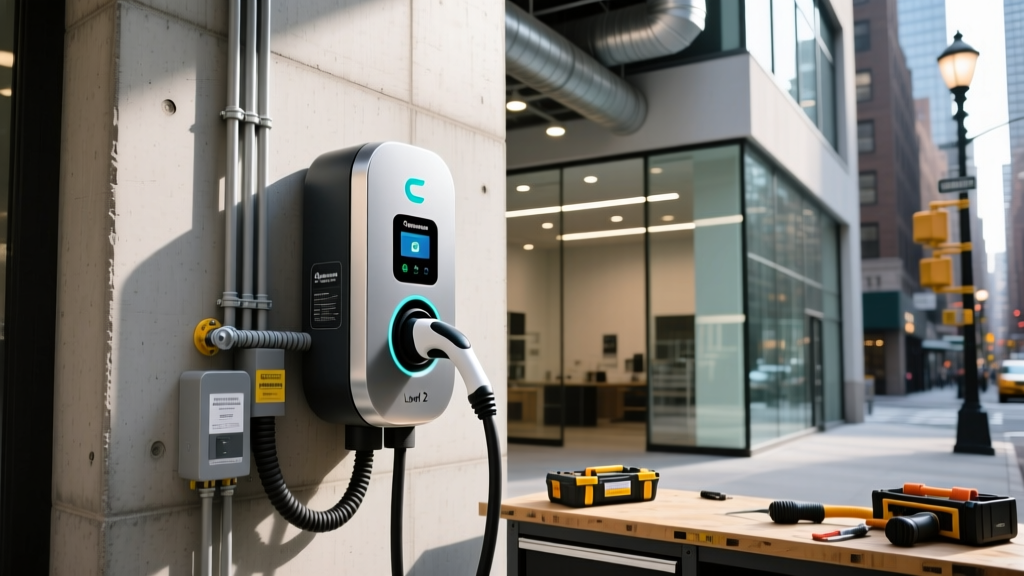
The "make-ready" portion of an EV charger installation refers to all the electrical infrastructure work needed before the charger itself gets mounted. In NYC, this often represents the majority of project cost, especially in buildings constructed before 1980 with limited panel capacity.
What a Standard Level 2 Installation Requires
A typical home Level 2 charger needs a dedicated 240V circuit, sized at 125% of the charger's continuous draw (per National Electrical Code Article 625). A 40-amp charger requires a 50-amp breaker. A 48-amp charger requires a 60-amp breaker. This dedicated circuit must run from your main electrical panel to the charger location using appropriately gauged copper wire — typically 6 AWG for 50-amp circuits and 4 AWG for 60-amp circuits.
In NYC specifically, several additional factors come into play:
- Con Edison interconnection: Any new EV charging load may require notification to Con Edison, particularly for multi-unit dwellings or installations exceeding 10 kW. Con Ed's EV Make-Ready Program can offset infrastructure costs for qualifying projects, covering up to 100% of utility-side upgrades and a significant portion of customer-side work for income-eligible customers and environmental justice communities.
- NYC DOB permitting: Electrical work requires a permit filed through the Department of Buildings. Your licensed electrician handles this, but the timeline adds 2-6 weeks in most boroughs.
- Panel capacity assessment: Many NYC homes — especially in Brooklyn, the Bronx, and Staten Island — have 100-amp or even 60-amp main panels. Adding a 50-amp EV circuit to a 100-amp panel that's already serving electric cooking, HVAC, and a dryer may exceed safe capacity.
When You Need a Panel Upgrade
If your electrician's load calculation shows the panel can't handle the additional EV circuit, you'll need a service upgrade — typically from 100A to 200A. This is the single biggest cost variable in NYC EV charger make-ready work. A panel upgrade involves replacing the main breaker panel, potentially upgrading the service drop from the utility, and new metering equipment.
| Component | Simple Install (Adequate Panel) | Complex Install (Panel Upgrade Needed) |
|---|---|---|
| Level 2 Charger Equipment | $350 – $750 | $350 – $750 |
| Electrical Labor (Licensed Electrician) | $800 – $2,000 | $2,500 – $5,000 |
| Panel / Service Upgrade | $0 (not needed) | $3,000 – $7,000 |
| Permit & DOB Fees | $200 – $500 | $400 – $800 |
| Conduit, Wiring, Mounting Hardware | $200 – $600 | $400 – $1,200 |
| Con Edison Make-Ready Application | $0 (if applicable) | $0 (if applicable) |
| Total Estimated Cost | $1,550 – $3,850 | $6,650 – $14,750 |
The wide range reflects real NYC variability: a Queens homeowner with a 200-amp panel and a garage outlet 15 feet from the panel will spend far less than a Bronx rowhouse owner needing a full service upgrade with a 60-foot conduit run through finished walls. Always get a professional load calculation before budgeting.
Connector Compatibility: NACS, CCS, and the 2026 Landscape
The connector landscape has consolidated dramatically since 2023, when Ford and GM announced adoption of Tesla's North American Charging Standard (NACS). As of the 2026 model year, NACS is the dominant connector for new EVs sold in North America, though CCS1-equipped vehicles from the 2022-2025 model years remain common on the road and at public chargers.
| Connector | Brands Using It (New Vehicles) | Public Charger Availability | Adapter Needed? |
|---|---|---|---|
| NACS (Tesla-style) | Tesla, Ford, GM, Rivian, Hyundai/Kia (2025+), BMW, Mercedes, Volvo/Polestar | Widest network (Tesla Superchargers + new NACS stations) | CCS-to-NACS adapter for legacy vehicles (~$200-$250) |
| CCS1 | VW/Audi (some 2025+), Stellantis, legacy 2022-2024 EVs | Electrify America, EVgo, ChargePoint DC stations | NACS-to-CCS adapter for new NACS vehicles (~$200) |
| CHAdeMO | Nissan Leaf (discontinued 2025), Mitsubishi Outlander PHEV | Declining — mostly legacy stations | No adapter widely available; network shrinking |
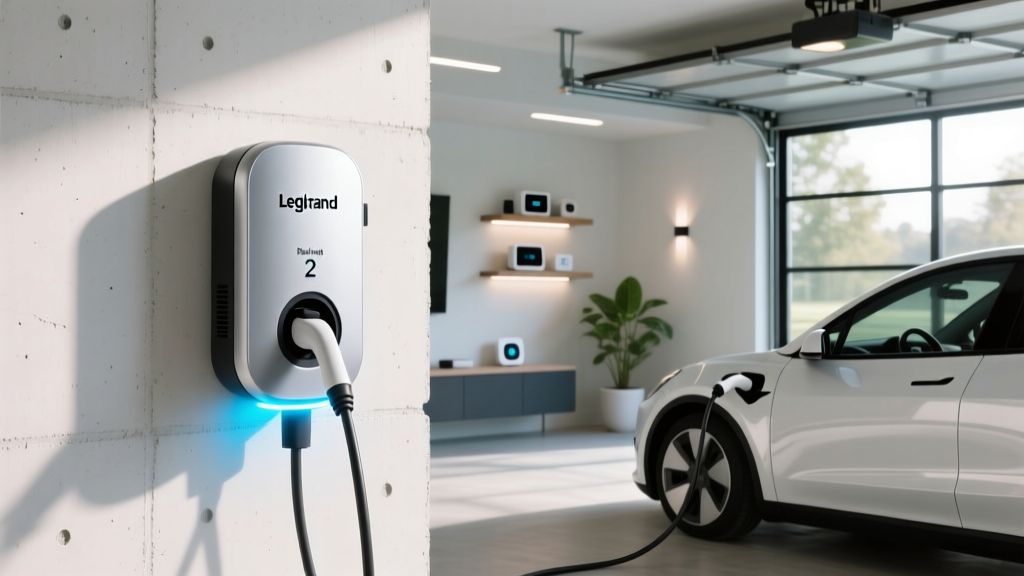
For home Level 2 charging, the connector matters less than you might think. All Level 2 chargers use the J1772 standard plug, which fits every EV sold in the US — including NACS-equipped vehicles, which accept J1772 through a built-in adapter (Tesla has included this since the original Roadster). When buying a home charger, confirm whether it ships with a NACS or J1772 plug, and verify your vehicle's inlet. Most 2026 charger models now offer both plug options.
Top Level 2 Chargers for NYC Installations (2026 Picks)
New York's environment — tight garages, outdoor exposure in the outer boroughs, occasional voltage fluctuations on older Con Ed circuits — demands specific charger features. Here are the units that perform best in NYC conditions, selected based on power output, build quality, smart features, and connector flexibility.
ChargePoint Home Flex (2nd Gen)
- Power Output: Up to 12 kW (50A) on a 60A circuit; adjustable down to 16A for limited panels
- Connector: J1772 (NACS adapter included)
- Cable Length: 23 feet
- Smart Features: Wi-Fi, app scheduling, Alexa/Google integration, utility demand-response ready
- Price: ~$550
- NYC Note: The amperage dip-switch adjustment is ideal for older NYC panels where a full 50A circuit isn't feasible — you can set it to 32A or 40A to match available capacity.
Grizzl-E Smart
- Power Output: Up to 10 kW (40A) on a 50A circuit
- Connector: J1772 or NACS (select at purchase)
- Cable Length: 24 feet
- Smart Features: Wi-Fi, OCPP-compatible, energy tracking
- Price: ~$450
- NYC Note: IP67-rated and built in Canada for cold climates — performs reliably in unheated Brooklyn garages and outdoor driveway installs in Staten Island. The aluminum enclosure handles humidity and temperature swings.
Emporia Vue Level 2 EV Charger
- Power Output: Up to 11.5 kW (48A) on a 60A circuit
- Connector: NACS (J1772 adapter available)
- Cable Length: 24 feet
- Smart Features: Integrates with Emporia Vue whole-home energy monitor, solar-aware scheduling, load management
- Price: ~$400
- NYC Note: Best value for high-output charging. If you're pairing with a home energy monitor to track Con Ed time-of-use rates, the Emporia ecosystem provides the most granular cost data available.
Wall Connector (Tesla, Gen 4)
- Power Output: Up to 11.5 kW (48A) on a 60A circuit
- Connector: NACS native; J1772 adapter available
- Cable Length: 24 feet
- Smart Features: Wi-Fi, OTA updates, Power Sharing (link multiple units on one circuit), access control
- Price: ~$475
- NYC Note: Power Sharing is invaluable for multi-unit dwellings or two-car garages — two Wall Connectors can share a single 60A circuit, dynamically splitting amperage. This can avoid a panel upgrade entirely in some NYC homes.
What It Costs to Charge: Home vs. Public vs. Gas
One of the strongest arguments for EV ownership in NYC is the cost-per-mile advantage of home charging, even with Con Edison's rates. The key variable is when you charge — Con Ed's time-of-use (TOU) plans reward overnight charging with significantly lower per-kWh costs.
| Scenario | Rate ($/kWh) | Vehicle Efficiency | Cost Per Mile |
|---|---|---|---|
| Home Level 2 (Off-Peak, Con Ed TOU) | $0.12 – $0.18 | 3.0 mi/kWh (e.g., Tesla Model Y) | $0.04 – $0.06 |
| Home Level 2 (Standard Con Ed Rate) | $0.22 – $0.30 | 3.0 mi/kWh | $0.07 – $0.10 |
| Public Level 2 (ChargePoint, EVgo) | $0.25 – $0.49 | 3.0 mi/kWh | $0.08 – $0.16 |
| DC Fast Charging (Electrify America, Tesla Supercharger) | $0.35 – $0.58 | 3.0 mi/kWh | $0.12 – $0.19 |
| Gasoline (NYC Average, Regular Unleaded) | — | 28 MPG combined (avg. compact SUV) | $0.13 – $0.15 |
| Gasoline (NYC Average, Premium) | — | 24 MPG combined (performance SUV) | $0.17 – $0.21 |
At off-peak home rates, an EV costs roughly one-third to one-half what a comparable gas vehicle costs per mile. Even at DC fast charging rates, most EVs match or beat gasoline on cost per mile. For a NYC driver covering 10,000 miles annually, home charging at off-peak rates saves approximately $900-$1,100 per year compared to a 28 MPG gas vehicle at $3.60/gallon.
According to fueleconomy.gov, the average 2026 EV achieves 100-130 MPGe combined, translating to 2.8-3.6 miles per kWh. Your actual efficiency depends on driving style, climate control use, and NYC's stop-and-go traffic — regenerative braking in heavy traffic actually helps recover energy, partially offsetting the efficiency penalty of urban driving.
Charging Time Examples: What to Expect with Common Battery Sizes
Here's how long common 2026 EV batteries take to charge at each level, using realistic sustained rates (not peak marketing numbers):
- Tesla Model Y Long Range (75 kWh usable, NMC): Level 1 at 1.4 kW: ~54 hours (10-100%). Level 2 at 9.6 kW (40A): ~8 hours (10-100%). DC Fast at 250 kW peak: ~25 minutes (10-80%), tapering to ~40 minutes (10-90%).
- Hyundai Ioniq 5 (77.4 kWh usable, NMC): Level 2 at 10.9 kW (48A): ~7.5 hours (10-100%). DC Fast at 240 kW peak (800V architecture): ~18 minutes (10-80%).
- Ford Mustang Mach-E Extended Range (91 kWh usable, NMC): Level 2 at 9.6 kW (40A): ~10 hours (10-100%). DC Fast at 150 kW peak: ~40 minutes (10-80%).
- Chevrolet Equinox EV (85 kWh usable, NMC): Level 2 at 11.5 kW (48A): ~8 hours (10-100%). DC Fast at 150 kW peak: ~35 minutes (10-80%).
A critical reality about DC fast charging: the published peak kW rate is not sustained across the full session. Battery management systems progressively reduce charge rate as the battery fills — a 250 kW peak may average only 120-150 kW across a 10-80% session. Cold batteries further reduce charging speed; in NYC's January temperatures (averaging 27-39°F), expect 20-40% slower DC charging unless your vehicle has preconditioned the battery during navigation to the charger.
Safety, Code, and NYC-Specific Installation Considerations
New York City's electrical code incorporates the National Electrical Code (NEC) with local amendments. Your licensed electrician will handle compliance, but understanding the requirements helps you evaluate quotes and plan the project.
- Dedicated circuit required: NEC Article 625 mandates that EV charging equipment be on a dedicated branch circuit — it cannot share with other outlets or appliances. This is non-negotiable.
- GFCI protection: The 2023 NEC (adopted by NYC) requires GFCI protection for all EV charging outlets. Hardwired chargers have internal ground-fault protection and may not require an external GFCI breaker, which saves $40-$80 on the breaker itself. Most NYC electricians now recommend hardwired installs for this reason.
- Outdoor rating: For driveway or curbside installations, the charger must carry at minimum a NEMA 4 (weatherproof) rating. All chargers recommended above meet or exceed this standard. Conduit and junction boxes must also be rated for wet locations.
- Co-op and condo board approval: In NYC multi-unit dwellings, EV charger installation typically requires board approval, a licensed engineer's assessment of building electrical capacity, and potentially a shared-infrastructure plan. The NYSERDA Drive Clean NY program provides technical assistance and funding for multi-unit dwelling make-ready projects.
- Curb-side and sidewalk installations: Installing a charger that requires running conduit across or under a public sidewalk requires a NYC Department of Transportation (DOT) permit and specific liability insurance. This is a significant additional cost and timeline factor for street-parking-dependent EV owners.
Frequently Asked Questions
How much does it cost to install a home EV charger in NYC?
For a straightforward installation with adequate panel capacity, expect $1,550-$3,850 including equipment, electrician labor, permits, and materials. If your home needs a panel upgrade (common in pre-1980 NYC buildings), total costs range from $6,650-$14,750. Con Edison's Make-Ready Program can offset a portion of utility-side infrastructure costs, and the federal IRS §30D rules do not cover charger installation for residential use (the §30C alternative fuel infrastructure credit expired for most residential applications), though New York State may offer additional incentives through NYSERDA.
How fast will each charging level add range to my EV?
Level 1 (standard 120V outlet) adds 3-5 miles of range per hour — adequate for plug-in hybrids with 25-40 miles of electric range, but impractical for full battery EVs. Level 2 (240V home charger) adds 12-60 miles per hour depending on amperage, fully recharging most EVs overnight. DC Fast Charging adds 180-1,200+ miles per hour at peak rates, delivering a 10-80% charge in 18-45 minutes depending on the vehicle and station power.
Which connector and charger is compatible with my EV?
If you drive a 2025 or newer Ford, GM, Rivian, Hyundai, Kia, BMW, Mercedes, or Tesla, your vehicle uses the NACS connector. For home Level 2 charging, all EVs accept the J1772 plug (NACS vehicles use an included adapter). When purchasing a home charger, select one matching your vehicle's native connector or use the manufacturer-provided adapter. CCS1 vehicles from 2022-2024 may need a CCS-to-NACS adapter (~$200) for access to the expanding Supercharger network. CHAdeMO vehicles (Nissan Leaf) face declining public charger availability.
How much does EV charging cost per mile compared to gasoline?
Charging at home on Con Edison's off-peak TOU rate costs approximately $0.04-$0.06 per mile for an efficient EV like the Tesla Model Y. Standard home rates bring this to $0.07-$0.10 per mile. Public DC fast charging ranges from $0.12-$0.19 per mile. By comparison, gasoline at NYC's 2026 average of $3.60/gallon costs $0.13-$0.15 per mile for a 28 MPG compact SUV, making home-charged EVs roughly 60-70% cheaper per mile.
What electrical upgrades might I need for a home charger?
The most common upgrade is a panel or service upgrade from 100A to 200A, required when your existing panel lacks capacity for a dedicated 50-60A EV circuit. Signs you may need this include: frequent breaker trips, a panel already near capacity with existing appliances, or a main panel rated below 150A. Your electrician will perform a load calculation per NEC Article 220 to determine this. Less common upgrades include upgrading the service drop wire from the utility pole, replacing an outdated fuse box with a breaker panel, or adding a sub-panel in a detached garage. For multi-unit buildings, a transformer upgrade or new utility service may be necessary — this is where Con Edison's Make-Ready Program becomes critical.