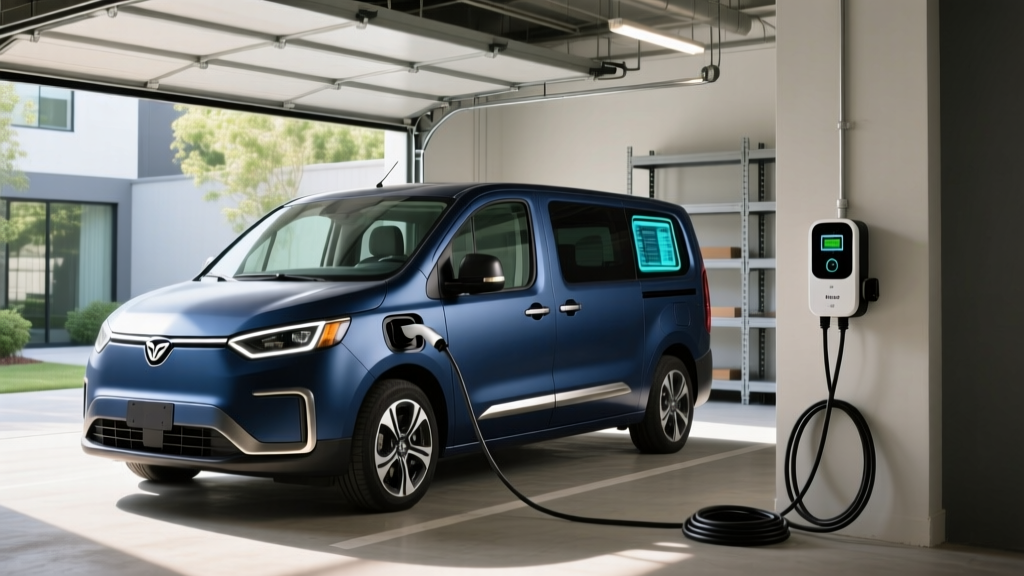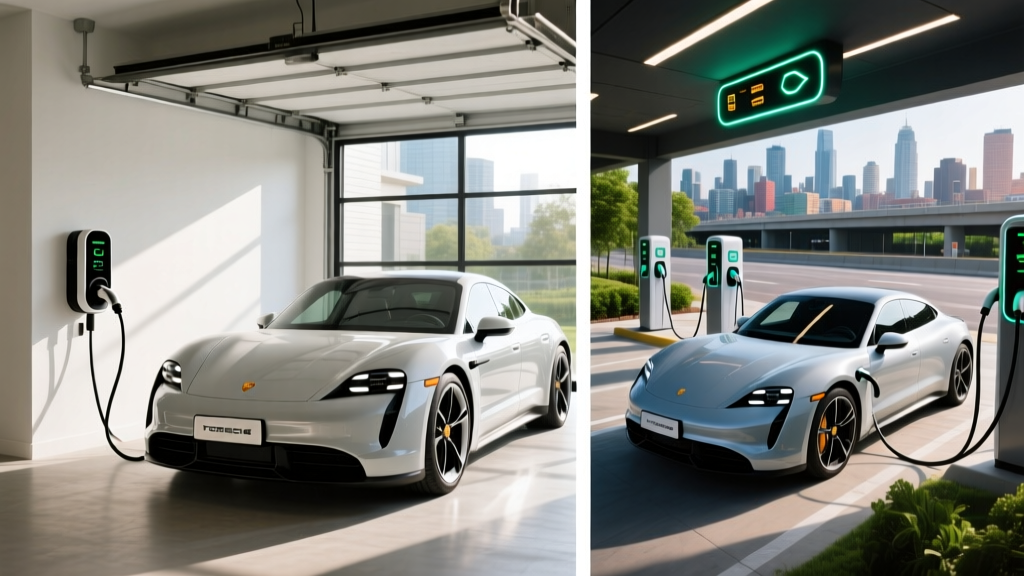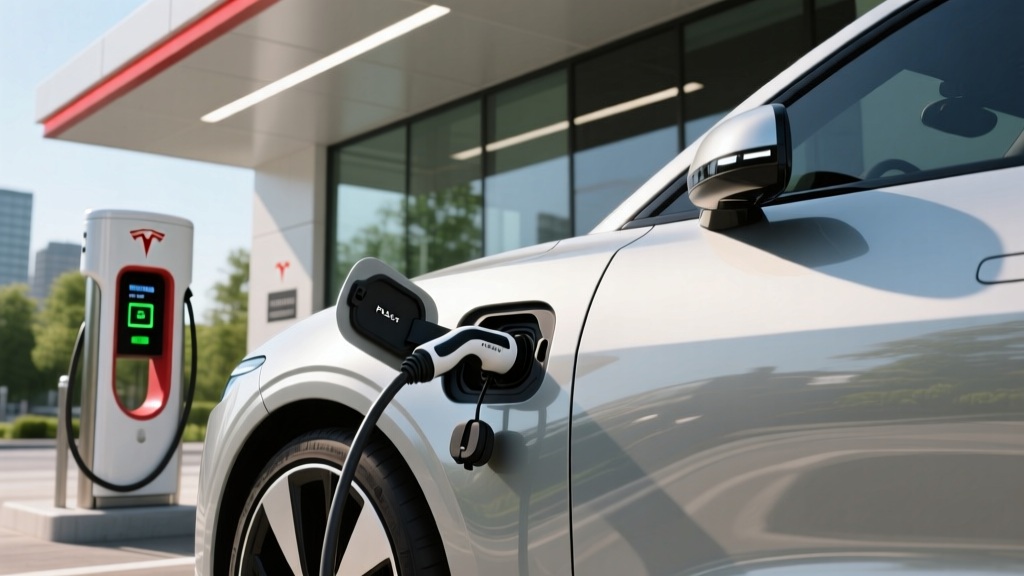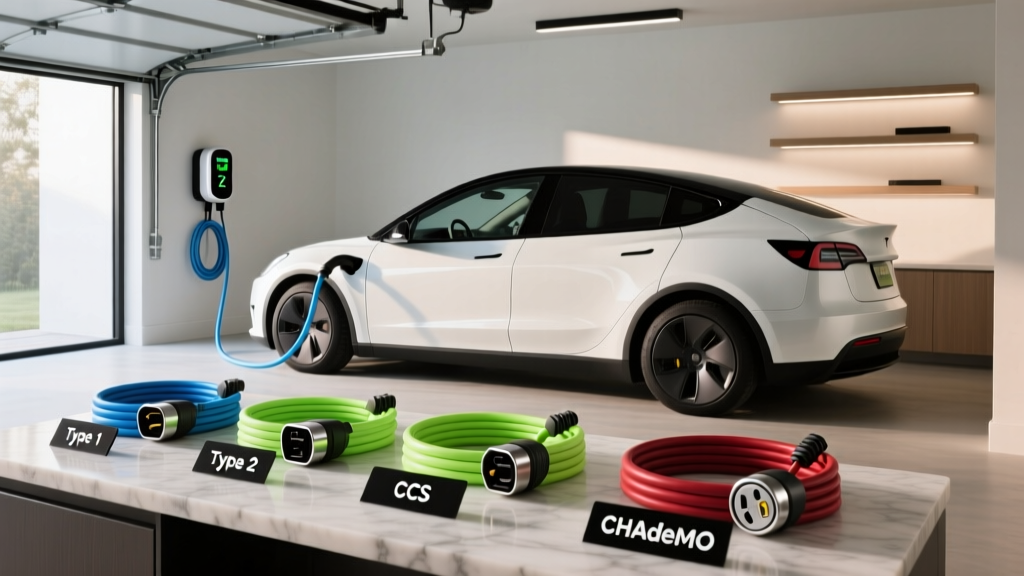
If you've just ordered your first electric vehicle—or you're trying to squeeze faster charging out of your current one—the physical connection between your car and the grid matters more than most buyers realize. The EV charger cable you use determines how quickly your battery refills, whether you can charge at home overnight or need to rely on public stations, and how much you'll spend per mile driven. This guide walks through every cable type, connector standard, and installation scenario you'll encounter as an EV owner in 2026.
Understanding EV Charging Levels: kW, kWh, and Miles Per Hour
Before comparing cables, let's nail down the two units that cause the most confusion:
- kWh (kilowatt-hour) measures energy—the size of your battery. A 75 kWh battery holds 75 kWh of energy, similar to how a 15-gallon gas tank holds 15 gallons of fuel.
- kW (kilowatt) measures power—the rate at which energy flows. A 19.2 kW charger delivers energy faster than a 7.2 kW charger, just as a wider hose fills a bucket faster.
Every EV charger cable operates at one of three charging levels. Here's how they stack up in real-world performance:
| Level | Voltage | Max Power (kW) | Miles of Range Added Per Hour | Typical Use Case |
|---|---|---|---|---|
| Level 1 | 120V AC | 1.2–1.9 kW | 3–5 miles | Emergency top-ups, PHEVs, low-mileage drivers |
| Level 2 | 240V AC | 3.3–19.2 kW | 12–75 miles | Home daily charging, workplace, public destination |
| DC Fast Charge | 400–900V DC | 50–350+ kW | 150–1,000+ miles (theoretical) | Road trips, rapid top-ups; 10–80% in 15–40 min |
Real-world caveat: DC fast charging speeds peak only between roughly 10–30% state of charge (SoC), then taper significantly as the battery fills. A charger rated for 250 kW might sustain that peak for only 5–8 minutes before dropping to 150 kW, then 75 kW, then 50 kW as you approach 80%. This is why manufacturers quote 10–80% times rather than 0–100%.
EV Charger Cable Connector Types: Which One Fits Your Car?
The connector on the end of your EV charger cable must match your vehicle's charge port. In 2026, North America is in the middle of a major transition from CCS1 to NACS (the former Tesla connector, now an SAE standard). Here's where each brand stands:
| Connector | Brands Using It | Notes |
|---|---|---|
| NACS (J3400) | Tesla, Ford, GM, Rivian, Volvo, Polestar, Mercedes-Benz, Nissan (new models), Fisker | Adopted by most major OEMs starting 2025–2026 model years |
| CCS1 (Combo) | Hyundai, Kia, BMW, Volkswagen, Stellantis/Chrysler, legacy models from Ford/GM | Still common on 2023–2024 models; CCS-to-NACS adapters widely available |
| CHAdeMO | Nissan Leaf (legacy), Mitsubishi Outlander PHEV (older) | Effectively discontinued for new models; infrastructure declining |
Adapter reality: If you own a CCS1-equipped vehicle but want access to Tesla's Supercharger network (now open to non-Tesla EVs at many locations), a CCS-to-NACS adapter is required. Tesla sells an official adapter for roughly $250, and third-party options from brands like Lectron and A2Z are available for $150–$200. For home Level 2 charging, most wall connectors now ship with NACS plugs, but CCS-compatible units remain available.
Home EV Charger Installation: Electrical Requirements and Costs
Installing a dedicated Level 2 home charger is the single biggest quality-of-life upgrade an EV owner can make. But the total cost depends heavily on your home's electrical panel, the distance from the panel to your garage or driveway, and local permitting requirements.
Electrical Requirements for Level 2 Charging
A Level 2 EV charger cable requires a 240-volt dedicated circuit, similar to what powers an electric dryer or oven. Common circuit sizes:
- 40-amp circuit → supports up to 32 amps continuous draw (9.6 kW max) — the most common home setup
- 50-amp circuit → supports up to 40 amps continuous (9.6 kW) or 48 amps (11.5 kW) with hardwired units
- 60-amp circuit → supports up to 48 amps continuous (11.5 kW) — needed for higher-output chargers
- 100-amp circuit → supports up to 80 amps continuous (19.2 kW) — rare in homes; requires a 200A+ panel
The National Electrical Code (NEC) requires that continuous loads (like EV charging, which runs for 3+ hours) not exceed 80% of the circuit breaker rating. So a 40A breaker safely delivers 32A continuous.
Installation Cost Breakdown
Here's what you should budget for a professional Level 2 home charger installation, based on national averages in 2026:
| Component | Simple Install (panel in garage) | Complex Install (long run / panel upgrade) |
|---|---|---|
| EV charger equipment (Level 2, 32–48A) | $350–$700 | $350–$700 |
| Electrician labor (2–4 hrs simple; 6–12 hrs complex) | $300–$800 | $1,200–$3,500 |
| Wiring, conduit, and materials | $100–$300 | $500–$2,000 |
| Permit and inspection | $50–$200 | $100–$350 |
| Electrical panel upgrade (if needed: 100A → 200A) | $0 (not needed) | $1,500–$4,000 |
| Total estimated cost | $800–$2,000 | $3,650–$10,550 |
Panel upgrade reality: Homes built before 1990 often have 100-amp or even 60-amp electrical panels. Adding a 40A or 50A dedicated EV circuit may exceed the panel's capacity, especially if you also run electric heat, a dryer, and an oven. A panel upgrade to 200 amps adds $1,500–$4,000 but is sometimes unavoidable. Some utilities offer rebates of $200–$500 for panel upgrades tied to EV adoption—check with your local provider.
Safety and Code Considerations
- Dedicated circuit: Your EV charger must be on its own breaker—never shared with other appliances.
- GFCI protection: The 2023 NEC (adopted in most jurisdictions by 2026) requires GFCI protection for all EV charging outlets. Hardwired chargers often have built-in GFCI, but plug-in units on a NEMA 14-50 outlet need a GFCI breaker (~$50–$80 extra).
- Outdoor rating: If your charger is mounted outside or in an uncovered carport, ensure the unit carries a NEMA 4 or IP65 weather rating. Most quality chargers are rated for outdoor use, but the connector holster should shield the plug from rain and debris.
- Cable management: Longer EV charger cables (25 feet) offer flexibility for driveway parking but add weight and bulk. Consider a retractable reel or hook system to keep the cable off the ground.
Charging Time Examples: 10–80% for Common Battery Sizes
How long your EV charger cable takes to refill your battery depends on the battery's usable capacity (in kWh) and the charger's sustained power output (in kW). Here are real-world estimates for popular 2026 EVs:
| Vehicle (Usable kWh) | Level 1 (1.4 kW) | Level 2 (11.5 kW / 48A) | DC Fast (Peak kW → Avg kW) |
|---|---|---|---|
| Tesla Model Y LR (~79 kWh) | ~39 hours | ~5 hours | ~25 min (250 kW peak → ~150 kW avg) |
| Hyundai Ioniq 5 (~77 kWh) | ~38 hours | ~5 hours | ~18 min (350 kW peak → ~190 kW avg, 800V) |
| Ford F-150 Lightning Ext (~131 kWh) | ~65 hours | ~8 hours | ~41 min (150 kW sustained avg) |
| Chevrolet Equinox EV (~85 kWh) | ~42 hours | ~5.5 hours | ~30 min (150 kW peak → ~110 kW avg) |
| Toyota RAV4 PHEV (~18 kWh) | ~9 hours | ~2.5 hours (3.3 kW onboard) | N/A (no DC fast charge) |
Key takeaway: Level 1 charging is adequate only for plug-in hybrids with small batteries or BEV owners who drive fewer than 30 miles per day and can charge over 12+ hours. For any BEV with a 70+ kWh battery, a Level 2 home charger is practically mandatory for daily use.
Cost to Charge: Home vs. Public vs. Gas Per Mile
One of the strongest arguments for EV ownership is lower fueling cost—but the savings vary dramatically depending on where and when you charge. Below is a cost-per-mile comparison using 2026 national averages:
| Charging Scenario | Rate ($/kWh) | Cost to Add 200 Miles* | Cost Per Mile |
|---|---|---|---|
| Home Level 2 (off-peak utility rate) | $0.08–$0.14 | $5.60–$9.80 | $0.028–$0.049 |
| Home Level 2 (standard residential rate) | $0.14–$0.20 | $9.80–$14.00 | $0.049–$0.070 |
| Public Level 2 (network pricing) | $0.25–$0.49 | $17.50–$34.30 | $0.088–$0.172 |
| DC Fast Charge (Electrify America, EVgo, etc.) | $0.35–$0.55 | $24.50–$38.50 | $0.123–$0.193 |
| Tesla Supercharger (varies by location/time) | $0.25–$0.40 | $17.50–$28.00 | $0.088–$0.140 |
| Gasoline vehicle (25 MPG combined, $3.40/gal) | — | $27.20 | $0.136 |
*Based on an average EV efficiency of 3.5 miles per kWh (≈286 Wh/mi), typical of midsize crossovers like the Model Y, Ioniq 5, and Equinox EV.
Home charging at off-peak rates delivers fuel costs roughly 60–75% lower than gasoline. But if you rely exclusively on DC fast charging at public stations, your cost per mile can equal or exceed a fuel-efficient gas car. This is why a home Level 2 charger isn't just a convenience—it's an economic necessity for most EV owners.
Recommended EV Charger Equipment for 2026
Not all Level 2 chargers are created equal. Below are top-performing units based on reliability, feature sets, and value:
Tesla Wall Connector (Gen 4)
- Power output: Up to 48 amps (11.5 kW on 60A circuit)
- Connector: NACS native; includes J1772 adapter in box
- Cable length: 24 feet
- Smart features: Wi-Fi, OTA updates, power sharing (link multiple units on one circuit), scheduled charging via Tesla app
- Price: ~$475
- Best for: Tesla owners and any NACS-equipped vehicle; excellent power-to-price ratio
ChargePoint Home Flex (2nd Gen)
- Power output: Adjustable 16–50 amps (up to 12 kW on 60A circuit)
- Connector: Available in NACS or J1772 (CCS-compatible) versions
- Cable length: 23 feet
- Smart features: Wi-Fi, ChargePoint app with detailed energy tracking, Alexa integration, flexible amperage setting to match your circuit
- Price: ~$599–$699
- Best for: Multi-EV households, CCS1 owners, renters who may move (adjustable amperage adapts to different homes)
Emporia Level 2 EV Charger
- Power output: Up to 48 amps (11.5 kW)
- Connector: J1772 (NACS adapter available separately)
- Cable length: 24 feet
- Smart features: Wi-Fi, Emporia energy monitoring ecosystem, solar integration for solar-self-consumption charging, load management
- Price: ~$399
- Best for: Budget-conscious buyers, solar panel owners, energy-monitoring enthusiasts
Grizzl-E Smart (United Chargers)
- Power output: Adjustable 16–40 amps (up to 9.6 kW)
- Connector: J1772 or NACS versions
- Cable length: 24 feet
- Smart features: Wi-Fi, OCPP compatibility, extreme cold rating (-40°C), aluminum enclosure
- Price: ~$449–$549
- Best for: Cold-climate owners, outdoor installations, durability-focused buyers
Cable length matters: A 24–25 foot EV charger cable is the sweet spot for most garages and driveways. Shorter cables (18 feet) save weight but may not reach your charge port if you park at an angle. Longer cables (30+ feet) are available from some brands but add significant bulk and cost. Always measure the distance from your planned charger mount to your vehicle's charge port before ordering.
Public Charging Cable Considerations
At public DC fast-charging stations, the cable is permanently attached to the dispenser—you don't bring your own. However, a few practical notes apply:
- Cable weight: High-power 350 kW CCS cables are liquid-cooled and significantly heavier than older 50 kW cables. Some users find them difficult to maneuver, especially in tight parking spots.
- Cable reach: Station cables are typically 6–10 feet long. If your charge port is on the opposite side from where you park, you may need to reposition. Tesla Supercharger stalls are designed for rear-driver-side ports; some non-Tesla stations assume front-quarter-panel ports.
- Carry a J1772-to-NACS adapter: For public Level 2 destination chargers (hotels, shopping centers), a small adapter ensures you can use any J1772-equipped station with a NACS vehicle. These adapters weigh under 1 pound and cost $100–$200.
Frequently Asked Questions
How much does it cost to install a home EV charger?
A straightforward Level 2 installation with the electrical panel nearby typically costs $800–$2,000 total (equipment, labor, permit). Complex installs requiring long conduit runs or a panel upgrade to 200 amps can reach $3,500–$10,000+. Always get 2–3 quotes from licensed electricians and ask specifically about the circuit size, wire gauge, and whether your panel has spare capacity. See the National Electrical Code (NFPA 70) for the applicable standards.
How fast will each charging level add range?
Level 1 (120V) adds roughly 3–5 miles of range per hour—fine for a PHEV but inadequate for most BEVs. Level 2 (240V) adds 12–75 miles per hour depending on amperage and your car's onboard charger capacity. DC fast charging can add 150+ miles in 15–20 minutes but is meant for road trips, not daily use, due to higher cost and long-term battery wear at high charge rates. Consult fueleconomy.gov for your specific vehicle's efficiency rating.
Which connector is compatible with my EV?
Check your vehicle's charge port or owner's manual. Most 2025–2026 models from Tesla, Ford, GM, Rivian, and Volvo use NACS. Most Hyundai, Kia, BMW, and VW models still use CCS1. CHAdeMO is limited to older Nissan Leaf and Mitsubishi models. If you're buying a charger for home, match it to your car's native connector to avoid adapter hassle.
How much does charging cost per mile vs. gas?
Home charging at off-peak rates costs roughly $0.03–$0.05 per mile—about 60–75% less than a 25 MPG gas car at $3.40/gallon ($0.14/mile). Public DC fast charging at $0.35–$0.55/kWh costs $0.12–$0.19 per mile, which can equal or exceed gasoline costs. The economic case for EVs depends heavily on consistent access to affordable home charging.
What electrical upgrades might I need?
If your home has a 100-amp electrical panel or less, you'll likely need a panel upgrade to 200 amps before adding a 40–60 amp dedicated EV circuit. Homes with 200A panels usually have sufficient capacity, but if you already run electric heat, an electric dryer, and an electric range simultaneously, a load calculation by your electrician may reveal the need for a smart load-management device (like the Emporia or Span panel integration) that dynamically reduces EV charging when other appliances draw heavy current.
Can I use an extension cord with my EV charger?
No. Extension cords are not rated for the sustained high-current draw of EV charging and create a serious fire hazard. If your charger cable doesn't reach your vehicle, relocate the charger unit or have an electrician install a properly rated outlet closer to your parking spot.
Does the federal tax credit cover home charger installation?
The IRS §30C Alternative Fuel Vehicle Refueling Property Credit covers up to 30% of home EV charger equipment and installation costs, capped at $1,000. However, eligibility depends on your census tract meeting certain income or rural criteria. Check the latest IRS guidance and consult a tax professional before claiming.
Your EV charger cable is the physical link between the grid and your daily driving. Choosing the right connector, installing a properly sized Level 2 circuit, and understanding the cost difference between home and public charging will determine whether your EV ownership experience is seamless or frustrating. Invest in a quality charger, hire a licensed electrician, and charge smart.