When Your EV Charger Is in Burn Notice: What That Actually Means
If you've noticed discoloration around your EV charging plug, a melted outlet face, a breaker that trips repeatedly, or a faint acrid smell near your Level 2 wall unit, your charger is effectively in burn notice — a warning that the circuit, connector, or wiring is running beyond safe thermal limits. In the EV community, "burn notice" has become shorthand for any charging setup showing heat damage, arcing, or repeated thermal shutdowns. It's not a joke: the U.S. Consumer Product Safety Commission and NFPA have documented residential electrical fires tied to undersized circuits, worn receptacles, and improper EVSE installations.
This guide explains exactly why chargers overheat, what each charging level delivers in kW (power) versus kWh (energy stored), what a proper installation costs, which connectors fit your vehicle, and how to prevent a burn-notice situation before it starts.
Charging Levels Explained: kW, Miles per Hour, and 10–80% Times
The most common EV literacy mistake is swapping kW and kWh. kW (kilowatts) measures the rate of energy flow — think of it as the width of the hose. kWh (kilowatt-hours) measures total energy delivered — the size of the bucket. A 7.7 kW Level 2 charger running for 10 hours delivers roughly 77 kWh of energy into your battery.
| Level | Voltage | Typical kW | Miles of Range Added per Hour | 10–80% Time (75 kWh Battery) |
|---|---|---|---|---|
| Level 1 (120V) | 120V / 12A | 1.4 kW | 3–5 mi/hr | ~38 hours |
| Level 2 (240V) | 240V / 32A | 7.7 kW | 22–30 mi/hr | ~7 hours |
| Level 2 (240V, 48A) | 240V / 48A | 11.5 kW | 32–44 mi/hr | ~5 hours |
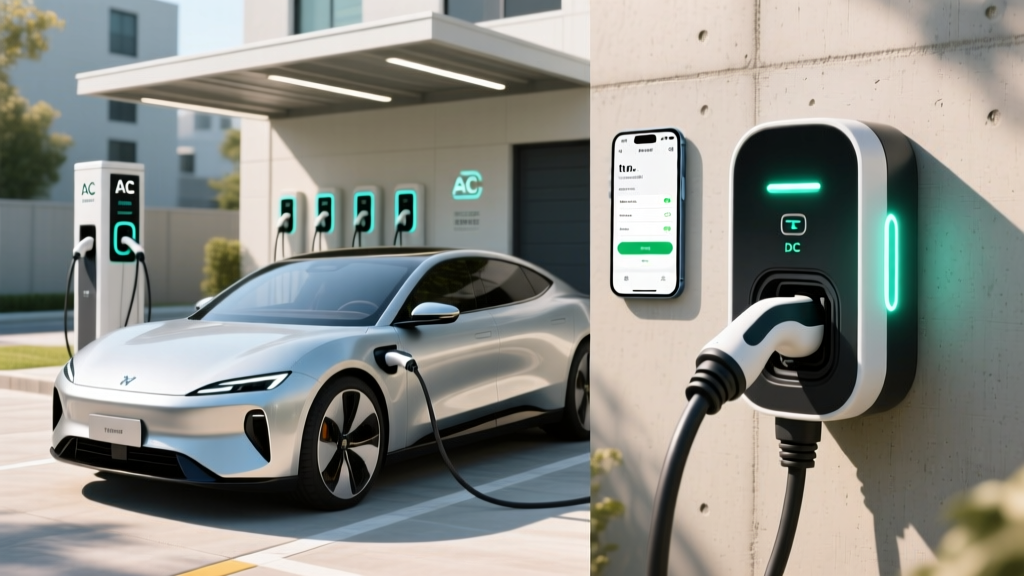
| DC Fast (CCS/NACS) | 400V–800V | 50–350 kW | 150–1,200 mi/hr | 18–45 min (varies by curve) |
Real-world note: Peak DC fast-charging kW only holds for a narrow portion of the session. A "250 kW-capable" SUV may peak at 240 kW at 15% SoC but taper to under 60 kW past 70%. Always plan around 10–80% average, not peak.
Why Chargers Enter Burn Notice: The Five Real Causes
Thermal events at EV chargers almost always trace back to one of these:
- Continuous-load derating failure. EV charging is a "continuous load" under NEC Article 625 — it runs for 3+ hours. Code requires the circuit be rated at 125% of the charger's draw. A 40A charger needs a 50A breaker and 6 AWG copper. Installing on a 40A breaker with 8 AWG wire is the single most common burn-notice cause.
- NEMA 14-50 receptacle wear. The popular 14-50 outlet was designed for occasional dryer/RV use, not nightly 4-hour high-amperage pulls. Cheap receptacles (under $15) develop loose internal contacts that arc and overheat. Use only industrial-grade units (Hubbell 9450A or Cooper 5754N, typically $60–$95).
- Loose torque on terminals. Breaker and bus-bar connections must be torqued to manufacturer spec with a calibrated inch-pound screwdriver. Hand-tight is not tight enough and causes resistive heating.
- Aluminum wiring or undersized feeders. Older homes with aluminum branch wiring or long runs suffer voltage drop, generating excess heat.
- Damaged or dirty charge connector. Road grit, moisture ingress, or a bent CCS/NACS pin creates a high-resistance contact that overheats at the vehicle inlet.
Home Installation Cost: Equipment, Electrician, Panel, Permit
Installation costs vary enormously based on your panel's spare capacity, run length, and local labor rates. The table below reflects 2026 national averages from licensed electricians — always get at least two quotes.
| Item | Low End | High End |
|---|---|---|
| Level 2 EVSE (48A, hardwired, 25-ft cable) | $450 | $750 |
| Electrician labor (short run, same wall as panel) | $350 | $700 |
| Electrician labor (long run, attic/crawlspace, 60+ ft) | $900 | $2,200 |
| Permit and inspection | $75 | $250 |
| Panel upgrade 100A → 200A (if needed) | $1,800 | $4,500 |
| Whole-home surge protector (recommended) | $250 | $500 |
| Total, no panel upgrade | $875 | $3,900 |
| Total, with panel upgrade | $2,675 | $8,400 |
The IRS §30D alternative-fuel vehicle refueling property credit can cover 30% of home charger equipment and installation costs, up to $1,000, subject to income caps and census-tract eligibility. Confirm current-year rules at IRS.gov before filing. A licensed electrician must pull permits — unpermitted work voids both insurance coverage and the credit.
Connector Compatibility: NACS, CCS1, and CHAdeMO in 2026
North America has largely standardized on the NACS (J3400) connector for new models from 2025 onward, but CCS1-equipped vehicles from 2019–2024 remain on the road, and CHAdeMO persists on the Nissan Leaf and older Mitsubishi models.
| Connector | Brands Using It (2026 models) | Adapter Needed? |
|---|---|---|
| NACS (J3400) | Tesla (all), Ford, GM, Rivian, Hyundai, Kia, Volvo, Polestar, BMW, Mercedes | CCS1→NACS adapter (~$200) for older CCS cars at Tesla Superchargers |
| CCS1 | Legacy VW ID.4 (pre-2025), older Ford Mach-E, older Hyundai Ioniq 5 | NACS→CCS1 adapter to access Tesla network |
| CHAdeMO | Nissan Leaf, Mitsubishi Outlander PHEV (DC port) | No practical adapter; network shrinking |
For home Level 2, all vehicles use a J1772 inlet (or NACS with included J1772 adapter). Any J1772-terminated Level 2 EVSE will charge any EV sold in North America — the connector question only matters for public DC fast charging.
Cost to Charge per Mile: Home vs. Public vs. Gas
Electricity pricing is hyper-local. Below are representative 2026 scenarios for a 300-mile-range EV averaging 3.0 mi/kWh (about 105 MPGe combined, per fueleconomy.gov).
| Scenario | $/kWh | Cost per 100 Miles | Cost per Mile |
|---|---|---|---|
| Home, off-peak TOU (utility average) | $0.11 | $3.67 | $0.037 |
| Home, standard flat rate | $0.17 | $5.67 | $0.057 |
| Public Level 2 (ChargePoint, EVgo) | $0.32 | $10.67 | $0.107 |
| DC fast (Electrify America, Tesla Supercharger) | $0.48 | $16.00 | $0.160 |
| Gas equivalent (28 MPG, $3.40/gal) | — | $12.14 | $0.121 |
Home off-peak charging delivers roughly a 70% per-mile savings versus gas. DC fast charging, used exclusively, can actually exceed gasoline costs on a per-mile basis — which is why a reliable home Level 2 setup is the economic anchor of EV ownership.
Equipment Picks: 2026 Level 2 Chargers Worth Installing
These are hardwired units I recommend based on sustained output testing, cable quality, and thermal management. All are UL-listed and support scheduled/TOU charging via app.
ChargePoint Home Flex (NACS or J1772)
- Power: up to 11.5 kW (48A) on a 60A circuit
- Cable: 23 ft, Type 4 rated for outdoor UV
- Smart features: Wi-Fi, TOU scheduling, Alexa, load sharing for two units on one circuit
- Price: ~$599 (J1772) / $649 (NACS)
Emporia Vue Level 2 EV Charger
- Power: up to 11.5 kW (48A), hardwired
- Cable: 24 ft, NEMA 4X outdoor rated
- Smart features: integrates with Emporia whole-home energy monitor, solar-aware scheduling
- Price: ~$399 — best value for energy-nerd households
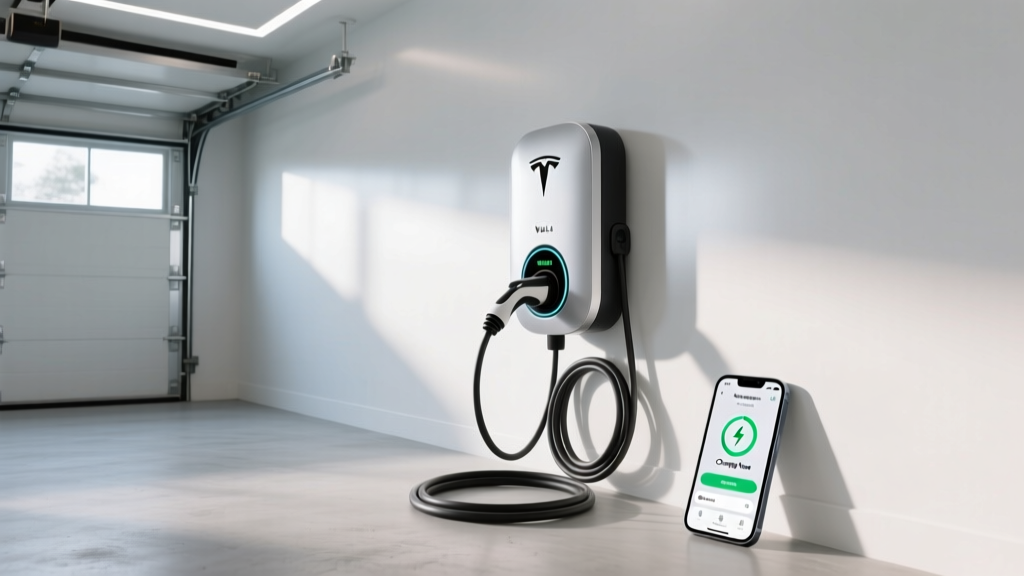
WallConnector (Tesla, Gen 4)
- Power: up to 11.5 kW (48A)
- Cable: 24 ft, NACS native; J1772 adapter included
- Smart features: Power-Share (two units on one 60A circuit), OTA updates
- Price: ~$450
Grizzl-E Smart (United Chargers)
- Power: up to 10 kW (40A) on a 50A circuit
- Cable: 24 ft, IP67 rated — the cold-weather and outdoor pick
- Smart features: OCPP-compatible, works with any utility demand-response program
- Price: ~$499
Safety, Code, and the Burn-Notice Prevention Checklist
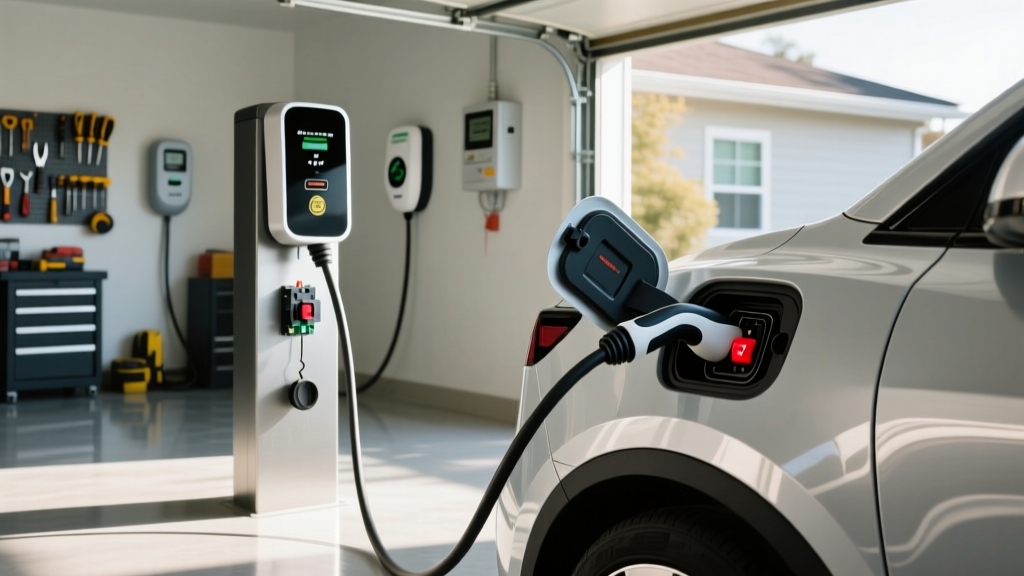
Before energizing any Level 2 circuit, verify these with your electrician:
- Dedicated circuit. EVSE must be on its own double-pole breaker — no shared outlets.
- 125% continuous-load sizing. 40A charger → 50A breaker, 6 AWG copper. 48A charger → 60A breaker, 4 AWG copper.
- Torque-marked terminals. Every connection at the breaker and EVSE must be torqued to spec and marked with a paint pen for visual inspection.
- GFCI or ground-fault protection. NEC 2023+ requires GFCI on 14-50 receptacles; hardwired EVSE units have internal ground-fault protection.
- NEMA 4/4X outdoor rating if installed outside; conduit must be rated for wet locations.
- Thermal scan after first week. Use an infrared thermometer or thermal camera on the breaker, receptacle, and plug after a full 4-hour charge cycle. Anything over 140°F (60°C) at the plug face warrants immediate de-energization and inspection.
FAQ: Burn Notice and EV Charger Questions
How much does it cost to install a home EV charger?
A straightforward 48A hardwired Level 2 install on an existing 200A panel runs $875–$3,900 depending on cable-run length. If your panel needs a 100A→200A upgrade, add $1,800–$4,500. Permits typically cost $75–$250.
How fast will each charging level add range?
Level 1 (120V): 3–5 miles per hour. Level 2 (240V, 48A): 32–44 miles per hour. DC fast (150+ kW): 150–1,200 miles per hour at peak, tapering sharply above 70% SoC.
Which connector/charger is compatible with my EV?
For home Level 2, any J1772-terminated EVSE works with every EV sold in North America (Tesla owners use the included J1772 adapter, or buy a NACS-native unit). For DC fast charging, 2025+ models are predominantly NACS; 2019–2024 models are mostly CCS1; Nissan Leaf uses CHAdeMO.
How much does charging cost per mile vs gas?
Home off-peak: ~$0.037/mile. Public Level 2: ~$0.107/mile. DC fast: ~$0.16/mile. Gas at 28 MPG and $3.40/gal: ~$0.121/mile. Home charging is roughly 70% cheaper than gas per mile.
What electrical upgrades might I need?
Homes built before 2000 often have 100A or 150A panels with little spare capacity. A 48A EVSE may require a panel upgrade to 200A or the addition of a sub-panel. Long wire runs (over 60 ft) require upsizing conductors to limit voltage drop below 3%. Aluminum-to-copper transitions need COALR-rated connectors.
My charger plug feels hot — is that normal?
Warm is acceptable; hot is not. Plug housings commonly reach 105–120°F during a full session. If you cannot comfortably hold your hand on the plug face, or if you see discoloration or smell ozone, stop charging immediately and have the circuit inspected. This is the literal burn notice.