Choosing among EV charger brands is no longer a one-size-fits-all decision. With the North American Charging Standard (NACS) now dominant, 48-amp and 80-amp home units widely available, and smart-grid features maturing, the right hardware depends on your vehicle's onboard charger capacity, your electrical panel's headroom, and how many miles you actually need to add overnight. This guide cuts through marketing claims and gives you the exact specs, costs, and compatibility data to pick the best home EV charger for your setup in 2026.
Charging Levels Explained: kW, Miles Per Hour, and What Your EV Can Accept
Before comparing EV charger brands, understand the three charging tiers. kW (kilowatts) measures power — the rate at which energy flows. kWh (kilowatt-hours) measures energy — the total amount stored in your battery. Think of kW as the width of a hose and kWh as the size of the bucket. A wider hose fills the bucket faster, but the bucket's capacity doesn't change.
| Level | Voltage | Max Power (kW) | Miles of Range Added Per Hour | Typical Use Case |
|---|---|---|---|---|
| Level 1 | 120V AC | 1.4–1.9 kW | 3–5 mi/hr | Overnight trickle; PHEVs or low-mileage drivers |
| Level 2 | 240V AC | 3.3–19.2 kW | 12–75 mi/hr | Primary home charging; daily replenishment |
| DC Fast Charge | 400–800V DC | 50–350 kW | 150–1,200+ mi/hr (peak) | Road trips; 10–80% in 15–35 min |
The critical constraint most buyers miss: your EV's onboard charger limits Level 2 speed. A Ford F-150 Lightning with the standard 10.5 kW onboard charger will never accept more than 10.5 kW, even plugged into a 19.2 kW Wallbox. Conversely, a Hummer EV with a 19.2 kW onboard charger can exploit the highest-output residential units. Always match the charger's kW output to your vehicle's acceptance rate to avoid overspending.
Home Installation Requirements: Electrical, Permits, and Real Costs
Most Level 2 home chargers require a dedicated 240-volt circuit, typically rated at 40, 50, or 60 amps. The National Electrical Code (NEC) requires that continuous loads (including EV charging) not exceed 80% of the circuit's rated capacity. That means a 50-amp circuit safely delivers 40 amps (9.6 kW at 240V), and a 60-amp circuit delivers 48 amps (11.5 kW).
Electrical Requirements Quick Reference
- 40-amp circuit: Delivers 32 amps / 7.7 kW — sufficient for most sedans and crossovers overnight
- 50-amp circuit: Delivers 40 amps / 9.6 kW — matches Tesla Model 3/Y, Hyundai Ioniq 5, Kia EV6 onboard chargers
- 60-amp circuit: Delivers 48 amps / 11.5 kW — ideal for trucks, SUVs with larger batteries (F-150 Lightning extended, Rivian R1T)
- 100-amp circuit: Delivers 80 amps / 19.2 kW — requires significant panel capacity; matches Hummer EV, some Cadillac Lyriq trims
Installation Cost Breakdown
The total cost to install a home EV charger varies enormously depending on your panel capacity, the distance from panel to charger location, and local permit fees. Here is what to expect in 2026:
| Component | Simple Install (Panel Adjacent) | Moderate Install (50–80 ft Run) | Complex Install (Panel Upgrade + Long Run) |
|---|---|---|---|
| EVSE Equipment (Level 2 charger) | $350–$700 | $350–$700 | $350–$700 |
| Electrician Labor | $300–$600 | $600–$1,200 | $1,200–$2,500 |
| Electrical Permit | $50–$150 | $50–$150 | $50–$200 |
| Panel Upgrade (if needed) | $0 | $0 | $1,500–$3,500 |
| Conduit, Wiring, Materials | $50–$150 | $200–$500 | $400–$800 |
| Total Estimated Cost | $750–$1,600 | $1,200–$2,550 | $3,500–$7,700 |
The panel upgrade is the wildcard. Homes built before 2000 often have 100-amp or 150-amp service panels that are already near capacity. Adding a 60-amp EV circuit may require upgrading to 200-amp service — a $1,500–$3,500 job on its own. Before buying any charger, have a licensed electrician perform a load calculation on your panel to determine available headroom. Some utilities and states offer rebates that offset panel-upgrade costs; check your local program.
Connector Compatibility: NACS, CCS1, and CHAdeMO in 2026
The connector landscape has consolidated significantly. As of 2026, nearly all new EVs sold in North America use the NACS (North American Charging Standard) connector, originally developed by Tesla and now adopted by Ford, GM, Hyundai/Kia, Rivian, Volvo, BMW, and most other major automakers. The legacy CCS1 connector persists on some 2023–2025 models still on dealer lots, and CHAdeMO is effectively discontinued (found only on older Nissan Leafs and Mitsubishi Outlander PHEVs).
| Connector | Brands Using It (2026 Models) | Adapter Needed? |
|---|---|---|
| NACS (Tesla-style) | Tesla, Ford, GM (Chevy/Cadillac/GMC), Hyundai, Kia, Rivian, Volvo, BMW, Mercedes-Benz, Lucid, Nissan (new models) | None for new vehicles |
| CCS1 | Legacy 2023–2025 models (VW ID.4 early, some Stellantis); still supported by Electrify America, EVgo | NACS-to-CCS adapter (~$200–$300) for newer NACS chargers |
| CHAdeMO | Discontinued; older Nissan Leaf (pre-2026) | Limited adapter availability; declining infrastructure |
For home Level 2 charging, most EV charger brands now ship with a NACS connector as standard. If you own a CCS1-equipped vehicle, look for chargers offering a CCS1 plug option or purchase a NACS-to-CCS1 adapter. According to fueleconomy.gov, always verify your vehicle's charge port type before ordering a hardwired unit — swapping connectors on a hardwired charger is not a simple task.
Top EV Charger Brands Compared: Output, Features, and Price
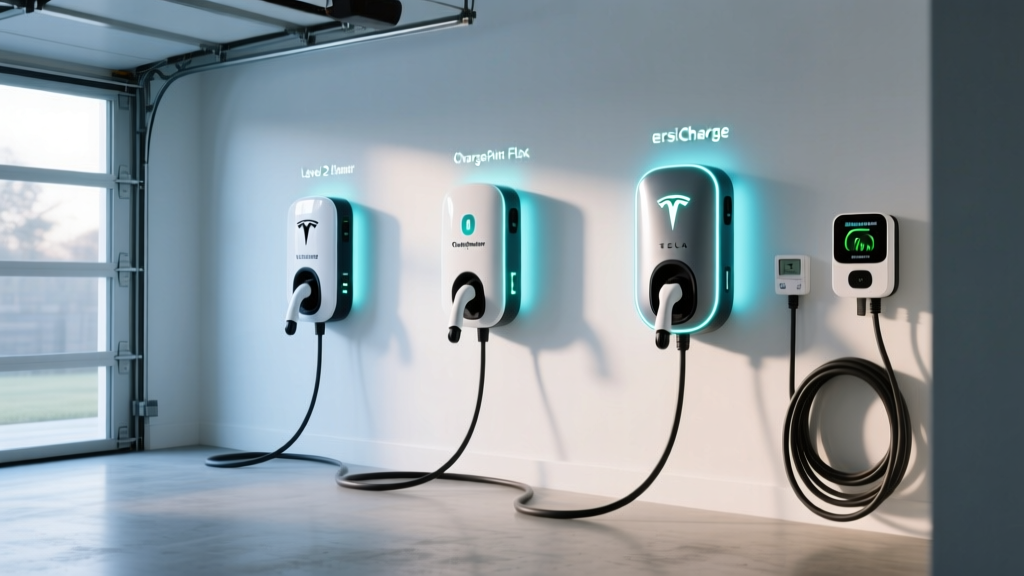
Here is how the leading EV charger brands stack up for 2026 home installations. All units below are Level 2, 240V, and available in NACS connector configurations.
ChargePoint Home Flex (2nd Gen)
- Power Output: Up to 12 kW (50 amps) on a 60-amp circuit; configurable down to 16 amps
- Connector: NACS (standard), CCS1 available
- Cable Length: 23 feet
- Smart Features: Wi-Fi, Alexa integration, scheduled charging, energy tracking, utility demand-response programs
- Installation: Hardwired or NEMA 14-50 plug
- Price: ~$549 (unit only)
Wallbox Pulsar Plus
- Power Output: Up to 11.5 kW (48 amps) on a 60-amp circuit
- Connector: NACS (standard on 2026 models)
- Cable Length: 25 feet
- Smart Features: Wi-Fi + Bluetooth, Power Sharing (link two units on one circuit), myWallbox app scheduling, solar integration
- Installation: Hardwired only
- Price: ~$449 (unit only)
Emporia Vue EV Charger
- Power Output: Up to 11.5 kW (48 amps) on a 60-amp circuit
- Connector: NACS
- Cable Length: 24 feet
- Smart Features: Integrates with Emporia Vue energy monitor for whole-home tracking, solar-aware scheduling, Time-of-Use optimization
- Installation: Hardwired or NEMA 14-50 plug
- Price: ~$399 (unit only) — best value pick
Tesla Wall Connector (4th Gen)
- Power Output: Up to 11.5 kW (48 amps) on a 60-amp circuit
- Connector: NACS (native Tesla; works with all NACS-equipped EVs)
- Cable Length: 24 feet
- Smart Features: Wi-Fi, over-the-air updates, Power Sharing, access control, energy metering
- Installation: Hardwired only
- Price: ~$425 (unit only)
Grizzl-E Smart (United Chargers)
- Power Output: Up to 10 kW (40 amps) on a 50-amp circuit
- Connector: NACS or J1772 (selectable)
- Cable Length: 24 feet
- Smart Features: Wi-Fi, OCPP protocol for utility programs, adjustable amperage, extreme-cold rated (-40°F)
- Installation: Hardwired or NEMA 14-50 plug; outdoor-rated (NEMA 4)
- Price: ~$449 (unit only)
Our pick for most buyers: the Wallbox Pulsar Plus balances price, output, cable length, and smart features. For households with solar panels or those wanting granular energy data, the Emporia Vue is unmatched at its price point. Tesla owners with no plans to own another EV brand will find the Tesla Wall Connector seamless. Cold-climate buyers in unheated garages or outdoor installations should consider the Grizzl-E for its extreme-temperature rating.
Cost to Charge: Home vs. Public vs. Gas — The Per-Mile Math
The financial case for home charging rests on electricity rates that are a fraction of public DC fast-charging prices. Here is a realistic cost comparison using 2026 national averages:
| Scenario | Rate | Cost Per kWh | Cost Per Mile (at 3 mi/kWh) |
|---|---|---|---|
| Home — Off-Peak (Time-of-Use plan) | $0.08–$0.12/kWh | $0.10 avg | $0.033/mile |
| Home — Standard Residential Rate | $0.14–$0.18/kWh | $0.16 avg | $0.053/mile |
| Public Level 2 (ChargePoint, EVgo) | $0.25–$0.49/kWh | $0.37 avg | $0.123/mile |
| DC Fast Charging (Electrify America, Tesla Supercharger) | $0.35–$0.55/kWh | $0.45 avg | $0.150/mile |
| Gasoline Vehicle (28 MPG avg, $3.40/gal) | $3.40/gallon | — | $0.121/mile |
At home off-peak rates, an EV costs roughly one-quarter per mile what a gasoline car costs. Even at standard residential rates, home charging is about half the per-mile cost of gas. However, exclusive reliance on DC fast charging erases most of the savings — a critical reason why home Level 2 installation is the linchpin of EV ownership economics.
Most EVs achieve roughly 3 miles per kWh (the efficiency metric analogous to MPG). A Tesla Model Y gets approximately 3.5 mi/kWh; a Ford F-150 Lightning approximately 2.0 mi/kWh. Adjust the per-mile column accordingly for your vehicle. The EPA's fueleconomy.gov site lists kWh/100mi ratings for every EV sold, which you can convert: divide 100 by the kWh/100mi figure to get miles per kWh.
Charging Time Examples: What to Expect With Common Battery Sizes
Charging time depends on three variables: battery capacity (kWh), the charger's power output (kW), and your vehicle's onboard charger limit. Below are realistic Level 2 charging times for popular 2026 EVs, assuming a 48-amp (11.5 kW) home charger on a 60-amp circuit:
| Vehicle | Battery (kWh Usable) | Onboard Charger Limit | Effective Charge Rate | 10–80% Time |
|---|---|---|---|---|
| Tesla Model Y Long Range | 75 kWh | 11.5 kW | 11.5 kW | ~4.5 hours |
| Hyundai Ioniq 5 (Long Range) | 77.4 kWh | 10.9 kW | 10.9 kW | ~5.0 hours |
| Ford F-150 Lightning (Extended) | 131 kWh | 19.2 kW (optional) / 10.5 kW (std) | 10.5–11.5 kW* | ~8.0–9.0 hours |
| Chevrolet Equinox EV | 85 kWh | 11.5 kW | 11.5 kW | ~5.2 hours |
| BMW i4 eDrive40 | 81.5 kWh | 11 kW | 11 kW | ~5.2 hours |
*The F-150 Lightning's standard onboard charger is 10.5 kW; the 19.2 kW dual onboard charger is a paid option. A standard 11.5 kW home charger cannot exceed the vehicle's onboard limit.
For context, a DC fast charger on a road trip can take the Ioniq 5 from 10–80% in roughly 18 minutes (peak 240 kW on a capable station), though the charge curve tapers significantly above 80%. At home, you rarely need to charge to 100% — most daily driving of 30–50 miles is replenished in 1–2 hours on Level 2.
Safety, Code, and Smart-Feature Considerations
EV charging involves sustained high-current draw, making proper installation non-negotiable. Key safety and code requirements per the NEC and typical local jurisdictions:
- Dedicated circuit: Your EV charger must be on its own dedicated breaker — not shared with other appliances or outlets.
- GFCI protection: The 2023 NEC update (adopted by most states by 2026) requires GFCI (Ground Fault Circuit Interrupter) protection for all EV receptacles. Hardwired units typically have built-in ground-fault protection and may not require an external GFCI breaker, but confirm with your electrician.
- Outdoor rating: If installing outdoors or in an unsealed garage, the unit must carry at minimum a NEMA 4 (weather-resistant) rating. The Grizzl-E and ChargePoint Home Flex both meet this standard.
- Cable management: The NEC prohibits EV charging cables from running across walkways or being extended with extension cords. Choose a cable length that reaches your charge port without crossing a path.
- Permit and inspection: Virtually all jurisdictions require an electrical permit and post-installation inspection for new 240V circuits. Do not skip this — it protects you and is required for insurance claims and home resale.
- Utility notification: Some utilities require advance notice before installing an EV charger, particularly if it draws 40+ amps. Many offer Time-of-Use (TOU) rate plans that can cut your charging cost in half by shifting to overnight hours.
On the smart-feature front, Wi-Fi connectivity is worth the small premium. Scheduled charging lets you align charging with off-peak utility rates (often 11 PM–6 AM), and energy-monitoring features help you track true transportation costs. Some utilities — including PG&E, ConEdison, and Xcel Energy — offer demand-response programs that pay you to allow them to briefly pause your charging during grid-peak events. A Wi-Fi-enabled charger is required to participate.
Frequently Asked Questions
How much does it cost to install a home EV charger?
A straightforward Level 2 installation on an existing 200-amp panel with a short wire run typically costs $750–$1,600 total (equipment + electrician + permit). If your panel needs an upgrade to 200 amps or the run is long (50+ feet through walls and conduit), expect $2,500–$7,700. Always get a load calculation from a licensed electrician before purchasing equipment.
How fast will each charging level add range?
Level 1 (120V) adds 3–5 miles of range per hour — adequate for PHEVs or very low daily mileage. Level 2 (240V) adds 12–75 miles per hour depending on the circuit amperage and your vehicle's onboard charger. DC fast charging adds hundreds of miles per hour at peak rates but is not intended for daily use due to cost and battery-wear considerations.
Which connector/charger is compatible with my EV?
If your EV is a 2025–2026 model, it almost certainly uses the NACS connector. Earlier models (2022–2024) from VW, Hyundai, Kia, and Ford may still have CCS1 ports. Check your owner's manual or charge-port door for the connector type. For home chargers, order the matching plug — NACS for new vehicles, CCS1 for legacy models. CHAdeMO (older Nissan Leaf) has limited new charger support.
How much does charging cost per mile vs. gas?
Home charging at off-peak rates costs approximately $0.03–$0.05 per mile, compared to $0.12 per mile for a 28 MPG gasoline vehicle at $3.40/gallon. Public DC fast charging at $0.45/kWh averages about $0.15/mile — slightly more than gas. The savings case depends heavily on consistent home charging access.
What electrical upgrades might I need?
The most common upgrade is a panel capacity increase from 100A or 150A to 200A service, costing $1,500–$3,500. Older homes may also need new wiring from the meter to the panel, or a sub-panel installation in the garage. Some utilities offer rebates for panel upgrades tied to EV adoption. A licensed electrician's load calculation will determine whether your current panel can accommodate a 40-, 50-, or 60-amp dedicated circuit without modification.