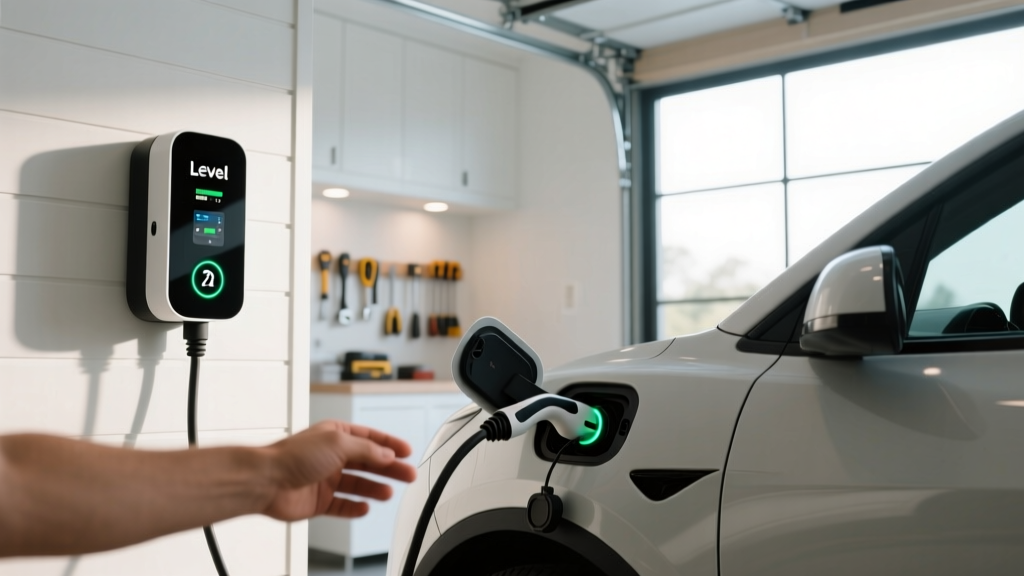
Charging an electric vehicle at home is where the ownership experience diverges most sharply from gasoline cars. Plug in overnight, wake up to a full battery, and pay a fraction of what a gas station charges per mile. But the phrase "EV charger at home" covers a wide range of setups — from a standard 120V wall outlet trickling 3 miles of range per hour to a hardwired 48-amp Level 2 station adding 40+ miles per hour. Getting the right setup depends on your daily mileage, electrical panel capacity, and budget.
This guide walks through every decision point with exact numbers: charging speeds in kilowatts (kW) and miles added per hour, real installation costs including electrician labor and permits, connector compatibility across 2026 models, and specific equipment recommendations with pricing.
Charging Levels Explained: How Fast Will Each Level Add Range?
EV charging is categorized into three levels. The critical distinction for any new EV owner is that kW (kilowatts) measures power — the rate at which energy flows — while kWh (kilowatt-hours) measures energy — the total amount stored in your battery. A 60 kWh battery charged at 10 kW takes roughly 6 hours from empty. Confusing these two is the single most common EV literacy gap.
| Level | Voltage | Power (kW) | Miles of Range Added Per Hour | Typical Use Case |
|---|---|---|---|---|
| Level 1 | 120V AC | 1.0–1.4 kW | 3–5 miles/hr | Overnight top-up, low-mileage drivers, PHEVs |
| Level 2 | 240V AC | 3.3–19.2 kW | 12–65 miles/hr | Daily home charging, workplace, public destinations |
| DC Fast Charging | 400–800V DC | 50–350 kW | 150–1,000+ miles/hr (peak) | Road trips, highway corridors, rapid top-ups |
For context, the average American drives about 37 miles per day according to FHWA data. A Level 1 charger can technically cover that — barely — but only if you plug in for 10+ hours. Most EV owners find Level 1 insufficient once daily driving exceeds 25 miles or when cold weather reduces efficiency by 20–30%.
Level 2 is the practical standard for home charging. A 40-amp circuit delivering 9.6 kW will fully recharge a 75 kWh battery (roughly the size in a Tesla Model Y Long Range or Ford Mustang Mach-E Extended Range) in about 8 hours. A 48-amp circuit at 11.5 kW shaves that to roughly 6.5 hours.
How Much Does It Cost to Install an EV Charger at Home?
Installation cost varies enormously based on your home's electrical infrastructure. A straightforward install near the panel might cost $500–$800 in labor; running conduit 60 feet across a finished garage with a panel upgrade can push past $4,000. Here's the realistic breakdown for 2026:
| Component | Low Estimate | High Estimate | Notes |
|---|---|---|---|
| Level 2 Charger (Equipment) | $350 | $750 | 32A–48A smart chargers; basic non-smart models from $250 |
| Electrician Labor | $400 | $2,500 | Depends on run length, wall type, conduit needs |
| Permit & Inspection | $50 | $300 | Varies by municipality; some jurisdictions waive for EV |
| Electrical Panel Upgrade (if needed) | $1,500 | $4,500 | 100A → 200A service upgrade; common in pre-1990 homes |
| Materials (conduit, wire, breaker) | $100 | $500 | #6 AWG copper for 50A circuits typical |
| Total (no panel upgrade) | $900 | $3,750 | Most homes with 200A service fall in $1,200–$2,200 |
| Total (with panel upgrade) | $2,400 | $8,250 | Older homes with 100A service |
The single biggest cost surprise is the panel upgrade. Homes built before the 1990s often have 100-amp electrical service. Adding a 40-amp or 50-amp dedicated EV circuit to an already-loaded 100A panel can exceed safe capacity, forcing an upgrade to 200A service. Your electrician will perform a load calculation (per NEC Article 220) to determine if your existing panel can handle the additional draw. Don't skip this step — overloaded panels are a fire hazard.
The federal Residential Clean Energy Credit (IRC §25D) covers 30% of home charging equipment and installation costs up to $1,000 through 2032. Some utilities and states offer additional rebates — check your local utility's EV program page and the AFDC state incentive database for current offers.
What Electrical Upgrades Might I Need?
Beyond the panel question, consider these infrastructure factors:
- Dedicated circuit: Your Level 2 charger requires its own dedicated breaker — typically 40A, 50A, or 60A depending on the charger's amperage. NEC rules require the breaker be rated at 125% of the continuous load, so a 40A charger needs a 50A breaker, and a 48A charger needs a 60A breaker.
- Wire gauge: A 50A circuit requires #6 AWG copper wire (THHN in conduit or NM-B for indoor runs). A 60A circuit requires #4 AWG copper. Your electrician will spec this based on run length and local code.
- NEMA 14-50 outlet vs. hardwired: A NEMA 14-50 receptacle (the same as a large dryer outlet) gives you flexibility to unplug the charger and take it when you move. Hardwiring eliminates the outlet failure point and is required for circuits above 50A in many jurisdictions. For 48A chargers, hardwiring is strongly recommended — NEC 2023 and later require GFCI protection on receptacles, and 240V GFCI breakers for 50A circuits cost $100–$150 and can nuisance-trip with EV loads.
- GFCI and outdoor ratings: If your charger is installed outdoors or in an unfinished garage, the unit must carry a NEMA 4 or NEMA 4X weather-resistance rating. All outdoor receptacles require GFCI protection.
- Wi-Fi signal: Smart chargers with scheduling and energy-monitoring features need reliable Wi-Fi at the install location. Test signal strength before mounting — a Wi-Fi extender or mesh node may be necessary in detached garages.
Which Connector Is Compatible with My EV?
The connector landscape shifted decisively in 2024–2025 when nearly every major automaker adopted the North American Charging Standard (NACS), originally developed by Tesla. By 2026, NACS is the dominant connector for new vehicles, though CCS1 (Combined Charging System) remains on many 2023–2025 models still on the road.
| Connector | Brands Using It (2026 MY) | Home Charger Availability |
|---|---|---|
| NACS (Tesla-style) | Tesla (all), Ford, GM, Rivian, Hyundai/Kia, BMW, Mercedes, Volvo/Polestar, Lucid, Nissan (new models) | Tesla Wall Connector, ChargePoint Home Flex (NACS), Emporia Vista (NACS) |
| CCS1 | Volkswagen ID.4 (some trims), remaining 2023–2025 models from Ford/GM/Hyundai | ChargePoint Home Flex (CCS), JuiceBox (CCS), Grizzl-E (CCS) |
| CHAdeMO | Nissan Leaf (legacy, still sold); Mitsubishi Outlander PHEV | Limited home options; mostly public DC stations |
If you own a CCS1-equipped vehicle but want to use Tesla Superchargers (which now accept non-Tesla vehicles at many locations), a CCS-to-NACS adapter is required. Tesla sells an official adapter for approximately $250, and third-party options from Lectron and A2Z are available for $150–$200. For home charging, the simplest solution is to buy a Level 2 charger with the matching connector for your vehicle — adapters for Level 2 are less common and generally unnecessary.
Owners with two EVs using different connectors (e.g., a 2024 Hyundai Ioniq 5 with CCS1 and a 2026 Ford F-150 Lightning with NACS) should consider a charger with a swappable connector cable or simply install two circuits if panel capacity allows.
How Much Does Charging Cost Per Mile vs. Gas?
Home charging is where EVs deliver their most dramatic cost advantage. The national average residential electricity rate in early 2026 is approximately $0.17/kWh (per EIA data), but time-of-use (TOU) plans can drop off-peak rates to $0.08–$0.12/kWh in many regions.
| Scenario | Energy Cost | Vehicle Efficiency | Cost Per Mile |
|---|---|---|---|
| Home charging (off-peak TOU) | $0.10/kWh | 3.0 mi/kWh (typical EV) | $0.033/mile |
| Home charging (standard rate) | $0.17/kWh | 3.0 mi/kWh | $0.057/mile |
| Public Level 2 (network pricing) | $0.30/kWh | 3.0 mi/kWh | $0.10/mile |
| DC Fast Charging (350 kW station) | $0.48/kWh | 3.0 mi/kWh | $0.16/mile |
| Gasoline (30 MPG combined) | $3.40/gallon | 30 MPG | $0.113/mile |
| Gasoline (22 MPG truck/SUV) | $3.40/gallon | 22 MPG | $0.155/mile |
At off-peak home rates, an EV costs roughly one-third to one-fifth per mile compared to a gasoline vehicle. Even at standard residential rates, home charging undercuts gasoline by about 50%. The economics flip if you rely exclusively on DC fast charging at $0.45–$0.55/kWh — at that point, per-mile costs can match or exceed an efficient gasoline car. This is why home charging access is the single most important factor in EV ownership satisfaction.
For a driver covering 12,000 miles per year, home off-peak charging costs approximately $400 annually versus $1,350 for gasoline at 30 MPG. That's roughly $950 in annual fuel savings — enough to recoup a basic Level 2 installation in the first year or two.
Charging Time Examples: What to Expect with Common Battery Sizes
Charging time depends on battery capacity (kWh), the charger's power output (kW), and the vehicle's onboard charger limit. Most 2026 EVs accept between 10 kW and 19.2 kW on Level 2 AC charging. Here are real-world estimates for common scenarios:
| Vehicle Example | Battery Size (kWh) | Onboard Charger Limit | Time at 9.6 kW (40A) | Time at 11.5 kW (48A) |
|---|---|---|---|---|
| Chevrolet Equinox EV | 85 kWh usable | 11.5 kW | ~6 hrs 10 min | ~5 hrs 10 min |
| Tesla Model Y Long Range | 75 kWh usable | 11.5 kW | ~5 hrs 25 min | ~4 hrs 35 min |
| Hyundai Ioniq 5 (NACS) | 77.4 kWh usable | 10.9 kW | ~5 hrs 35 min | ~5 hrs 20 min (limited by car) |
| Ford F-150 Lightning Ext. Range | 131 kWh usable | 19.2 kW | ~9 hrs 30 min | ~8 hrs 00 min |
| BMW i4 eDrive40 | 81.5 kWh usable | 11 kW | ~5 hrs 55 min | ~5 hrs 45 min (limited by car) |
Two important nuances: First, charging slows significantly above 80% state of charge to protect battery longevity — the charge curve tapers, so the last 20% can take as long as the first 60%. For daily driving, most owners set a charge limit of 80% and only charge to 100% before long road trips. Second, the vehicle's onboard charger caps the AC charging rate — plugging a car with a 10.9 kW onboard charger into an 11.5 kW station won't speed things up. Know your vehicle's onboard charger spec before overspending on a high-amperage unit.
Best Home EV Chargers for 2026: Equipment Picks
The following chargers represent the strongest options across price, reliability, and features as of 2026. All support NACS natively or via configurable connector cables.
Tesla Wall Connector (Gen 4)
- Power: Up to 11.5 kW (48A)
- Connector: NACS native
- Cable length: 24 feet
- Smart features: Wi-Fi, OTA updates, power sharing (link multiple units on one circuit), Tesla app scheduling
- Price: ~$475
- Best for: Tesla owners and any NACS-equipped vehicle; best value at 48A
ChargePoint Home Flex
- Power: Up to 12 kW (50A) — adjustable via DIP switches down to 16A
- Connector: Available in NACS or CCS1 configurations
- Cable length: 23 feet
- Smart features: Wi-Fi, ChargePoint app with detailed energy tracking, Alexa/Google Home integration, scheduled charging
- Price: ~$550–$650
- Best for: Multi-EV households needing flexible amperage; excellent app experience
Emporia Vue 2 with EV Charger
- Power: Up to 11.5 kW (48A)
- Connector: NACS or J1772 (with adapter for NACS)
- Cable length: 24 feet
- Smart features: Integrates with Emporia whole-home energy monitor, solar-aware charging, TOU rate optimization, detailed per-session cost tracking
- Price: ~$400 (charger only); ~$700 with Vue energy monitor bundle
- Best for: Solar-panel owners and energy-monitoring enthusiasts; best TOU optimization
Grizzl-E Smart
- Power: Up to 9.6 kW (40A)
- Connector: J1772 standard; NACS adapter available
- Cable length: 24 feet
- Smart features: Wi-Fi, evDuty app, adjustable amperage
- Price: ~$450
- Best for: Canadian and cold-climate buyers (built in Vancouver, rated to -40°F); rugged outdoor use
For most buyers in 2026, the Tesla Wall Connector at $475 is the strongest value — 48 amps, 24-foot cable, NACS native, and a clean installation profile. If you own a CCS1 vehicle and don't plan to switch, the ChargePoint Home Flex in CCS configuration offers superior amperage flexibility and energy tracking.
Frequently Asked Questions
Can I use a regular 120V outlet to charge my EV at home?
Yes — this is Level 1 charging. It delivers about 1.0–1.4 kW, adding roughly 3–5 miles of range per hour. For a plug-in hybrid with a 20–40 mile electric range, Level 1 overnight charging is often sufficient. For a full EV with a 75+ kWh battery, Level 1 requires 50+ hours for a full charge and is best treated as a backup or supplementary option.
Do I need a permit to install a home EV charger?
In most U.S. jurisdictions, yes. A hardwired Level 2 charger or a new 240V receptacle installation requires an electrical permit and inspection. Permit fees typically range from $50 to $300. Skipping the permit risks insurance claim denial if an electrical fire occurs and can create problems during a home sale inspection.
Will charging my EV at home significantly increase my electric bill?
A typical EV driven 12,000 miles per year at 3.0 mi/kWh consumes about 4,000 kWh annually. At $0.12/kWh (off-peak TOU), that adds approximately $480 per year or $40 per month to your electric bill. This replaces roughly $1,350 in annual gasoline costs, yielding net savings of $870/year.
Is it better to hardwire my charger or use a NEMA 14-50 outlet?
Hardwiring is preferred for 48A chargers because it avoids the GFCI breaker requirement that NEC 2023+ imposes on 240V receptacles — those GFCI breakers cost $100–$150 and can nuisance-trip during charging sessions. A NEMA 14-50 outlet offers portability if you plan to move or want to use the outlet for other equipment. For 40A chargers, a NEMA 14-50 with a standard breaker remains a practical choice where local code permits.
Can my solar panels power my home EV charger?
Directly, yes — but timing matters. Most residential solar systems produce peak power midday, while most EV owners charge overnight. Without a home battery (like a Tesla Powerwall), your solar energy is exported to the grid during the day and you pull grid power at night. Chargers with solar-aware scheduling (like the Emporia Vue system) can optimize charging to coincide with peak solar production, effectively charging your EV for free during sunny afternoons.
How long does a home EV charger last?
Quality Level 2 chargers from established brands (Tesla, ChargePoint, Emporia) carry 3-year warranties and typically last 8–12 years. The most common failure points are the cable (from repeated bending and UV exposure) and the Wi-Fi module. Outdoor installations in extreme climates may see shorter lifespans — look for NEMA 4 ratings and UV-resistant cables for outdoor mounting.