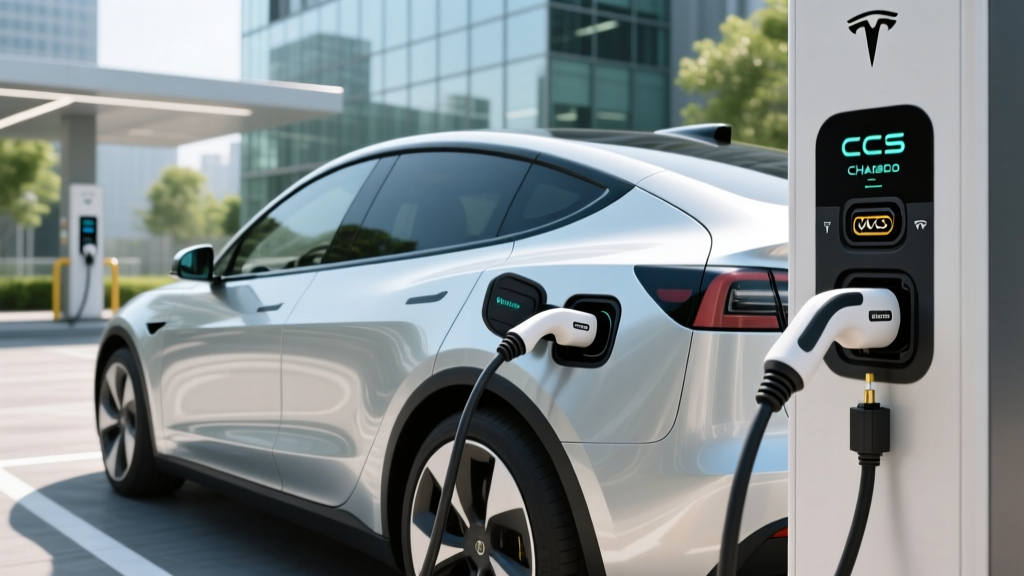
The North American charging connector landscape has fundamentally shifted. With nearly every major automaker adopting the North American Charging Standard (NACS) for new vehicles starting in the 2025–2026 model years, millions of existing CCS1 and CHAdeMO EVs now require an EV charger adapter to access the expanding Tesla Supercharger network. Meanwhile, newer NACS-equipped vehicles still need adapters for legacy CCS and CHAdeMO public chargers that remain widespread across the country.
This guide breaks down exactly which adapter you need based on your vehicle's connector, how fast each charging level delivers power (in kW, not kWh — power vs. energy), what home installation actually costs, and which adapters and chargers are worth your money in 2026.
Charging Levels Explained: Speeds in kW and Miles Per Hour
Before choosing an adapter, you need to understand the three charging levels and what each delivers. Charging speed is measured in kW (kilowatts), which represents power flow rate. The energy stored in your battery is measured in kWh (kilowatt-hours). A 240 kW DC fast charger delivers power at 240 kW; a 75 kWh battery holds 75 kWh of energy capacity. These units are not interchangeable.
| Level | Voltage | Power (kW) | Miles of Range Added Per Hour | Typical Use Case |
|---|---|---|---|---|
| Level 1 | 120V AC | 1.0–1.4 kW | 3–5 miles/hr | Overnight trickle; emergency top-up |
| Level 2 | 240V AC | 3.3–19.2 kW | 12–70 miles/hr | Home daily charging; workplace; shopping centers |
| DC Fast Charge | 400–800V DC | 50–350 kW | 150–1,200+ miles/hr (peak) | Road trips; 10–80% in 15–40 minutes |
Real-world caveat: Peak DC fast-charge kW is not sustained. A vehicle rated for 250 kW peak will typically sustain that rate only between roughly 10–40% State of Charge (SoC), then taper progressively. Expect a 10–80% session on a 250 kW-capable vehicle to take 18–25 minutes depending on battery temperature and chemistry. Cold batteries charge significantly slower — preconditioning (warming the pack before arrival via navigation routing) is essential for achieving advertised speeds.
Connector Compatibility: Which EV Charger Adapter Do You Need?
The connector on your vehicle determines which public chargers you can plug into natively and which require an adapter. Here is the 2026 compatibility landscape:
| Connector | Shape | Vehicles Using It (2026) | Public Charger Availability |
|---|---|---|---|
| NACS (J3400) | Compact, 5-pin | Tesla (all years), Ford, GM, Rivian, Volvo, Polestar, Hyundai/Kia (2025+), Honda (2026+) | Tesla Supercharger (20,000+ stalls), growing third-party NACS stations |
| CCS1 | Oval, 7-pin (Combo) | Legacy VW ID.4, BMW iX, pre-2025 Hyundai/Kia, pre-2025 Ford/GM EVs, Stellantis | Electrify America, EVgo, ChargePoint — still the most widespread non-Tesla standard |
| CHAdeMO | Round, large | Nissan Leaf (discontinued but many on road), Mitsubishi Outlander PHEV (legacy) | Declining; some Electrify America and independent stations |
| J1772 | Round, 5-pin (AC only) | All EVs for Level 1/Level 2 AC charging (via onboard adapter or native port) | Universal for AC Level 2 public chargers |
Common Adapter Types in 2026
- CCS1-to-NACS adapter: Allows CCS1 vehicles (e.g., 2024 VW ID.4, 2023 Ford Mustang Mach-E) to charge at NACS/Tesla Superchargers. Rated typically at 150–250 kW DC. Price range: $150–$300.
- NACS-to-CCS1 adapter: Allows NACS vehicles (e.g., 2026 Ford F-150 Lightning, 2025 Tesla Model Y) to charge at Electrify America and other CCS1 stations. Rated typically at 200–350 kW. Price range: $175–$275.
- CHAdeMO-to-CCS1 adapter: Rare and expensive ($400+); relevant mostly for Nissan Leaf owners needing access to CCS infrastructure. Availability limited.
- J1772-to-NACS adapter: Allows NACS vehicles to use J1772 Level 2 public chargers. Often included with Tesla vehicles. Rated at 48A/11.5 kW AC. Price: $50–$100.
Home Charger Installation: Electrical Requirements and Costs
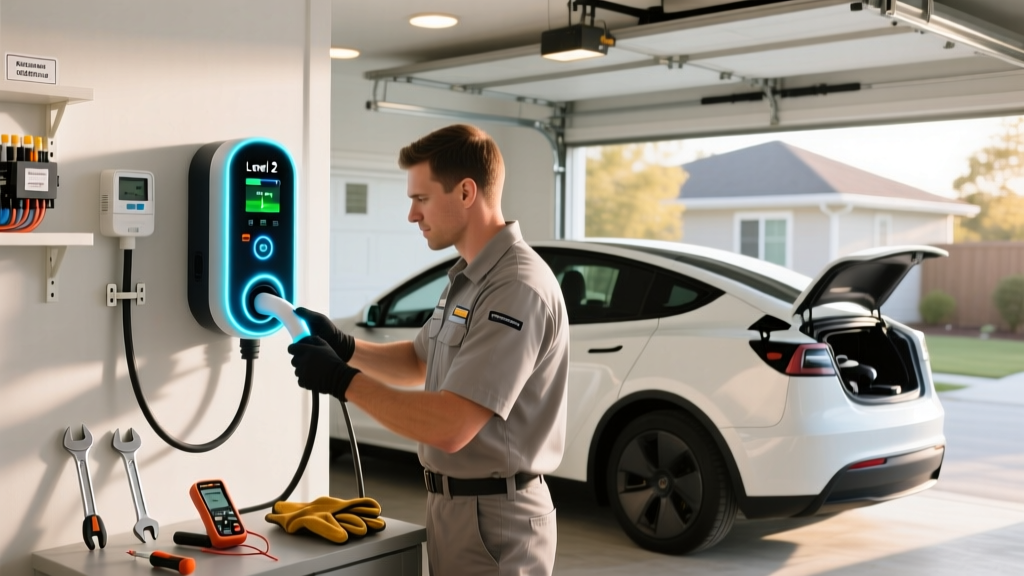
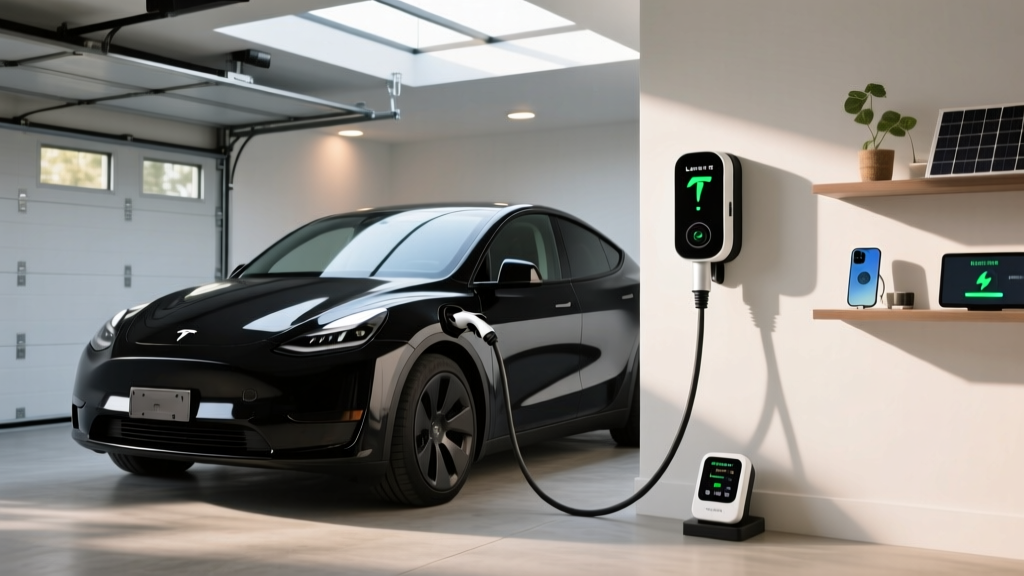
Most EV owners do the majority of their charging at home on Level 2. A proper home setup requires a 240V dedicated circuit, and the total cost depends heavily on your electrical panel's capacity and the distance from panel to charger location.
Electrical Requirements
- Circuit: A 40A dedicated circuit is standard for a 32A continuous-draw charger (NEC requires circuits rated 125% above continuous load). For higher-power 48A chargers, a 60A circuit is needed.
- Wire gauge: 6 AWG copper for 40A circuits; 4 AWG for 60A circuits, depending on run length and local code.
- GFCI protection: Required by NEC 2020+ for outdoor receptacles (NEMA 14-50) and increasingly for hardwired installations in some jurisdictions. Hardwired installations with built-in GFCI in the charger unit are preferred for reliability.
- Outdoor rating: If mounted outside, the charger must carry a NEMA 4 or NEMA 4X rating for weather resistance.
Panel Upgrade Reality
Homes with 100A electrical service panels — common in pre-1990 construction — often cannot support a 40A EV circuit without a panel upgrade to 200A. A panel upgrade typically costs $1,500–$3,500 depending on your utility's requirements, local labor rates, and whether a new meter base is needed. This is the single largest variable in home charger installation cost. Have a licensed electrician perform a load calculation before committing to equipment.
| Component | Low-End Cost | High-End Cost | Notes |
|---|---|---|---|
| Level 2 Charger Equipment | $300 | $750 | 32A–48A, 240V; smart vs. basic models |
| Electrician Labor (standard install) | $400 | $1,200 | Depends on run length, wall type, conduit |
| Permit & Inspection | $50 | $250 | Varies by municipality; some jurisdictions waive for EV |
| Electrical Panel Upgrade (if needed) | $1,500 | $3,500 | 100A → 200A; not always required |
| Total (no panel upgrade) | $750 | $2,200 | Typical scenario for modern homes |
| Total (with panel upgrade) | $2,250 | $5,700 | Older homes needing service upgrade |
Source: Cost ranges reflect national averages from HomeAdvisor 2025 EV charger install data and industry surveys. Always get 2–3 local quotes. A licensed electrician must perform final spec and load calculations — this guide provides estimates, not electrical engineering.
Charging Cost Per Mile: Home vs. Public vs. Gas
One of the strongest ownership arguments for EVs is lower fuel cost per mile — but only if you charge smart. Public DC fast charging can approach or exceed gasoline cost per mile, while home off-peak charging delivers dramatic savings.
| Scenario | Rate | Cost Per kWh | Cost Per Mile (at 3.5 mi/kWh) | Annual Cost (12,000 mi) |
|---|---|---|---|---|
| Home off-peak (utility time-of-use) | $0.08–$0.14/kWh | $0.11 avg | $0.031 | $377 |
| Home standard rate | $0.14–$0.22/kWh | $0.18 avg | $0.051 | $617 |
| Public Level 2 (ChargePoint, etc.) | $0.25–$0.49/kWh | $0.35 avg | $0.100 | $1,200 |
| DC Fast Charge (Electrify America, EVgo) | $0.35–$0.69/kWh | $0.48 avg | $0.137 | $1,646 |
| Tesla Supercharger (2026 avg) | $0.25–$0.45/kWh | $0.33 avg | $0.094 | $1,131 |
| Gasoline (25 MPG combined, $3.40/gal) | — | — | $0.136 | $1,632 |
Key insight: Home off-peak charging at $0.11/kWh costs roughly $0.03/mile — about 4.5× cheaper than gasoline at $3.40/gal and 25 MPG. But exclusive DC fast charging at $0.48/kWh is essentially cost-parity with gasoline. The economics of EV ownership depend heavily on home charging access. Per fueleconomy.gov, the average 2026 EV achieves 3.0–4.0 miles per kWh combined; we use 3.5 mi/kWh as a representative midpoint.
Charging Time Examples: 10–80% by Battery Size and Power
Charge time depends on battery capacity (kWh), peak charge rate accepted by the vehicle (kW), and the charge curve taper above ~60% SoC. Here are real-world estimates for common configurations:
- 60 kWh battery (e.g., base Chevrolet Equinox EV) at 150 kW peak: 10–80% in approximately 28–32 minutes. Sustained average rate ~85 kW due to taper.
- 75 kWh battery (e.g., Tesla Model Y Long Range) at 250 kW peak: 10–80% in approximately 18–22 minutes. Strong sustained curve to ~50% SoC.
- 84 kWh battery (e.g., Hyundai Ioniq 5, 800V architecture) at 240 kW peak: 10–80% in approximately 18 minutes. The 800V platform sustains high power longer than 400V systems.
- 100 kWh battery (e.g., Ford F-150 Lightning Extended Range) at 150 kW peak: 10–80% in approximately 40–45 minutes. Larger capacity offsets moderate charge rate.
- Level 2 home charging at 11.5 kW (48A): 0–100% in 6–9 hours depending on battery size. Sufficient for overnight replenishment for virtually all daily driving.
Equipment Recommendations: Chargers and Adapters for 2026
ChargePoint Home Flex (NACS or J1772)
- Power Output: Up to 12 kW (50A circuit, 40A continuous) — configurable down to 16A for lower-capacity panels
- Connector: Available in NACS native or J1772 (with NACS adapter included for J1772 version)
- Cable Length: 23 feet
- Smart Features: Wi-Fi connected, app scheduling, utility demand-response integration, Alexa/Google Home, energy tracking
- Price: ~$550–$650
- Best for: Most home installations; flexible amperage accommodates older panels without upgrade
Grizzl-E Smart (NACS or J1772)
- Power Output: Up to 11.5 kW (48A continuous on 60A circuit)
- Connector: NACS or J1772 options
- Cable Length: 24 feet
- Smart Features: OCPP-compatible, app control, load sharing (two units on one circuit), adjustable amperage
- Price: ~$450–$550
- Best for: Budget-conscious buyers wanting full smart features; excellent cold-weather durability (rated to -40°F)
Tesla Wall Connector (NACS native)
- Power Output: Up to 11.5 kW (48A continuous on 60A circuit)
- Connector: NACS native; J1772 adapter available separately for non-Tesla EVs
- Cable Length: 24 feet
- Smart Features: Wi-Fi, over-the-air updates, power sharing between multiple units, integrates with Tesla app
- Price: ~$475
- Best for: Tesla households or mixed fleets (NACS is now the universal standard); cleanest cable management
Lectron Vortex NACS-to-CCS1 Adapter
- Power Rating: Up to 250 kW DC / 400A
- Connector: NACS vehicle side → CCS1 charger side
- Use Case: Allows 2025+ NACS vehicles (Ford, GM, Rivian, Hyundai/Kia) to use Electrify America, EVgo CCS chargers
- Price: ~$180–$230
- Best for: NACS vehicle owners who travel in areas where CCS infrastructure still outnumbers NACS
Safety, Code, and Best Practices
EV charging draws sustained high current for hours — unlike most household appliances. This places specific demands on your electrical system:
- Dedicated circuit: Your EV charger must be on its own dedicated breaker — never shared with other appliances. A 40A charger requires a 50A breaker; a 48A charger requires a 60A breaker.
- Hardwired vs. plug-in: Hardwired installations (no plug) are preferred for reliability and are required above 40A in many jurisdictions. Plug-in (NEMA 14-50) offers portability but introduces a connection point that can overheat if the receptacle is low quality. Use only industrial-grade (Hubbell, Bryant) 14-50 receptacles — not residential-grade.
- GFCI protection: NEC 2020 and later requires GFCI on outdoor receptacles. Some EV chargers have built-in GFCI, which satisfies code for hardwired installations and avoids nuisance trips common with external GFCI breakers.
- Cable management: Keep charging cables off the ground to prevent damage and tripping hazards. Wall-mounted cable organizers or retractors ($30–$60) are worthwhile.
- Surge protection: A whole-panel surge protective device (SPD, ~$150–$300 installed) protects your charger and vehicle's onboard electronics from grid voltage spikes.
Frequently Asked Questions
How much does it cost to install a home EV charger?
A typical Level 2 home charger installation costs $750–$2,200 when no panel upgrade is needed (equipment $300–$750, electrician $400–$1,200, permit $50–$250). If your home has a 100A panel that needs upgrading to 200A, add $1,500–$3,500, bringing the total to $2,250–$5,700. Always get a professional load calculation first.
How fast will each charging level add range?
Level 1 (120V) adds 3–5 miles of range per hour. Level 2 (240V) adds 12–70 miles per hour depending on amperage (16A–80A). DC fast charging adds 150–1,200+ miles per hour at peak power, but sessions are typically measured in minutes (10–80% in 18–45 minutes) because the charge rate tapers significantly above 60% SoC.
Which connector or charger is compatible with my EV?
Check your vehicle's charge port. If it's NACS (compact 5-pin, standard on 2025+ Ford/GM/Rivian/Hyundai/Kia/Volvo/Polestar and all Teslas), you can use Tesla Superchargers and NACS stations natively; you'll need a NACS-to-CCS1 adapter for Electrify America/EVgo CCS chargers. If your vehicle has CCS1 (older VW, BMW, pre-2025 Ford/GM/Kia/Hyundai), you need a CCS1-to-NACS adapter to access Superchargers. CHAdeMO vehicles (Nissan Leaf) have the most limited options; adapters are expensive and availability is limited.
How much does charging cost per mile vs. gas?
Home off-peak charging averages $0.03/mile — roughly 4.5× cheaper than gasoline at $3.40/gal in a 25 MPG vehicle ($0.14/mile). Standard-rate home charging is about $0.05/mile. However, exclusive public DC fast charging at $0.48/kWh averages $0.14/mile — essentially the same as gasoline. The cost advantage of EVs depends on reliable home charging access. Per fueleconomy.gov, the average EV achieves 3.0–4.0 miles per kWh.
What electrical upgrades might I need?
The most common upgrade is a panel upgrade from 100A to 200A service ($1,500–$3,500) in older homes. You may also need a new conduit run if the charger is far from the panel (over 50 feet adds wire cost), a new breaker slot if your panel is full, or a meter base upgrade if your utility requires it for higher service. Some utilities offer rebates of $250–$1,000 for panel upgrades done for EV charging — check with your local provider. Per the IRS §30D guidelines, the federal tax credit covers new clean vehicles but does not cover home charger installation; however, the separate §30C Alternative Fuel Vehicle Refueling Property Credit may cover up to 30% of home charger equipment and installation costs (up to $1,000), subject to census-tract eligibility and income requirements — consult a tax professional.
Do I need an EV charger adapter for home charging?
Usually not. For home Level 2 charging, you buy a wall charger with the connector matching your vehicle (NACS or J1772). Adapters are primarily needed for public charging — when your vehicle's connector doesn't match the station's connector. The one exception: if you own a Tesla Wall Connector (NACS native) and have a J1772 vehicle in the household, you'll need a J1772-to-NACS adapter (~$50–$100) for that vehicle to use the home unit.