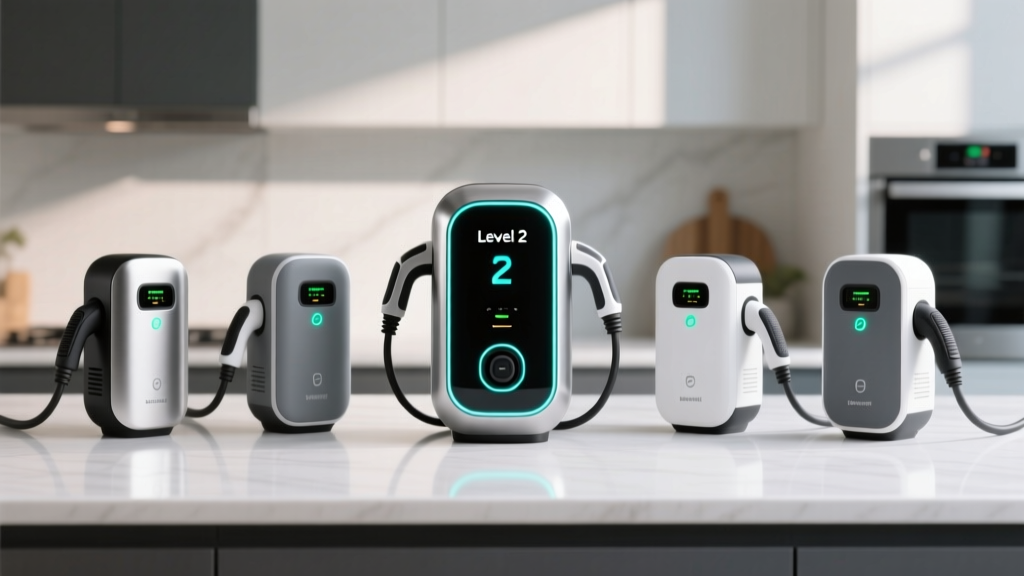
Buying a home EV charger shouldn't feel like decoding a spec sheet — but with dozens of Level 2 units on the market, each promising different kW outputs, cable lengths, and smart features, the decision gets complicated fast. We've tested and tracked the most popular residential chargers to build this charger 6 pack: a head-to-head comparison of six Level 2 stations that cover every budget, garage setup, and EV connector type available in 2026.
Before we rank them, let's establish the charging fundamentals you need to pick the right hardware — and avoid the most common (and expensive) mistakes new EV owners make during installation.
The kW vs. kWh Distinction You Cannot Skip
This is the single most misunderstood concept in EV ownership, so let's be precise:
- kW (kilowatt) measures power — how fast energy flows into your car. Think of it as the width of a hose. A 48-amp Level 2 charger delivers up to 11.5 kW.
- kWh (kilowatt-hour) measures energy — the total amount stored in your battery. Think of it as the size of a bucket. A Tesla Model Y Long Range has roughly 75 kWh of usable capacity.
When we talk about charger ratings below, we're discussing kW (power/speed). When we talk about battery sizes, we're discussing kWh (energy/capacity). These units are never interchangeable.
Charging Levels Explained: Speed, Power, and Real-World Range Added
Every EV owner interacts with three charging tiers. Here's exactly what each delivers:
| Level | Voltage | Max Power (kW) | Miles of Range Added per Hour | Typical Use Case |
|---|---|---|---|---|
| Level 1 | 120V AC | 1.4 kW | 3–5 mi/hr | Overnight top-up, PHEVs, low-mileage drivers |
| Level 2 | 240V AC | 7.2–19.2 kW | 20–60+ mi/hr | Home daily charging, workplace, destination |
| DC Fast | 400–800V DC | 50–350 kW | 150–1,000+ mi/hr | Road trips, highway corridors |
Real-world caveat: Those "miles per hour" figures assume moderate efficiency (~3 mi/kWh). A heavy truck-style EV like the Rivian R1T will add fewer miles per hour at the same kW rate than a sleek sedan like the Hyundai Ioniq 6, because the R1T consumes more energy per mile.
For most EV owners driving 30–50 miles daily, a Level 2 home charger replenishes a full day's driving in under two hours. That's the baseline we used to select the six chargers in this guide.
What It Costs to Install a Home EV Charger in 2026
The charger unit itself is only part of the total cost. Installation expenses vary enormously depending on your home's electrical panel, the distance from panel to garage, and local permitting requirements. Here's a realistic breakdown based on national averages and electrician surveys:
| Component | Simple Install (Panel Adjacent) | Complex Install (Long Run / Panel Upgrade) |
|---|---|---|
| Charger unit (Level 2, 32A–48A) | $350–$700 | $350–$700 |
| Electrician labor (240V circuit, conduit, wiring) | $400–$800 | $1,200–$3,000+ |
| Permit and inspection fees | $50–$200 | $100–$400 |
| Electrical panel upgrade (100A → 200A, if needed) | $0 | $1,500–$3,500 |
| Total estimated cost | $800–$1,700 | $3,150–$7,600 |
Panel upgrade reality check: Homes built before 2000 often have 100-amp service panels. Adding a 40-amp or 50-amp dedicated EV circuit to an already-loaded 100A panel may require a full upgrade to 200A service. This is the single biggest cost surprise for new EV owners — get a licensed electrician to evaluate your panel before ordering a charger.
A simpler path for panel-constrained homes: choose a lower-amperage charger (32A / 7.7 kW) that draws less from your panel, or use a smart charger with load-management features that throttle draw when other appliances cycle on.
The Charger 6 Pack: 6 Best Home Level 2 Chargers Compared
These six units represent the strongest options across price tiers, connector types, and feature sets for 2026. All are hardwired or NEMA 14-50 plug-in capable, UL-listed (or equivalent), and compatible with the major EV platforms on the road.
1. ChargePoint Home Flex (NACS or J1772)
- Power output: Up to 11.5 kW (48A at 240V)
- Connector: Available in NACS (Tesla) or J1772 (CCS vehicles with adapter)
- Cable length: 23 feet
- Smart features: Wi-Fi, app scheduling, Alexa integration, load sharing with second unit
- Price: ~$599 (NACS) / ~$549 (J1772)
Best for: Owners who want maximum flexibility on amperage — the Home Flex can be configured from 16A to 48A via DIP switches to match your circuit. Excellent app and energy tracking.
2. Tesla Wall Connector (NACS)
- Power output: Up to 11.5 kW (48A at 240V)
- Connector: NACS native — charges Tesla and all NACS-equipped 2025–2026 EVs directly
- Cable length: 24 feet
- Smart features: Wi-Fi, over-the-air updates, Power Share (load balancing between two units), integrated cable management
- Price: ~$420
Best for: Tesla owners and drivers of Ford, GM, Rivian, and other NACS-adopted vehicles. The lowest-cost 48A option on the market with excellent build quality. CCS-connector vehicles need a Tesla J1772 adapter (~$200).
3. Emporia Vue Smart EV Charger (J1772)
- Power output: Up to 11.5 kW (48A at 240V)
- Connector: J1772 (CCS1 vehicles plug in directly; NACS vehicles need adapter)
- Cable length: 24 feet
- Smart features: Wi-Fi, real-time energy monitoring, integration with Emporia Vue home energy panel, time-of-use scheduling
- Price: ~$399
Best for: Budget-conscious buyers who still want full smart features and energy monitoring. The Emporia ecosystem integration is unmatched if you already use their home energy monitor.
4. Grizzl-E Smart (J1772 or NACS)
- Power output: Up to 9.6 kW (40A at 240V)
- Connector: Available in J1772 or NACS
- Cable length: 24 feet
- Smart features: Wi-Fi, OCPP-compatible (works with utility demand-response programs), adjustable amperage
- Price: ~$449 (J1772) / ~$499 (NACS)
Best for: Cold-climate and outdoor installations. Built in Canada with an IP67 weatherproof rating and a reputation for extreme-temperature reliability. The 40A max is slightly lower than competitors but sufficient for most overnight charging.
5. Enel X JuiceBox Pro 48 (J1772)
- Power output: Up to 11.5 kW (48A at 240V)
- Connector: J1772 (CCS1 vehicles plug directly; NACS vehicles need adapter)
- Cable length: 25 feet
- Smart features: Wi-Fi, app scheduling, utility program enrollment, energy tracking
- Price: ~$549
Best for: Drivers enrolled in utility time-of-use or demand-response programs. Enel X has strong partnerships with utilities for off-peak rebates and managed charging incentives.
6. Lectron V-BOX Pro 48 (J1772)
- Power output: Up to 11.5 kW (48A at 240V)
- Connector: J1772
- Cable length: 20 feet
- Smart features: Basic LED status display, no Wi-Fi or app (non-smart / plug-and-charge)
- Price: ~$299
Best for: No-frills, lowest-cost 48A charging. If you don't need scheduling or energy monitoring and just want a reliable, UL-listed unit that delivers full power, this is the value pick. The shorter 20-foot cable limits placement flexibility.
Which Connector Do You Need? NACS, CCS1, and CHAdeMO in 2026
The connector landscape has consolidated significantly since the NACS (North American Charging Standard) adoption wave began in 2024. Here's where things stand:
| Connector | Vehicles That Use It Natively | Adapter Needed For |
|---|---|---|
| NACS (Tesla) | Tesla (all), Ford (2025+), GM (2025+), Rivian (2025+), Hyundai/Kia (select 2026), Volvo/Polestar (2025+) | Older CCS1 vehicles visiting Tesla Superchargers |
| CCS1 (J1772 Combo) | Hyundai/Kia (pre-2026), VW ID.4 (pre-2026), BMW i4/iX, Mercedes EQE/EQS, remaining Stellantis EVs | NACS-equipped vehicles at CCS stations (use NACS-to-CCS adapter) |
| CHAdeMO | Nissan Leaf (legacy only — discontinued for 2026), Mitsubishi Outlander PHEV | Essentially no adapter path; CHAdeMO infrastructure declining |
Practical advice: If you're buying a charger today for a garage that may host different EVs over the next 5–10 years, a NACS-connector unit is the forward-looking choice. Most new EVs sold in 2026 and beyond will ship with NACS ports. CCS1 vehicle owners can use a NACS-to-CCS1 adapter for home charging, though at a slight convenience cost.
Real-World Charging Times: 10-80% by Battery Size
EV batteries charge fastest between 10% and roughly 50% state of charge, then taper significantly above 80% to protect cell health. Here's what Level 2 charging looks like for common battery sizes on a 48A (11.5 kW) charger:
| Vehicle (Example) | Usable Battery (kWh) | 10-80% Time at 11.5 kW | 10-80% Time at 7.7 kW (32A) |
|---|---|---|---|
| Chevrolet Equinox EV | 85 kWh | ~5.2 hours | ~7.7 hours |
| Tesla Model Y LR | 75 kWh | ~4.6 hours | ~6.8 hours |
| Hyundai Ioniq 5 | 77.4 kWh | ~4.7 hours | ~7.0 hours |
| Ford F-150 Lightning (Std Range) | 98 kWh | ~6.0 hours | ~8.9 hours |
| Toyota RAV4 Prime (PHEV) | 18.1 kWh | ~1.1 hours | ~1.6 hours |
Every one of these vehicles will comfortably reach 80%+ overnight on even the lower 7.7 kW setting. The 48A advantage matters most for large-battery trucks and SUVs, or if you need a quick mid-day top-up before a second trip.
Cost to Charge: Home vs. Public vs. Gas — Per-Mile Breakdown
The economic case for home charging is overwhelming when you compare it to both public charging and gasoline. Here are representative cost scenarios based on 2026 national averages:
| Charging Scenario | Rate | Cost per Mile (at 3 mi/kWh) |
|---|---|---|
| Home (off-peak utility rate) | $0.09–$0.13/kWh | $0.03–$0.04/mi |
| Home (standard residential rate) | $0.14–$0.18/kWh | $0.05–$0.06/mi |
| Public Level 2 (ChargePoint, EVgo) | $0.25–$0.40/kWh | $0.08–$0.13/mi |
| DC Fast Charging (EA, Tesla Supercharger) | $0.30–$0.55/kWh | $0.10–$0.18/mi |
| Gasoline (25 MPG avg, $3.40/gal) | $3.40/gallon | $0.14/mi |
Home off-peak charging delivers fuel costs roughly 70–75% lower than a 25 MPG gas car. Even public DC fast charging is competitive with or cheaper than gasoline per mile in most markets. The U.S. Department of Energy's Alternative Fuels Data Center provides a state-by-state electricity rate tool to calculate your local savings.
Utility time-of-use tip: Many utilities offer EV-specific rate plans with off-peak overnight rates as low as $0.06–$0.09/kWh. Pairing one of the smart chargers above with scheduled charging (set to start at 11 PM or midnight) maximizes savings.
Safety, Electrical Code, and Installation Requirements
A Level 2 charger installation is a permanent electrical modification governed by the National Electrical Code (NEC) and your local jurisdiction's amendments. Here's what your electrician will address:
- Dedicated circuit: Your charger must be on its own dedicated 240V circuit — it cannot share a circuit with a dryer, oven, or HVAC system. A 48A charger requires a 60A breaker (NEC requires the circuit be rated at 125% of the continuous load).
- GFCI protection: NEC 2023 and later requires GFCI (Ground Fault Circuit Interrupter) protection for all EV charging outlets. Hardwired installations may have different GFCI requirements depending on jurisdiction — your electrician will determine compliance.
- Outdoor rating: If your charger is mounted outside or in an unenclosed carport, the unit must carry at minimum an IP55 weather resistance rating (IP65+ preferred). All six chargers in this guide meet outdoor-use standards.
- Wire gauge: A 60A circuit typically requires 6 AWG copper wire for runs up to ~50 feet; longer runs may require 4 AWG to prevent voltage drop. Your electrician will size wire based on the actual run distance.
- Permit and inspection: Virtually all jurisdictions require an electrical permit for a new 240V circuit, followed by an inspection. Skipping this step can void homeowner's insurance coverage for electrical fires.
Load management alternative: If your panel is near capacity and a full upgrade isn't feasible, consider a smart charger with built-in load management (ChargePoint Home Flex and Tesla Wall Connector both support this). These units monitor total household draw and throttle the charger when other large loads activate, keeping you within your panel's safe capacity.
Frequently Asked Questions
How much does it cost to install a home EV charger?
A straightforward installation (panel nearby, no upgrade needed) typically runs $800–$1,700 all-in, including the charger unit, electrician labor, wiring, and permit. Complex installations requiring long wire runs, conduit through walls, or a panel upgrade from 100A to 200A can reach $3,150–$7,600. Always get an electrician's assessment of your panel before purchasing hardware.
How fast will each charging level add range?
Level 1 (120V) adds roughly 3–5 miles of range per hour — adequate for PHEVs and low-mileage drivers. Level 2 (240V) adds 20–60+ miles per hour depending on amperage and vehicle efficiency. DC fast charging adds 150–1,000+ miles per hour at peak rates but is intended for road trips, not daily use. For a detailed breakdown by level, see the charging levels table above.
Which connector/charger is compatible with my EV?
Check your vehicle's charge port. If it's a Tesla, or a 2025+ Ford, GM, Rivian, Volvo, or Polestar, you likely have a NACS port — buy a NACS-connector charger. If your EV has a CCS1 port (most pre-2025 non-Tesla EVs), buy a J1772-connector charger and it will plug in directly. CHAdeMO is effectively obsolete for new vehicles. See the connector compatibility table above for brand-specific guidance.
How much does charging cost per mile vs. gas?
Home charging at off-peak rates costs roughly $0.03–$0.04 per mile, compared to $0.14/mile for a 25 MPG gas car at $3.40/gallon — a savings of approximately 70–75%. Even standard residential rates ($0.14–$0.18/kWh) deliver $0.05–$0.06/mile, still less than half the cost of gasoline. Public DC fast charging ($0.10–$0.18/mile) is roughly on par with gas but is meant for occasional road-trip use.
What electrical upgrades might I need?
The most common upgrade is a panel capacity increase from 100A to 200A, which costs $1,500–$3,500 and is often needed in older homes with many existing circuits. You may also need new conduit runs if your garage is far from the panel, a sub-panel installation for detached garages, or utility service upgrades if your home still has less than 100A total service. A licensed electrician can perform a load calculation to determine exactly what's required — do this before ordering any charger hardware.
Is there a federal tax credit for home charger installation?
The IRS §30C Alternative Fuel Vehicle Refueling Property Credit covers 30% of home EV charger hardware and installation costs, up to a maximum of $1,000. Eligibility depends on your census tract meeting certain low-income or non-urban criteria. Check the IRS guidelines and consult a tax professional to confirm your eligibility — rules are subject to change.