The Bottleneck Most EV Buyers Miss
You plug your new electric vehicle into a public charger rated for 150 kW. Your car's spec sheet says it accepts up to 250 kW peak. Yet the display reads 48 kW. What gives?
The answer is almost always that your charge rate is limited by the charging station — or, more precisely, by the weakest link in the chain between the grid and your battery. An EV charging session is governed by the lowest capacity in a three-part system: the station's maximum output (kW), the vehicle's onboard charger or DC charge acceptance rate, and the cable or connector in between. Understanding which link is constraining your session is the difference between a 20-minute top-up and a 90-minute wait.
This guide breaks down every charging level, the real math behind kW versus kWh, home installation costs including panel upgrades, connector compatibility as the industry shifts to NACS, and exactly what charging costs per mile compared to gasoline.
Charging Levels Explained: kW, Miles Per Hour, and Real-World Times
Before diagnosing any bottleneck, you need to know the three charging tiers available to EV owners. Power is measured in kW (kilowatts) — that's the rate of energy flow, like water pressure from a hose. Energy is measured in kWh (kilowatt-hours) — that's the total volume of electricity stored in your battery, like gallons in a tank. A 75 kWh battery charged at 7.5 kW for 10 hours receives 75 kWh of energy (minus small efficiency losses).
| Level | Voltage | Max Power (kW) | Miles of Range Added Per Hour | Typical Use Case |
|---|---|---|---|---|
| Level 1 | 120V AC | 1.0–1.9 kW | 3–5 miles | Overnight trickle, PHEVs, emergencies |
| Level 2 | 240V AC | 3.3–19.2 kW | 12–75 miles | Home daily charging, workplace, retail |
| DC Fast (Level 3) | 400–900V DC | 50–350+ kW | 150–1,200+ miles | Road trips, highway corridors |
Real-World Charging Time Examples (10% to 80% SoC)
Charge times below assume a 75 kWh usable battery (typical midsize crossover like the Hyundai Ioniq 5 or Tesla Model Y) and average conditions. Times lengthen significantly in cold weather or when the battery is hot.
- Level 1 (1.4 kW, 120V/12A): ~54 hours — impractical for BEVs, fine for PHEVs with 15 kWh batteries
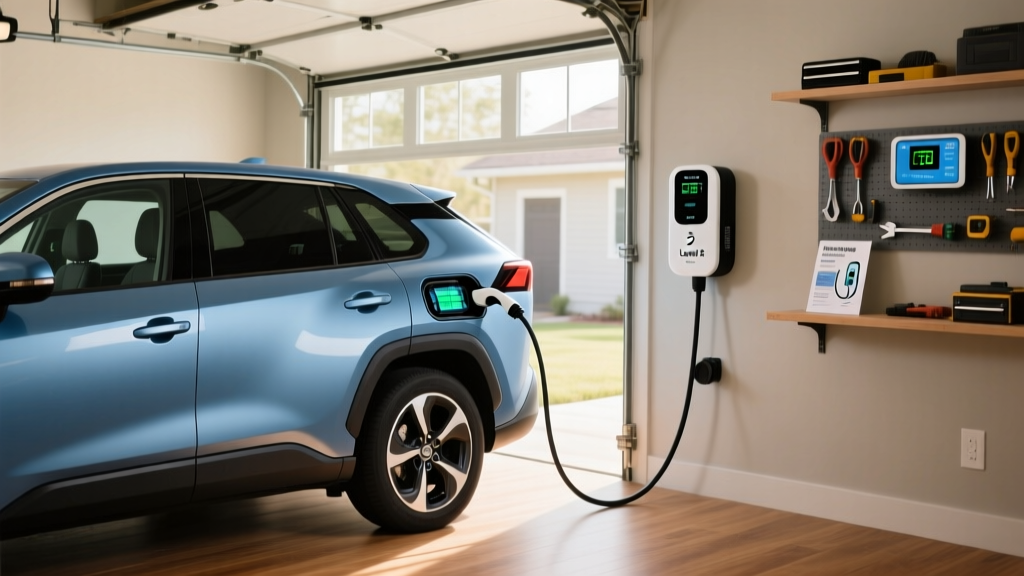
- Level 2 (7.7 kW, 240V/32A): ~7 hours — typical overnight home session
- Level 2 (11.5 kW, 240V/48A): ~4.5 hours — fast home charging with 60A circuit
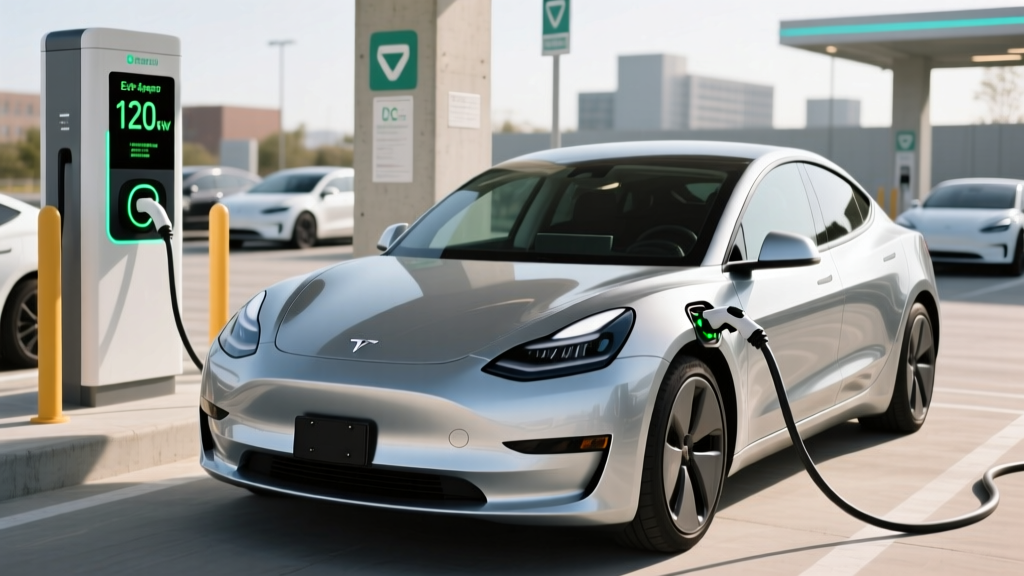
- DC Fast (50 kW station): ~75 minutes — your charge rate is limited by the charging station if your car accepts 150+ kW
- DC Fast (150 kW station, car capped at 150 kW): ~28 minutes
- DC Fast (350 kW station, 800V architecture like Ioniq 5/Porsche Taycan): ~18 minutes peak, tapering above 80%
Why Your Charge Rate Is Limited by the Charging Station (Not Your Car)
When you see a lower-than-expected kW number on the charger display, the bottleneck is usually one of four things:
- The station's rated output is below your car's acceptance rate. A 50 kW CHAdeMO station feeding a Nissan Ariya capable of 130 kW will cap at 50 kW. The car can only accept what's offered.
- Power sharing between pedestals. Many Electrify America and EVgo stations split a 350 kW cabinet between two stalls. If both cars are charging, each may receive ~175 kW or less.
- Cable and connector thermal limits. Older CCS1 cables are often thermally limited to ~200 kW without liquid cooling. A car capable of 270 kW on a non-cooled cable will plateau around 180–200 kW.
- Grid-side constraints and utility demand charges. Some destination chargers are configured at 40A instead of 48A to avoid utility demand charges, reducing output from 11.5 kW to 9.6 kW.
Your vehicle also self-limits based on battery state of charge (SoC). The published peak kW applies only at low SoC (typically 10–30%). Above 80%, charge rate tapers dramatically to protect battery longevity — a 250 kW-capable vehicle may draw just 30–40 kW at 90% SoC. This is normal physics, not a station fault.
Home EV Charger Installation: Electrical Requirements, Costs, and Panel Upgrades
Installing a Level 2 home charger is the single highest-impact upgrade an EV owner can make. It converts daily charging from a chore into an invisible overnight event. But costs vary enormously based on your home's electrical infrastructure.
Standard Electrical Requirements
A typical home Level 2 charger requires:
- Voltage: 240V (same as an electric dryer or oven)
- Amperage: 40A or 60A dedicated circuit (supports 32A or 48A continuous charging, per NEC 80% rule)
- Breaker: 50A or 70A double-pole breaker in your main panel
- Wire gauge: 6 AWG copper for 48A circuits, 4 AWG for 60A circuits over longer runs
- Hardwired vs plug: NEMA 14-50 outlet (50A) or hardwired connection (60A+, required by some jurisdictions)
The Panel-Upgrade Gotcha
Most homes built before 2000 have 100A or 150A main panels. Adding a 60A EV circuit on top of an electric range, dryer, HVAC, and water heater can exceed your panel's capacity. A licensed electrician will perform a NEC Article 220 load calculation before issuing a quote. If your panel is maxed, expect:
- 200A panel upgrade: $1,800–$3,500 including permit
- Service mast/line replacement (rare): adds $1,500–$3,000
- Smart-load alternatives: devices like the Emporia Smart Panel or Span Drive can avoid panel upgrades by dynamically shedding load (~$1,000–$2,000 extra)
| Line Item | Simple Install (Panel Adjacent) | Complex Install (Long Run + Panel Upgrade) |
|---|---|---|
| Level 2 Charger (Equipment) | $350–$650 | $350–$650 |
| Electrician Labor | $400–$900 | $1,200–$2,500 |
| Materials (wire, conduit, breaker) | $150–$400 | $500–$1,200 |
| Permit & Inspection | $75–$250 | $150–$400 |
| Panel Upgrade (if needed) | $0 | $1,800–$3,500 |
| Total Range | $975–$2,200 | $4,000–$8,250 |
The federal Alternative Fuel Vehicle Refueling Property Credit (IRS Form 8911) covers 30% of home charger equipment and installation costs, up to $1,000, subject to census-tract eligibility. Confirm eligibility with a tax professional before purchase.
Connector Compatibility: NACS, CCS1, CHAdeMO, and the Adapter Era
North America has standardized on NACS (North American Charging Standard, SAE J3400) as of the 2025–2026 model years. But the installed base of CCS1 and CHAdeMO chargers remains enormous, and adapters are now a routine part of EV ownership.
| Connector | Native Vehicles | DC Fast Network Support | Adapter Situation |
|---|---|---|---|
| NACS (J3400) | Tesla (all), Ford, GM, Rivian, Volvo, Polestar, Hyundai/Kia (2025+), most new 2026 models | Tesla Supercharger (250–350 kW), EA, EVgo NACS stalls | CCS1→NACS adapters available (~$150–$230) |
| CCS1 | Legacy VW ID.4, older Bolt EV, pre-2025 Hyundai/Kia, BMW i4/iX, Mercedes EQE/EQS | Electrify America, EVgo, ChargePoint | NACS→CCS1 adapters required for Supercharger access |
| CHAdeMO | Nissan Leaf (legacy only, discontinued), Mitsubishi Outlander PHEV | Declining network; some EA and EVgo stalls | No reliable CHAdeMO→NACS adapter exists |
Key advisory for buyers: Any new EV purchased in 2026 should ideally have native NACS or come with a manufacturer-supplied NACS adapter. CHAdeMO vehicles are no longer recommended for new buyers due to network attrition. Per fueleconomy.gov, current EV listings now filter by connector type — use this tool when shopping.
Cost to Charge: Home vs Public vs Gas Per Mile
The economics of EV ownership depend heavily on where you charge. The same 30 kWh session (roughly 100 miles of range in a midsize EV) costs radically different amounts depending on venue.
| Charging Scenario | $/kWh | Cost Per Mile (at 3 mi/kWh) | Equivalent Gas MPG at $3.40/gal |
|---|---|---|---|
| Home, off-peak utility rate | $0.09–$0.14 | $0.03–$0.05 | 68–113 MPG |
| Home, standard residential rate | $0.16–$0.22 | $0.05–$0.07 | 48–68 MPG |
| Public Level 2 (ChargePoint, workplace) | $0.25–$0.49 | $0.08–$0.16 | 21–42 MPG |
| DC Fast (EA, EVgo, Tesla Supercharger) | $0.38–$0.61 | $0.13–$0.20 | 17–26 MPG |
| Gasoline vehicle baseline (28 MPG combined) | — | $0.12 | 28 MPG |
The takeaway: home charging is almost always cheaper than gas, while exclusive reliance on DC fast charging can exceed gasoline costs on a per-mile basis. Most owners charge 80–90% at home and use DC fast only for road trips — a pattern that yields 60–70% annual fuel savings versus a comparable gasoline vehicle, per DOE EV cost calculators.
Level 2 Home Charger Equipment Picks: Power, Cable, and Smart Features
Not all Level 2 chargers are equal. Below are four field-tested picks across price tiers, selected for power output, cable length, smart features, and 2026 NACS availability.
Emporia Vue 2 (J1772 + NACS)
- Power output: 48A / 11.5 kW (requires 60A circuit)
- Cable length: 24 ft
- Smart features: Wi-Fi, energy monitoring, solar integration, load management, EV/Emporia panel pairing
- Connector options: J1772 (with NACS adapter included) or native NACS
- Price: $399–$449
- Best for: Solar owners, budget-conscious buyers, load-managed homes
ChargePoint Home Flex (NACS 2025+)
- Power output: Up to 50A / 12 kW (dip-switch configurable 16A–50A)
- Cable length: 23 ft
- Smart features: Alexa, scheduling, utility demand-response, Alexa/Google Home
- Connector: Native NACS (2025+ models), J1772 for legacy
- Price: $549–$599
- Best for: Amazon ecosystem, utility DR programs
Grizzl-E Smart (United Chargers)
- Power output: 40A / 9.6 kW (24A, 32A, 40A selectable)
- Cable length: 24 ft
- Smart features: OCPP, Wi-Fi, rugged outdoor housing, -40°F operation
- Connector: J1772 or NACS
- Price: $549–$649
- Best for: Cold climates, outdoor installations, Canadian/US northern owners
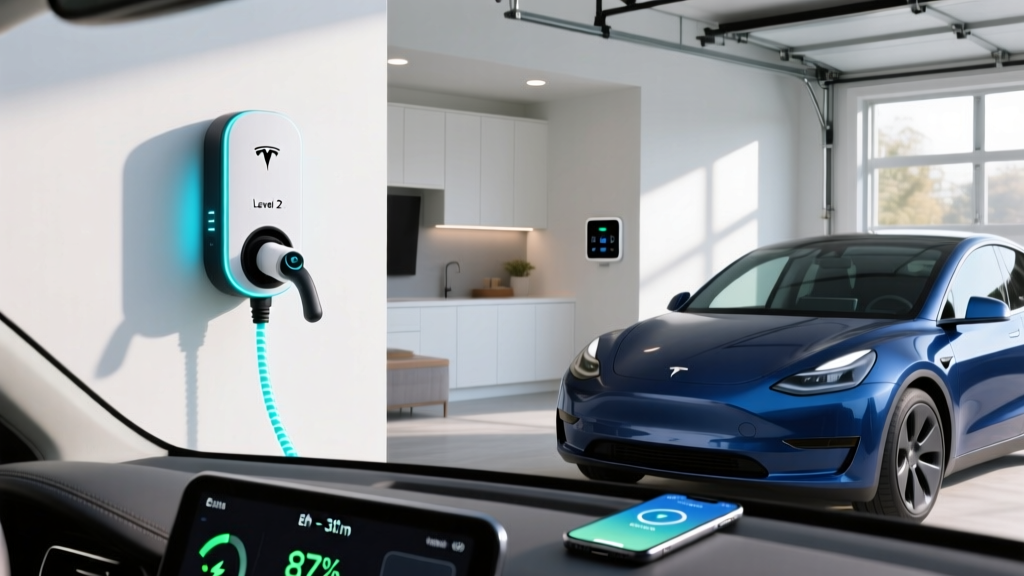
Tesla Wall Connector (Gen 3)
- Power output: 48A / 11.5 kW (60A circuit)
- Cable length: 24 ft
- Smart features: Wi-Fi, OTA updates, Power-Share load balancing between two units, NACS native
- Connector: NACS (native); J1772 adapter sold separately
- Price: $420–$475
- Best for: Tesla owners, multi-Tesla households, Powerwall integration
Safety, Code, and Inspection Requirements
A Level 2 EV charger is a continuous-load appliance under NEC Article 625. Key code requirements include:
- Dedicated circuit: No other outlets or appliances may share the breaker.
- Continuous-load derating: A 48A charger requires a 60A breaker (48A × 125%).
- GFCI protection: Required for receptacle-based (NEMA 14-50) installations in garages per NEC 2020/2023. Hardwired installations often exempt — confirm with your local AHJ (Authority Having Jurisdiction).
- Outdoor rating: Any outdoor charger must carry a NEMA 4 or IP65 weather rating; all units listed above qualify.
- Permit and inspection: Required in most US jurisdictions. Skipping the permit can void homeowner's insurance coverage for EV-related electrical fires.
- UL or ETL listing: Never install a non-listed Amazon/eBay charger — they bypass critical safety relays and have caused documented residential fires.
Frequently Asked Questions
How much does it cost to install a home EV charger?
A simple Level 2 install near your panel typically runs $975–$2,200 including equipment, labor, materials, and permit. If your home needs a 200A panel upgrade, expect $4,000–$8,250 total. The 30% federal Alternative Fuel Vehicle Refueling Property Credit (up to $1,000) may offset part of this cost if you live in an eligible census tract.
How fast will each charging level add range?
Level 1 (120V) adds 3–5 miles of range per hour — adequate for plug-in hybrids but impractical for full EVs. Level 2 (240V, 40–48A) adds 25–40 miles per hour, enough to fully replenish most EVs overnight. DC fast charging adds 150–1,200+ miles per hour depending on station output (50–350 kW), but taper above 80% SoC cuts effective speed dramatically.
Which connector or charger is compatible with my EV?
For 2026 model-year vehicles, native NACS is the standard on Tesla, Ford, GM, Rivian, Volvo, Hyundai, and Kia. Legacy CCS1 vehicles (VW ID.4, older Bolts, pre-2025 Hyundai/Kia) require a NACS→CCS1 adapter (~$170–$230) to access Tesla Superchargers. CHAdeMO vehicles (Nissan Leaf) face declining network support and are not recommended for new purchases.
How much does charging cost per mile vs gas?
At a national average residential rate of $0.17/kWh and typical EV efficiency of 3 miles per kWh, home charging costs roughly $0.057 per mile — about half the $0.12 per mile a 28 MPG gasoline vehicle burns at $3.40/gal. Public DC fast charging ($0.48/kWh average) costs ~$0.16/mile, exceeding gas costs. Maximizing home charging is the key to EV economics.
What electrical upgrades might I need?
Most pre-2000 homes with 100A or 150A main panels need a 200A panel upgrade ($1,800–$3,500) before adding a 60A EV circuit. Newer homes with 200A service usually have sufficient headroom. Alternatives include smart load-management devices (Emporia, Span) that share capacity between the EV and other appliances, or reducing charger amperage from 48A to 32A to stay within panel limits.
Why does my 250 kW-capable EV only charge at 48 kW on some public stations?
Your charge rate is limited by the charging station itself — either its rated output (many older public stations are 50 kW), thermal cable limits, or power sharing between two pedestals on one cabinet. Always check the station's posted kW rating in your charging app before driving there. A 350 kW-capable car on a 50 kW station will peak at 50 kW regardless of its onboard hardware.