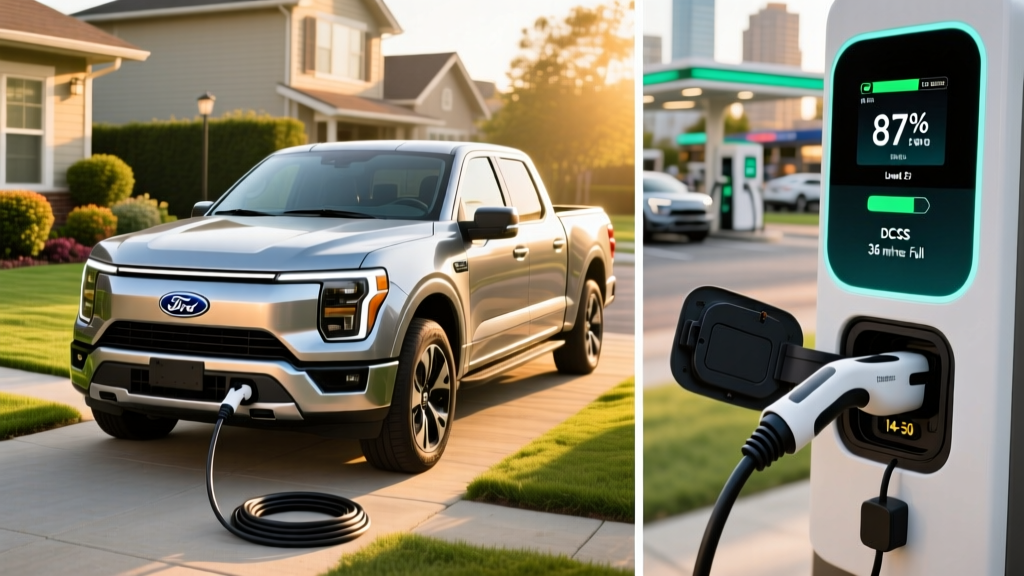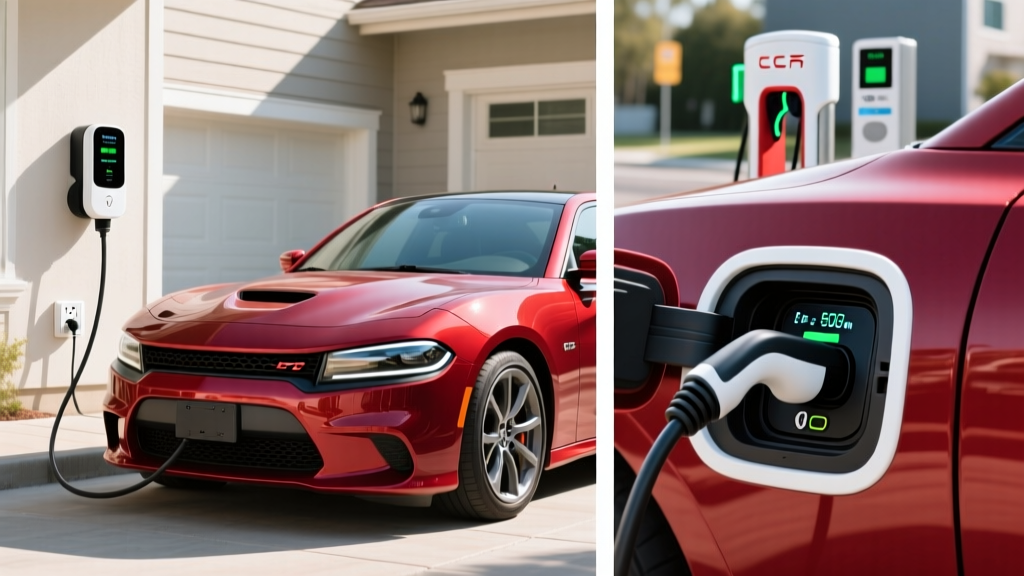
Your EV car range isn't just a number printed on a window sticker — it's a dynamic figure shaped by how you charge, where you charge, and the equipment you use. A 320-mile EPA estimate can shrink to 240 miles on a cold highway run, and a 150 kW peak charge rate rarely sustains for the full session. Understanding the relationship between charging infrastructure and usable range is the single most practical step you can take as an EV owner or buyer.
This guide covers every layer of EV charging — from the electrical panel in your garage to the DC fast charger on the interstate — with exact numbers on speeds, costs, and equipment so you can plan around real-world range, not marketing claims.
Charging Levels Explained: Speeds, kW, and Real-World Range Added
EV charging is categorized into three levels, each defined by voltage, power delivery (measured in kilowatts, or kW), and the practical miles of range added per hour. Note that kW measures the rate of energy flow (power), while kWh measures the total capacity of your battery (energy). Confusing these two is the most common EV literacy mistake — think of kW as the speed of water flowing through a hose, and kWh as the size of the bucket you're filling.
| Level | Voltage | Power (kW) | Miles of Range/Hour | Best For |
|---|---|---|---|---|
| Level 1 | 120V AC | 1.0–1.4 kW | 3–5 mi/hr | Overnight top-ups, PHEVs, low-mileage drivers |
| Level 2 | 240V AC | 3.3–19.2 kW | 12–75 mi/hr | Daily home/workplace charging, primary EV use |
| DC Fast Charging | 400–900V DC | 50–350 kW | 150–1,200+ mi/hr | Road trips, highway corridors, quick top-ups |
For a typical 75 kWh battery pack (like a Tesla Model Y Long Range or Hyundai Ioniq 5), Level 2 at 11.5 kW will fully charge from 10% to 100% in roughly 7 hours — ideal for overnight replenishment. DC fast charging from 10% to 80% takes 18–30 minutes depending on peak kW and the vehicle's charge curve.
Home Charger Installation: Electrical Requirements, Costs, and Panel Upgrades
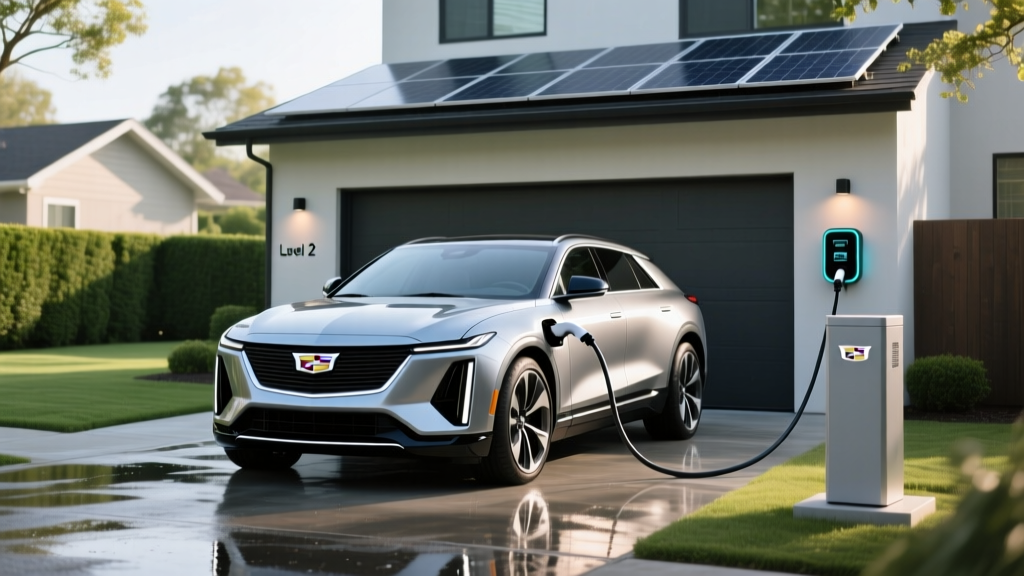
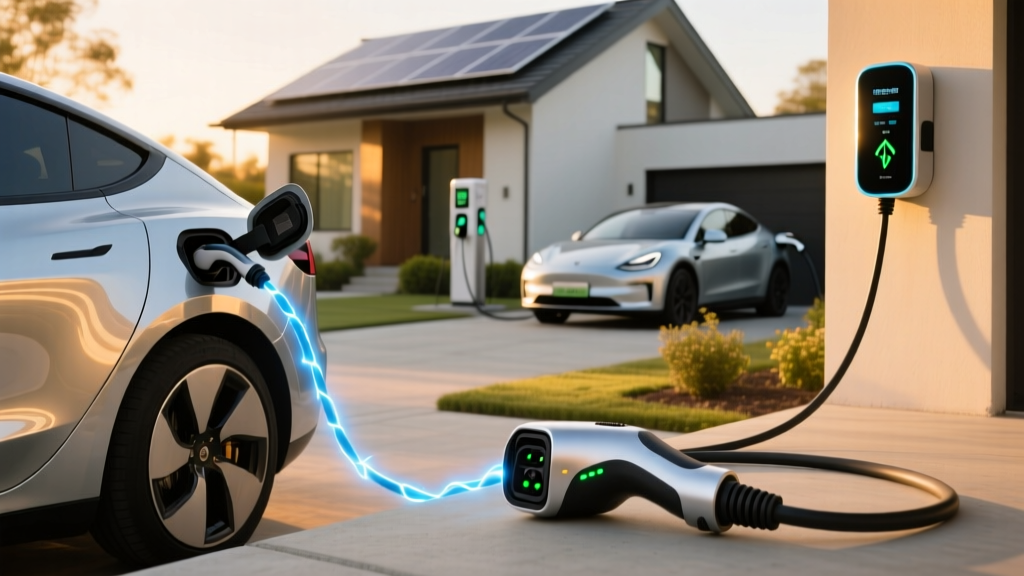
Installing a Level 2 home charger is the most impactful upgrade for daily EV ownership. Most EV owners do 80–90% of their charging at home, waking up every morning to a full battery and eliminating routine range anxiety entirely.
Electrical Requirements
A standard Level 2 home charger requires a 240-volt dedicated circuit, similar to what powers an electric dryer or oven. The most common residential setup is a 40-amp or 48-amp circuit, which delivers 9.6 kW or 11.5 kW respectively to the vehicle (EVs typically draw 80% of the circuit's rated capacity for continuous loads, per National Electrical Code). A NEMA 14-50 outlet is the most versatile installation choice, allowing you to plug in and swap chargers, though many opt for a hardwired unit for higher amperage and a cleaner install.
Do You Need a Panel Upgrade?
This is the cost variable most guides gloss over. If your home has a 100-amp electrical panel — common in homes built before the 1990s — adding a 40-amp EV circuit may push you past safe capacity, especially if you already run electric heat, an electric dryer, and an electric oven. A licensed electrician will perform a load calculation to determine whether your panel can handle the additional draw. If a panel upgrade to 200 amps is needed, expect to add $1,500–$3,500 to your total project cost.
| Component | Low Estimate | High Estimate | Notes |
|---|---|---|---|
| Level 2 Charger (Equipment) | $250 | $700 | Smart Wi-Fi chargers cost more |
| Electrician Labor (240V circuit run) | $500 | $2,000 | Depends on distance from panel to garage |
| Permit & Inspection | $50 | $300 | Varies by municipality |
| Electrical Panel Upgrade (if needed) | $1,500 | $3,500 | 100A to 200A upgrade |
| Total (no panel upgrade) | $800 | $3,000 | Most common scenario for modern homes |
| Total (with panel upgrade) | $2,300 | $6,500 | Older homes with 100A service |
The federal Residential Clean Energy Credit does not cover EV chargers as of current IRS guidance, but some utilities and state programs offer rebates of $250–$1,000 for Level 2 equipment and installation. Check with your local utility for specific programs.
Connector Compatibility: NACS, CCS, CHAdeMO, and Adapter Needs
The charging connector landscape has consolidated significantly since 2024, when Ford, GM, Rivian, Volvo, and most major automakers adopted the North American Charging Standard (NACS), originally developed by Tesla. Here's where each connector stands today:
| Connector | Brands Using It | DC Fast Charge Availability | Adapter Needed? |
|---|---|---|---|
| NACS (Tesla) | Tesla, Ford, GM, Rivian, Volvo, Polestar, Mercedes-Benz, Hyundai/Kia (new models), Subaru, Lucid | Tesla Supercharger network + third-party NACS stations | CCS-to-NACS adapter for older CCS vehicles at NACS stations |
| CCS1 (Combo) | Legacy VW ID.4, BMW iX (pre-2025), Stellantis models, some Hyundai/Kia (carryover) | Electrify America, EVgo, ChargePoint DC stations | NACS-to-CCS adapter to use Tesla Superchargers |
| CHAdeMO | Nissan Leaf (discontinued 2025), Mitsubishi Outlander PHEV | Declining — limited to legacy stations | No widely available adapter to NACS/CCS |
If you're buying a new EV in 2026, NACS is the dominant standard going forward. Owners of CCS-equipped vehicles can purchase a NACS-to-CCS adapter ($150–$250) to access Tesla's Supercharger network, which now offers over 25,000 stalls in North America. For home Level 2 charging, most chargers ship with a J1772 connector (the Level 2 standard) or a NACS connector — Tesla vehicles accept J1772 with the included adapter, and new NACS vehicles may ship with a J1772-to-NACS adapter.
Cost to Charge: Home vs. Public vs. Gas — Price Per Mile
The economic case for EV ownership hinges on the cost-per-mile of electricity versus gasoline. Here's how the numbers break down across common scenarios, using a mid-size EV with 3.5 miles per kWh efficiency (roughly equivalent to a Tesla Model 3 or Hyundai Ioniq 6):
| Scenario | Cost per kWh | Cost per Mile | Annual Cost (12,000 mi) |
|---|---|---|---|
| Home charging (national avg. electricity) | $0.16/kWh | $0.046/mi | $552 |
| Home charging (off-peak TOU rate) | $0.09/kWh | $0.026/mi | $312 |
| Public Level 2 (workplace/network) | $0.25–$0.49/kWh | $0.07–$0.14/mi | $840–$1,680 |
| DC Fast Charging (road trip pricing) | $0.35–$0.55/kWh | $0.10–$0.16/mi | $1,200–$1,920 |
| Gasoline (30 MPG combined, $3.40/gal) | — | $0.113/mi | $1,356 |
Home charging at off-peak rates delivers the most dramatic savings — roughly a quarter of the cost per mile of gasoline. Even exclusive DC fast charging approaches parity with gas, which is why home Level 2 access remains the economic linchpin of EV ownership. If you rely entirely on public DC fast charging, your per-mile cost may equal or exceed a fuel-efficient hybrid.
Charging Time Examples: How Long Does 10–80% Take?
Battery size, charger power, and the vehicle's onboard charge curve all determine how long a session takes. Here are real-world 10–80% charging times for common EV battery sizes at various power levels:
- 60 kWh battery (e.g., Chevrolet Equinox EV): 150 kW DC fast charger → ~22 minutes; 11.5 kW Level 2 → ~4.5 hours
- 75 kWh battery (e.g., Tesla Model Y Long Range): 250 kW Supercharger → ~18 minutes; 11.5 kW Level 2 → ~5.5 hours
- 84 kWh battery (e.g., Hyundai Ioniq 5 N): 350 kW DC fast charger → ~18 minutes (800V architecture); 11.5 kW Level 2 → ~6 hours
- 100 kWh battery (e.g., GMC Sierra EV): 350 kW DC fast charger → ~25 minutes; 19.2 kW Level 2 → ~4.5 hours
Equipment Recommendations: Top Level 2 Home Chargers for 2026
The home charger market has matured considerably. Here are top picks based on power output, build quality, smart features, and connector options:
ChargePoint Home Flex
- Power: Up to 12 kW (50A circuit) — adjustable down to 16A
- Connector: J1772 (NACS adapter included for Tesla/NACS vehicles)
- Cable Length: 23 feet
- Smart Features: Wi-Fi, Alexa, scheduling, energy tracking
- Price: ~$549
- Best For: Flexibility — adjustable amperage works with any panel capacity
Tesla Wall Connector
- Power: Up to 11.5 kW (48A/60A circuit)
- Connector: NACS native (J1772 adapter available)
- Cable Length: 24 feet
- Smart Features: Wi-Fi, OTA updates, power sharing between units
- Price: ~$475
- Best For: Tesla and NACS-equipped vehicles — cleanest integration
Emporia Level 2 EV Charger
- Power: Up to 11.5 kW (48A)
- Connector: J1772
- Cable Length: 24 feet
- Smart Features: Wi-Fi, real-time energy monitoring, solar integration
- Price: ~$399
- Best For: Budget-conscious buyers who want detailed energy data
Grizzl-E Smart
- Power: Up to 10 kW (40A)
- Connector: J1772
- Cable Length: 24 feet
- Smart Features: Wi-Fi, OCPP compatible, extreme cold rated (-40°F)
- Price: ~$449
- Best For: Cold-climate durability — built in Canada, rugged enclosure
Safety, Electrical Code, and Installation Best Practices
EV charging involves sustained high-current draw — often for 6–8 hours continuously. This places unique demands on your home's electrical system that go beyond typical appliance circuits:
- Dedicated circuit: Your Level 2 charger must be on its own dedicated breaker — never shared with other outlets or appliances. The National Electrical Code (NEC) requires this for continuous loads.
- GFCI protection: Outdoor installations require Ground Fault Circuit Interrupter (GFCI) protection. Many modern chargers have built-in GFCI, but local codes may require a GFCI breaker at the panel as well.
- Outdoor rating: If installing outside, ensure the charger carries a NEMA 4 or IP65 weather rating. All recommended chargers above meet this standard.
- Wire gauge: A 48A charger on a 60A circuit typically requires 4 AWG copper wire. Your electrician will size this based on circuit length and local code.
- Permit and inspection: Most jurisdictions require an electrical permit for a new 240V circuit. The inspection ensures proper grounding, wire sizing, and breaker rating — skipping this step can void your homeowner's insurance in the event of a fire.
Frequently Asked Questions
How much does it cost to install a home EV charger?
A typical Level 2 home charger installation costs between $800 and $3,000 when no panel upgrade is needed, covering equipment ($250–$700), electrician labor ($500–$2,000), and permits ($50–$300). Homes with older 100-amp panels may need a $1,500–$3,500 panel upgrade, bringing the total to $2,300–$6,500. Always get a load calculation from a licensed electrician before committing.
How fast will each charging level add range?
Level 1 (120V) adds 3–5 miles of range per hour — suitable for plug-in hybrids or EVs driven under 30 miles daily. Level 2 (240V) adds 12–75 miles per hour depending on amperage, fully replenishing most EVs overnight. DC fast charging adds 150–1,200+ miles per hour of peak power, enabling 10–80% charges in 18–30 minutes on a road trip.
Which connector/charger is compatible with my EV?
For 2025–2026 models, most new EVs use NACS (Tesla's connector, now the industry standard). Older CCS-equipped vehicles can use a NACS-to-CCS adapter ($150–$250) to access Tesla Superchargers. CHAdeMO (Nissan Leaf) has limited future support. For home Level 2 charging, most chargers use J1772, which is compatible with all EVs via included adapters.
How much does charging cost per mile vs. gas?
Home charging at the national average electricity rate ($0.16/kWh) costs roughly $0.046 per mile — about 40% of the cost of gasoline at $3.40/gallon in a 30 MPG vehicle ($0.113/mile). Off-peak home rates ($0.09/kWh) drop this to $0.026/mile. Public DC fast charging at $0.35–$0.55/kWh approaches gasoline parity at $0.10–$0.16/mile.
What electrical upgrades might I need?
The most common upgrade is a panel capacity increase from 100A to 200A ($1,500–$3,500), necessary in older homes where the existing panel is near capacity. Some homes may also need a new conduit run from the panel to the garage ($200–$800) or a sub-panel installation if the main panel is on the opposite side of the house. A licensed electrician's load calculation will identify exactly what's needed before any work begins.