Understanding EV Charging Levels: Speed, Power, and Real-World Range
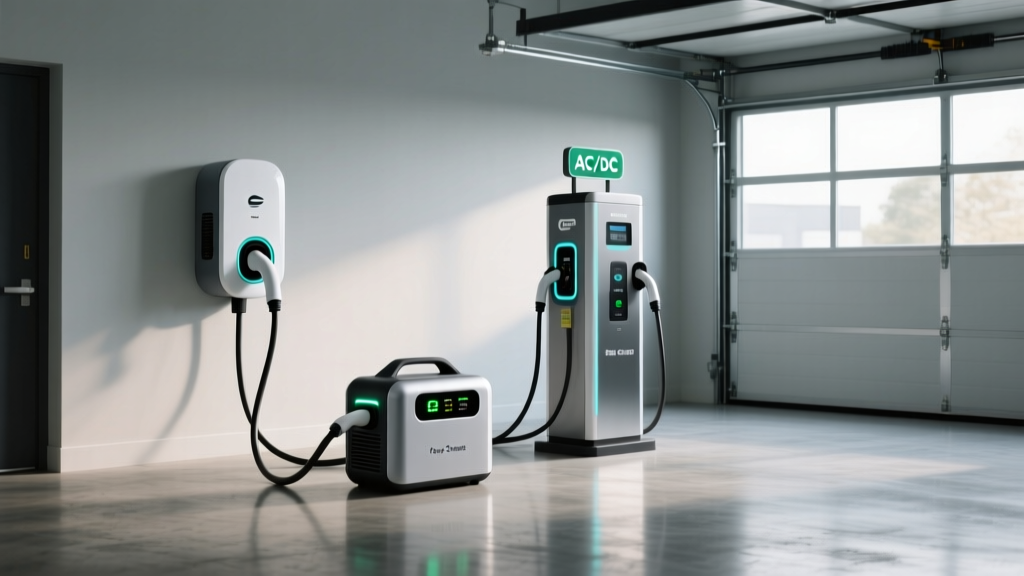
Before evaluating EV car charger manufacturers, you need a clear picture of what each charging level actually delivers. The single most important distinction in EV charging is between kW (kilowatts), which measures power flow rate, and kWh (kilowatt-hours), which measures total energy stored in your battery. A 48-amp Level 2 charger delivers up to 11.5 kW of power; if you run it for one hour, it adds roughly 11.5 kWh of energy to your battery pack.
| Level | Voltage | Max Power (kW) | Miles of Range Added per Hour | Typical Use Case |
|---|---|---|---|---|
| Level 1 | 120V AC | 1.4–1.9 kW | 3–5 mi/hr | Overnight top-up, PHEVs, low-mileage drivers |
| Level 2 | 240V AC | 3.3–19.2 kW | 12–75 mi/hr | Home daily charging, workplace, public AC stations |
| DC Fast (Level 3) | 400–900V DC | 50–350+ kW | 150–1,200+ mi/hr (peak) | Road trips, highway corridors, commercial fleets |
For most EV owners, Level 2 is the daily workhorse. A typical 75 kWh battery (like the one in a Tesla Model Y Long Range) charged at 11.5 kW gains roughly 45 miles of range per hour — enough to fully replenish overnight. DC fast charging is reserved for road trips, where a 250 kW station can take that same battery from 10% to 80% in approximately 20–25 minutes, depending on the vehicle's charge curve and battery temperature.
Home Charger Installation: Electrical Requirements and True Costs
Installing a Level 2 home charger is the single biggest ownership decision after buying the EV itself. The total cost depends on your home's electrical panel capacity, the distance from the panel to your garage or driveway, and local permitting requirements. Here is what a realistic 2026 installation looks like.
Electrical Requirements
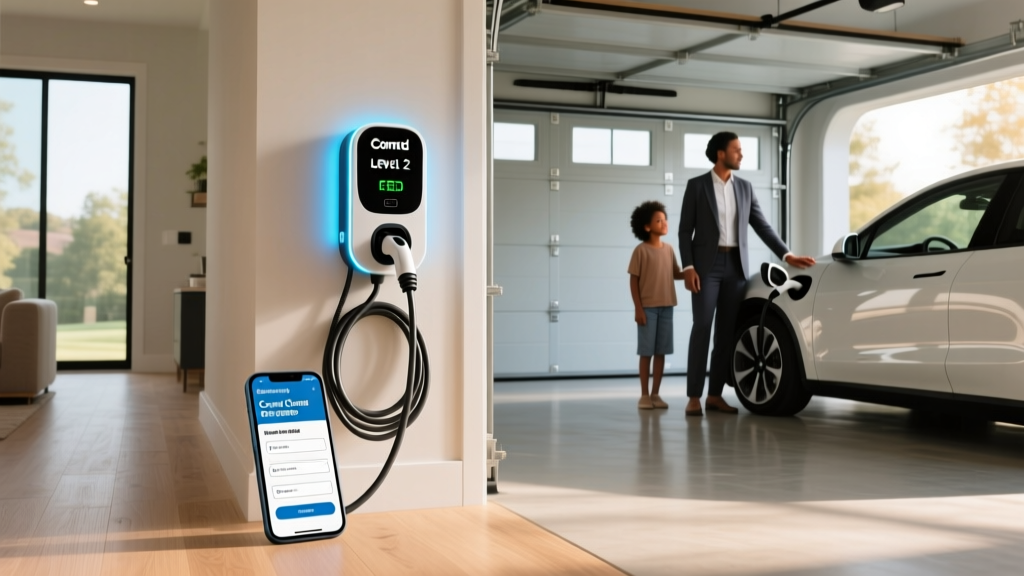
Most residential Level 2 chargers require a dedicated 240V circuit. Common configurations include:
- 40-amp circuit (delivers up to 32A continuous / 7.7 kW) — sufficient for most EVs and the minimum recommended for a 60–80 kWh battery
- 50-amp circuit (delivers up to 40A continuous / 9.6 kW) — ideal for larger batteries like the Ford F-150 Lightning's 131 kWh pack
- 60-amp circuit (delivers up to 48A continuous / 11.5 kW) — maximum for most single-family homes; requires 6 AWG copper wire
The National Electrical Code (NEC) requires that continuous loads (including EV charging) not exceed 80% of the circuit breaker rating. A 40A breaker therefore supports 32A continuous draw — not 40A.
Panel Upgrade Considerations
Homes built before 2000 often have 100-amp or 150-amp main service panels. Adding a 50A or 60A EV circuit to an already-loaded panel may require a panel upgrade to 200 amps, which typically costs $1,500–$3,500. Signs you may need an upgrade:
- Your panel is at or near capacity (few or no open breaker slots)
- You already run high-draw appliances (electric range, dryer, HVAC, hot tub)
- Your panel is a legacy brand with known issues (e.g., Federal Pacific, Zinsco)
Some homeowners can avoid a full panel upgrade by installing a smart load-management device (like the Emporia VUE with automatic load shedding), which dynamically reduces charger amperage when other appliances draw heavy power. These devices cost $200–$400 and can save thousands on panel work.
| Component | Cost Range | Notes |
|---|---|---|
| Level 2 Charger (Equipment) | $300–$750 | Smart Wi-Fi models at higher end |
| Electrical Permit | $50–$250 | Varies by municipality |
| Electrician Labor (standard install) | $400–$1,200 | Depends on run length, wall type, conduit |
| Panel Upgrade (if needed) | $1,500–$3,500 | 200A service upgrade |
| Total (no panel upgrade) | $750–$2,200 | Most common scenario |
| Total (with panel upgrade) | $2,250–$5,700 | Older homes, high-load panels |
The federal government and many utilities offer incentives. Check the IRS Residential Clean Energy Credit — while the §30D credit applies to vehicles, the §25C Energy Efficient Home Improvement Credit may cover up to 30% of charger equipment and installation costs (capped at $1,000 for the charger circuit). Many utilities also offer rebates of $250–$500 for installing a smart Level 2 charger.
Connector Compatibility: NACS, CCS1, and CHAdeMO Explained
The North American charging connector landscape has consolidated significantly since 2023, when Ford, GM, Rivian, and most major automakers announced adoption of the North American Charging Standard (NACS) — originally Tesla's proprietary connector. As of the 2025–2026 model years, NACS is the dominant standard for new EVs sold in the United States.
| Connector | Automakers Using It (Native) | Adapter Needed For |
|---|---|---|
| NACS (Tesla-style) | Tesla, Ford, GM, Rivian, Volvo, Polestar, Mercedes-Benz, BMW, Hyundai, Kia, Lucid, Toyota | Older CCS public chargers (adapter included with many new EVs) |
| CCS1 | VW (legacy models), some remaining 2024–2025 inventory | Tesla Superchargers (CCS-to-NACS adapter, ~$200–$250) |
| CHAdeMO | Nissan Leaf (discontinued 2025), Mitsubishi Outlander PHEV (legacy) | Nearly all DC fast networks (CHAdeMO-to-CCS or NACS adapter) |
Key takeaway for home charger buyers: If you are purchasing a new EV in 2025–2026, it almost certainly uses NACS. Buy a NACS-connector home charger. If you own an older CCS1 vehicle, you can purchase a NACS home charger and use a CCS1-to-NACS adapter (~$150–$250) or buy a CCS1-native charger. CHAdeMO vehicles are increasingly rare, and adapter options are limited — plan to rely on the shrinking CHAdeMO public network or trade into a newer vehicle.
Leading EV Car Charger Manufacturers: Equipment Picks and Specs
The market for residential Level 2 equipment has matured, with several manufacturers standing out for reliability, smart features, and build quality. Below are the top contenders for 2026, based on power output, connector options, smart-home integration, and long-term durability.
Tesla Wall Connector (Gen 4)
- Power Output: Up to 11.5 kW (48A on a 60A circuit)
- Connector: NACS native
- Cable Length: 24 feet
- Smart Features: Wi-Fi, over-the-air updates, Power Sharing (link up to 6 units on one circuit), Tesla app scheduling, load management
- Price: ~$475
- Best For: Tesla owners and NACS-equipped EVs; best-in-class smart features
ChargePoint Home Flex
- Power Output: Configurable up to 12 kW (50A on a 60A circuit); adjustable down to 16A for smaller circuits
- Connector: NACS or CCS1 (choose at purchase)
- Cable Length: 23 feet
- Smart Features: Wi-Fi, ChargePoint app with detailed energy tracking, Alexa/Google Home integration, scheduled charging, utility demand-response compatible
- Price: ~$699
- Best For: Multi-EV households, utility program participants, those wanting granular energy data
Emporia Level 2 EV Charger
- Power Output: Up to 11.5 kW (48A on a 60A circuit)
- Connector: NACS (J1772 adapter included)
- Cable Length: 24 feet
- Smart Features: Wi-Fi, Emporia app with real-time energy monitoring, solar integration (pairs with Emporia VUE energy monitor), automatic load management, TOU scheduling
- Price: ~$399
- Best For: Budget-conscious buyers, solar-panel owners, homes needing load management to avoid panel upgrades
Grizzl-E Smart
- Power Output: Up to 10 kW (40A on a 50A circuit)
- Connector: NACS or J1772 (configurable)
- Cable Length: 24 feet
- Smart Features: Wi-Fi, OCPP-compatible (works with utility programs), app scheduling, load balancing
- Price: ~$549
- Best For: Cold-climate owners (rated to -40°F), outdoor installations, rugged durability
EnelX JuiceBox 2 (48A)
- Power Output: Up to 11.5 kW (48A)
- Connector: NACS
- Cable Length: 25 feet
- Smart Features: Wi-Fi, JuiceNet app, energy tracking, smart scheduling
- Price: ~$599
- Best For: Fleet and multi-family applications, strong OCPP support
Charging Cost per Mile: EV vs. Gas in 2026
The economic case for home charging is compelling, but public DC fast charging narrows the gap. Below is a realistic cost comparison using national average electricity and fuel prices.
| Scenario | Rate | Vehicle Efficiency | Cost per Mile |
|---|---|---|---|
| Home Level 2 (national avg. electricity) | $0.16/kWh | 3.5 mi/kWh (e.g., Tesla Model Y) | $0.046/mi |
| Home Level 2 (off-peak TOU rate) | $0.09/kWh | 3.5 mi/kWh | $0.026/mi |
| Public Level 2 (network pricing) | $0.30/kWh | 3.5 mi/kWh | $0.086/mi |
| DC Fast Charging ( Electrify America, EVgo) | $0.48/kWh | 3.0 mi/kWh (highway) | $0.160/mi |
| Gas Vehicle (28 MPG combined) | $3.40/gal | 28 MPG | $0.121/mi |
| Gas Vehicle (22 MPG, truck/SUV) | $3.40/gal | 22 MPG | $0.155/mi |
The bottom line: Home charging — especially on a time-of-use (TOU) plan with off-peak rates — costs roughly one-quarter to one-third what gasoline costs per mile. Even DC fast charging is competitive with a mid-efficiency gas car. A driver covering 12,000 miles per year at home off-peak rates spends approximately $312 annually on electricity, versus $1,457 in gasoline for a 28 MPG vehicle — a savings of over $1,100 per year.
Charging Time Examples: How Long Does It Really Take?
Charging time depends on your battery's usable capacity (in kWh), the charger's power output (in kW), and the charge curve. Here are real-world estimates for common scenarios:
| Battery (Usable kWh) | Example Vehicle | Level 2 @ 11.5 kW | DC Fast @ 150 kW | DC Fast @ 250 kW |
|---|---|---|---|---|
| 60 kWh | Chevrolet Equinox EV | ~3.6 hours | ~30 min | ~22 min |
| 75 kWh | Tesla Model Y LR | ~4.6 hours | ~35 min | ~25 min |
| 84 kWh | Hyundai Ioniq 5 (2025+) | ~5.1 hours | ~28 min | ~18 min |
| 100 kWh | Ford F-150 Lightning (Std Range) | ~6.1 hours | ~42 min | ~32 min |
| 131 kWh | Ford F-150 Lightning (ER) | ~8.0 hours | ~55 min | ~42 min |
Note that the Hyundai Ioniq 5's 800V architecture allows it to sustain higher DC fast-charging speeds longer than 400V vehicles, which is why its 250 kW time is notably faster despite a larger battery than the Equinox EV. According to fueleconomy.gov, the Ioniq 5 achieves a combined MPGe of 114, translating to roughly 3.8 miles per kWh — one of the most efficient midsize electric crossovers available.
Safety, Code Compliance, and Installation Best Practices
EV charging draws significant continuous current for hours at a time — making proper installation non-negotiable. Here are the critical safety and code considerations:
- Dedicated Circuit: Your Level 2 charger must be on its own dedicated breaker — never shared with other outlets or appliances. This prevents overloading and tripping.
- GFCI Protection: The 2023 NEC (adopted by most jurisdictions by 2025–2026) requires GFCI (Ground Fault Circuit Interrupter) protection for all 240V receptacles used for EV charging. Hardwired installations are exempt from this requirement, which is one reason professionals often recommend hardwiring.
- Outdoor Rating: If your charger is mounted outside, ensure it carries a NEMA 4 (weatherproof) or IP65/IP66 rating. All chargers listed above meet outdoor standards.
- Wire Gauge: A 60A circuit requires 6 AWG copper wire (THHN in conduit or NM-B in walls). A 50A circuit requires 6 AWG or 8 AWG depending on insulation type. Your electrician will specify based on run length and local code.
- Permit and Inspection: Nearly all jurisdictions require a permit for a new 240V circuit. The inspection verifies wire gauge, breaker sizing, grounding, and GFCI compliance. Do not skip this — it protects your home and is required for insurance coverage.
- UL Listing: Only purchase chargers that are UL-listed (or ETL-listed to UL standards). This ensures independent safety testing. Avoid unbranded chargers from online marketplaces that lack certification.
Frequently Asked Questions
How much does it cost to install a home EV charger?
A standard Level 2 home charger installation (equipment, permit, and electrician labor) costs between $750 and $2,200 for most homes with a modern 200A electrical panel. If your home requires a panel upgrade from 100A or 150A to 200A, expect the total to rise to $2,250–$5,700. Utility rebates and the federal §25C credit (up to $1,000) can offset a meaningful portion of this cost.
How fast will each charging level add range?
Level 1 (120V) adds 3–5 miles of range per hour — suitable only for plug-in hybrids or very low-mileage drivers. Level 2 (240V, 48A) adds approximately 40–45 miles per hour for an efficient EV like the Tesla Model Y, fully replenishing most batteries overnight. DC fast charging at 250 kW can add 200+ miles in 15–20 minutes, though actual speed depends on the vehicle's charge curve and battery temperature.
Which connector/charger is compatible with my EV?
For 2025–2026 model-year vehicles, the answer is almost certainly NACS. Tesla, Ford, GM, Rivian, Hyundai, Kia, BMW, Mercedes-Benz, Volvo, and Toyota all use NACS natively. If you own an older CCS1 vehicle (like a 2023 VW ID.4), you can either buy a CCS1 home charger or use a CCS1-to-NACS adapter (~$200) with a NACS charger. CHAdeMO is effectively legacy — only the discontinued Nissan Leaf and older Mitsubishi models use it.
How much does charging cost per mile vs gas?
Home charging on a national average electricity rate ($0.16/kWh) costs approximately $0.046 per mile in an efficient EV. Off-peak TOU rates can drop this to $0.026/mile. A comparable 28 MPG gas vehicle at $3.40/gallon costs $0.121/mile. Even DC fast charging at $0.48/kWh ($0.16/mile) is competitive with gasoline. Annual savings for a 12,000-mile driver range from $700 to $1,150 depending on electricity rates.
What electrical upgrades might I need?
The most common upgrade is a panel upgrade from 100A or 150A to 200A, needed when your existing panel lacks capacity for a new 40–60A circuit. This costs $1,500–$3,500. Alternatives include installing a smart load-management device ($200–$400) that dynamically limits charger draw when other appliances are active, or opting for a lower-amperage charger (24A or 32A) that fits within your existing panel's spare capacity. A licensed electrician can perform a load calculation to determine your exact needs. For detailed electrical code requirements, consult the National Fire Protection Association's NEC resources.