Buying an EV is only half the equation. The other half—where you actually recharge—determines whether electric ownership feels effortless or frustrating. For most drivers, that means installing an EV car charger for home, where 80% or more of all charging happens. Done right, you wake up every morning with a full battery, paying a fraction of what gas would cost. Done poorly, you're staring at a tripped breaker or a $3,000 electrical surprise.
This guide walks through exactly what's involved in 2026: the charging levels and their real-world speeds, what your electrical panel can (and can't) handle, which connector your car needs, what it costs per mile versus gasoline, and which wall-mounted chargers actually deliver on their spec sheets.
Charging Levels Explained: Speed, Power, and What You Actually Get
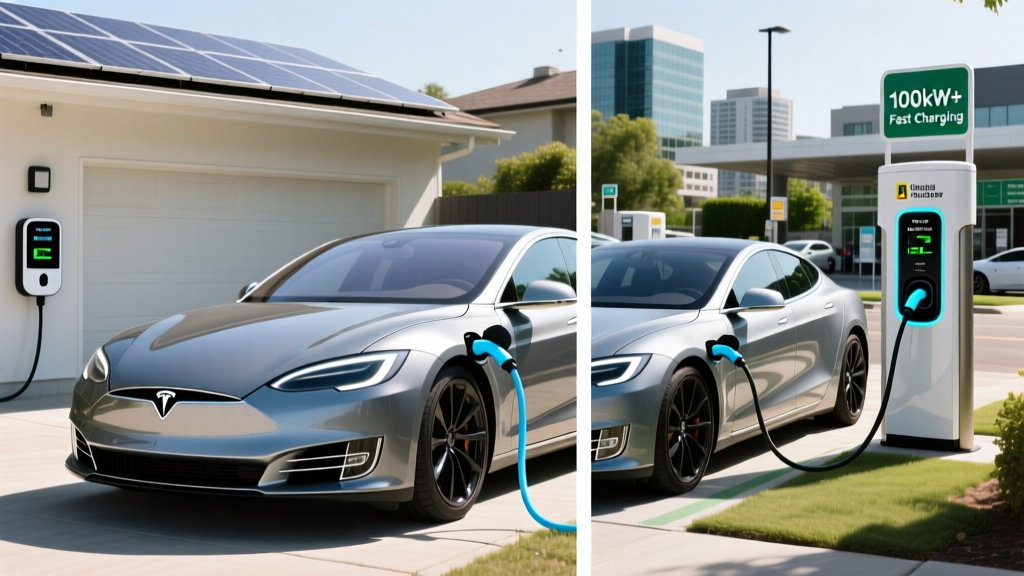
EV charging is measured in kW (kilowatts), which is the rate of power flow—think of it as how fast water comes out of a hose. The energy stored in your battery is measured in kWh (kilowatt-hours)—the total volume of water in the tank. Confusing these two is the single most common EV mistake. A 48-amp Level 2 charger delivering 11.5 kW will add roughly 11.5 kWh of energy to your battery in one hour (minus ~5% efficiency loss).
| Level | Voltage | Max Power (kW) | Miles of Range Added/Hour | Typical Use Case |
|---|---|---|---|---|
| Level 1 | 120V AC | 1.0–1.4 kW | 3–5 mi/hr | Overnight trickle; PHEVs; emergency backup |
| Level 2 | 240V AC | 3.3–19.2 kW | 12–75 mi/hr | Home wall charger; workplace; public AC |
| DC Fast Charge | 400–800V DC | 50–350 kW | 150–1,000+ mi/hr (peak) | Road trips; highway corridors; 10–80% in 15–30 min |
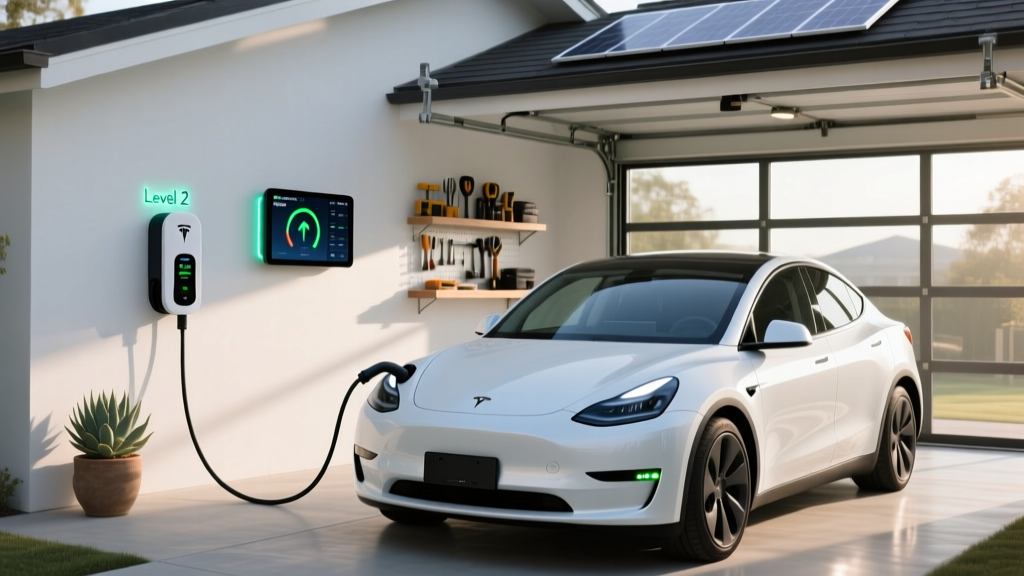
For a home EV car charger, Level 2 is the standard. A typical 40-amp circuit delivers up to 9.6 kW (32 amps continuous, following the NEC 80% rule for continuous loads). That's enough to fully recharge a 75 kWh battery pack—like the one in a Tesla Model Y Long Range—overnight in about 8–9 hours. A 48-amp unit on a 60-amp circuit pushes 11.5 kW, shaving roughly 90 minutes off that time.
Real-world charging time examples (Level 2 at 11.5 kW / 48A):
- Tesla Model Y (75 kWh usable, NMC): 10–80% in ~5.5 hours
- Hyundai Ioniq 5 (77.4 kWh usable, NMC): 10–80% in ~5.7 hours
- Ford F-150 Lightning Extended Range (131 kWh usable, NMC): 10–80% in ~9.5 hours
- Chevrolet Equinox EV (85 kWh usable, NMC): 10–80% in ~6.3 hours
Level 1 (120V standard outlet) is fine for plug-in hybrids with small batteries—a Toyota RAV4 Prime's 18.1 kWh pack tops off in about 12–14 hours. For a full BEV with a 75+ kWh battery, Level 1 is impractical as a daily solution; a full charge would take 3+ days.
Electrical Requirements: What Your Panel Can Handle
Before ordering a charger, open your electrical panel and check two things: your main service amperage (usually 100A or 200A on the main breaker) and your available spare breaker slots. A Level 2 EV charger typically requires a dedicated 240V circuit at 40, 50, or 60 amps.
Common home charger circuit requirements:
- 40-amp circuit → 50-amp breaker, 6 AWG copper wire → delivers up to 9.6 kW (32A continuous)
- 48-amp circuit → 60-amp breaker, 4 AWG copper wire → delivers up to 11.5 kW (40A continuous)
- 80-amp circuit → 100-amp breaker, 2 AWG copper wire → delivers up to 19.2 kW (rare in homes; mostly for commercial or ultra-high-power setups)
The National Electrical Code (NEC) requires EV chargers to be treated as continuous loads, meaning the circuit must be rated at 125% of the charger's maximum draw. A 48-amp charger needs a 60-amp breaker—not a 50-amp one. This is non-negotiable for safety and code compliance.
Panel upgrade reality: If you have a 100-amp main panel that's already heavily loaded (electric range, dryer, HVAC, water heater), adding a 60-amp EV circuit may push you over capacity. A licensed electrician will perform a load calculation. If you need a panel upgrade to 200A, expect to add $1,500–$3,500 to your total project cost. Homes built after 2000 usually have 200A service and sufficient headroom; homes from the 1970s–1990s are a coin flip.
How Much Does It Cost to Install a Home EV Charger?
Installation costs vary enormously based on your panel's proximity to the charger location, local labor rates, and whether upgrades are needed. Here's a realistic 2026 breakdown:
| Component | Low End | Typical | High End |
|---|---|---|---|
| Level 2 charger hardware (40–48A, hardwired or NEMA 14-50) | $350 | $550 | $750 |
| Electrician labor (short run, <20 ft from panel) | $300 | $600 | $900 |
| Electrician labor (long run, conduit, attic/crawlspace) | $800 | $1,200 | $2,000 |
| Electrical permit (municipal) | $50 | $125 | $300 |
| Panel upgrade (100A → 200A, if needed) | $1,500 | $2,500 | $3,500 |
| NEMA 14-50 outlet (if plug-in charger) | $100 | $200 | $350 |
| Total (no panel upgrade, short run) | $650 | $1,150 | $1,650 |
| Total (with panel upgrade, long run) | $2,800 | $3,800 | $5,500 |
The federal government does not currently offer a dedicated tax credit for home charger equipment in 2026 (the previous §30C Alternative Fuel Vehicle Refueling Property Credit has specific eligibility requirements including census tract qualifications and prevailing wage rules for commercial installations—check the IRS for current residential applicability). Some states and utilities offer rebates of $250–$1,000 for Level 2 equipment or installation; check your local utility's EV program page.
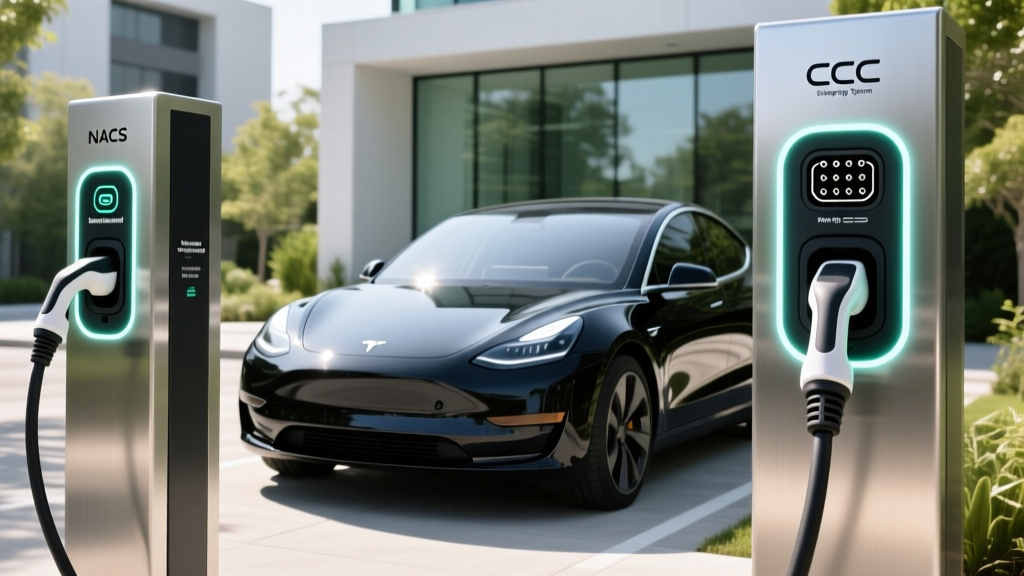
Which Connector Does Your EV Need? NACS, CCS, and CHAdeMO in 2026
The connector landscape has consolidated significantly since Tesla opened its Supercharger network and the North American Charging Standard (NACS) was adopted industry-wide. Here's where things stand for the 2026 model year:
| Connector | Brands Using It (New Vehicles) | Home Charger Availability |
|---|---|---|
| NACS (Tesla/J3400) | Tesla, Ford, GM, Rivian, Volvo, Polestar, Mercedes-Benz, Nissan (2025+), Honda (2025+), Hyundai/Kia (2026+) | Tesla Wall Connector, ChargePoint Home Flex (NACS), Emporia Vue (NACS) |
| CCS1 | Hyundai/Kia (2025 and older), BMW (some models), VW/ID.4 (2025 and older), Stellantis | ChargePoint Home Flex (CCS), EnelX JuiceBox (CCS), Emporia Vue (CCS) |
| CHAdeMO | Nissan Leaf (legacy); essentially discontinued for new vehicles after 2025 | Limited home options; mostly DC public stations |
Key advice for 2026 buyers: If your EV has a NACS port (most new vehicles now do), buy a NACS home charger. If your EV still has CCS1, buy a CCS charger or use a NACS-to-CCS adapter (available from Tesla and third parties for ~$200–$250) with a Tesla Wall Connector. Avoid investing in CHAdeMO home equipment unless you're exclusively charging a legacy Nissan Leaf and plan to keep it long-term.
For public DC fast charging, the situation mirrors home: NACS-equipped vehicles access Tesla Superchargers directly; CCS vehicles use Electrify America, EVgo, and other networks. Most new public stations being built in 2026 include both NACS and CCS cables.
Cost to Charge at Home vs. Gas: The Per-Mile Math
The financial case for home charging hinges on your local electricity rate. Here's how the numbers stack up across different scenarios, using a 2026 Hyundai Ioniq 5 (3.0 miles/kWh efficiency) and a Toyota Camry gas equivalent (32 MPG combined) as baselines:
| Scenario | Rate | EV Cost/Mile | Gas Cost/Mile (32 MPG @ $3.40/gal) | Annual Savings (12,000 mi) |
|---|---|---|---|---|
| Home off-peak (utility time-of-use rate) | $0.11/kWh | $0.037 | $0.106 | $828 |
| Home standard rate (national avg.) | $0.17/kWh | $0.057 | $0.106 | $588 |
| Home peak rate (summer TOU) | $0.30/kWh | $0.100 | $0.106 | $72 |
| Public Level 2 (ChargePoint, etc.) | $0.35/kWh | $0.117 | $0.106 | -$132 |
| DC Fast Charge (Electrify America) | $0.48/kWh | $0.160 | $0.106 | -$648 |
The takeaway is unambiguous: home charging is where the savings live. At off-peak rates, you pay roughly a third of what gasoline costs per mile. But if you rely entirely on DC fast charging at $0.48/kWh, you're actually paying more than gas. This is why installing an EV car charger at home is financially essential—not optional—for most owners.
According to fueleconomy.gov, the average EV in 2026 achieves 3.0–4.0 miles per kWh. Multiply your local $/kWh rate by your vehicle's kWh/mile consumption (the inverse of mi/kWh) to get your personal cost per mile.
Top Home EV Chargers for 2026: Equipment Recommendations
After testing and tracking reliability data across the major brands, these are the home Level 2 chargers that earn our recommendation for different use cases:
Tesla Wall Connector (Gen 4) — Best Overall for NACS Vehicles
- Power Output: Up to 11.5 kW (48A) on a 60A circuit
- Connector: NACS (J3400)
- Cable Length: 24 ft
- Smart Features: Wi-Fi, OTA updates, Tesla app scheduling, Power Sharing (link multiple units on one circuit), Tesla vehicle integration
- Price: ~$475
- Why it wins: Seamless Tesla integration, excellent build quality, compact form factor. Works with non-Tesla NACS vehicles. No CCS option—NACS only.
ChargePoint Home Flex — Most Versatile (NACS or CCS)
- Power Output: Up to 12 kW (50A) on a 60A circuit; configurable down to 16A for weaker panels
- Connector: Available in NACS or CCS1; J1772 with adapter
- Cable Length: 23 ft
- Smart Features: Wi-Fi, ChargePoint app, Alexa/Google Home, amperage adjustment via app, energy tracking, scheduled charging
- Price: ~$550–$650 depending on connector
- Why it wins: The amperage configurability is huge—if your electrician says your panel can only handle 40A, you can software-limit the Flex instead of buying a different unit. UL-listed, NEMA 4 outdoor rated.
Emporia Vue Smart EV Charger — Best Budget Option
- Power Output: Up to 11.5 kW (48A) on a 60A circuit
- Connector: NACS or J1772 (with CCS adapter)
- Cable Length: 24 ft
- Smart Features: Wi-Fi, Emporia app, solar integration (pairs with Emporia Vue energy monitor), scheduled charging, energy dashboard
- Price: ~$350–$400
- Why it wins: Best price-to-feature ratio. If you have rooftop solar, the integration with the Emporia ecosystem lets you charge exclusively on solar surplus. Basic app compared to ChargePoint, but functional.
What we don't recommend: Ultra-cheap ($150–$200) no-name chargers from marketplace sellers. These often lack UL certification, use undersized internal components, and may not trip properly on ground faults. Your car and your home's wiring deserve certified equipment. Look for UL-listed or ETL-listed marks on any charger you buy.
Safety, Electrical Code, and Installation Best Practices
A Level 2 EV charger is a high-draw, continuous-load appliance that will run for 6–10 hours at a stretch. Proper installation isn't optional—it's a fire-safety requirement.
Non-negotiable installation standards:
- Dedicated circuit: Your EV charger must have its own breaker. It cannot share a circuit with a dryer, range, or any other appliance.
- GFCI protection: The 2020 NEC (and updated 2023/2026 editions) requires GFCI protection for all EV charging outlets. Hardwired chargers with built-in ground-fault protection satisfy this requirement. If using a NEMA 14-50 receptacle, your electrician should install a GFCI breaker.
- Outdoor rating: If your charger mounts outside, it must carry a NEMA 4 (weather-resistant) rating. All three chargers recommended above meet this standard.
- Wire gauge: Your electrician will size wire to the circuit amperage and run length. For a 60A circuit under 50 feet, 4 AWG copper is standard. Longer runs may require 3 AWG to prevent voltage drop.
- Permit and inspection: Most municipalities require an electrical permit for a new 240V circuit. The permit fee ($50–$300) covers a post-installation inspection that verifies code compliance. Skip the permit and you risk insurance denial if an electrical fire occurs.
Hardwired vs. plug-in (NEMA 14-50): Hardwired chargers eliminate the outlet as a failure point and don't require a GFCI breaker (the charger has internal protection). Plug-in chargers offer portability—you can unplug and take the unit if you move. For a permanent installation, hardwired is the electrician's preference. For renters or those who may relocate, NEMA 14-50 offers flexibility.
Frequently Asked Questions
How much does it cost to install a home EV charger?
For a straightforward installation with a short wire run and no panel upgrade, expect $650–$1,650 total (equipment + electrician + permit). If your home needs a panel upgrade from 100A to 200A or has a long, complex wire run through conduit, costs can reach $2,800–$5,500. Always get at least two quotes from licensed electricians.
How fast will each charging level add range?
Level 1 (120V) adds 3–5 miles per hour—suitable for PHEVs only. Level 2 (240V, 48A) adds 30–40 miles per hour for most EVs, fully recharging overnight. DC fast charging adds 150–1,000+ miles per hour at peak power, but tapers significantly above 80% state of charge. For daily driving, Level 2 at home is the practical standard.
Which connector and charger is compatible with my EV?
Check your vehicle's charge port. For 2026 models: Tesla, Ford, GM, Rivian, Volvo, and most new Hyundai/Kia vehicles use NACS. Older Hyundai/Kia, VW, and BMW models use CCS1. The Nissan Leaf (discontinued after 2025) used CHAdeMO. Match your home charger's connector to your car's port, or use a certified adapter.
How much does charging cost per mile versus gas?
At a national average home electricity rate of $0.17/kWh and 3.0 mi/kWh efficiency, EV charging costs about $0.057 per mile. Gasoline at $3.40/gallon in a 32 MPG vehicle costs $0.106 per mile. Home charging saves $500–$800 annually for a 12,000-mile driver. Public DC fast charging at $0.48/kWh is actually more expensive than gas—home charging is where the economics work.
What electrical upgrades might I need?
The most common upgrade is a panel replacement from 100A to 200A service ($1,500–$3,500). You may also need: new breaker slots, a sub-panel if your main panel is full, heavier-gauge wire for long runs, or a utility service upgrade if your transformer can't support the added load. An electrician's load calculation will identify what's needed before you commit to equipment.
Can I charge my EV on a regular 120V outlet?
Yes, but slowly. Level 1 charging at 120V/12A delivers about 1.4 kW—roughly 4 miles of range per hour. For a 75 kWh battery going from 10% to 80%, that's over 40 hours. It works for PHEVs with small batteries or as an emergency backup, but not as a primary charging strategy for battery-electric vehicles.
Does a home EV charger need its own circuit?
Yes. The NEC requires a dedicated circuit for EV supply equipment. Sharing a circuit with other appliances risks overloading the breaker and creates a fire hazard. Your electrician will install a new breaker and run dedicated wiring from the panel to the charger location.
Installing an EV car charger for home is one of the highest-ROI upgrades an EV owner can make. The upfront cost of $1,000–$2,000 (typical install) pays for itself within 2–3 years through fuel savings alone, and the daily convenience of starting every trip with a full battery eliminates the single biggest friction point of EV ownership. Size your circuit correctly, buy UL-listed equipment, pull the permit, and you'll never visit a gas station again.