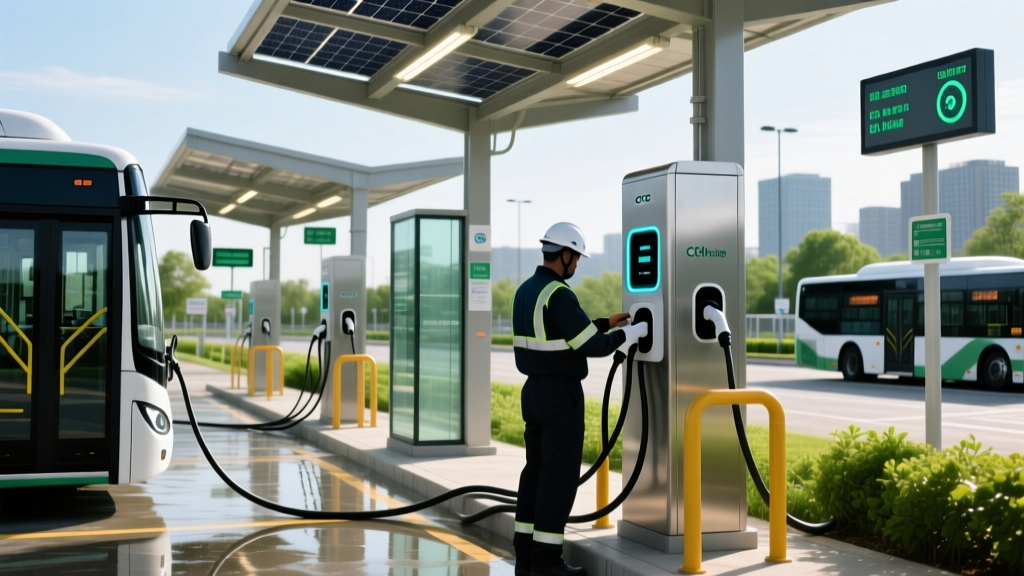
If you've ever watched an electric transit bus pull into a depot and plug into a massive cabinet, you've seen a bus charger in action. These heavy-duty systems — often delivering 150 kW to 600 kW of DC power — keep municipal fleets rolling. But the physics behind them is identical to what powers your home EV charger. Understanding how transit-scale charging works actually clarifies what you need in your own garage.
This guide breaks down the full charging ecosystem: what bus chargers do at the fleet level, how those same principles scale down to Level 1, Level 2, and DC fast charging for passenger EVs, and exactly what it costs to install a home setup in 2026.
What Are Bus Chargers and How Do They Relate to Passenger EVs?
Electric bus chargers are high-power DC fast-charging systems designed for battery-electric transit buses with packs ranging from 200 kWh to over 600 kWh. Manufacturers like Proterra, ABB, and Siemens build depot chargers rated at 150–600 kW, often using the CCS1 or SAE J3105 overhead connector standard.
A typical 60-foot electric transit bus (e.g., the New Flyer Xcelsior CHARGE NG) carries roughly 440 kWh of NMC battery capacity and charges at up to 350 kW via CCS1. That means a 10–80% charge takes roughly 60–90 minutes — comparable in charging-curve behavior to a passenger EV, just at much higher absolute power.
The key takeaway for passenger EV owners: the same kW vs. kWh relationship governs everything. A kilowatt (kW) measures power — the rate of energy flow. A kilowatt-hour (kWh) measures energy — the total amount stored. A 350 kW bus charger fills a 440 kWh battery; your 11.5 kW home Level 2 charger fills a 75 kWh battery. The math scales linearly.
Charging Levels: Speeds, Power, and Range Added Per Hour
Whether you're charging a 40-foot bus or a compact crossover, every EV charger falls into one of three levels. Here's how they compare for passenger vehicles:
| Level | Voltage | Power (kW) | Miles of Range per Hour | Typical Use |
|---|---|---|---|---|
| Level 1 | 120V AC | 1.0–1.9 kW | 3–5 mi/hr | Overnight trickle, emergency |
| Level 2 | 240V AC | 3.3–19.2 kW | 12–75 mi/hr | Home daily charging, workplace |
| DC Fast | 200–800V DC | 50–350 kW | 150–1,000+ mi/hr (peak) | Road trips, fleet depots, bus chargers |
A critical nuance: peak kW is not sustained kW. A passenger EV that advertises "250 kW peak" charging typically sustains that rate only between roughly 10–30% State of Charge (SoC), then tapers progressively. By 60% SoC, you might be at 120 kW; by 80%, perhaps 60 kW. Bus chargers face the same taper — a 350 kW depot charger might average 200 kW across a full session.
How Much Does It Cost to Install a Home EV Charger?
This is the question every new EV buyer asks, and the answer depends heavily on your home's electrical panel. Here's a realistic 2026 breakdown for a hardwired 48-amp (11.5 kW) Level 2 home charger:
| Component | Low Estimate | High Estimate | Notes |
|---|---|---|---|
| Level 2 charger unit (48A, hardwired) | $400 | $750 | Smart Wi-Fi models at upper end |
| Electrician labor (2–6 hours) | $600 | $2,400 | Depends on run length, wall type |
| Electrical permit | $50 | $300 | Varies by municipality |
| 240V circuit wiring (materials) | $100 | $500 | Wire gauge, conduit, connectors |
| Panel upgrade (if needed) | $1,500 | $4,000 | 100A→200A service upgrade |
| Total (no panel upgrade) | $1,150 | $3,950 | Most homes with 200A service |
| Total (with panel upgrade) | $2,650 | $7,950 | Older homes with 100A service |
The panel upgrade is the budget killer most online guides gloss over. Homes built before 1990 often have 100-amp main panels. Adding a 60-amp breaker (required for a 48-amp continuous load per NEC 80% rule) to a panel already running dryers, ranges, and HVAC can exceed the panel's capacity. A licensed electrician will perform a load calculation before recommending an upgrade.
Federal and local incentives can offset costs. The residential clean energy credit (IRS §25C) covers 30% of home charging equipment and installation costs, up to $1,000 annually through 2032. Check your state and utility for additional rebates — many utilities offer $250–$500 rebates on Level 2 hardware.
Connector Compatibility: NACS, CCS1, and CHAdeMO in 2026
The connector landscape has consolidated significantly. Tesla's North American Charging Standard (NACS) is now the dominant plug for new passenger EVs, while CCS1 remains standard for commercial vehicles — including most electric bus chargers at transit depots.
| Connector | Brands Using It Natively | Max DC Rate | Adapter Needed For |
|---|---|---|---|
| NACS (Tesla standard) | Tesla, Ford, GM, Rivian, Volvo, Polestar, Hyundai/Kia (2025+), BMW, Mercedes | Up to 350 kW | CCS1 stations require NACS-to-CCS adapter |
| CCS1 (Combo) | VW ID.4 (pre-2026), legacy BMW i3, most electric buses | Up to 350 kW | Tesla Superchargers require CCS-to-NACS adapter |
| CHAdeMO | Nissan Leaf (legacy only — discontinued) | Up to 100 kW | No viable adapter to NACS/CCS for DC |
For home Level 2 charging, all modern passenger EVs use the J1772 connector (or NACS, which includes J1772 signaling for AC). If you buy a NACS-equipped home charger, CCS-vehicle owners will need a J1772-to-NACS adapter. If you buy a J1772 charger, NACS vehicles need a simple J1772-to-NACS adapter (usually included with the car).
Charging Time Examples: 10–80% for Common Battery Sizes
Here's what real-world charging looks like across popular EV battery sizes. Times assume optimal battery preconditioning (warming the pack to ~30°C before DC fast charging) and starting at 10% SoC:
- 58 kWh battery (e.g., VW ID.4 Standard): 170 kW peak DC → 10–80% in ~28 minutes. Home Level 2 at 11.5 kW → 0–100% in ~5.5 hours.
- 75 kWh battery (e.g., Tesla Model Y Long Range): 250 kW peak DC → 10–80% in ~22 minutes. Home Level 2 at 11.5 kW → 0–100% in ~7 hours.
- 84 kWh battery (e.g., Hyundai Ioniq 5 N): 240 kW peak DC → 10–80% in ~18 minutes (800V architecture sustains higher power longer). Home Level 2 at 11.5 kW → 0–100% in ~7.8 hours.
- 100 kWh battery (e.g., GMC Sierra EV): 350 kW peak DC → 10–80% in ~25 minutes. Home Level 2 at 11.5 kW → 0–100% in ~9.2 hours.
- 440 kWh battery (e.g., transit bus): 350 kW depot charger → 10–80% in ~65 minutes. This is where bus chargers earn their keep.
Remember: cold weather (below 32°F / 0°C) can increase DC fast-charging times by 20–40% unless the vehicle actively preconditioned the battery. Always precondition before a fast-charging stop.
How Much Does Charging Cost Per Mile vs. Gas?
The economics of EV charging depend on where and when you plug in. Here's a realistic cost comparison using a midsize EV averaging 3.0 miles/kWh (roughly 112 MPGe) versus a comparable gas car at 28 MPG combined:
| Scenario | Rate | Cost per Mile | Annual Cost (12,000 mi) |
|---|---|---|---|
| Home off-peak (utility rate) | $0.09/kWh | $0.030 | $360 |
| Home standard rate | $0.16/kWh | $0.053 | $640 |
| Public Level 2 (ChargePoint, etc.) | $0.25/kWh | $0.083 | $1,000 |
| DC Fast (Electrify America, etc.) | $0.48/kWh | $0.160 | $1,920 |
| Gasoline (28 MPG, $3.50/gal) | $3.50/gal | $0.125 | $1,500 |
The verdict: home charging is dramatically cheaper than gas — roughly 75% less per mile on off-peak rates. But if you rely exclusively on DC fast charging at $0.48/kWh, your per-mile cost actually exceeds gasoline. This is why home Level 2 installation is the single most important financial decision an EV owner makes.
For context at the fleet level: transit agencies running electric bus chargers typically negotiate commercial electricity rates of $0.06–$0.10/kWh, plus demand charges. Even with heavy use, per-mile energy costs for electric buses run 50–70% below diesel.
Recommended Home Level 2 Chargers (2026 Picks)
Based on real-world reliability, smart features, and value, these are the Level 2 chargers worth installing in 2026:
ChargePoint Home Flex (NACS or J1772)
- Power: Up to 12 kW (50A) — configurable down to 16A for lower-capacity panels
- Cable length: 23 feet
- Smart features: Wi-Fi, app scheduling, Alexa integration, energy tracking
- Price: ~$550 (NACS) / ~$500 (J1772)
- Best for: Flexible amperage adjustment for older panels
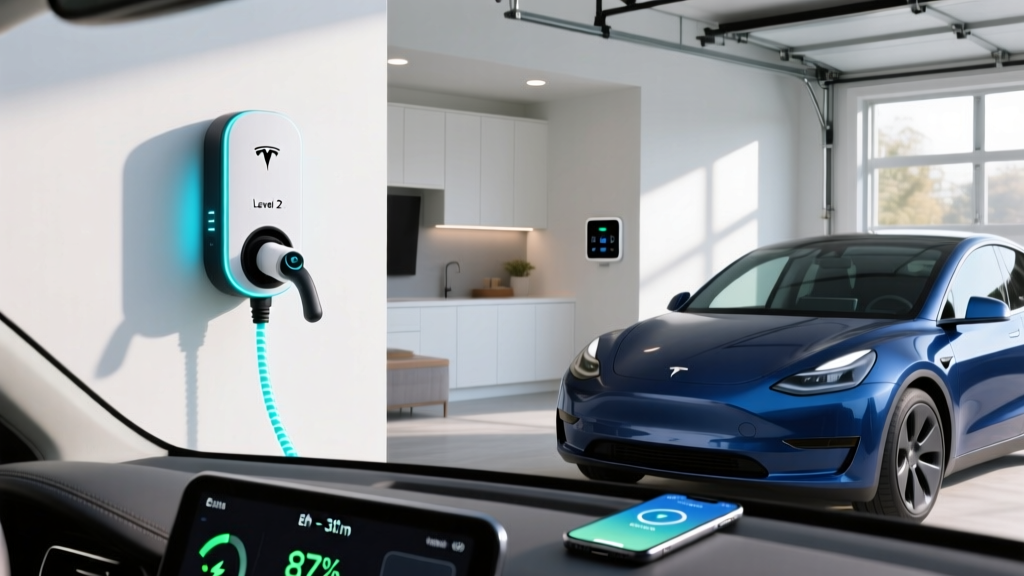
Tesla Wall Connector (NACS native)
- Power: Up to 11.5 kW (48A)
- Cable length: 24 feet
- Smart features: Wi-Fi, OTA updates, Powerwall integration, load sharing (pair two units on one circuit)
- Price: ~$475
- Best for: Tesla and NACS-native vehicle owners; multi-EV households
Emporia Vue EV Charger (J1772)
- Power: Up to 11.5 kW (48A)
- Cable length: 24 feet
- Smart features: Wi-Fi, energy monitoring via Emporia Vue panel integration, solar-aware scheduling
- Price: ~$400
- Best for: Budget-conscious buyers with solar panels
Grizzl-E Smart (J1772 or NACS)
- Power: Up to 10 kW (40A)
- Cable length: 24 feet
- Smart features: OCPP protocol, works with utility demand-response programs
- Price: ~$450
- Best for: Cold-climate durability (rated to -40°C), utility program participants
Safety, Electrical Code, and Installation Requirements
Home EV charging is safe when installed correctly, but the electrical demands are significant. A Level 2 charger draws continuous current for hours — more like an electric furnace than a phone charger. Here's what code and safety demand:
- Dedicated circuit: Your charger must have its own breaker — no sharing with other outlets or appliances. A 48A charger requires a 60A breaker (NEC Article 625 requires circuits rated at 125% of continuous load).
- GFCI protection: NEC 2020 and later require GFCI protection for all EV charging outlets. Hardwired units typically have GFCI built into the charger itself; receptacle-plugged units need a GFCI breaker.
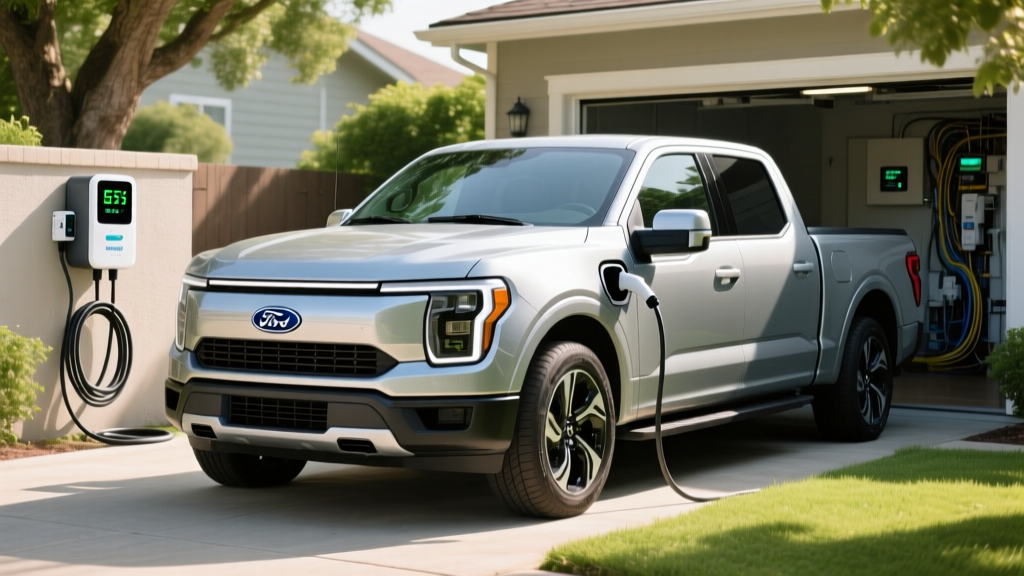
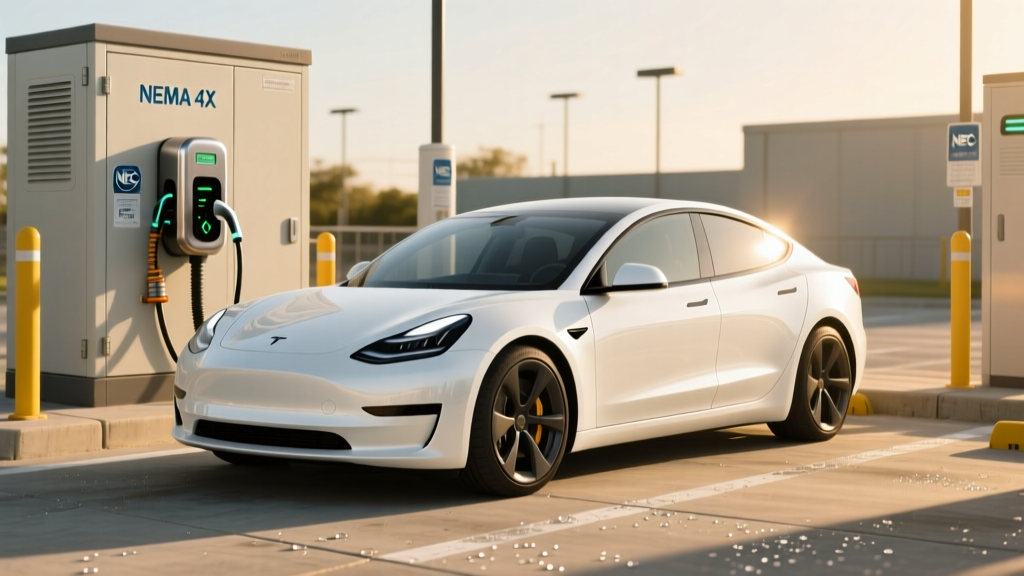
- Outdoor rating: If your charger is installed outside (garage-less homes, driveways), it must carry a NEMA 4 or NEMA 4X rating for weather resistance. All recommended units above meet this standard.
- Wire gauge: A 60A circuit requires minimum 6 AWG copper wire (THHN in conduit or NM-B cable where permitted). Longer wire runs may need 4 AWG to minimize voltage drop.
- Permit and inspection: Every jurisdiction requires an electrical permit for new 240V circuits. The inspection ensures proper grounding, breaker sizing, and conductor routing. Do not skip this — unpermitted work can void home insurance.
For homes considering future bus-scale ambitions (e.g., electric school bus V2H bidirectional setups), consult your electrician about conduit sizing for potential future upgrades. Running oversized conduit during initial installation costs marginally more but avoids trenching again later.
Frequently Asked Questions
How fast will each charging level add range?
Level 1 (120V) adds 3–5 miles per hour — fine for plug-in hybrids with 30 miles of electric range, inadequate for full EVs. Level 2 (240V, 48A) adds 30–45 miles per hour for most EVs, fully replenishing overnight. DC fast charging (50–350 kW) adds 150–1,000+ miles per hour at peak, designed for 10–80% top-ups in 18–35 minutes.
Which connector or charger is compatible with my EV?
Check your vehicle's charge port. If it's NACS (Tesla-style plug), buy a NACS home charger or use a J1772 adapter. If it's CCS1 (two-pin DC combo), buy a J1772 Level 2 charger and use CCS adapters for DC fast charging on road trips. CHAdeMO vehicles (Nissan Leaf only, now discontinued) have limited DC charging options and no adapter path to NACS Superchargers.
What electrical upgrades might I need?
The most common upgrade is a panel service increase from 100A to 200A ($1,500–$4,000). If your panel is already 200A but near capacity, an electrician may recommend a load-management device (e.g., Emporia Smart Load Center or Tesla Gateway) that dynamically throttles charger amperage when other appliances are running — avoiding a full panel upgrade.
Do bus chargers use the same connectors as passenger EVs?
Most electric transit buses in North America use CCS1 (same DC standard as many legacy passenger EVs) or the SAE J3105 overhead pantograph connector for opportunity charging at bus stops. Depot bus chargers from ABB and ChargePoint are CCS1-compatible, meaning a CCS1 passenger EV could theoretically use one — but depot chargers are private infrastructure not accessible to the public.
How much does it cost to install a home EV charger?
Expect $1,150–$3,950 for a standard installation on a 200A panel with a nearby garage outlet location. If you need a panel upgrade from 100A to 200A, add $1,500–$4,000. The IRS §25C credit covers 30% of equipment and installation up to $1,000, effectively reducing typical costs by $345–$1,000.
Is it cheaper to charge at home or at public stations?
Home charging on off-peak utility rates ($0.09/kWh) costs roughly $0.03/mile — about 75% less than gasoline. Public DC fast charging ($0.48/kWh) costs $0.16/mile, which actually exceeds gasoline at $3.50/gallon and 28 MPG. The economic case for EVs depends heavily on reliable home charging access.