What Is a Booster Charger and Why Does It Matter?
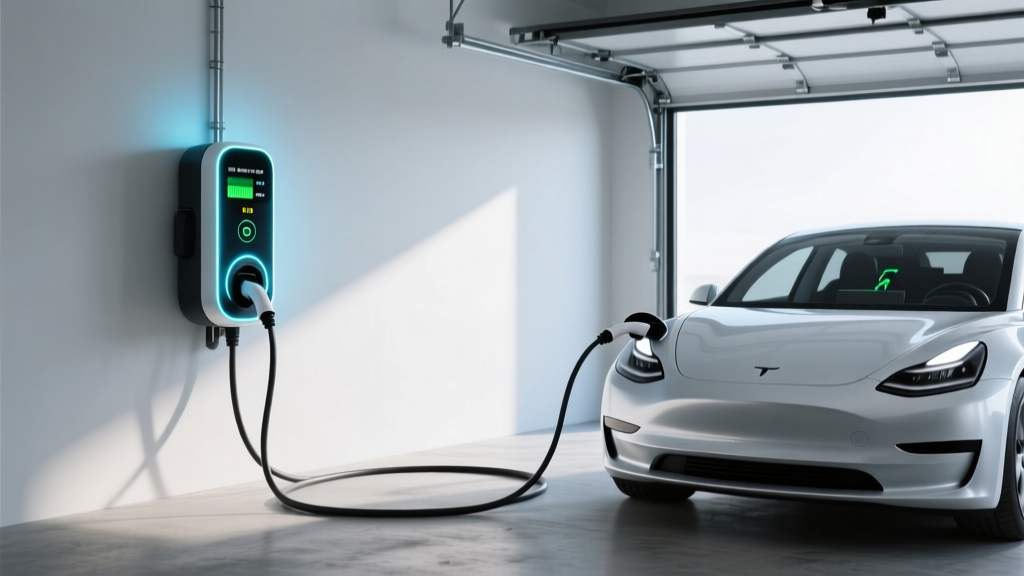
A "booster charger" is the term many EV owners use for a Level 2 home charging station — the 240-volt equipment that replenishes your battery 5 to 7 times faster than a standard 120-volt wall outlet. If you've been relying on the mobile cord that came with your EV (Level 1, ~1.3 kW), a dedicated Level 2 booster charger running at 7.2 kW to 11.5 kW transforms overnight charging from a frustrating trickle into a genuine daily solution.
This guide breaks down every charging tier with exact speeds in kilowatts (kW, the rate of power delivery) versus kilowatt-hours (kWh, the energy stored in your battery) — a distinction that trips up many new EV buyers. We'll cover home electrical requirements, real installation costs, connector standards, per-mile economics, and specific hardware recommendations for 2026 model-year EVs.
Charging Levels Explained: Speeds, Times, and Real-World Expectations
Every EV owner interacts with three charging tiers. Here's what each delivers in measurable terms:
| Level | Voltage / Amps | Power (kW) | Miles of Range Added per Hour | 10-80% Time (75 kWh Battery) | Typical Use Case |
|---|---|---|---|---|---|
| Level 1 | 120V / 12A | ~1.3-1.4 kW | 3-5 mi/hr | ~40 hours | Overnight trickle; PHEV top-ups |
| Level 2 (Home Booster) | 240V / 32-48A | 7.2-11.5 kW | 22-44 mi/hr | 4.5-7 hours | Daily home charging; overnight full replenishment |
| DC Fast Charging | 400-800V DC | 50-350 kW | 150-800+ mi/hr (peak) | 18-45 minutes | Road trips; public stations |
Real-world caveats: Level 2 miles-per-hour figures assume moderate efficiency (~3 mi/kWh, typical of a mid-size crossover like the Hyundai Ioniq 5 or Tesla Model Y). Larger vehicles like the Ford F-150 Lightning or Rivian R1T yield closer to 2-2.5 mi/kWh, reducing effective range gain per hour. Cold batteries (below 40°F) also accept charge more slowly until the thermal management system warms the pack — expect 20-30% slower Level 2 speeds in winter without preconditioning.
DC fast charging speeds peak only between roughly 10-50% State of Charge (SoC). Above 80%, the charge curve tapers sharply to protect battery health. A station rated at 350 kW may sustain that peak for only 5-8 minutes before dropping to 100-150 kW. This is why manufacturers quote 10-80% times rather than 0-100%.
Home Electrical Requirements and Panel Upgrade Realities
Installing a Level 2 booster charger is fundamentally an electrical project, not just plugging in hardware. Here's what your home's electrical system must support:
Circuit and breaker sizing: A 48-amp continuous-load charger requires a 60-amp dedicated circuit (the National Electrical Code requires breakers rated at 125% of continuous load). A 32-amp charger needs a 40-amp circuit. The charger must be the only load on that circuit — no sharing with dryers or HVAC.
Panel capacity: Most modern 200-amp service panels can accommodate a 60-amp EV circuit. Homes with 100-amp service (common in pre-1980 construction) often cannot. A licensed electrician will perform a load calculation per NEC Article 220 to determine available headroom. If your panel is near capacity, you face two options:
- Panel upgrade to 200A: $2,500-$5,000+ depending on utility requirements, conduit runs, and local permitting.
- Load-management device: Smart panels like the Span panel or a Span-driven load shedder can dynamically allocate power to the EV circuit only when other loads are low — avoiding a full panel upgrade in some cases ($500-$1,500 additional hardware cost).
Wiring: A 60-amp circuit typically requires 6 AWG copper wire (THHN in conduit or NM-B/Romex where code permits). Longer runs (over 75 feet from panel to charger) may require 4 AWG to prevent voltage drop. Conduit type (EMT, PVC, flex) depends on whether the run is exposed, buried, or inside walls.
How Much Does It Cost to Install a Home EV Booster Charger?
Installation costs vary dramatically based on panel condition, wire run distance, and local labor rates. Here's a realistic breakdown based on 2026 electrician quotes across suburban and urban markets:
| Cost Component | Simple Install (Panel Nearby, 200A) | Moderate Install (50ft+ Run) | Complex Install (Panel Upgrade Needed) |
|---|---|---|---|
| Level 2 Charger Hardware | $350-$700 | $350-$700 | $350-$700 |
| Electrician Labor (2-6 hours) | $400-$900 | $800-$1,800 | $600-$1,200 |
| Materials (Wire, Conduit, Breaker) | $100-$300 | $300-$700 | $200-$500 |
| Permit & Inspection | $50-$200 | $50-$200 | $100-$300 |
| Panel Upgrade (if needed) | N/A | N/A | $2,500-$5,000 |
| Total Range | $900-$2,100 | $1,500-$3,400 | $3,750-$7,700 |
Federal incentive note: The Residential Clean Energy Credit (IRC §25D) previously covered 30% of home charging equipment and installation costs (up to $1,000). This credit expired for equipment placed in service after December 31, 2025, unless extended by Congress. Some states and utilities still offer rebates — check your local utility's EV program page and the AFDC state incentive database for current offers.
Connector Compatibility: NACS, CCS1, CHAdeMO, and Adapter Needs
The North American charging connector landscape consolidated significantly in 2024-2025 when nearly every major automaker adopted the North American Charging Standard (NACS, also called the Tesla connector) for new vehicles. Here's where each brand stands for 2026 model-year vehicles:
| Connector Type | Brands Using It (2026 Models) | Home Charger Availability | Adapter Needed? |
|---|---|---|---|
| NACS (Tesla-style) | Tesla, Ford, GM, Rivian, Volvo, Polestar, Hyundai, Kia (new models), Mercedes-Benz, BMW (select) | Widely available (Tesla Wall Connector, ChargePoint, Emporia, Grizzl-E) | CCS1-to-NACS adapters available (~$150-$250) for older CCS1 vehicles charging at NACS stations |
| CCS1 (Combo) | Volkswagen ID.4 (carryover), older Ford/GM/Hyundai/Kia models (pre-2025), Stellantis, some legacy EVs | Widely available (most chargers still offer CCS1 cables or dual-cable units) | NACS-to-CCS1 adapters (~$100-$200) for CCS1 vehicles charging at NACS-only home chargers |
| CHAdeMO | Nissan Leaf (discontinued after 2025), Mitsubishi Outlander PHEV (older models) | Limited; most new home chargers do not include CHAdeMO | No practical adapter to NACS/CCS1 for DC; Level 2 uses J1772 which CHAdeMO vehicles also accept |
For Level 2 home charging specifically: All non-Tesla EVs sold before the NACS transition used the J1772 connector for AC charging. Most Level 2 home chargers sold today ship with either a J1772 plug (compatible with CCS1 vehicles via the top portion of the CCS connector) or a NACS plug. If you own a CCS1/J1772 vehicle and buy a NACS-connector home charger, a simple NACS-to-J1772 adapter (~$80-$150) resolves compatibility. Tesla vehicles can charge on J1772 chargers using the included Tesla-to-J1772 adapter.
Cost to Charge: Home vs. Public vs. Gas per Mile
The economic case for a home booster charger rests on electricity being substantially cheaper than gasoline per mile driven. Here's how the numbers break down using national averages:
| Scenario | Rate ($/kWh) | Vehicle Efficiency | Cost per Mile | Annual Cost (12,000 mi) |
|---|---|---|---|---|
| Home Level 2 (off-peak utility rate) | $0.09-$0.14 | 3.0 mi/kWh (typical crossover) | $0.03-$0.047 | $360-$564 |
| Home Level 2 (standard residential rate) | $0.15-$0.20 | 3.0 mi/kWh | $0.05-$0.067 | $600-$804 |
| Public Level 2 (network pricing) | $0.25-$0.49 | 3.0 mi/kWh | $0.083-$0.163 | $996-$1,956 |
| DC Fast Charging (public) | $0.35-$0.65 | 3.0 mi/kWh | $0.117-$0.217 | $1,404-$2,604 |
| Gasoline (25 MPG combined, $3.30/gal) | $3.30/gallon | 25 MPG | $0.132 | $1,584 |
The takeaway: Home Level 2 charging at off-peak rates costs roughly 70-80% less per mile than gasoline. Even at standard residential rates, EV fueling is about 50-65% cheaper. Public DC fast charging, however, can equal or exceed gasoline costs — which is why a home booster charger is the single most impactful investment for EV economics. Relying exclusively on public fast charging erases most of the fuel-cost advantage.
Time-of-use (TOU) rates: Many utilities offer EV-specific TOU plans where overnight charging (typically 11 PM - 6 AM) drops to $0.07-$0.10/kWh. Programming your booster charger to start at midnight via its app maximizes savings. A 75 kWh battery charged from 10-80% overnight at $0.09/kWh costs roughly $4.73 — equivalent to about 1.4 gallons of gas but yielding ~175 miles of range.
Top Booster Charger Equipment Picks for 2026
Based on power output, build quality, smart features, connector options, and real-world reliability reports, here are the leading Level 2 home units currently available:
Emporia Vue EV Charger (J1772 or NACS)
- Power: 48A / 11.5 kW (hardwired) or 40A / 9.6 kW (NEMA 14-50 plug)
- Cable length: 24 feet
- Smart features: Energy monitoring via Emporia app, solar integration (auto-charge only when excess solar is produced), scheduling, load management
- Connector: J1772 or NACS (choose at purchase)
- Price: ~$399-$499
- Best for: Solar-panel owners; budget-conscious buyers wanting full smart features
Tesla Wall Connector (NACS)
- Power: 48A / 11.5 kW (hardwired on 60A circuit)
- Cable length: 24 feet
- Smart features: Wi-Fi updates, power sharing between multiple units, Tesla app integration, access control
- Connector: NACS (native Tesla; works with all NACS-equipped 2025+ EVs)
- Price: ~$450
- Best for: Tesla owners and households with multiple NACS vehicles (power-sharing feature splits one circuit across two chargers)
ChargePoint Home Flex (J1772 or NACS)
- Power: Up to 50A / 12 kW (hardwired on 60A+ circuit); adjustable down to 16A for lower-capacity panels
- Cable length: 23 feet
- Smart features: ChargePoint app with detailed session history, Alexa/Google integration, flexible amperage settings
- Connector: J1772 or NACS
- Price: ~$599-$699
- Best for: Buyers who want adjustable amperage to match existing panel capacity without upgrading
Grizzl-E Smart (J1772 or NACS)
- Power: 40A / 9.6 kW (NEMA 14-50) or 48A / 11.5 kW (hardwired)
- Cable length: 24 feet
- Smart features: OCPP-compatible, app scheduling, works with utility demand-response programs
- Connector: J1772 or NACS
- Price: ~$449-$549
- Best for: Cold-climate owners (rated to -40°F) and those wanting an open-protocol charger not locked to one ecosystem
Hardwired vs. plug-in: Hardwired chargers (directly connected to the circuit with no plug) are required for circuits above 50 amps and are generally more reliable since they eliminate the NEMA 14-50 receptacle as a failure point. Plug-in units offer portability — you can take the charger when you move — but require a properly installed 14-50 outlet, which some electricians install incorrectly (using residential-grade receptacles not rated for daily EV plugging/unplugging cycles). If you go plug-in, specify an industrial-grade Hubbell or Bryant 14-50 receptacle (~$75-$100 vs. $15 for a residential one).
Safety, Code Compliance, and Installation Best Practices
EV charging draws high continuous current for hours — a fundamentally different load profile than typical household appliances. Cutting corners creates fire risk. Here's what proper installation requires:
- Dedicated circuit: The charger must have its own breaker — never shared with other loads. This is NEC-mandated, not optional.
- GFCI protection: NEC 2023 and later require GFCI protection for all receptacles in garages. Hardwired chargers are exempt from this requirement, which is one reason many electricians now recommend hardwiring — it avoids nuisance GFCI trips that some EV owners experience with 14-50 receptacles.
- Outdoor rating: If the charger is installed outside (driveway, carport), it must carry a NEMA 4 or NEMA 4X weather rating. All chargers listed above meet this standard. Verify the connector holster also provides weather protection.
- UL or ETL listing: Only purchase chargers with UL (Underwriters Laboratories) or ETL (Intertek) certification marks. Uncertified chargers from overseas marketplaces may lack proper overcurrent protection and can void home insurance coverage in the event of a fire.
- Permit and inspection: Virtually all jurisdictions require an electrical permit for a new 240V circuit. The inspection verifies wire gauge, breaker sizing, grounding, and bonding are correct. Skipping the permit risks insurance denial if an electrical fire occurs and can flag during a home sale.
Frequently Asked Questions
Can I use a dryer outlet to charge my EV?
Technically, a NEMA 14-50 outlet (the same type used by electric dryers and ranges) can power a plug-in Level 2 charger. However, you should never share the circuit with the dryer — the charger needs a dedicated breaker. Also, older 14-50 outlets may have degraded connections or undersized wiring. Have an electrician inspect or install a new dedicated 14-50 outlet rather than simply unplugging the dryer nightly. Repeated plugging and unplugging wears out residential-grade receptacles quickly.
Will a booster charger degrade my EV battery?
No. Level 2 charging at 7.2-11.5 kW generates minimal heat compared to DC fast charging at 150-350 kW. Battery degradation is primarily driven by high SoC sustained for long periods, extreme temperatures, and frequent DC fast charging. Level 2 home charging is actually the gentlest way to charge, and most EV battery warranties (typically 8 years/100,000 miles with a 70% capacity retention threshold) assume daily Level 2 use. Set your charge limit to 80% for daily driving and 100% only before long trips to maximize longevity.
How fast will a 48-amp booster charger charge a 75 kWh battery?
At 48 amps on a 240V circuit, the charger delivers 11.5 kW. Charging from 10% to 80% SoC requires roughly 52.5 kWh of energy. Accounting for ~10% charging losses (heat, battery management overhead), the charger needs to deliver about 58 kWh, taking approximately 5 hours. For a vehicle with ~3 mi/kWh efficiency, that adds about 175 miles of range — enough for most daily driving needs with margin to spare.
My home has 100-amp service. Can I still install a Level 2 charger?
Possibly, but options are limited. A 100-amp panel may not have capacity for a 60-amp EV circuit without exceeding the panel's rated load. Solutions include: (1) installing a lower-amperage charger at 16-24 amps (3.8-5.8 kW) on a 20-30 amp circuit, which still adds 12-20 miles per hour — adequate for overnight charging if your daily drive is under 50 miles; (2) using a smart load-management device that throttles the charger when other circuits are active; or (3) upgrading to 200-amp service ($2,500-$5,000). An electrician's load calculation will determine which path is required.
Is a smart charger worth the extra cost over a "dumb" unit?
Smart chargers (Wi-Fi-connected with app control) typically cost $50-$150 more than basic units. The value depends on your utility rate structure. If your utility offers time-of-use pricing, a smart charger's scheduling feature alone can save $200-$400 annually by restricting charging to off-peak hours. Energy monitoring helps track actual charging costs. For flat-rate electricity, a dumb charger works fine — but you lose remote monitoring and the ability to participate in utility demand-response programs that some providers pay $50-$150/year to join.