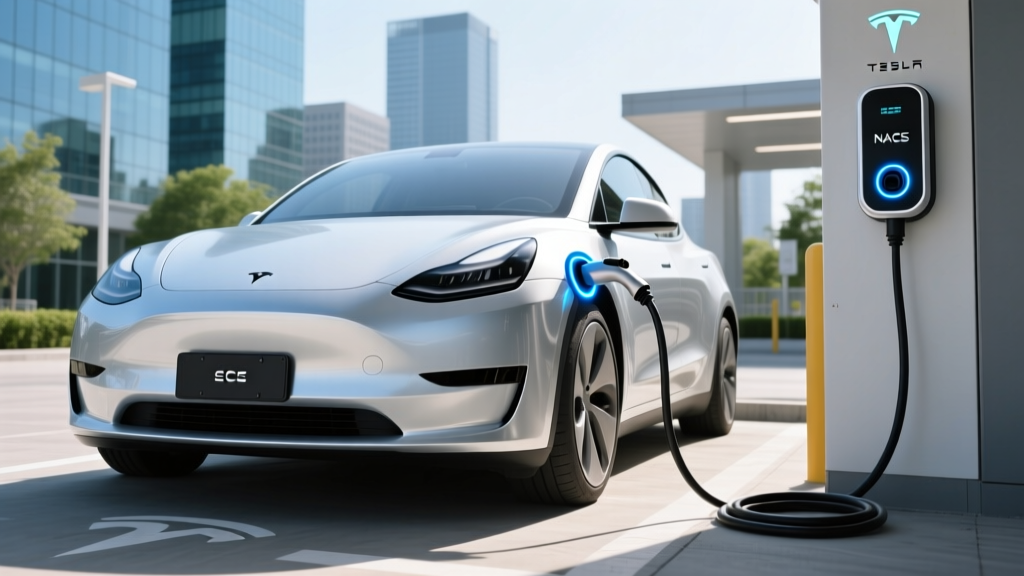
If you have shopped for an EV charger or pulled up to a public fast-charging station in the last year, you have probably stared at a plug and wondered: will this actually fit my car? The North American charging landscape is in the middle of a massive connector transition. Tesla's NACS (North American Charging Standard) is rapidly becoming the default, but millions of CCS1-equipped EVs are on the road, and older Nissan Leaf and Mitsubishi owners still rely on CHAdeMO. That means the right EV adapter is no longer a niche accessory — it is essential hardware for daily charging and road trips alike.
This guide breaks down every connector type, which adapters exist (and which do not), what home installation actually costs in 2026, and how to pick the right Level 2 charger for your garage. We will use exact numbers — kW, kWh, dollars, and minutes — because vague promises about "fast charging" do not help you plan a 300-mile drive.
Charging Levels Explained: kW, Miles Per Hour, and Real Charge Times
Before we talk adapters, let's nail down the three charging levels. The critical distinction: kW (kilowatts) measures power — how fast energy flows into your car. kWh (kilowatt-hours) measures energy — the total capacity of your battery. Think of kW as the width of the hose and kWh as the size of the bucket.
| Level | Voltage | Power (kW) | Miles of Range Added Per Hour | Typical Use |
|---|---|---|---|---|
| Level 1 | 120V AC | 1.0–1.9 kW | 3–5 miles | Overnight top-ups, PHEVs, emergencies |
| Level 2 | 240V AC | 3.3–19.2 kW | 12–75 miles | Home daily charging, workplace, destinations |
| DC Fast Charge | 400–800V DC | 50–350 kW | 150–1,000+ miles/hr (peak) | Road trips, highway corridors, quick top-ups |
A few real-world examples put these numbers in context. A Chevrolet Equinox EV with a ~85 kWh (usable) battery charging on a 48-amp (11.5 kW) Level 2 home charger will go from 10% to 80% in roughly 5.5 hours — perfectly suited for overnight charging. That same battery on a 150 kW DC fast charger can reach 10–80% in approximately 28 minutes, though the charge curve tapers significantly above 80%, which is why fast-charger sessions rarely fill to 100%.
For a smaller battery like the 62 kWh pack in a Nissan Leaf, a 7.7 kW Level 2 charger handles 10–80% in about 5.5 hours as well. The math scales with battery size and charger power: divide the kWh you need by the kW available, then add ~10% for charging losses.
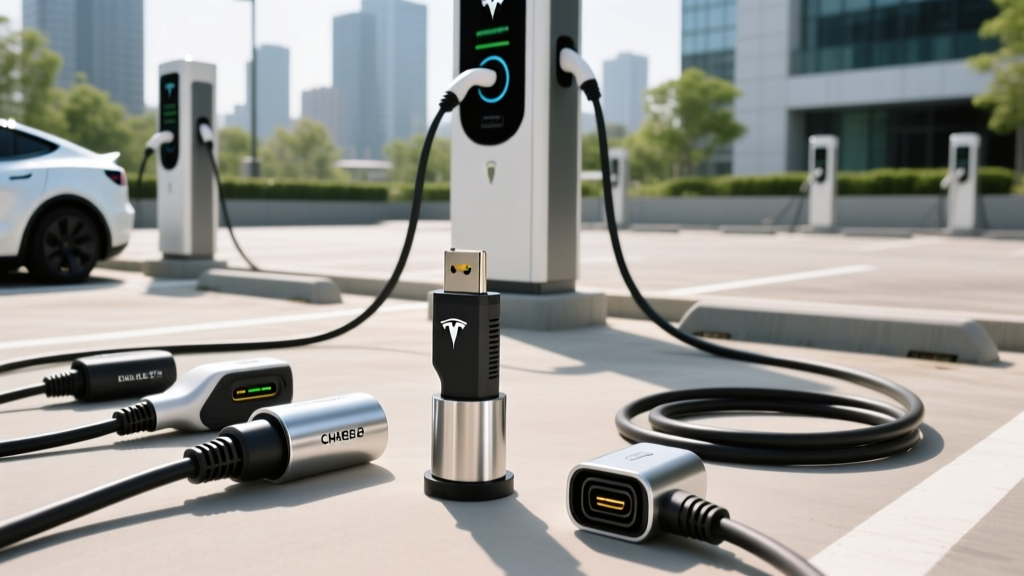
Connector Compatibility: NACS, CCS1, CHAdeMO, and the EV Adapter You Need
Here is where adapter shopping gets specific. As of the 2025–2026 model years, nearly every major automaker has switched to NACS for new vehicles. But the installed base of CCS1 vehicles is enormous, and public infrastructure still includes all three connector types depending on the network and station age.
| Connector | Brands / Models Using It | Adapter Needed For | Adapter Availability |
|---|---|---|---|
| NACS (Tesla) | Tesla (all years), Ford (2025+), GM (2025+), Rivian (2025+), Hyundai/Kia (2025+), Volvo/Polestar (2025+), BMW (2025+), Mercedes (2025+) | CCS1 public chargers (legacy stations) | Tesla sells a NACS-to-CCS adapter (~$250); third-party options from Lectron, A2Z |
| CCS1 (Combo) | Ford (pre-2025), GM (pre-2025), VW ID.4, Hyundai Ioniq 5 (pre-2025), Kia EV6 (pre-2025), BMW i4/iX (pre-2025), most 2022–2024 EVs | Tesla Superchargers (NACS stations) | Tesla CCS adapter for non-Tesla vehicles (~$200–250); Ford/GM provide adapters to eligible owners |
| CHAdeMO | Nissan Leaf (all years), Mitsubishi Outlander PHEV (older), some legacy models | CCS or NACS stations | Very limited — no reliable CHAdeMO-to-CCS adapter for DC fast charging exists commercially; CHAdeMO stations are declining |
| J1772 | All non-Tesla EVs for Level 1/Level 2 AC charging | Tesla Wall Connector or NACS Level 2 | Tesla includes J1772 adapter with vehicles; widely available third-party ($30–80) |
The biggest practical issue in 2026: if you drive a CCS1-equipped EV (say, a 2024 Hyundai Ioniq 5 or 2023 Ford Mustang Mach-E), you need a CCS-to-NACS adapter to access Tesla Superchargers, which now number over 25,000 stalls across North America and represent the most reliable public charging network. Ford and GM shipped free adapters to registered owners of qualifying models; check your manufacturer portal before paying out of pocket.
For CHAdeMO owners — primarily Nissan Leaf drivers — the situation is tougher. CHAdeMO infrastructure is shrinking as networks prioritize CCS and NACS. While the Leaf remains a capable commuter EV, road-trip flexibility is increasingly limited. There is no commercially viable CHAdeMO-to-NACS DC fast-charge adapter, which means Leaf owners should plan routes around Electrify America, EVgo, and remaining CHAdeMO-equipped stations.
Home Charger Installation: Electrical Requirements, Costs, and Panel Upgrades
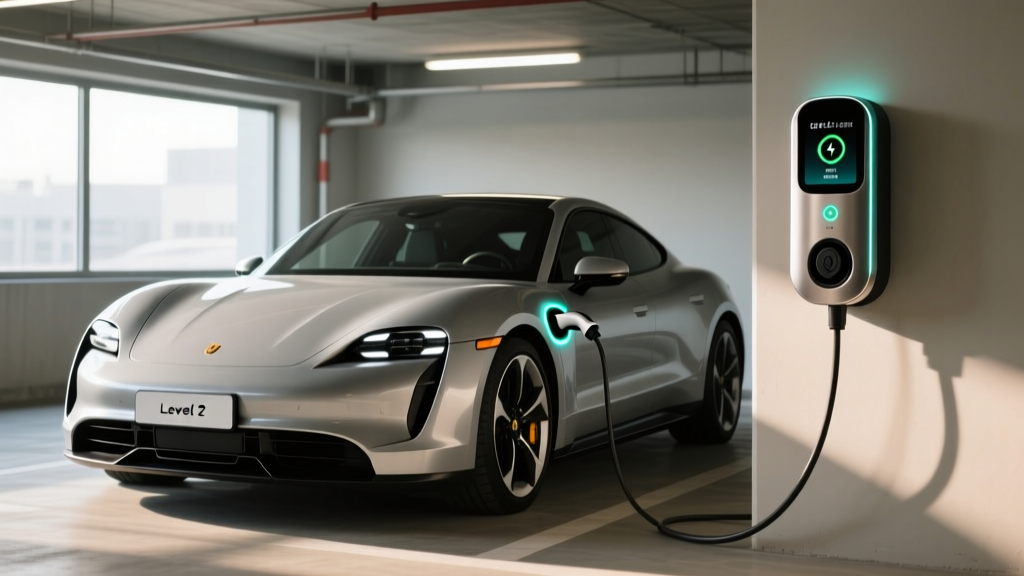
A Level 2 home charger is the single biggest quality-of-life upgrade an EV owner can make. But installation costs vary wildly depending on your home's electrical panel, the distance from panel to garage, and local permit requirements. Here is what to expect.
Electrical requirements for a typical Level 2 install:
- Circuit: Dedicated 240V circuit, typically 40A, 50A, or 60A breaker
- Charger amperage: A 48A charger (like the ChargePoint Home Flex or Tesla Wall Connector) requires a 60A breaker — electrical code mandates the breaker be rated at 125% of the continuous load
- Wire gauge: 6 AWG copper for 48A; 4 AWG for 60A circuits (varies by run length and local code)
- Outlet vs. hardwired: NEMA 14-50 outlet offers portability (take the charger when you move); hardwired allows higher amperage and avoids GFCI breaker nuisance trips common with some 50A outlets
- GFCI protection: NEC 2020/2023 requires GFCI on receptacle-based EV circuits; hardwired units typically do not require a separate GFCI breaker since the charger has built-in ground-fault protection
- Outdoor rating: If your charger mounts outside, it must carry a NEMA 4 or NEMA 4X weatherproof rating
| Component | Simple Install (panel near garage) | Complex Install (long run, panel upgrade) |
|---|---|---|
| Level 2 charger equipment | $350–$700 | $350–$700 |
| Electrician labor (2–4 hrs simple / 6–12 hrs complex) | $400–$800 | $1,200–$3,000 |
| Electrical permit | $50–$200 | $50–$200 |
| Wire, conduit, breaker | $100–$300 | $300–$800 |
| Panel upgrade (100A → 200A) if needed | N/A | $1,500–$4,000 |
| Total estimated cost | $900–$2,000 | $3,100–$8,700 |
The panel upgrade is the hidden cost that catches older-home owners off guard. Homes built before the 1990s often have 100-amp or even 60-amp main panels. Adding a 60A EV circuit to a 100A panel may exceed capacity, especially if you also run electric heat, an electric oven, and a dryer. A licensed electrician will perform a load calculation per NEC Article 220 to determine if your panel can handle the additional draw. If it cannot, a panel upgrade to 200A is mandatory — and that alone can cost $1,500–$4,000.
Recommended Level 2 Home Chargers: Power, Features, and Price
Here are four proven Level 2 chargers for 2026, selected for reliability, power output, and connector flexibility. Every recommendation includes the exact output and connector — because a charger without those specs is just a guess.
Tesla Wall Connector (Gen 3)
- Max power: 11.5 kW (48A at 240V)
- Connector: NACS native; J1772 adapter included
- Cable length: 24 ft
- Smart features: Wi-Fi, OTA updates, power sharing between two units, access control
- Price: ~$475
- Best for: Tesla owners and NACS-equipped 2025+ EVs. Excellent value for the power output.
ChargePoint Home Flex
- Max power: 12 kW (50A at 240V, configurable down to 16A)
- Connector: J1772 (compatible with all non-Tesla EVs; Tesla owners use their J1772 adapter)
- Cable length: 23 ft
- Smart features: Wi-Fi, ChargePoint app scheduling, Alexa integration, amperage configurable via DIP switch
- Price: ~$550–$700
- Best for: CCS1/J1772 EV owners who want flexible amperage to match their panel capacity.
Emporia Level 2 EV Charger
- Max power: 11.5 kW (48A at 240V)
- Connector: J1772
- Cable length: 24 ft
- Smart features: Wi-Fi, Emporia energy monitoring integration, solar-aware scheduling, load management
- Price: ~$350–$400
- Best for: Budget-conscious buyers and homes with Emporia whole-home energy monitors or solar panels.
Grizzl-E Smart
- Max power: 10 kW (40A at 240V)
- Connector: J1772
- Cable length: 24 ft
- Smart features: Optional smart module for scheduling; base model is a rugged dumb charger
- Price: ~$399–$549
- Best for: Cold-climate and outdoor installs. Built in Canada, rated to -40°F, NEMA 4 waterproof.
A note on amperage selection: most EVs have an onboard charger that caps AC intake. The Ford F-150 Lightning (extended range) accepts up to 19.2 kW AC, making a 80A circuit worthwhile. But a Hyundai Ioniq 5 tops out at 10.9 kW AC — so a 48A charger delivers its maximum speed and anything beyond that is wasted capacity. Match your charger to your car's onboard charger limit.
Charging Cost Per Mile: Home vs. Public vs. Gas
The economic case for EV charging depends entirely on where and when you charge. Let's run the numbers against a comparable gas vehicle getting 28 MPG combined on $3.40/gallon regular unleaded — roughly $0.121 per mile in fuel.
| Charging Scenario | Rate ($/kWh) | Cost Per Mile (at 3.0 mi/kWh) | Annual Cost (12,000 mi) |
|---|---|---|---|
| Home, off-peak utility rate | $0.08–$0.12 | $0.027–$0.040 | $320–$480 |
| Home, standard residential rate | $0.14–$0.18 | $0.047–$0.060 | $560–$720 |
| Public Level 2 (ChargePoint, etc.) | $0.25–$0.49 | $0.083–$0.163 | $1,000–$1,960 |
| DC Fast Charge (Electrify America, EVgo) | $0.35–$0.56 | $0.117–$0.187 | $1,400–$2,240 |
| Tesla Supercharger (member pricing) | $0.25–$0.35 | $0.083–$0.117 | $1,000–$1,400 |
| Gas vehicle (28 MPG, $3.40/gal) | — | $0.121 | $1,457 |
The takeaway is clear: home charging on off-peak or standard residential rates delivers massive savings — typically 60–75% less per mile than gas. But exclusive reliance on DC fast charging erases much of that advantage, pushing per-mile costs near or above gas prices. The optimal ownership pattern is 85–90% home Level 2 charging with DC fast charging reserved for road trips.
According to fueleconomy.gov, the average EV achieves 3–4 miles per kWh, which is the efficiency baseline for these calculations. Cold weather, high speeds, and aggressive driving reduce that figure by 15–30%, which proportionally increases your cost per mile.
Safety, Code, and the Electrical Details That Matter
Beyond the permit, several code and safety specifics affect your installation:
- Dedicated circuit: Your EV charger must be on its own dedicated breaker — no sharing with other appliances. A 48A charger on a shared circuit is a fire risk and a code violation.
- NEMA 14-50 outlet orientation: If using a receptacle, the outlet must be properly oriented and torqued to spec. Loose connections on 50A outlets have caused documented thermal events in EV charging.
- Outdoor installations: Use a charger rated NEMA 4 (splash-proof) or NEMA 4X (corrosion-resistant). Conduit runs to outdoor outlets should be weatherproof and secured per local code.
- Load management: If your panel is near capacity, consider a smart charger with load-management features (Emporia, Tesla Power Share) that dynamically reduces charging amperage when other household loads spike.
- Utility notification: Many utilities require you to notify them before installing a Level 2 charger. Some offer time-of-use (TOU) rates that dramatically lower off-peak charging costs — but only if you enroll.
Which EV Adapter Do You Actually Need? A Decision Framework
Choose a CCS-to-NACS adapter if: You drive a pre-2025 CCS1 EV (Ioniq 5, EV6, Mach-E, ID.4, BMW i4) and want access to Tesla Superchargers for road trips. This is the highest-value adapter purchase for most current EV owners.
Choose a NACS-to-CCS adapter if: You drive a 2025+ NACS-equipped EV and your local public charging infrastructure still has CCS-only Electrify America or EVgo stations. As networks retrofit to NACS, this adapter becomes less critical.
Choose a J1772-to-NACS adapter if: You have a Tesla and want to use non-Tesla Level 2 chargers at hotels, workplaces, or destinations. Tesla includes this adapter with new vehicles, so check your glovebox before buying a second.
Do not buy an adapter if: Your EV connector already matches the infrastructure you use daily. An adapter introduces a failure point and a slight efficiency loss. For home charging, match your charger's native connector to your car.
For adapter purchases, stick with manufacturer-approved or well-reviewed third-party brands (Lectron, A2Z EV, Tesla OEM). Budget adapters from unverified sellers on marketplace sites may lack proper thermal protection or fail safety certification. Look for UL listing or equivalent certification on any adapter carrying more than Level 1 current.
Frequently Asked Questions
How much does it cost to install a home EV charger?
A straightforward Level 2 installation with the electrical panel near the garage typically costs $900–$2,000 all-in (charger, labor, permit, materials). Complex installs requiring long wire runs, conduit, or a 200A panel upgrade can range from $3,100–$8,700. Always get at least two quotes from licensed electricians and verify they include permit costs.
How fast will each charging level add range?
Level 1 (120V) adds 3–5 miles per hour. Level 2 (240V, 48A) adds roughly 30–40 miles per hour for most EVs. DC fast charging can add 150–300+ miles in a 20–30 minute session, depending on peak kW and the vehicle's charge curve. See the charging-levels table above for exact figures.
Which connector/charger is compatible with my EV?
Check your vehicle's charge port. If it is a Tesla or a 2025+ model from Ford, GM, Rivian, Hyundai, Kia, or most other brands, you have NACS. Pre-2025 non-Tesla EVs almost universally use CCS1. The Nissan Leaf uses CHAdeMO. For Level 2 AC charging, all non-Tesla EVs use J1772. The connector-compatibility table above maps every major brand.
How much does charging cost per mile vs gas?
Home charging at standard residential rates ($0.14–$0.18/kWh) costs roughly $0.05–$0.06 per mile — about half the cost of gas at $3.40/gallon in a 28 MPG vehicle. Off-peak home rates drop that to $0.03–$0.04 per mile. DC fast charging at $0.40–$0.56/kWh pushes costs near or slightly above gas per mile.
What electrical upgrades might I need?
The most common upgrade is a 100A-to-200A panel replacement ($1,500–$4,000) if your existing panel lacks capacity for a dedicated 60A EV circuit. Older homes may also need service-line upgrades from the utility. A licensed electrician will perform a NEC Article 220 load calculation to determine if your panel can support EV charging alongside existing loads like electric heat, dryers, and ovens. See the NFPA National Electrical Code for the governing standards.
Can I use a NACS adapter for DC fast charging?
Yes — but only if the adapter is explicitly rated for DC fast charging. Tesla's CCS-to-NACS adapter and the adapters shipped by Ford and GM support DC fast charging at up to 150–250 kW depending on the vehicle. Cheaper third-party adapters may only be rated for Level 2 AC. Always verify the DC rating before purchasing.
Is a NEMA 14-50 outlet or hardwired installation better?
A hardwired connection avoids the GFCI nuisance-tripping issues that some homeowners experience with NEMA 14-50 receptacles under NEC 2020+ code. Hardwired also allows up to 48A continuous on a 60A breaker, while some 14-50 outlets are limited to 40A. The advantage of 14-50 is portability — you can unplug and take the charger when you move. If you choose 14-50, use a commercial-grade receptacle (Hubbell, Bryant) rather than a residential-grade one for better thermal performance under continuous load.
For the latest federal incentive information on home charger installation — including the Alternative Fuel Vehicle Refueling Property Credit (IRS Form 8911), which can cover up to 30% of equipment and installation costs (capped at $1,000) for eligible taxpayers in qualifying census tracts — consult a tax professional. Eligibility depends on your location and income, and the rules are subject to legislative change.