If you've searched for reliable EV charging infrastructure in Europe — or you're planning a cross-border trip through Germany, the UK, Italy, or Sweden — you've likely encountered E.ON charging points. As one of the continent's largest energy providers, E.ON operates an extensive network of public chargers and offers home charging solutions across multiple markets. But what does that actually mean for your daily driving, your wallet, and your home's electrical system?
This guide breaks down E.ON's charging ecosystem with exact numbers: kW output at every level, real installation costs, connector compatibility, and a cost-per-mile comparison against gasoline. Whether you're plugging in at home overnight or topping up on the Autobahn, here's the data you need.
Understanding Charging Levels: kW, Speeds, and Real-World Range
Before evaluating any specific charging network, you need to understand the three charging levels and how they translate into miles added to your battery. The critical distinction: kW (kilowatts) measures power — how fast energy flows into your car. kWh (kilowatt-hours) measures energy — the total capacity of your battery. Think of kW as the width of a hose and kWh as the size of the bucket.
| Level | Voltage | Power (kW) | Miles of Range Per Hour | Typical Use Case |
|---|---|---|---|---|
| Level 1 (AC) | 120V (US) / 230V (EU) | 1.4–2.3 kW | 3–5 mi/hr (US) / 8–15 km/hr (EU) | Overnight trickle; PHEVs; emergency backup |
| Level 2 (AC) | 240V (US) / 230–400V (EU) | 3.7–22 kW | 12–80 mi/hr depending on kW and vehicle | Home daily charging; workplace; destination |
| DC Fast Charging | 400–800V DC | 50–350+ kW | 150–1,200+ mi/hr (peak) | Road trips; highway corridors; rapid top-ups |
E.ON's public network spans all three categories, though their primary offerings are 11–22 kW AC destination chargers and 50–350 kW DC fast chargers along major highways. On a typical 75 kWh battery (like a Volkswagen ID.4 or Tesla Model Y), here's what charge times look like in practice:
- 7.4 kW home wallbox: 10–80% in approximately 7.5 hours (full overnight charge)
- 11 kW AC (3-phase EU): 10–80% in approximately 5 hours
- 22 kW AC (3-phase EU): 10–80% in approximately 2.5 hours (if vehicle supports 22 kW AC onboard)
- 50 kW DC: 10–80% in approximately 55–65 minutes
- 150 kW DC: 10–80% in approximately 25–30 minutes (with charge curve taper above 80%)
- 350 kW DC: 10–80% in approximately 15–18 minutes (compatible 800V vehicles only, e.g., Hyundai Ioniq 5, Porsche Taycan, Kia EV6)
E.ON's Public Charging Network: Coverage and Speeds
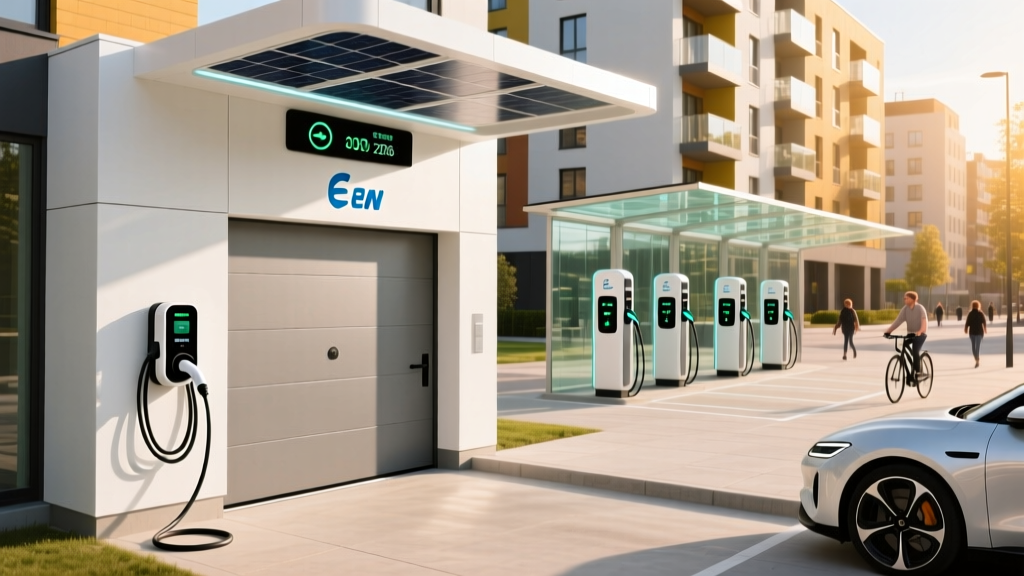
E.ON operates one of Europe's largest charging networks under its E.ON Drive brand, with presence in Germany, the UK, Italy, Sweden, and several other markets. As of early 2026, the network includes over 70,000 charging points accessible through roaming agreements, with E.ON directly operating thousands of high-power DC hubs along motorways and urban centers.
Key characteristics of E.ON's public infrastructure:
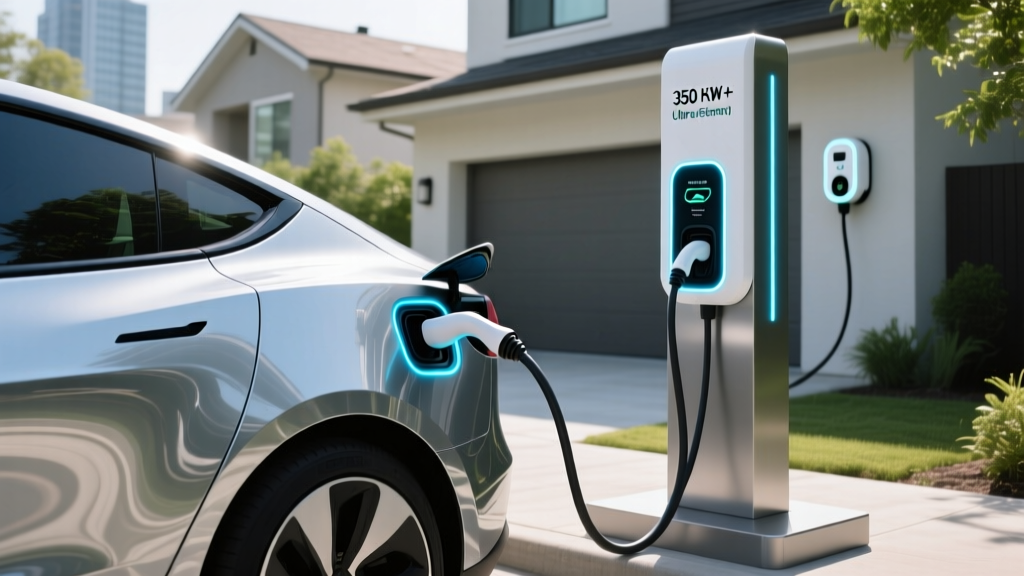
- Ultra-fast highway hubs: 150–350 kW DC chargers (CCS2 in Europe) at motorway rest stops, capable of adding 200+ km of range in 10 minutes on compatible vehicles
- Urban AC chargers: 11–22 kW AC points at shopping centers, parking garages, and workplaces
- E.ON Drive app: Provides real-time availability, pricing, and remote session monitoring
- Roaming access: E.ON Drive cards and apps typically grant access to partner networks including Ionity, EnBW, and others across Europe
Pricing on E.ON's public network varies by country and charger type. In Germany (2026), expect approximately:
- AC charging (11–22 kW): €0.39–€0.49/kWh
- DC fast charging (50–150 kW): €0.59–€0.69/kWh
- Ultra-fast DC (150–350 kW): €0.69–€0.79/kWh
- Subscription plans can reduce per-kWh costs by 15–25% for frequent users
Home Charging with E.ON: Installation, Electrical Requirements, and Costs
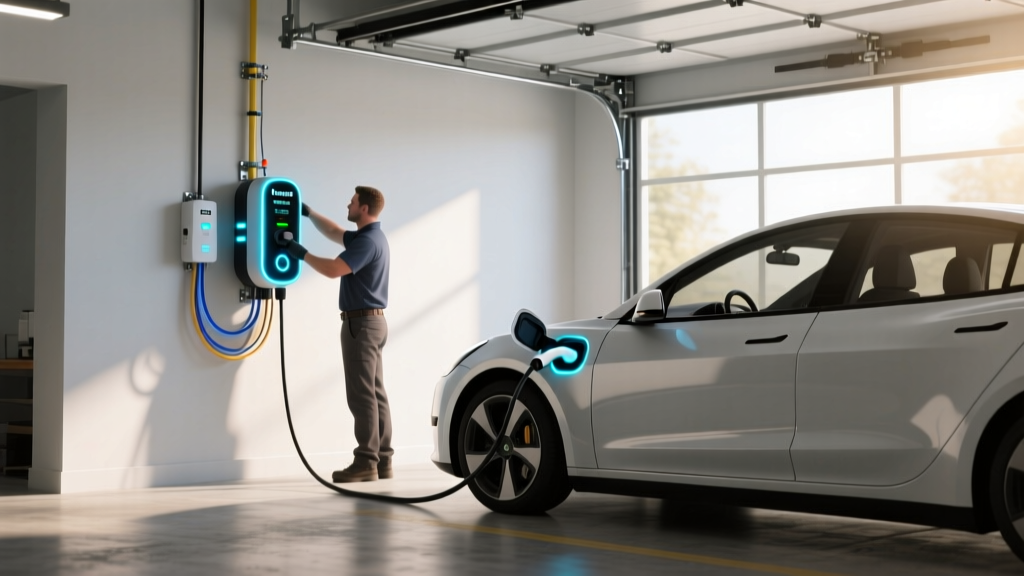
E.ON offers home wallbox solutions in several markets, often bundled with electricity tariffs that include off-peak EV rates. But regardless of whether you buy through E.ON or a third-party supplier, the electrical fundamentals are the same.
Electrical Requirements for Home Level 2 Charging
In European markets (230V single-phase or 400V three-phase), a typical home wallbox installation requires:
- Single-phase (7.4 kW): 230V, 32A dedicated circuit — suitable for most homes and overnight charging
- Three-phase (11–22 kW): 400V, 16–32A dedicated circuit — faster charging, requires 3-phase supply (common in newer EU homes, less common in older UK housing stock)
- Dedicated circuit breaker: Your charger must have its own circuit, not shared with other high-draw appliances
- RCD/GFCI protection: Residual Current Device (Type A or Type B, depending on charger and local code) is mandatory for safety
- Outdoor rating: If mounted externally, the unit must be rated IP54 or higher for weather resistance
Do You Need a Panel Upgrade?
This is the question that catches many homeowners off guard. If your home's electrical panel is already near capacity — running electric heating, an electric oven, a heat pump, or an older 60A service — adding a 7.4–22 kW EV charger may exceed your available capacity.
Signs you may need a panel upgrade:
- Your main service is 60A or below (common in pre-1990s homes)
- Your electrician's load calculation shows less than 40A of spare capacity
- You're adding a 22 kW three-phase charger to an older single-phase supply
- You already have multiple high-draw circuits (electric range, dryer, heat pump, hot tub)
A panel upgrade from 60A to 100–200A can add €1,500–€4,000 (£1,200–£3,500 in the UK) to your project. Always get a licensed electrician's load calculation before purchasing equipment.
| Component | Low Estimate | High Estimate | Notes |
|---|---|---|---|
| Wallbox unit (7.4–22 kW) | €400 / £350 | €1,200 / £900 | Smart Wi-Fi models cost more; E.ON-branded units often bundled |
| Electrician labor | €300 / £250 | €1,000 / £800 | Varies by cable run distance, wall type, and local rates |
| Materials (cable, conduit, breaker) | €100 / £80 | €400 / £300 | Longer runs from panel to garage increase cost |
| Permit / notification | €50 / £40 | €200 / £150 | Required in most EU jurisdictions; UK requires Building Regs notification |
| Panel upgrade (if needed) | €1,500 / £1,200 | €4,000 / £3,500 | Only if existing capacity is insufficient |
| Total (no panel upgrade) | €850 / £720 | €2,800 / £2,150 | Typical range for most homeowners |
| Total (with panel upgrade) | €2,350 / £1,920 | €6,800 / £5,650 | Older homes with limited capacity |
Connector Compatibility: Will E.ON Chargers Fit Your EV?
Connector standards vary significantly by region and vehicle origin. E.ON's European network primarily uses Type 2 (AC) and CCS2 (DC) connectors — the European standard. Here's how major EV brands align:
| Connector Type | Charging Type | Compatible Vehicles (Europe) | Adapter Needed? |
|---|---|---|---|
| Type 2 (Mennekes) | AC Level 2 | BMW i4/iX, VW ID.3/ID.4/ID.5, Mercedes EQE/EQS, Audi Q4 e-tron, Porsche Taycan, most EU-market EVs | No — native connector |
| CCS2 | DC Fast | All modern European EVs (same vehicles as Type 2, DC pins added) | No — native connector |
| Tesla (NACS/CCS2 adapter) | AC/DC | Tesla Model 3/Y/S/X (EU models ship with CCS2 port since 2022) | Pre-2022 EU Teslas may need CCS2 adapter for non-Tesla chargers |
| CHAdeMO | DC Fast | Nissan Leaf, older Mitsubishi Outlander PHEV | No — native, but CHAdeMO stations are declining in EU |
| GB/T | AC/DC | Chinese-market EVs (BYD, MG in some trims) | Yes — GB/T-to-CCS2 adapter required in Europe |
For US readers traveling or relocating: North America uses Type 1 (J1772) for AC and CCS1 or NACS for DC. Tesla's NACS connector has become the dominant North American standard as of 2025–2026, with Ford, GM, Rivian, Hyundai, and others adopting it. E.ON does not operate in North America, so this guide's public-charging details apply to European markets.
Cost to Charge: E.ON Points vs Gasoline Per Mile
The economic case for EV charging hinges on your electricity rate and where you charge. Here's a realistic comparison using a mid-size EV consuming 3.0 miles per kWh (approximately 18 kWh/100 km — typical for a Tesla Model Y or Hyundai Ioniq 5):
| Scenario | Rate | Cost Per Mile | Cost Per 300-Mile Trip |
|---|---|---|---|
| Home off-peak (EU night tariff) | €0.12/kWh | €0.04 / £0.035 | €12.00 / £10.50 |
| Home standard rate | €0.30/kWh | €0.10 / £0.087 | €30.00 / £26.10 |
| E.ON public AC (11–22 kW) | €0.45/kWh | €0.15 / £0.13 | €45.00 / £39.15 |
| E.ON public DC fast (150 kW) | €0.65/kWh | €0.22 / £0.19 | €66.00 / £57.42 |
| Gasoline car (30 MPG, €1.75/L) | €7.95/gallon | €0.27 / £0.23 | €81.00 / £70.47 |
| Gasoline car (25 MPG, €1.75/L) | €7.95/gallon | €0.32 / £0.28 | €96.00 / £83.52 |
The takeaway: Home charging at off-peak rates delivers 6–8x savings over gasoline on a per-mile basis. Even public DC fast charging on E.ON's network undercuts gasoline by 20–30% per mile. The worst-case EV scenario — frequent exclusive use of ultra-fast public DC chargers — still costs less than fueling a 25 MPG gasoline car.
For a driver covering 12,000 miles annually with 80% home charging and 20% public fast charging, the annual fuel savings versus a 30 MPG gasoline car typically range from €1,100–€1,800 (£950–£1,550), depending on local electricity and fuel prices.
Recommended Home Charging Equipment
Whether you purchase through E.ON's home solutions or choose an independent wallbox, here are proven options with exact specifications for the European market:
Wallbox Pulsar Max
- Power: 7.4 kW (single-phase) or 22 kW (three-phase)
- Connector: Type 2 tethered cable (5m or 7m)
- Smart features: Wi-Fi, Bluetooth, app scheduling, solar integration, load balancing
- Price: €550–€750 / £480–£650
- Best for: Most European homes; excellent app; solar-optimized charging
Zappi V2+ (myenergi)
- Power: 7.4 kW (1-phase) or 22 kW (3-phase)
- Connector: Type 2 tethered (6.5m) or untethered socket
- Smart features: Eco/Eco+/Fast modes, solar/wind diversion, app control, CT clamp load monitoring
- Price: €750–€950 / £650–£820
- Best for: Homes with solar panels; best-in-class renewable energy integration
EO Mini Pro 3
- Power: 7.4 kW (single-phase only)
- Connector: Type 2 tethered or universal socket
- Smart features: Compact design, app control, OCPP compatible, load management
- Price: €500–€650 / £430–£560
- Best for: Small installations, tight spaces, UK OZEV-compliant setups
E.ON Drive vBoxx (E.ON branded)
- Power: 11 kW or 22 kW (three-phase)
- Connector: Type 2 tethered (5m)
- Smart features: E.ON app integration, tariff-optimized scheduling, MID-certified meter for billing
- Price: €600–€900 / £520–£780 (often bundled with E.ON electricity tariff)
- Best for: E.ON electricity customers wanting a unified billing and support experience
E.ON vs Other European Networks: Where It Fits
E.ON Drive competes with several major European charging networks. Here's how it compares on key dimensions:
- Ionity: Focuses exclusively on ultra-fast 350 kW highway charging; higher per-kWh pricing (€0.69–€0.79) but fastest speeds. E.ON offers broader urban coverage.
- EnBW (Germany): Largest German network by point count; competitive pricing. E.ON matches on speed, differs on tariff bundling.
- Shell Recharge: Growing rapidly at fuel stations; mixed reliability reports. E.ON benefits from utility-grade infrastructure maintenance.
- Tesla Supercharger: Best-in-class reliability and pricing for Tesla owners; opening to non-Tesla EVs in Europe with CCS2. E.ON offers brand-agnostic access.
For E.ON electricity customers, the primary advantage is integrated billing and access to EV-specific tariffs with off-peak rates as low as €0.08–€0.15/kWh in some markets — dramatically reducing home charging costs.
Frequently Asked Questions
How much does it cost to install a home EV charger?
For a typical European home with adequate electrical capacity, expect €850–€2,800 (£720–£2,150) including the wallbox unit, electrician labor, materials, and permits. If your home requires a panel upgrade (common in pre-1990s buildings), add €1,500–€4,000 (£1,200–£3,500). Always get a licensed electrician's load calculation before committing to equipment.
How fast will each charging level add range?
Level 1 (standard outlet): 3–5 miles per hour — suitable only for PHEVs or emergencies. Level 2 home wallbox (7.4–22 kW): 25–80 miles per hour depending on power and vehicle acceptance rate — fully recharges most EVs overnight. DC fast charging (50–350 kW): 150–1,200 miles per hour at peak — adds 200+ km in 10–15 minutes on compatible vehicles. Remember that DC fast charging tapers significantly above 80% SoC.
Which connector and charger is compatible with my EV?
In Europe, virtually all modern EVs use Type 2 for AC charging and CCS2 for DC fast charging. This includes Volkswagen Group (VW, Audi, Porsche, Skoda, Cupra), BMW, Mercedes-Benz, Hyundai/Kia, Tesla (EU models since 2022), Ford, Volvo/Polestar, and Stellantis brands. Nissan Leaf uses CHAdeMO for DC. Check your vehicle's charge port — if it's a Type 2/CCS2 combo socket, you're compatible with E.ON's entire European network without adapters.
How much does charging cost per mile compared to gas?
Charging at home on an off-peak tariff costs approximately €0.04 per mile (€0.035/mi in the UK) — roughly 6–7x cheaper than a 30 MPG gasoline car at current European fuel prices. Even public DC fast charging at €0.65/kWh delivers ~€0.22 per mile, still 20% below gasoline. Your exact savings depend on local electricity rates, your vehicle's efficiency (kWh/100km), and how much you can charge at home versus public stations.
What electrical upgrades might I need for a home charger?
The most common upgrade is a panel capacity increase if your main service is 60A or near its limit. Other potential needs include: running a new dedicated circuit from your panel to the garage/parking spot (cost scales with distance), upgrading from single-phase to three-phase supply (for 22 kW charging), installing a smart load management system (if you have multiple high-draw appliances), or adding a Type B RCD for maximum safety. A qualified electrician's site survey will identify all requirements before installation begins.