Quick Verdict: Who the Enphase IQ 50 Is For
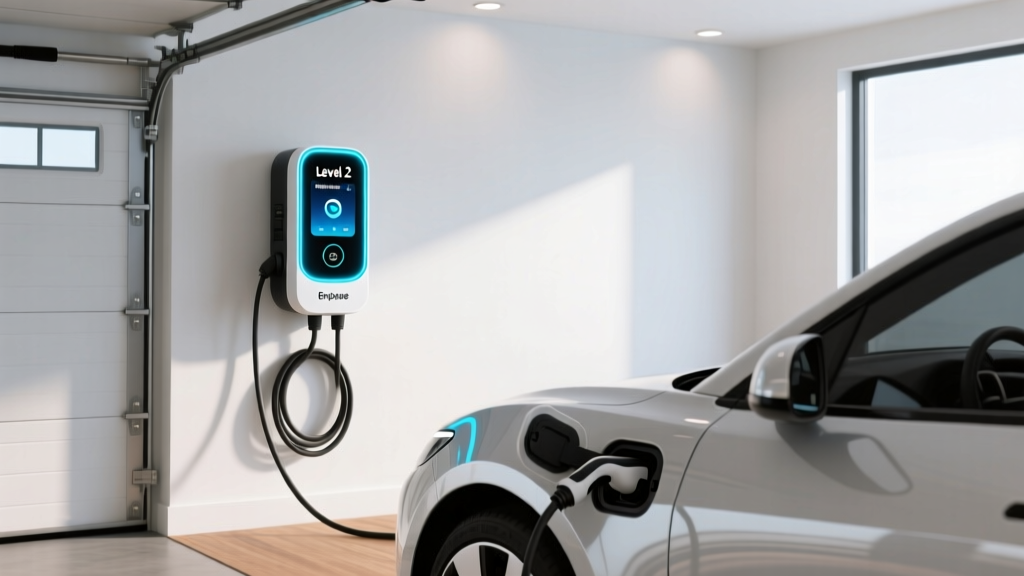
The Enphase IQ 50 Level 2 smart EV charger delivers up to 12 kW of continuous power on a 60-amp dedicated circuit, adding roughly 44–48 miles of range per hour to most modern EVs. Priced around $699 for the hardware alone, it is not the cheapest wallbox on the market, but it occupies a specific and increasingly valuable niche: homeowners who already run an Enphase solar and battery ecosystem and want their EV charging to integrate directly with on-site generation.
If you have Enphase IQ microinverters or an IQ System Controller, the IQ 50 can be configured to charge your EV primarily from excess solar production — a feature called Green Charging — reducing grid draw and maximizing the value of your rooftop array. For EV owners without solar, or those on a competing solar platform, the IQ 50 is still a capable, well-built Level 2 charger, but alternatives like the ChargePoint Home Flex or Emporia Vue may offer better standalone value.
Understanding Charging Levels: Where the IQ 50 Fits
Before evaluating any home charger, it helps to ground expectations in the three charging levels available to EV owners. The single most important distinction: kW (kilowatts) measures power — how fast energy flows into your car. kWh (kilowatt-hours) measures energy — the total capacity of your battery. Think of kW as the width of a hose and kWh as the size of the bucket.
| Level | Voltage | Max Power (kW) | Miles of Range Added per Hour | Typical Use Case |
|---|---|---|---|---|
| Level 1 | 120V AC | 1.4 kW | 3–5 mi/hr | Overnight top-ups, PHEVs, low-mileage drivers |
| Level 2 | 240V AC | 3.3–19.2 kW | 12–70 mi/hr | Home daily charging, workplace, destination |
| DC Fast | 400–800V DC | 50–350+ kW | 150–1,200+ mi/hr | Road trips, highway corridors |
The Enphase IQ 50 is a Level 2 charger rated for up to 50 amps / 12 kW on a 240-volt circuit. That places it in the upper-middle tier of residential chargers — below the 19.2 kW ceiling that some high-amperage units offer, but well above the 7.2–9.6 kW that most 32–40 amp home chargers deliver.
Enphase IQ 50 Specifications and Charge Times
Max Output: 50A / 12 kW (240V)
Circuit Required: 60A dedicated breaker
Connector: J1772 (NACS adapter included in updated 2025+ packages)
Cable Length: 24 feet
Wi-Fi: Built-in, Enphase IQ system integration
Outdoor Rating: NEMA 4 (indoor/outdoor)
Energy Metering: Built-in revenue-grade metering
MSRP: ~$699 (charger only, before installation)
To understand what 12 kW means in practice, here are approximate 10–80% charge times for several popular EV battery sizes. Note that Level 2 charging is relatively linear — unlike DC fast charging, there is minimal taper until you approach 100%.
| Vehicle Example | Usable Battery (kWh) | 10–80% Energy Needed (kWh) | Estimated Time |
|---|---|---|---|
| Chevrolet Equinox EV | 85 kWh | ~59.5 kWh | ~5 hours |
| Tesla Model Y (Long Range) | 75 kWh | ~52.5 kWh | ~4.4 hours |
| Hyundai Ioniq 5 | 77.4 kWh | ~54.2 kWh | ~4.5 hours |
| Ford F-150 Lightning (Extended) | 131 kWh | ~91.7 kWh | ~7.6 hours |
| Toyota RAV4 Prime (PHEV) | 18.1 kWh | ~12.7 kWh | ~1.1 hours |
For most commuters driving 30–50 miles daily, the IQ 50 replenishes a day's worth of driving in well under two hours. Even an F-150 Lightning owner arriving home at 15% will wake up to a full battery after an overnight session.
Connector Compatibility: NACS, CCS, and CHAdeMO
The North American charging connector landscape has shifted decisively toward NACS (North American Charging Standard), the connector Tesla pioneered and which nearly every major automaker has adopted for 2025 and later models. Here is how the IQ 50 interfaces with each standard:
| Connector | Native Support? | Adapter Needed? | Vehicles Using This Standard |
|---|---|---|---|
| J1772 (legacy) | Yes — native plug | None | Pre-2025 non-Tesla EVs (Nissan Leaf, older Bolt, etc.) |
| NACS (Tesla) | Via included adapter (2025+ packages) | J1772-to-NACS adapter | Tesla Model 3/Y/S/X, 2025+ Ford, GM, Hyundai, Rivian, etc. |
| CCS1 | Via J1772 adapter (CCS1 = J1772 + DC pins) | J1772 works for AC portion | Most non-Tesla EVs through 2024 |
| CHAdeMO | No — different AC standard | Not practical for home L2 | Nissan Leaf (legacy), Mitsubishi Outlander PHEV |
For Level 2 home charging, the AC charging standard is either J1772 or NACS. CCS1 and CHAdeMO distinctions matter primarily at DC fast chargers; their AC pins are compatible with J1772 (CCS1) or require a dedicated cable (CHAdeMO). If you drive a Nissan Leaf with CHAdeMO DC capability, its AC charging still uses J1772, so the IQ 50 works without issue.
If you are buying a 2025 or 2026 model-year EV from Ford, GM, Hyundai, Kia, Rivian, or Volvo, it will almost certainly ship with a NACS port. Enphase updated the IQ 50 packaging to include a J1772-to-NACS adapter, but verify this at purchase — earlier production units shipped J1772 only.
Installation Costs: What to Budget
The hardware price of the IQ 50 (~$699) is only part of the total cost. Professional installation by a licensed electrician is required for any 240V / 60A circuit, and costs vary widely based on your home's electrical panel, the distance from panel to charger location, and local permitting fees.
| Cost Component | Simple Install (panel nearby, no upgrade) | Moderate Install (longer run, minor upgrades) | Complex Install (panel upgrade required) |
|---|---|---|---|
| Charger Hardware (IQ 50) | $699 | $699 | $699 |
| Electrician Labor (240V/60A circuit) | $400–$700 | $800–$1,500 | $1,200–$2,500 |
| Materials (conduit, wire, breaker) | $100–$200 | $200–$500 | $300–$600 |
| Permit & Inspection | $50–$150 | $50–$200 | $100–$300 |
| Electrical Panel Upgrade (if needed) | — | — | $1,500–$3,500 |
| Total Estimated Cost | $1,249–$1,749 | $1,749–$2,899 | $3,799–$7,599 |
Federal and Utility Incentives
The federal Alternative Fuel Vehicle Refueling Property Credit (IRS Form 8911) can cover up to 30% of home charging equipment and installation costs, capped at $1,000. This credit is subject to income limits and census-tract eligibility requirements — it is not available to all taxpayers. Many utilities also offer rebates of $250–$750 for installing a smart Level 2 charger. Check the Alternative Fuels Data Center for state and local incentive databases.
Smart Features and Solar Integration
The IQ 50's primary differentiator is its native integration with the Enphase IQ ecosystem. If your home has Enphase microinverters, an IQ Gateway, and optionally an IQ Battery, the charger communicates directly with these components via the Enphase App. Key smart features include:
- Green Charging: Automatically schedules or throttles EV charging to use excess solar production, minimizing grid electricity consumption.
- Scheduled Charging: Set time-of-use schedules to charge during off-peak utility rate windows.
- Energy Monitoring: Revenue-grade metering tracks exactly how many kWh each charging session uses, visible in the Enphase App alongside solar production and home consumption data.
- Load Management: When paired with the IQ System Controller, the charger can dynamically reduce power draw if total home load approaches panel capacity — potentially avoiding a panel upgrade.
- Over-the-Air Updates: Firmware updates are delivered automatically via Wi-Fi.
For solar owners, Green Charging is the compelling reason to choose the IQ 50 over a cheaper standalone charger. If your system produces 8 kW of surplus solar during midday, the IQ 50 can direct that energy to your car rather than exporting it to the grid at low wholesale rates. Over a year, this can meaningfully reduce your effective charging cost.
Charging Cost Per Mile: EV vs. Gas
One of the strongest economic arguments for home Level 2 charging is the cost advantage over gasoline. Here is a comparison using real-world energy prices and an efficient EV consuming approximately 3 miles per kWh (roughly the EPA efficiency of a Tesla Model Y or Hyundai Ioniq 5):
| Scenario | Rate | Cost per kWh | Cost per Mile (3 mi/kWh) |
|---|---|---|---|
| Home Level 2 — Off-Peak (national avg.) | ~$0.13/kWh | $0.13 | $0.043 |
| Home Level 2 — Peak Rate | ~$0.28/kWh | $0.28 | $0.093 |
| Home Level 2 — With Solar (net cost) | ~$0.05/kWh | $0.05 | $0.017 |
| Public Level 2 (e.g., ChargePoint) | ~$0.25–$0.49/kWh | $0.37 avg. | $0.123 |
| DC Fast Charging (e.g., Electrify America) | ~$0.40–$0.56/kWh | $0.48 avg. | $0.160 |
| Gasoline (28 MPG avg., $3.50/gal) | $3.50/gal | — | $0.125 |
Home off-peak charging at $0.043/mile represents roughly a 65% cost reduction compared to gasoline at $3.50/gallon and 28 MPG. Even public Level 2 and DC fast charging are competitive with or slightly cheaper than gas on a per-mile basis. The Enphase IQ 50's scheduling features make it straightforward to lock in the cheapest off-peak rates automatically.
Equipment Comparison: IQ 50 vs. Competing Level 2 Chargers
Power: 12 kW (50A)
Connector: J1772 + NACS adapter
Cable: 24 ft
Smart Features: Solar integration, Green Charging, Enphase App
Price: ~$699
Best for: Enphase solar/battery homeowners
Power: Up to 12 kW (50A, configurable)
Connector: J1772 or NACS
Cable: 23 ft
Smart Features: Alexa, scheduling, ChargePoint network
Price: ~$599
Best for: Standalone smart charging, flexible amperage
Power: Up to 11.5 kW (48A)
Connector: J1772 or NACS
Cable: 24 ft
Smart Features: Whole-home energy monitoring, solar-aware scheduling
Price: ~$399
Best for: Budget-conscious buyers wanting energy data
The IQ 50's 12 kW output is competitive with the ChargePoint Home Flex at its maximum setting. The Emporia Vue maxes out at 11.5 kW (48A), a marginal difference. Where the IQ 50 pulls ahead is the depth of solar integration — it communicates natively with Enphase hardware rather than relying on third-party APIs or manual configuration.
Safety, Code, and Installation Requirements
The National Electrical Code (NEC) and most local jurisdictions impose specific requirements on Level 2 EV charger installations:
- Dedicated Circuit: The IQ 50 requires a dedicated 60-amp, 240-volt circuit. It cannot share a circuit with other appliances.
- Continuous Load Rule: NEC Article 625 classifies EV charging as a continuous load, meaning the circuit must be rated at 125% of the charger's maximum draw. A 50A charger therefore needs a 60A breaker and appropriately sized wire (typically 6 AWG copper or 4 AWG aluminum).
- GFCI Protection: The 2020 NEC and later require GFCI (Ground Fault Circuit Interrupter) protection for all EV charging outlets. Hardwired installations like the IQ 50 may be exempt in some jurisdictions, but confirm with your local inspector.
- Outdoor Rating: The IQ 50 carries a NEMA 4 rating, meaning it is sealed against rain, splashing water, and dust — suitable for outdoor installation without an additional enclosure.
- Permit and Inspection: Virtually all jurisdictions require a permit for a new 240V circuit. The installation must pass inspection before use. Factor $50–$300 into your budget for permit fees.
Frequently Asked Questions
How much does it cost to install a home EV charger?
For the Enphase IQ 50 specifically, total installed cost typically ranges from $1,249 for a simple installation near the electrical panel to over $7,500 if a full panel upgrade from 100A to 200A is required. The national average for a straightforward Level 2 installation without a panel upgrade is approximately $1,500–$2,500 including hardware, labor, materials, and permits.
How fast will each charging level add range?
Level 1 (120V) adds 3–5 miles per hour. Level 2 at 12 kW (the IQ 50's output) adds approximately 44–48 miles per hour depending on vehicle efficiency. DC fast charging can add 150–1,200+ miles per hour at peak rates, though sustained rates taper significantly above 80% state of charge. See the charging levels table above for the full comparison.
Which connector is compatible with my EV?
If your EV is a 2025 or newer model from Tesla, Ford, GM, Hyundai, Kia, Rivian, or Volvo, it likely has a NACS port. The IQ 50 ships with a J1772-to-NACS adapter in updated packages. Older non-Tesla EVs use J1772 natively. The Nissan Leaf uses CHAdeMO for DC fast charging but J1772 for AC Level 2 — so the IQ 50 is compatible for home charging.
How much does charging cost per mile vs gas?
Home off-peak charging at the national average rate of $0.13/kWh costs approximately $0.043 per mile for an efficient EV (3 mi/kWh). Gasoline at $3.50/gallon in a 28 MPG vehicle costs $0.125 per mile. That is a roughly 65% savings with home EV charging. Solar-charged miles can drop below $0.02 per mile.
What electrical upgrades might I need?
The most common upgrade is a panel capacity increase from 100A to 200A, which costs $1,500–$3,500. You may also need new conduit runs if your panel is far from the desired charger location (garage or driveway). Some older homes need a service upgrade from the utility — contact your electric provider early in the process. The Enphase IQ System Controller's dynamic load management feature can sometimes avoid a panel upgrade by throttling charger power when other home loads are high.
Does the Enphase IQ 50 work without Enphase solar?
Yes. The IQ 50 functions as a standard Level 2 charger without any solar system. However, you lose the Green Charging feature and the deeper energy-management integration that justify its premium over competitors like the ChargePoint Home Flex or Emporia Vue. If you have no solar and no plans to add it, a less expensive charger may be a better fit.
Is the 30% federal tax credit available for the IQ 50 installation?
The Alternative Fuel Vehicle Refueling Property Credit (IRS Form 8911) covers 30% of equipment and installation costs up to $1,000. However, eligibility depends on your income level and whether your home is located in a qualifying census tract. Consult a tax professional and verify current-year rules on the IRS website before claiming.