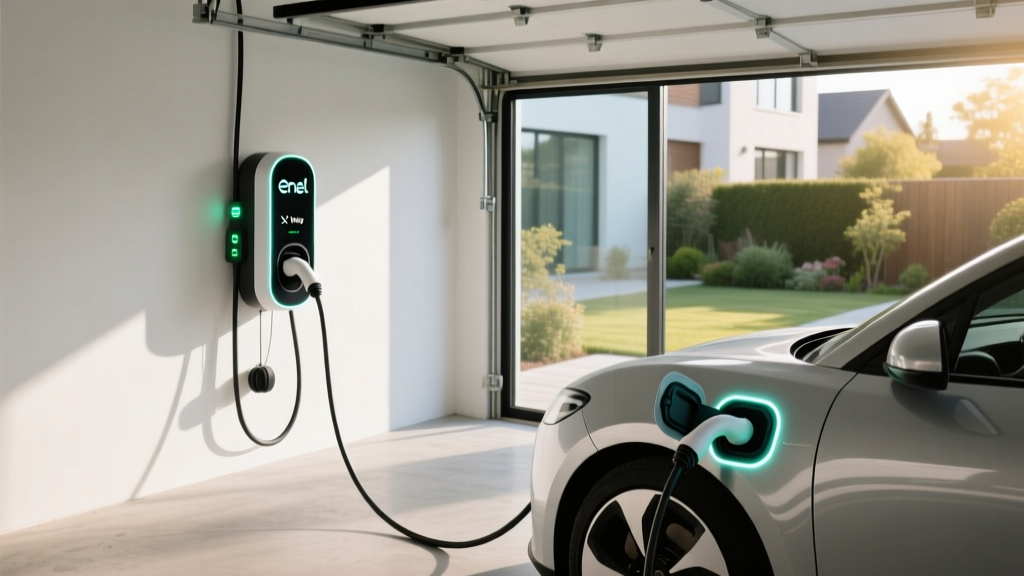
If you've been researching home Level 2 chargers, the Enel X Way charging station (the JuiceBox lineage, now under the Enel X Way brand) keeps surfacing. It's one of the most widely deployed smart chargers in North America, with a reputation built on utility partnerships, commercial networks, and a growing residential lineup. But does it deserve a spot on your garage wall in 2026?
This guide evaluates the Enel X Way home charger lineup against real-world installation requirements, charging speeds, connector compatibility, and operating costs — with exact numbers, not marketing fluff. We'll also cover the electrical upgrades your home might need before any charger gets plugged in.
Enel X Way Home Charger Lineup: What's Available in 2026
Enel X Way's residential portfolio centers on the JuiceBox series, now branded under the Enel X Way umbrella. The core models available to US buyers:
- JuiceBox 32 — 32A / 7.7 kW output, 240V, NEMA 14-50 plug or hardwired. Best for homes with limited panel capacity.
- JuiceBox 48 — 48A / 11.5 kW output, 240V, hardwired (NEC 2023+ requires hardwired for circuits over 40A). The most popular residential pick.
- JuiceBox Pro 48 — Same 11.5 kW output with enhanced Wi-Fi, Ethernet port, and energy-monitoring features.
All models include a 25-foot cable, integrated cable management, and the Enel X Way app for scheduling, energy tracking, and utility demand-response enrollment. Pricing typically ranges from $449 to $699 depending on model and retailer.
JuiceBox 48 — Best Overall
- Power output: 11.5 kW (48A @ 240V)
- Connector: J1772 (NACS adapter included or available)
- Cable length: 25 ft
- Smart features: Wi-Fi, app scheduling, utility DR
- Price: ~$599
JuiceBox 32 — Budget/Panel-Limited
- Power output: 7.7 kW (32A @ 240V)
- Connector: J1772
- Cable length: 25 ft
- Smart features: Wi-Fi, app control
- Price: ~$449
Charging Levels Explained: Speeds in kW and Miles Per Hour
Before evaluating any charger, you need clarity on the three charging levels and what they actually deliver. kW (kilowatts) measures power — the rate of energy flow. kWh (kilowatt-hours) measures energy — what your battery stores. A 48A charger delivering 11.5 kW fills a 75 kWh battery in roughly 6.5 hours from empty.
| Level | Voltage | Max Power (kW) | Miles of Range Added Per Hour | Typical Use |
|---|---|---|---|---|
| Level 1 | 120V AC | 1.4–1.9 kW | 3–5 mi/hr | Overnight top-up, PHEVs |
| Level 2 | 240V AC | 3.3–19.2 kW | 12–75 mi/hr | Home daily charging, workplace |
| DC Fast | 400–800V DC | 50–350 kW | 150–1,000+ mi/hr | Road trips, highway corridors |
The Enel X Way JuiceBox 48 sits at the practical top of Level 2 for residential use. At 11.5 kW, it adds roughly 35–45 miles of range per hour for a typical EV consuming 3–4 miles/kWh. That means a Chevrolet Equinox EV (85 kWh battery, ~315 mi EPA range) recovers from 20% to 80% in about 4.5 hours — easily overnight.
How Much Does It Cost to Install the Enel X Way Charging Station?
The charger itself is only part of the equation. Installation costs vary enormously based on your electrical panel's capacity, the distance from panel to charger location, and local permit fees. Here's a realistic breakdown:
| Component | Simple Install (panel near garage) | Complex Install (long run, panel upgrade) |
|---|---|---|
| Enel X Way JuiceBox 48 unit | $599 | $599 |
| Electrician labor (2–6 hrs @ $100–$150/hr) | $200–$400 | $600–$1,200 |
| Electrical materials (conduit, wire, 60A breaker) | $100–$200 | $300–$600 |
| Permit & inspection | $50–$150 | $50–$200 |
| Panel upgrade (100A → 200A) if needed | N/A | $1,500–$3,500 |
| Total estimated cost | $950–$1,350 | $3,050–$6,100 |
Panel upgrade reality check: Homes built before 2000 often have 100A or 125A main panels. Adding a 60A dedicated circuit for a 48A charger (NEC requires circuits rated at 125% of continuous load: 48A × 1.25 = 60A) may exceed available capacity. A licensed electrician will perform a load calculation per NEC Article 220. If you're already planning solar, heat pump, or hot tub installations, bundle the panel upgrade to save on total labor.
Electrical Requirements: What Your Home Needs
The JuiceBox 48 requires a 240V, 60A dedicated circuit with hardwired connection. The JuiceBox 32 can use a NEMA 14-50 receptacle (50A circuit) or be hardwired. Key requirements:
- Dedicated circuit: The charger cannot share a breaker with other appliances.
- GFCI protection: NEC 2020 and later requires GFCI protection for EV receptacles. Hardwired installations may be exempt depending on local code interpretation — your electrician will advise.
- Outdoor rating: The JuiceBox carries a NEMA 4 rating (weather-resistant), suitable for outdoor mounting. If installing outside, ensure the conduit and junction box are also rated for wet locations.
- Wire gauge: 6 AWG copper for 48A/60A circuits; 8 AWG for 32A/40A circuits. Longer runs (over 100 ft) may require 4 AWG to minimize voltage drop.
Connector Compatibility: Will It Fit Your EV?
The connector landscape shifted dramatically in 2024–2025 when Ford, GM, Rivian, Volvo, and others adopted the NACS (North American Charging Standard) — Tesla's connector. Here's where things stand in 2026:
| Connector | Brands Using It (2026) | Adapter Needed for Enel X Way? |
|---|---|---|
| J1772 | Legacy EVs, most pre-2025 models, PHEVs (Toyota, Hyundai, Kia, VW) | No — native on JuiceBox |
| NACS (Tesla) | Tesla (all years), Ford (2025+), GM (2025+), Rivian (2025+), Volvo/Polestar | Yes — J1772-to-NACS adapter (~$100–$200) |
| CCS1 | Being phased out on new models; remains on 2020–2024 vehicles | J1772 native; CCS combo not needed for L2 |
| CHAdeMO | Nissan Leaf (legacy only, discontinued after 2025) | J1772 adapter available (~$150) |
Key insight: Level 2 AC charging uses only the J1772 portion of any connector. The JuiceBox ships with a J1772 plug. If your EV has a NACS port (2025+ Ford, GM, Rivian, Tesla), you'll need a J1772-to-NACS adapter for home charging. Enel X Way and third-party vendors like Lectron sell these adapters. For DC fast charging on road trips, NACS vehicles access Tesla Superchargers directly.
Real Charge Times: What to Expect with the Enel X Way
Charge time depends on your vehicle's onboard charger capacity — not just the station's output. The JuiceBox 48 can deliver up to 11.5 kW, but your EV may accept less:
- Tesla Model Y (2026): 11.5 kW onboard → full 11.5 kW from JuiceBox 48. 10–80% on a 75 kWh battery: ~4.5 hours.
- Ford Mustang Mach-E (2026): 10.5 kW onboard → caps at 10.5 kW. 10–80% on 91 kWh extended-range battery: ~6 hours.
- Hyundai Ioniq 5 (2026): 10.9 kW onboard → 10.9 kW. 10–80% on 84 kWh battery: ~5.5 hours.
- Chevrolet Equinox EV (2026): 11.5 kW onboard → full 11.5 kW. 10–80% on 85 kWh battery: ~5 hours.
- Toyota RAV4 PHEV: 6.6 kW onboard → caps at 6.6 kW. 0–100% on 18.1 kWh battery: ~2.5 hours.
For most EV owners, overnight charging (8–12 hours available) means even a JuiceBox 32 at 7.7 kW fully replenishes any daily driving. The 48A model matters most if you routinely deplete large batteries (towing, long commutes) or need faster turnaround between drivers in a multi-EV household.
Cost to Charge: Home vs. Public vs. Gas
One of the strongest arguments for home charging is cost. Here's how the Enel X Way at home compares to public options and gasoline, based on 2026 average rates:
| Charging Scenario | Rate ($/kWh) | Cost Per Mile (3.5 mi/kWh EV) | Cost for 300 Miles |
|---|---|---|---|
| Home off-peak (utility TOU rate) | $0.08–$0.12 | $0.023–$0.034 | $6.90–$10.20 |
| Home standard rate | $0.14–$0.18 | $0.040–$0.051 | $12.00–$15.30 |
| Public Level 2 (ChargePoint, etc.) | $0.25–$0.49 | $0.071–$0.140 | $21.30–$42.00 |
| DC Fast (Electrify America, Tesla) | $0.35–$0.55 | $0.100–$0.157 | $30.00–$47.10 |
| Gasoline (25 MPG avg, $3.40/gal) | $3.40/gal | $0.136 | $40.80 |
Home off-peak charging with the Enel X Way JuiceBox costs roughly one-quarter to one-fifth what gasoline costs per mile. Even at standard residential rates, you save 60–70% vs. gas. The Enel X Way app lets you schedule charging during off-peak windows (typically 11 PM – 7 AM) to lock in the lowest rates — a feature that pays for the charger within months for high-mileage drivers.
According to fueleconomy.gov, the average EV achieves 3–4 miles per kWh, while a comparable gas vehicle averages 25–30 MPG. Your savings widen if your utility offers dedicated EV rates or if your state has low electricity costs (Pacific Northwest, parts of the Southeast).
Smart Features and the Enel X Way App
The JuiceBox's smart capabilities go beyond basic on/off scheduling:
- Utility demand-response enrollment: Many utilities (PG&E, ConEdison, Xcel Energy) offer bill credits for allowing slight charge-delay during peak events. The Enel X Way platform integrates with these programs.
- Energy monitoring: Track kWh consumed per session, monthly totals, and estimated cost.
- Load sharing: If you install two JuiceBox units on a single circuit, Enel X Way's load-sharing feature splits available amperage dynamically — useful for two-EV garages without a panel upgrade.
- Remote access: Start/stop sessions, check status, and receive completion alerts from your phone.
One limitation: Enel X Way's cloud services have experienced intermittent outages in past years. The charger still functions as a basic charger during outages (it defaults to immediate charging), but you lose scheduling and monitoring until connectivity resumes.
Tax Credits and Incentives for Home Charger Installation
The federal Alternative Fuel Vehicle Refueling Property Credit (IRS Form 8911) covers up to 30% of home charger equipment and installation costs, capped at $1,000. However, this credit is only available if you live in a qualifying census tract (non-urban or low-income community per IRS guidelines). Check the IRS refueling property credit page for current eligibility maps.
Additionally, many utilities and states offer separate rebates:
- Utility rebates: $200–$500 off charger purchase or installation (varies by provider).
- State incentives: California, New York, Colorado, and others offer additional credits — check your state energy office.
- Time-of-use rate enrollment: Not a rebate, but discounted overnight rates effectively save $300–$600/year for average drivers.
Note: This is separate from the §30D clean vehicle credit for the EV itself. Consult a tax professional to confirm your eligibility for both.
Frequently Asked Questions
How much does it cost to install a home EV charger?
A straightforward Enel X Way JuiceBox 48 installation (panel nearby, no upgrade) costs $950–$1,350 including equipment, electrician, and permit. Complex installs with long wire runs or a panel upgrade can reach $3,000–$6,100. Always get 2–3 quotes from licensed electricians.
How fast will each charging level add range?
Level 1 (120V) adds 3–5 miles per hour. Level 2 at 11.5 kW (JuiceBox 48) adds roughly 35–45 miles per hour. DC fast charging at 150+ kW can add 150–1,000+ miles per hour but is not suitable for daily home use due to battery stress and cost.
Which connector/charger is compatible with my EV?
The Enel X Way JuiceBox uses a J1772 connector, compatible with all EVs either natively (pre-2025 models, PHEVs) or via a J1772-to-NACS adapter (~$100–$200) for newer Tesla, Ford, GM, and Rivian vehicles with NACS ports. Level 2 AC charging does not use CCS or CHAdeMO pins.
How much does charging cost per mile vs gas?
Home off-peak charging costs $0.023–$0.034 per mile; gasoline at 25 MPG and $3.40/gallon costs $0.136 per mile. That's a 75–83% fuel cost reduction. Public DC fast charging narrows the gap to $0.10–$0.16 per mile — still cheaper than gas but less compelling.
What electrical upgrades might I need?
The JuiceBox 48 requires a dedicated 60A, 240V circuit. Homes with 100A or 125A main panels may need a panel upgrade to 200A ($1,500–$3,500). Your electrician will perform an NEC Article 220 load calculation. If capacity is tight, the JuiceBox 32 (40A circuit) or the JuiceBox 48 with software-limited amperage can work without a panel upgrade.
Is the Enel X Way JuiceBox worth it vs. competitors?
The JuiceBox 48 competes with the ChargePoint Home Flex ($599, up to 50A), Tesla Wall Connector ($470, 48A), and Emporia Vue ($399, 48A). The JuiceBox wins on utility demand-response integration and load-sharing for dual-charger setups. The Tesla Wall Connector is cheaper and includes NACS natively. Choose Enel X Way if your utility partners with their platform or if you need two chargers on one circuit.