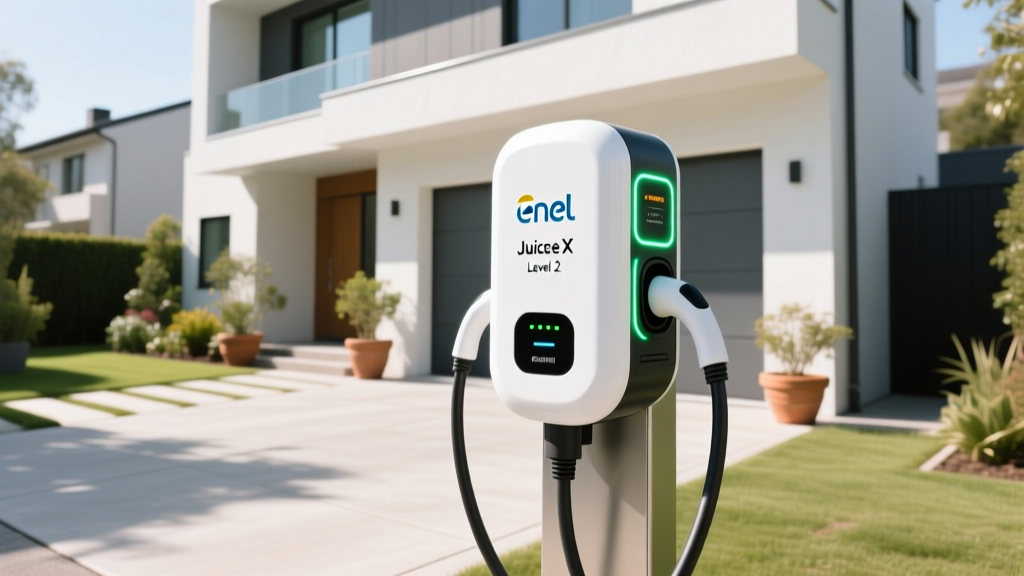
Enel X made its name in the EV world with the JuiceBox, one of the earliest Wi-Fi-connected home Level 2 chargers to gain mass adoption. But after Enel X restructured its North American operations in mid-2024, the future of the JuiceBox line became uncertain. Now in 2026, the Enel X charging station brand is effectively in legacy status — existing units still work, the app still functions, but new hardware availability has dwindled. If you already own one, or are considering a used or remaining-stock unit, here's everything you need to know about performance, compatibility, and whether it still holds up against modern competitors.
Enel X JuiceBox Lineup: Power, Connectors, and Current Status
The JuiceBox shipped in three power tiers over its production run. All models use a standard J1772 connector (Level 2 AC), which is native to every non-Tesla EV sold in the US through 2024 and still compatible with NACS-equipped 2025+ vehicles via the J1772-to-NACS adapter most automakers now include.
| Model | Max Power (kW) | Amperage | Voltage | Cable Length | Wi-Fi | Approx. Price (MSRP) |
|---|---|---|---|---|---|---|
| JuiceBox 32 | 7.7 kW | 32A | 240V | 24 ft | Yes | $549 (discontinued) |
| JuiceBox 40 | 9.6 kW | 40A | 240V | 24 ft | Yes | $599 (limited stock) |
| JuiceBox 48 | 11.5 kW | 48A | 240V | 24 ft | Yes | $649 (rare) |
The JuiceBox 40 became the volume seller because it balanced cost with charging speed — 9.6 kW adds roughly 35–40 miles of range per hour for a midsize EV like the Hyundai Ioniq 5 or Tesla Model Y. The 48-amp version pushes that to around 42–46 miles per hour but requires a 60-amp dedicated circuit, which not every home panel can support.
kW (kilowatts) measures power — how fast energy flows into your car. kWh (kilowatt-hours) measures energy capacity — how much your battery holds. A JuiceBox 40 delivers 9.6 kW of power. If you charge a 77.4 kWh battery (Ioniq 5) from empty at that rate for one hour, you'd add 9.6 kWh of energy — roughly 35 miles of range. Never confuse the two when comparing chargers.
How Fast Will an Enel X Charging Station Add Range?
Charging speed depends on three factors: the charger's max kW output, your EV's onboard charger capacity, and the battery's state of charge. Here's how the JuiceBox lineup compares across all three charging levels most EV owners encounter:
| Level | Voltage | Typical Power | Miles of Range/Hour | Best For |
|---|---|---|---|---|
| Level 1 (120V outlet) | 120V | 1.4–1.9 kW | 3–5 mi/hr | Overnight trickle, PHEVs |
| Level 2 — JuiceBox 32 | 240V | 7.7 kW | 28–32 mi/hr | Budget home install |
| Level 2 — JuiceBox 40 | 240V | 9.6 kW | 35–40 mi/hr | Most EVs, daily use |
| Level 2 — JuiceBox 48 | 240V | 11.5 kW | 42–46 mi/hr | Large batteries (F-150 Lightning, Rivian) |
| DC Fast Charging | 400–800V | 50–350 kW | 150–1,000+ mi/hr | Road trips, rapid top-ups |
For context, a 2026 Tesla Model Y Long Range (75 kWh usable battery, ~320 mi EPA range) charging on a JuiceBox 40 from 20% to 80% would take approximately 4.5 hours. That's perfectly suited for overnight charging while you sleep. A Ford F-150 Lightning Extended Range (131 kWh usable) on the same JuiceBox 40 needs roughly 9 hours for 20–80% — still doable overnight but tight. That's where the JuiceBox 48's 11.5 kW output shortens the window to about 7.5 hours.
On DC fast chargers, these same vehicles charge dramatically faster. The Ioniq 5 with its 800V architecture peaks at 240 kW and hits 10–80% in roughly 18 minutes. The JuiceBox is strictly a home/workplace Level 2 solution — it does not provide DC fast charging.
Home Installation: Electrical Requirements and Costs
Installing any Level 2 Enel X charging station requires a 240-volt dedicated circuit, similar to what a clothes dryer or electric oven uses. The exact amperage depends on your JuiceBox model:
- JuiceBox 32 (7.7 kW): Requires a 40-amp breaker (NEC rules mandate the breaker be rated 125% above continuous load: 32A × 1.25 = 40A)
- JuiceBox 40 (9.6 kW): Requires a 50-amp breaker
- JuiceBox 48 (11.5 kW): Requires a 60-amp breaker
The JuiceBox can be hardwired directly to your panel or plugged into a NEMA 14-50 outlet (for the 40A model) or NEMA 6-50 (for the 48A). Hardwiring is generally preferred for reliability and is required by code in some jurisdictions for circuits above 50 amps.
Installation Cost Breakdown
Here's what a typical Enel X charging station installation costs in 2026, based on national averages. Your actual cost depends heavily on your home's existing electrical infrastructure:
| Component | Simple Install (panel nearby) | Complex Install (panel far, upgrade needed) |
|---|---|---|
| JuiceBox 40 unit | $599 | $599 |
| Permit fee | $50–$150 | $50–$250 |
| Electrician labor (run conduit, wire, breaker) | $300–$600 | $800–$2,500 |
| Electrical panel upgrade (if needed) | $0 | $1,500–$3,500 |
| Conduit and materials | $50–$150 | $200–$500 |
| Total Estimated Cost | $1,000–$1,500 | $3,150–$7,350 |
Homes built before 2000 often have 100-amp main panels. Adding a 50-amp EV circuit may exceed available capacity, especially if you also run electric heat, a dryer, and an oven. A licensed electrician will perform a load calculation per NEC Article 220. If you need a 200-amp panel upgrade, budget $1,500–$3,500 additional. Some utilities offer rebates for panel upgrades tied to EV adoption — check with your local provider.
Safety and Code Considerations
The JuiceBox carries UL listing (UL 2594 for EV supply equipment), which is required by the National Electrical Code for any hardwired or plug-in charger. Key installation requirements:
- Dedicated circuit: The EV charger must have its own breaker — no sharing with other appliances
- GFCI protection: NEC 2020 and later require GFCI protection for all 125V–250V receptacles in garages (625.54). Hardwired units like the JuiceBox are exempt from this specific requirement but must still meet ground-fault protection standards built into the unit
- Outdoor rating: The JuiceBox is rated NEMA 4 (indoor/outdoor), meaning it can handle rain and splashing water. However, the plug connection should be protected from direct weather exposure with a weatherproof cover
- Cable management: The 24-foot cable should not drape across walkways. Enel X includes a cable holster, but a proper J-hook or retractable reel improves safety
Connector Compatibility: NACS, CCS1, and Adapters
The Enel X JuiceBox uses a J1772 connector — the North American standard for Level 2 AC charging since 2010. Here's how that maps to today's EV landscape in 2026:
| EV Connector Type | Compatible with JuiceBox? | Adapter Needed? |
|---|---|---|
| J1772 (Chevy Bolt, older Nissan Leaf, BMW i3) | Yes — plug and play | None |
| NACS / Tesla (Model 3/Y/S/X, 2025+ Ford, GM, Rivian, Hyundai) | Yes — with adapter | J1772-to-NACS adapter (included with most 2025+ NACS vehicles, ~$50–$100 aftermarket) |
| CCS1 (most 2022–2024 non-Tesla EVs) | Yes — J1772 portion | None (CCS1 includes J1772 pins on top) |
| CHAdeMO (Nissan Leaf, Mitsubishi Outlander PHEV) | Yes — for Level 2 AC only | None (CHAdeMO is DC-only; Leaf uses J1772 for AC) |
The critical takeaway: the JuiceBox will charge any EV sold in North America at Level 2 speeds, either natively or with a simple adapter. The NACS transition has not made J1772 chargers obsolete — it just means you'll use an adapter, which takes about 5 seconds to connect.
For DC fast charging, NACS vehicles access the Tesla Supercharger network (now open to other brands), while CCS1 vehicles use Electrify America, EVgo, and ChargePoint networks. The JuiceBox is not involved in DC charging at all.
Cost to Charge: JuiceBox at Home vs. Public vs. Gas
One of the strongest arguments for home charging on an Enel X charging station is cost. Here's a realistic breakdown using 2026 electricity rates and gas prices:
| Scenario | Rate | Cost per kWh | Cost per Mile (250 Wh/mi EV) |
|---|---|---|---|
| Home — off-peak utility rate | $0.08–$0.14/kWh | $0.11 avg | $0.028/mi |
| Home — standard rate | $0.14–$0.22/kWh | $0.18 avg | $0.045/mi |
| Public Level 2 (ChargePoint, etc.) | $0.25–$0.49/kWh | $0.37 avg | $0.093/mi |
| DC Fast Charging (Electrify America) | $0.35–$0.55/kWh | $0.45 avg | $0.113/mi |
| Gas car (28 MPG combined, $3.40/gal) | $3.40/gal | N/A | $0.121/mi |
At off-peak home rates, charging a JuiceBox costs roughly 4x less per mile than gasoline. Even at standard residential rates, you're saving 60–75% per mile. The break-even math is compelling: if you drive 12,000 miles/year in an EV averaging 3.5 miles/kWh, home charging on off-peak rates costs about $335/year versus $1,450 for gas. That's over $1,100 in annual fuel savings.
Time-of-use (TOU) utility plans are essential for maximizing savings. Most utilities offer rates 30–60% lower between 10 PM and 6 AM. The JuiceBox's app includes scheduled charging, so you can plug in at 6 PM and tell it to start charging at 11 PM automatically.
How the JuiceBox Compares to 2026 Alternatives
With Enel X's reduced North American presence, buyers shopping for a home charger today have strong alternatives. Here's how the JuiceBox 40 stacks up:
Enel X JuiceBox 40
- Power: 9.6 kW (40A)
- Connector: J1772
- Smart features: Wi-Fi, app scheduling, energy tracking
- Cable: 24 ft
- Price: ~$599 (limited availability)
- Concern: Uncertain long-term app support
ChargePoint Home Flex
- Power: Up to 12 kW (50A, adjustable)
- Connector: J1772 or NACS
- Smart features: Wi-Fi, Alexa, detailed app
- Cable: 23 ft
- Price: ~$699
- Advantage: NACS option, active company
Tesla Wall Connector
- Power: Up to 11.5 kW (48A)
- Connector: NACS (J1772 adapter available)
- Smart features: Wi-Fi, OTA updates, load sharing
- Cable: 24 ft
- Price: ~$475
- Advantage: Best value, native NACS
The Tesla Wall Connector at $475 with native NACS and 48A output is the strongest value in 2026 — especially since most new EVs now ship with NACS ports. The ChargePoint Home Flex offers flexibility with its adjustable amperage and NACS option. The JuiceBox remains a solid piece of hardware, but Enel X's uncertain support trajectory makes it a riskier long-term investment.
Smart Features and App Experience
The JuiceBox app provides real-time charging status, session history, energy consumption tracking, and scheduled charging. It also supports load sharing if you install two JuiceBox units on a single circuit — a useful feature for two-EV households with limited panel capacity.
However, as of early 2026, user reports indicate the app receives infrequent updates. While it remains functional, the lack of active development means bugs may persist longer than with actively maintained competitors. ChargePoint and Tesla both push regular firmware and app updates. If smart features matter to you — detailed energy dashboards, utility demand-response integration, or solar-charging optimization — the alternatives have a clearer support roadmap.
Is the Enel X Charging Station Still a Good Buy?
If you can find a JuiceBox 40 at a discount (remaining stock or a well-maintained used unit at $300–$400), it's still a capable, UL-listed charger with a 24-foot cable and Wi-Fi scheduling. The hardware itself is durable — many 2018–2020 units are still running daily without issues.
But for a full-price new purchase in 2026, the math favors alternatives. The Tesla Wall Connector delivers more power (11.5 kW vs 9.6 kW) at a lower price ($475 vs $599) with native NACS support and active firmware updates. Unless you specifically need J1772-native for an older EV and find the JuiceBox at a steep discount, the Tesla or ChargePoint units are the smarter buy today.
Frequently Asked Questions
How much does it cost to install an Enel X home charger?
Expect $1,000–$1,500 for a straightforward installation where your electrical panel is near the garage and has sufficient capacity. If you need a panel upgrade, long conduit runs, or trenching, costs can reach $3,000–$7,000+. Always get a quote from a licensed electrician who will perform a load calculation first.
Can I use a JuiceBox with a Tesla or other NACS vehicle?
Yes. The JuiceBox uses a J1772 connector, which works with any NACS-equipped vehicle using a J1772-to-NACS adapter. Most 2025+ NACS vehicles include this adapter in the trunk. Charging speed will be limited to the JuiceBox's max output (9.6 kW for the JuiceBox 40), which is fine for overnight home charging.
Does the JuiceBox qualify for the federal tax credit?
The JuiceBox hardware itself may qualify under the Residential Clean Energy Credit (IRS §25D), which covers 30% of qualified EV supply equipment costs (charger + installation) through 2032. This is separate from the §30D vehicle purchase credit. There is no annual cap on the §25D credit for charging equipment. Verify eligibility with a tax professional, as rules around principal residence and income apply.
Will Enel X continue supporting the JuiceBox app and firmware?
As of early 2026, the JuiceBox app and cloud services remain operational, but Enel X has significantly scaled back its North American consumer operations. There is no public commitment to long-term app maintenance or new firmware features. The charger will continue to function as a basic Level 2 unit even if the app eventually goes offline — charging is hardware-controlled, not cloud-dependent.
What size breaker do I need for a JuiceBox 40?
The JuiceBox 40 draws 40 amps continuously. Per NEC 625.41, EV chargers are considered continuous loads, requiring the circuit breaker to be rated at 125% of the load. That means you need a 50-amp breaker on a dedicated 240V circuit using 6 AWG copper wire (or 4 AWG aluminum). Your electrician will confirm wire gauge based on run length.
How does the JuiceBox compare to DC fast charging speeds?
The JuiceBox maxes out at 11.5 kW (JuiceBox 48). DC fast chargers deliver 50–350 kW — roughly 5x to 30x faster. A JuiceBox is designed for overnight home charging (8–10 hours for a full charge), not rapid top-ups. For road trips, you'll use DC fast chargers from networks like Tesla Supercharger, Electrify America, or EVgo, which add 100–250+ miles in 15–30 minutes depending on the vehicle and charger.