Quick Verdict: The Emporia Pro for Data-Driven EV Owners
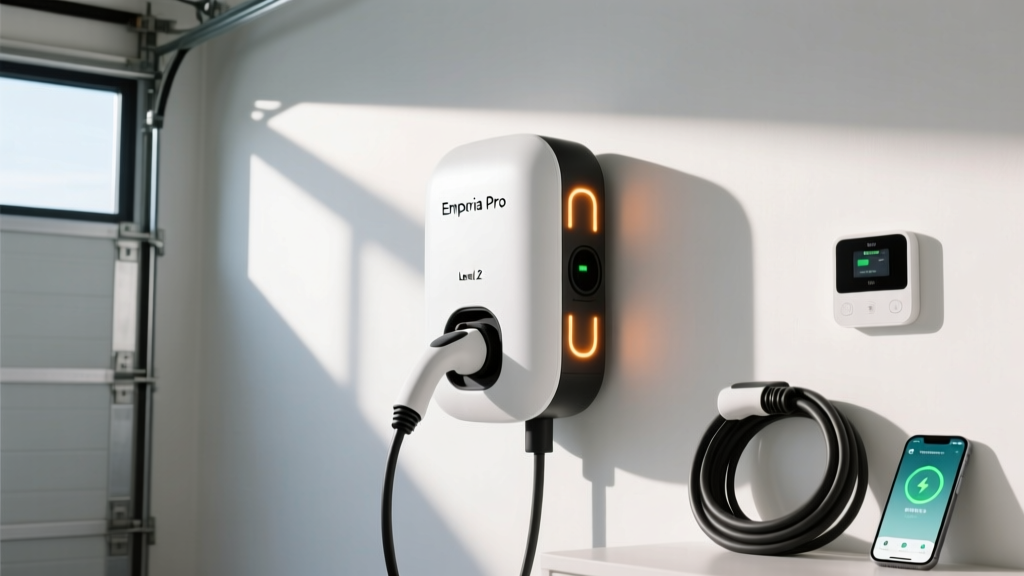
If you track every kilowatt-hour your EV pulls from the grid, the Emporia Pro Level 2 charger was practically built for you. Unlike most home EVSEs that offer a basic LED and a companion app, the Emporia Pro integrates directly with the Emporia Vue home energy monitor, giving you circuit-level visibility into exactly how much energy your charging sessions consume — and how that maps to your utility's time-of-use rates.
At 48 amps (11.5 kW on a 240V/60A circuit), the Emporia Pro delivers the maximum Level 2 speed most residential electrical panels can support without an upgrade. It's hardwired, NEMA 4-rated for outdoor use, and carries a price tag around $599–$649 — undercutting competitors like the ChargePoint Home Flex and Tesla Wall Connector on pure hardware cost.
But raw specs don't tell the whole story. Below, we break down real installation costs, charge-time math for popular 2025–2026 EVs, connector compatibility (including NACS), and the electrical panel gotchas that can double your install bill.
Charging Levels Explained: kW, Miles Per Hour, and What Your EV Actually Sees
Before evaluating any home charger, you need to understand the three charging tiers and — critically — the difference between kW (kilowatts, a measure of power or rate) and kWh (kilowatt-hours, a measure of energy or capacity). Think of kW as how fast water flows through a hose, and kWh as the total gallons in the bucket. Your EV battery is measured in kWh; your charger is rated in kW.
| Level | Voltage | Max Power (kW) | Miles of Range Added Per Hour | Typical Use Case |
|---|---|---|---|---|
| Level 1 | 120V AC | 1.4–1.9 kW | 3–5 miles | Overnight trickle; PHEVs; emergency top-ups |
| Level 2 | 240V AC | 3.3–19.2 kW | 12–75 miles | Home daily charging; workplace; destination |
| DC Fast (Level 3) | 400–900V DC | 50–350+ kW | 150–1,000+ miles (theoretical) | Road trips; highway corridors; 10–80% in 18–40 min |
For daily driving, Level 2 is the sweet spot. Most EV owners drive 30–40 miles per day; even a modest 7.7 kW Level 2 charger replenishes that in roughly 1.5–2 hours overnight. The Emporia Pro at 11.5 kW can add approximately 35–45 miles of range per hour for a typical midsize EV like the Hyundai Ioniq 5 or Tesla Model Y, meaning a full overnight session easily covers any daily commute.
Emporia Pro Level 2 Charger: Full Spec Breakdown
Here's exactly what you're getting with the Emporia Pro, compared against two of the most popular Level 2 home chargers on the market in 2025–2026:
| Spec | Emporia Pro | Tesla Wall Connector | ChargePoint Home Flex |
|---|---|---|---|
| Max Amperage | 48A | 48A | 50A (configurable) |
| Max Power (kW) | 11.5 kW | 11.5 kW | 12 kW |
| Circuit Required | 60A dedicated | 60A dedicated | 60A dedicated |
| Connector | J1772 (NACS adapter avail.) | NACS (J1772 adapter avail.) | J1772 (NACS adapter avail.) |
| Cable Length | 24 ft | 24 ft | 23 ft |
| Wi-Fi / Smart App | Yes (Emporia app + Vue integration) | Yes (Tesla app) | Yes (ChargePoint app) |
| Energy Monitoring | Circuit-level via Emporia Vue | Session-level only | Session-level only |
| Outdoor Rating | NEMA 4 | NEMA 3R (indoor/outdoor) | NEMA 4 |
| Approx. Hardware Price | $599–$649 | $475 | $699 |
| Installation Type | Hardwired only | Hardwired only | Hardwired or NEMA 14-50 plug |
The Emporia Pro's standout feature is its deep energy-monitoring integration. If you already use an Emporia Vue panel monitor, the Pro charger shows up as a discrete circuit, letting you track charging costs down to the penny — and automate sessions to run only during off-peak utility windows when electricity rates drop to $0.05–$0.08/kWh.
Home Installation: Electrical Requirements, Panel Upgrades, and Real Costs
The hardware price is only part of the equation. Installing a 48-amp Level 2 charger like the Emporia Pro requires a dedicated 60-amp, 240-volt circuit run from your main electrical panel to the charger location. Here's what that actually involves — and what it costs.
Electrical Requirements
- Voltage: 240V (split-phase residential service)
- Amperage: 60A dedicated breaker (NEC 80% rule: a 48A continuous load requires a 60A circuit)
- Wire gauge: Typically 6 AWG copper (THHN in conduit) or 4 AWG aluminum, depending on run length and local code
- Connection: Hardwired (the Emporia Pro does not offer a plug-in NEMA 14-50 option)
- GFCI protection: NEC 2020 and later requires GFCI protection for EVSE receptacles; hardwired units like the Emporia Pro are generally exempt from this requirement, but check with your local inspector
Installation Cost Breakdown
| Component | Simple Install (panel nearby, short run) | Complex Install (long run, conduit, panel upgrade) |
|---|---|---|
| Charger hardware (Emporia Pro) | $599–$649 | $599–$649 |
| Electrician labor (2–4 hrs @ $100–$175/hr) | $200–$700 | $800–$2,000 |
| Materials (wire, conduit, breaker, fittings) | $100–$300 | $300–$800 |
| Permit fee | $50–$200 | $50–$200 |
| Panel upgrade (100A → 200A) if needed | N/A | $1,500–$3,500 |
| Total estimated cost | $950–$1,850 | $3,250–$7,150 |
The wide range is real, not a hedge. If your electrical panel is in the garage next to where you'll mount the charger, with available capacity on a 200A service, your install may land near $1,000 all-in. If you're running 80 feet of conduit from a panel in the basement to a detached garage, or if your home still has a 100A panel that can't spare 60A, costs climb fast.
Federal Tax Credit for Home Charger Installation
The IRS §30C Alternative Fuel Vehicle Refueling Property Credit covers 30% of the cost of home EV charger hardware and installation, up to $1,000. This credit applies to equipment placed in service in 2025–2026, but it has a key limitation: it's only available for installations at residences in census tracts that are classified as low-income or non-urban. Check your eligibility at the IRS §30C page or consult a tax professional.
Connector Compatibility: Will the Emporia Pro Work With Your EV?
The Emporia Pro ships with a J1772 connector — the standard plug used by every non-Tesla EV sold in North America through 2024. However, the connector landscape has shifted dramatically. Tesla's NACS (North American Charging Standard) connector is now the dominant standard, with Ford, GM, Rivian, Volvo, Hyundai, Kia, and others adopting it for 2025–2026 models.
| Connector | EV Brands Using It | Adapter Needed for Emporia Pro (J1772)? |
|---|---|---|
| J1772 | Hyundai (Ioniq 5 pre-2025), Kia (EV6 pre-2025), VW (ID.4), BMW (i4, iX), Subaru (Solterra), older Nissan Leaf (also CHAdeMO DC) | None — native fit |
| NACS (Tesla standard) | Tesla (all models), Ford (F-150 Lightning, Mustang Mach-E 2025+), GM (Equinox EV, Blazer EV, Silverado EV), Rivian (R1T, R1S 2025+), Hyundai (Ioniq 5 2025+), Kia (EV6 2025+) | Yes — J1772-to-NACS adapter (~$50–$100) or purchase a NACS-native cable if Emporia offers one |
| CHAdeMO | Nissan Leaf (DC fast only; AC charging is J1772) | None for Level 2 AC (Leaf uses J1772 for AC) |
For AC Level 2 charging, the practical reality is straightforward: if your EV has a NACS port, you'll need a J1772-to-NACS adapter to use the Emporia Pro. These adapters are widely available from brands like Lectron and Tesla (the official Tesla J1772 adapter, which comes with many Tesla vehicles, works in reverse for this purpose). If you're buying a 2025 or 2026 model-year EV, confirm whether it ships with NACS or J1772 before ordering your charger.
Charge Time Math: 10–80% With the Emporia Pro vs. Competitors
Peak kW ratings are useful for comparison, but what matters is how long it takes to charge your specific EV's battery from 10% to 80% — the range most drivers use for daily charging (charging above 80% slows dramatically due to the battery management system tapering current to protect cell health).
| Vehicle (2025–2026) | Battery (kWh usable) | Onboard Charger Limit | 10–80% Time at 11.5 kW |
|---|---|---|---|
| Tesla Model Y Long Range | 75 kWh | 11.5 kW | ~4 hr 15 min |
| Hyundai Ioniq 5 (2025, NACS) | 77.4 kWh | 10.9 kW | ~4 hr 45 min |
| Ford F-150 Lightning (Std Range) | 98 kWh | 11.3 kW (optional 19.2 kW) | ~6 hr 0 min |
| Chevrolet Equinox EV 3RS | 85 kWh | 11.5 kW | ~5 hr 10 min |
| BMW i4 eDrive40 | 81.5 kWh | 11 kW | ~5 hr 0 min |
| Toyota bZ4X | 64 kWh | 7.2 kW | ~5 hr 30 min (limited by vehicle) |
Notice the Toyota bZ4X: even though the Emporia Pro can supply 11.5 kW, the bZ4X's onboard charger maxes out at 7.2 kW, so charging takes longer regardless of which Level 2 station you use. Always check your EV's onboard charger rating — it's the bottleneck for AC charging. According to fueleconomy.gov, most 2025–2026 EVs support 11–11.5 kW onboard charging, but some base trims and PHEVs are limited to 6.6 or 7.2 kW.
Cost to Charge: Home vs. Public vs. Gas Per Mile
The economic case for home Level 2 charging hinges on your local electricity rates. Here's a realistic comparison using a midsize EV averaging 3.0 miles per kWh (roughly 33 kWh/100 mi, typical of a Model Y or Ioniq 5) versus a gas vehicle at 28 MPG combined.
| Scenario | Rate | Cost per Mile (EV) | Cost per Mile (Gas, 28 MPG) |
|---|---|---|---|
| Home off-peak (TOU rate) | $0.07/kWh | $0.023 | $0.125 (at $3.50/gal) |
| Home standard rate | $0.14/kWh | $0.047 | $0.125 |
| Home peak rate (summer) | $0.28/kWh | $0.093 | $0.125 |
| Public Level 2 (ChargePoint, EVgo) | $0.25–$0.40/kWh | $0.083–$0.133 | $0.125 |
| DC Fast Charging (Electrify America, Tesla Supercharger) | $0.35–$0.55/kWh | $0.117–$0.183 | $0.125 |
The takeaway is clear: home charging during off-peak hours is 4–5x cheaper per mile than gasoline. Even at standard residential rates, you're saving roughly 60–65%. But rely exclusively on DC fast charging at $0.45+/kWh and your EV can actually cost more per mile than a fuel-efficient gas car. This is why a reliable home Level 2 setup like the Emporia Pro isn't just a convenience — it's where the economics of EV ownership work best.
Safety, Code, and Installation Best Practices
EV charging involves sustained high-current draw — often 8+ hours at 48 amps. This isn't like running a dryer for 45 minutes. The National Electrical Code (NEC) treats EVSE as a continuous load, which drives specific requirements:
- Dedicated circuit: The 60A breaker must serve only the EV charger — no shared circuits with other appliances.
- 80% rule: A 60A circuit supports a maximum continuous load of 48A (60 × 0.80 = 48A). Never install a 48A charger on a 50A breaker.
- Wire sizing: 6 AWG copper for runs up to ~100 feet; longer runs may require 4 AWG to limit voltage drop below 3%.
- Outdoor rating: The Emporia Pro is NEMA 4-rated, meaning it's protected against rain, splashing water, and external ice formation — suitable for outdoor mounting without an additional enclosure.
- GFCI: Hardwired EVSEs are generally not required to have external GFCI protection under NEC 2023 (the EVSE itself contains ground-fault protection). However, if your local jurisdiction adopts a stricter interpretation or if you use a receptacle instead of hardwiring, a GFCI breaker may be required. Your electrician will confirm this at permit time.
- Permit and inspection: Virtually all jurisdictions require an electrical permit for a new 240V circuit. Budget $50–$200 for the permit and plan for a post-installation inspection. Skipping the permit risks voiding your homeowner's insurance coverage for electrical fires.
Frequently Asked Questions
How much does it cost to install the Emporia Pro Level 2 charger at home?
Expect $950–$1,850 for a straightforward installation where your electrical panel is near the charger location and has available capacity on a 200A service. If you need a long conduit run, a sub-panel, or a full service upgrade from 100A to 200A, total costs can reach $3,250–$7,150. The hardware itself is $599–$649, with the remainder going to licensed electrician labor, materials, and permits.
How fast will the Emporia Pro charge my EV?
At its full 48A / 11.5 kW output, the Emporia Pro adds roughly 35–45 miles of range per hour to a typical midsize EV. A 10–80% charge on a 75–85 kWh battery takes approximately 4–5.5 hours. However, your actual speed depends on your EV's onboard charger limit — if your vehicle caps AC charging at 7.2 kW (like the Toyota bZ4X), you'll see slower times regardless of the charger's capability.
Is the Emporia Pro compatible with Tesla and NACS-equipped EVs?
The Emporia Pro ships with a J1772 connector. Tesla vehicles and 2025–2026 models from Ford, GM, Rivian, Hyundai, and Kia that use the NACS port will require a J1772-to-NACS adapter (typically $50–$100) for Level 2 AC charging. This works perfectly for overnight home charging. If you want a native NACS cable, check whether Emporia offers a NACS cable option or consider the Tesla Wall Connector as an alternative.
How much does EV charging cost per mile compared to gasoline?
Charging at home during off-peak hours at $0.07/kWh costs roughly $0.023/mile for an efficient EV — about 5x cheaper than a 28 MPG gas car at $3.50/gallon ($0.125/mile). At standard residential rates ($0.14/kWh), the EV still costs about $0.047/mile. However, DC fast charging at $0.45+/kWh can push EV costs above gas on a per-mile basis, which is why home Level 2 charging is critical to the ownership economics.
What electrical upgrades might I need before installing a Level 2 charger?
If your home has a 200A electrical panel with available breaker slots and capacity, you likely need only a new 60A double-pole breaker and a wire run — no major upgrade. If your home has a 100A panel, especially in older construction, an electrician's load calculation may reveal that you need a service upgrade to 200A ($1,500–$3,500) to safely support a 48A EV charger alongside existing appliances. A lower-amperage charger (32A on a 40A circuit) can sometimes avoid the need for a panel upgrade.
Does the Emporia Pro work with solar panels or home batteries?
Yes — and this is where the Emporia ecosystem shines. If you have solar panels monitored through the Emporia Vue, the app can show you when your solar production exceeds your home's base load, allowing you to schedule charging sessions to run on excess solar generation. This effectively reduces your charging cost to near zero during peak sun hours. The Emporia Pro does not natively support solar-direct charging without the Vue monitor, so plan to add that if you don't already have one.