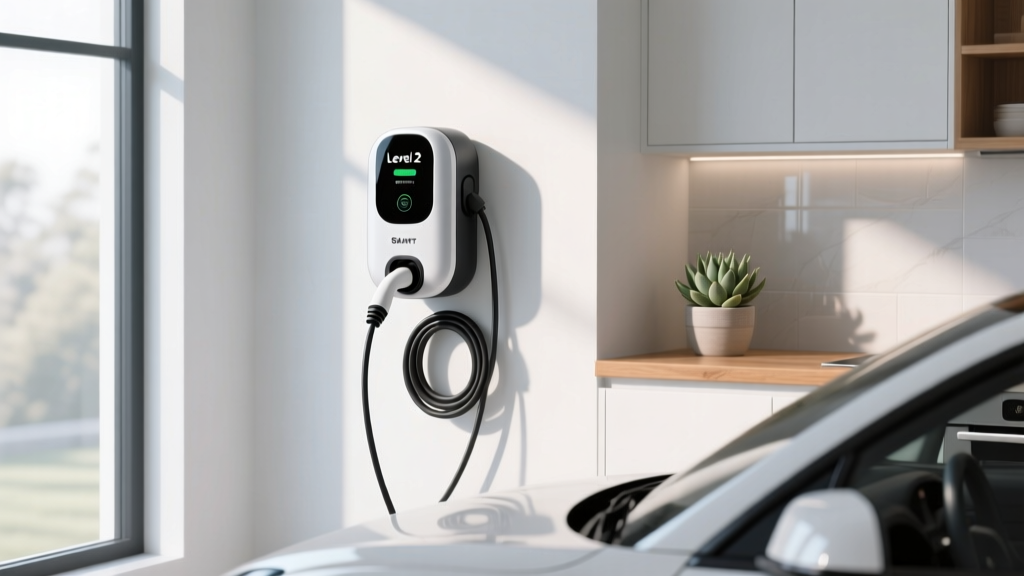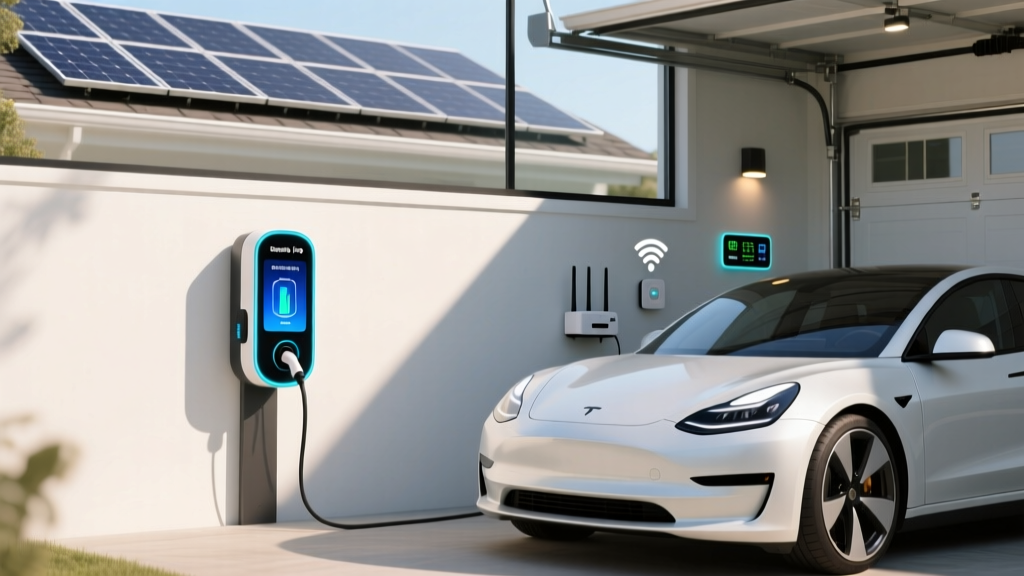
If you've ever wanted your home EV charger to talk to your solar panels and your energy monitor, the Emporia Pro EV Charger is one of the few Level 2 units built to do exactly that. Emporia, known for its whole-home energy monitoring system (the Vue), designed the Pro charger to integrate directly with that ecosystem — letting you schedule charging around solar production, off-peak utility rates, or grid-demand events.
But smart features only matter if the hardware delivers. In this guide, we break down the Emporia Pro's real-world charging performance, electrical requirements, installation costs, connector compatibility, and how it stacks up against the ChargePoint Home Flex and Wallbox Pulsar Plus for 2026 buyers.
Emporia Pro EV Charger: Core Specifications
| Spec | Emporia Pro EV Charger |
|---|---|
| Max Power Output | 11.5 kW (48A @ 240V) |
| Adjustable Amperage | 16A–48A (configurable in app) |
| Connector | J1772 (NACS adapter available); native NACS on 2026 models |
| Cable Length | 24 feet |
| Wi-Fi / Connectivity | Wi-Fi 2.4 GHz + Bluetooth |
| Smart Features | Solar-aware scheduling, TOU optimization, Emporia Vue integration, load management |
| Indoor/Outdoor Rating | NEMA 4 (indoor/outdoor) |
| Energy-Star Certified | Yes |
| Warranty | 3 years |
| MSRP (2026) | ~$599 (J1772) / ~$649 (NACS) |
At 11.5 kW, the Emporia Pro sits at the top of the residential Level 2 tier. Most EVs with onboard chargers rated at 11.5 kW or higher — including the Tesla Model Y, Hyundai Ioniq 5, Ford Mustang Mach-E, and BMW iX — will accept the full output. Vehicles with lower onboard charger limits (the base Nissan Leaf at 6.6 kW, for instance) will only draw what they can accept, so you won't damage anything by oversupplying.
Understanding Charging Levels: What Speed Are You Actually Getting?
Before evaluating any home charger, you need clarity on the three charging levels. The critical distinction: kW (kilowatts) measures power — how fast energy flows into your battery. kWh (kilowatt-hours) measures energy — the total capacity stored. Think of kW as the width of a hose and kWh as the size of the bucket.
| Level | Voltage | Power (kW) | Miles of Range Added Per Hour | Typical Use Case |
|---|---|---|---|---|
| Level 1 | 120V AC | 1.2–1.9 kW | 3–5 mi/hr | Overnight top-up; PHEVs; emergency |
| Level 2 | 240V AC | 3.3–19.2 kW | 12–75 mi/hr | Daily home charging; workplace |
| DC Fast Charge | 200–900V DC | 50–350+ kW | 150–1,000+ mi/hr | Road trips; highway corridors |
The Emporia Pro is a Level 2 charger delivering up to 11.5 kW. For a vehicle averaging 3 mi/kWh (like a Tesla Model 3 Long Range or Hyundai Ioniq 6), that translates to roughly 34 miles of range per hour of charging. A full overnight session (8 hours) adds approximately 270 miles — more than enough for most daily commutes and weekly driving.
Charging Time Examples: 10–80% SoC
Most EV owners charge between 10% and 80% state of charge (SoC) for daily use, preserving battery health by avoiding sustained 100% fills. Here's what that looks like on the Emporia Pro at full 11.5 kW output:
| Vehicle (Battery Size) | Usable kWh (10–80%) | Charge Time @ 11.5 kW |
|---|---|---|
| Tesla Model 3 LR (79 kWh) | ~55 kWh | ~4 hrs 45 min |
| Hyundai Ioniq 5 (77.4 kWh) | ~54 kWh | ~4 hrs 40 min |
| Ford F-150 Lightning Ext. Range (131 kWh) | ~92 kWh | ~8 hrs |
| Chevrolet Equinox EV (85 kWh) | ~60 kWh | ~5 hrs 15 min |
| Toyota RAV4 Prime PHEV (18.1 kWh) | ~12.7 kWh | ~1 hr 10 min |
Note: Level 2 charging is relatively linear — unlike DC fast charging, there's minimal taper below 80% SoC. You can expect consistent power delivery throughout the session.
Installation Costs: What You'll Actually Spend
The Emporia Pro's ~$599 sticker price is only part of the equation. Professional installation by a licensed electrician is mandatory for a safe, code-compliant 240V circuit — and costs vary widely depending on your home's electrical infrastructure.
| Cost Component | Simple Install (panel nearby) | Complex Install (panel upgrade / long run) |
|---|---|---|
| Emporia Pro Charger (hardware) | $599–$649 | $599–$649 |
| 60A breaker + wiring (6 AWG copper) | $200–$400 | $400–$800 |
| Electrician labor (2–4 hrs typical) | $300–$600 | $800–$2,000 |
| Permit & inspection | $50–$150 | $50–$200 |
| Electrical panel upgrade (if needed) | $0 | $1,500–$3,500 |
| Total Estimated Cost | $1,150–$1,800 | $3,350–$7,150 |
What Electrical Upgrades Might You Need?
The Emporia Pro at 48A continuous draw requires a 60A dedicated circuit (the National Electrical Code mandates that continuous loads use only 80% of a breaker's rated capacity: 48A ÷ 0.8 = 60A). Here's what your electrician will evaluate:
- Panel capacity: A 100A panel in an older home may not have headroom for a 60A EV circuit alongside existing loads (HVAC, electric range, dryer). Upgrading to a 200A panel typically costs $1,500–$3,500.
- Wire gauge: 6 AWG copper (THHN in conduit or NM-B/Romex) is standard for a 60A circuit. Longer runs (over 100 feet from panel to charger) may require 4 AWG to prevent voltage drop.
- GFCI protection: The 2023 NEC (adopted by most jurisdictions by 2026) requires GFCI protection for all EV charging outlets. Hardwired installations like the Emporia Pro often sidestep this requirement since many units include built-in ground-fault protection — but check local code.
- Load management: If your panel is near capacity, the Emporia Pro's built-in load management (when paired with the Emporia Vue monitor) can dynamically reduce charging amperage to avoid tripping the main breaker — potentially saving you a panel upgrade.
According to the U.S. Department of Energy, most homeowners spend between $1,000 and $2,500 on a complete Level 2 installation when no panel upgrade is needed.
Connector Compatibility: Will It Fit Your EV?
The North American charging connector landscape has shifted dramatically. Tesla's NACS (North American Charging Standard) has been adopted by nearly every major automaker for 2025–2026 models. Here's what you need to know:
| EV Brand (2025–2026 Models) | Native Connector | Emporia Pro Compatibility |
|---|---|---|
| Tesla (Model 3/Y/S/X) | NACS | NACS model or J1772 + Tesla adapter |
| Ford (Mach-E, F-150 Lightning) | NACS (2025+) | NACS model or J1772 + Ford-provided adapter |
| GM (Equinox EV, Blazer EV, Silverado EV) | NACS (2025+) | NACS model or J1772 + adapter |
| Hyundai/Kia (Ioniq 5/6, EV6/EV9) | CCS1 → NACS (2026+) | J1772 + CCS adapter (2025); NACS (2026) |
| Volkswagen (ID.4, ID.7) | CCS1 → NACS (2026+) | J1772 + adapter or NACS model |
| BMW (i4, i5, iX) | CCS1 → NACS (2025+) | NACS model or J1772 + adapter |
| Nissan (Leaf — legacy) | CHAdeMO | J1772 model (Level 2 only) |
Bottom line: If you're buying a 2026 EV, order the Emporia Pro with the native NACS connector. If you own a 2024–2025 CCS-equipped vehicle, the J1772 model with a CCS-to-J1772 adapter (~$100–$150) covers you — and you can swap to NACS when you upgrade vehicles.
Smart Features: Solar Integration and Energy Management
This is where the Emporia Pro differentiates from competitors like the ChargePoint Home Flex or Wallbox Pulsar Plus. If you have — or plan to install — rooftop solar, the Emporia ecosystem offers genuine advantages:
- Solar-only charging: The Emporia Vue energy monitor detects real-time solar surplus and directs only excess solar energy to the charger. You can set the car to charge exclusively on solar, ensuring zero grid draw.
- Time-of-use (TOU) optimization: Program charging to begin when your utility's off-peak rate kicks in (e.g., 11 PM–6 AM). The app syncs with many utility rate plans automatically.
- Load balancing: On a constrained panel, the charger dynamically adjusts amperage based on real-time household consumption — preventing breaker trips without requiring a panel upgrade.
- Energy tracking: Every charging session is logged with kWh consumed, cost (based on your configured rate), and solar vs. grid percentage.
If you don't have solar or an Emporia Vue, the Pro still functions as a capable Wi-Fi-connected Level 2 charger with scheduling and session tracking — but you lose the solar-aware and whole-home load-management features that justify its price premium over simpler units.
Cost to Charge: Home vs. Public vs. Gas
One of the strongest economic arguments for home Level 2 charging is cost per mile. Let's run real numbers:
| Charging Scenario | Rate ($/kWh) | Cost for 60 kWh Fill | Cost Per Mile (at 3 mi/kWh) |
|---|---|---|---|
| Home — Off-Peak TOU Rate | $0.08–$0.12 | $4.80–$7.20 | $0.027–$0.040 |
| Home — Standard Residential Avg. | $0.16 | $9.60 | $0.053 |
| Home — Solar (after payback) | ~$0.02–$0.04 | $1.20–$2.40 | $0.007–$0.013 |
| Public Level 2 (ChargePoint, etc.) | $0.25–$0.49 | $15.00–$29.40 | $0.083–$0.163 |
| DC Fast Charge (EA, Tesla Supercharger) | $0.30–$0.55 | $18.00–$33.00 | $0.100–$0.183 |
| Gasoline (30 MPG @ $3.40/gal) | — | $6.80 (per gal equiv.) | $0.113 |
At the U.S. residential average of ~$0.16/kWh (per EIA data), home charging costs roughly $0.05 per mile — about half the cost of gasoline at 30 MPG. With off-peak TOU rates or solar surplus, you can drop below $0.03/mile. Even the most expensive DC fast charging is generally competitive with or cheaper than gasoline on a per-mile basis.
Federal Tax Credit for Home Charging Equipment
The IRS §30C Alternative Fuel Vehicle Refueling Property Credit offers a 30% credit on home EV charger equipment and installation costs, capped at $1,000. To qualify:
- The charger must be installed at your primary residence.
- The property must be located in an eligible census tract (generally low-income or non-urban areas — check the IRS eligibility map).
- Equipment must be new and placed in service during the tax year.
On a $1,500 total installation (charger + electrician), a qualifying homeowner could claim a $450 credit — effectively reducing the Emporia Pro's net cost significantly.
Emporia Pro vs. ChargePoint Home Flex vs. Wallbox Pulsar Plus
| Feature | Emporia Pro | ChargePoint Home Flex | Wallbox Pulsar Plus |
|---|---|---|---|
| Max Output | 11.5 kW (48A) | 12 kW (50A) | 11.5 kW (48A) |
| Adjustable Amperage | 16–48A | 16–50A | 16–48A |
| Cable Length | 24 ft | 23 ft | 25 ft |
| Connector Options | J1772 / NACS | J1772 (NACS via adapter) | J1772 / NACS |
| Solar Integration | Yes (Vue ecosystem) | No | Yes (with Power Meter add-on) |
| Load Management | Yes (with Vue) | No | Yes (with Power Meter) |
| Wi-Fi | Yes | Yes | Yes |
| Outdoor Rating | NEMA 4 | NEMA 4 | NEMA 4 |
| Warranty | 3 years | 3 years | 3 years |
| MSRP (2026) | ~$599–$649 | ~$699 | ~$599–$649 |
Choose the Emporia Pro if: You have (or plan) rooftop solar, already use the Emporia Vue energy monitor, or want load management without buying a separate power meter. The solar-aware scheduling is genuinely useful — not a gimmick — for households generating their own electricity.
Choose the ChargePoint Home Flex if: You want the highest amperage ceiling (50A/12 kW) for future-proofing, prefer ChargePoint's established app ecosystem, or don't need solar integration. It's the most broadly recommended unit for straightforward installs.
Choose the Wallbox Pulsar Plus if: You want a compact form factor, NACS native support, and optional load management via the Wallbox Power Meter accessory. It's a strong all-rounder at a competitive price.
Safety, Code, and Installation Best Practices
EV chargers draw sustained high current for hours — making proper installation non-negotiable. Key requirements for the Emporia Pro:
- Dedicated circuit: The 60A breaker must serve only the EV charger. No shared circuits with other appliances.
- Hardwired vs. plug: The Emporia Pro is available hardwired (preferred for permanent installs, eliminates GFCI breaker requirement in many jurisdictions) or with a NEMA 14-50 plug (allows portability but requires a GFCI breaker under 2023 NEC in most areas).
- NEMA 4 rating: The Pro is rated for indoor and outdoor use, including rain and dust. It is not rated for submersion or direct hose spray — mount it under an eave or carport if possible in heavy-rain climates.
- Permit and inspection: Most jurisdictions require an electrical permit for a new 240V circuit. Your electrician should pull this; the inspection ensures the installation meets NEC and local amendments. Skipping the permit risks insurance coverage denial in the event of an electrical fire.
- Wi-Fi security: The Emporia app communicates with the charger over your home network. Use a strong Wi-Fi password and keep the charger's firmware updated — smart chargers are IoT devices and should be treated accordingly.
Frequently Asked Questions
How much does it cost to install the Emporia Pro EV charger at home?
Expect $1,150–$1,800 for a straightforward install (panel nearby, no upgrade needed) or $3,350–$7,150 if your home requires an electrical panel upgrade. The charger itself costs ~$599–$649; the remainder covers a 60A breaker, 6 AWG wiring, electrician labor, and permit fees.
How fast will the Emporia Pro charge my EV?
At its full 11.5 kW output, the Pro adds approximately 30–35 miles of range per hour for most EVs. A 10–80% charge on a 77 kWh battery (like a Hyundai Ioniq 5) takes roughly 4 hours and 40 minutes. PHEVs with smaller batteries (15–20 kWh) fill in about 1–2 hours.
Which connector do I need — NACS or J1772?
For 2025–2026 Tesla, Ford, GM, BMW, Rivian, and Volvo models: order the native NACS version. For 2024–2025 Hyundai, Kia, and VW models still equipped with CCS1: the J1772 model with a CCS adapter works, but plan to switch to NACS when your next vehicle arrives. The Nissan Leaf (CHAdeMO) uses J1772 for Level 2.
How much does home charging cost per mile compared to gas?
At the U.S. residential average of $0.16/kWh and a vehicle efficiency of 3 mi/kWh, home charging costs about $0.053 per mile. A comparable 30 MPG gas car at $3.40/gallon costs $0.113 per mile — more than double. With off-peak TOU rates ($0.08–$0.12/kWh), EV charging drops to $0.027–$0.040 per mile.
What electrical upgrades might my home need?
The most common upgrade is a panel replacement from 100A to 200A service ($1,500–$3,500) if your existing panel lacks capacity for a 60A dedicated circuit. Older homes with knob-and-tube or aluminum wiring may also need rewiring between the panel and charger location. The Emporia Pro's load-management feature (with Vue) can sometimes avoid a panel upgrade by dynamically limiting charge rate when household demand is high.
Does the Emporia Pro work without the Emporia Vue monitor?
Yes. Without the Vue, the Pro functions as a standard Wi-Fi-connected Level 2 charger with scheduling, session tracking, and app control. However, solar-aware charging, whole-home load balancing, and real-time energy surplus detection require the Vue energy monitor (~$100–$150 additional).
Is the Emporia Pro eligible for any tax credits or rebates?
The IRS §30C credit covers 30% of equipment and installation costs up to $1,000, but only for homes in eligible census tracts. Many utilities also offer rebates of $200–$500 for smart Level 2 chargers — check with your local provider. Consult a tax professional to confirm eligibility for your specific situation.