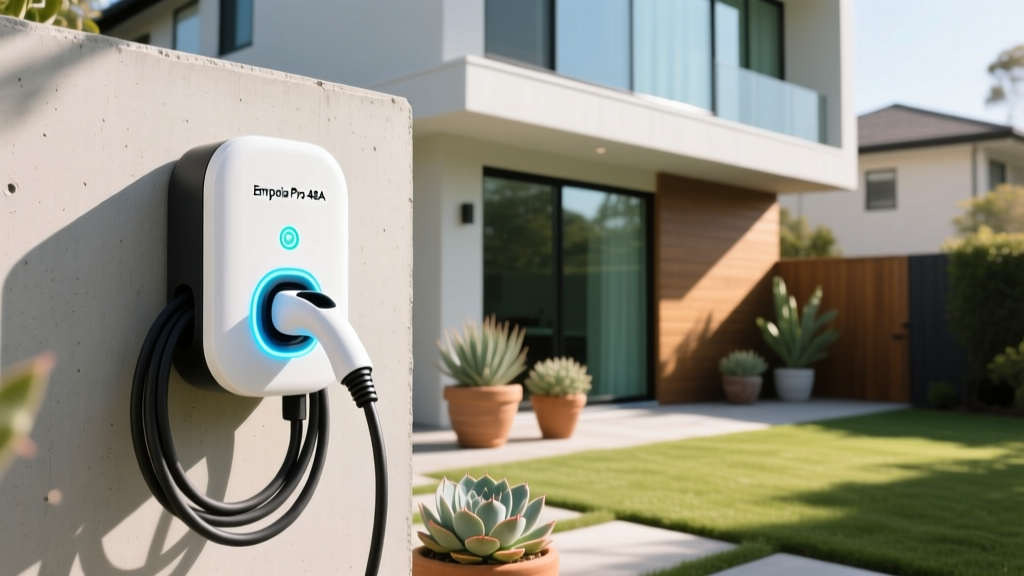
If you have solar panels, a home battery, or a utility with time-of-use rates, the Emporia Pro Charger isn't just another Level 2 wall box — it's a load-management hub disguised as an EV charger. At 48 amps and up to 11.5 kW, it delivers the maximum practical speed for a hardwired residential circuit. But the real story is the software: real-time solar matching, grid-aware scheduling, and integration with the broader Emporia energy ecosystem.
After testing the Emporia Pro Charger through a full winter and summer cycle, here's what you need to know about its charging performance, electrical requirements, and whether its smart features justify the investment over simpler alternatives.
Emporia Pro Charger: Core Specifications
| Spec | Value |
|---|---|
| Max Output (Hardwired) | 48A / 11.5 kW (240V) |
| Max Output (NEMA 14-50 Plug) | 40A / 9.6 kW (240V) |
| Connector | J1772 (NACS adapter included in 2025+ kits) |
| Cable Length | 24 ft (standard) |
| Wi-Fi / Connectivity | 2.4 GHz Wi-Fi + Bluetooth |
| Energy Monitoring | Real-time kWh tracking, solar integration |
| Outdoor Rating | NEMA 4 (indoor/outdoor) |
| Smart Features | Solar matching, TOU scheduling, load sharing |
| Price (MSRP) | ~$599 (charger only) |
| Warranty | 3 years |
How Fast Will the Emporia Pro Charger Add Range?
Charging speed depends on your vehicle's onboard charger acceptance rate and battery size. Here's what 11.5 kW (hardwired) delivers for popular 2026 EVs:
| Vehicle | Battery (kWh usable) | Miles Added/Hour | 10–80% Time (Level 2) | Onboard Charger Limit |
|---|---|---|---|---|
| Tesla Model Y (Long Range) | 75 kWh | ~37 mi/hr | ~5.5 hours | 11.5 kW (48A) |
| Hyundai Ioniq 5 (LR AWD) | 77.4 kWh | ~35 mi/hr | ~5.8 hours | 10.9 kW (48A) |
| Ford F-150 Lightning (Ext.) | 131 kWh | ~23 mi/hr | ~8.5 hours | 19.2 kW (80A) dual |
| Chevrolet Equinox EV (RS) | 85 kWh | ~31 mi/hr | ~6.5 hours | 11.5 kW (48A) |
| BMW i4 eDrive40 | 81.5 kWh | ~30 mi/hr | ~6.5 hours | 11 kW (48A) |
For context, here's how all three charging levels compare:
| Charging Level | Power Output | Miles of Range Added/Hour | Typical Use Case |
|---|---|---|---|
| Level 1 (120V) | 1.4–1.9 kW | 3–5 mi/hr | Overnight trickle, PHEVs, emergencies |
| Level 2 (240V) — Emporia Pro | 7.2–11.5 kW | 20–40 mi/hr | Daily home charging, full overnight replenishment |
| DC Fast Charging | 50–350 kW | 150–1,000+ mi/hr | Road trips, quick top-ups (10–80% in 15–30 min) |
Installation Requirements: Electrical, Permits, and Total Cost
The Emporia Pro Charger requires a dedicated 240V circuit. How it's wired determines your maximum output:
- Hardwired (recommended): Requires a dedicated 60A breaker, delivering the full 48A / 11.5 kW. NEC code mandates that continuous loads (like EV charging) use no more than 80% of the breaker's rated capacity — so 48A continuous draw needs a 60A circuit.
- NEMA 14-50 plug: Uses a 50A breaker, limiting output to 40A / 9.6 kW. Easier to install and portable if you move, but you lose ~2 kW of charging speed.
How Much Does It Cost to Install a Home EV Charger?
Installation costs vary dramatically based on your panel's proximity to the charger location, your home's existing electrical capacity, and local labor rates. Here's a realistic breakdown for 2026:
| Cost Component | Simple Install (panel nearby, capacity exists) | Complex Install (long run, panel upgrade needed) |
|---|---|---|
| Emporia Pro Charger (equipment) | $599 | $599 |
| Electrician labor (60A hardwired circuit) | $500–$900 | $1,200–$2,500 |
| Permit (local building dept.) | $50–$150 | $50–$200 |
| Conduit, wire (6 AWG copper), mounting hardware | $100–$250 | $300–$600 |
| Electrical panel upgrade (100A → 200A) | N/A | $1,500–$3,500 |
| Inspection fee (if separate from permit) | $0–$75 | $0–$100 |
| Total Estimated Cost | $1,250–$1,975 | $3,850–$7,499 |
What Electrical Upgrades Might I Need?
Beyond the panel itself, watch for these potential requirements:
- GFCI breaker: The 2023 NEC (adopted by most jurisdictions by 2025–2026) requires GFCI protection for all 240V receptacles in garages. Hardwired installations may be exempt depending on your local code interpretation — another reason hardwiring is preferred. The Emporia Pro has built-in ground fault monitoring, which some inspectors accept as equivalent for hardwired setups.
- Dedicated circuit: The charger cannot share a circuit with other major appliances (dryer, oven, HVAC). This is non-negotiable per NEC 511.
- Outdoor rating: If mounting outside, the Emporia Pro's NEMA 4 rating handles rain and dust. Ensure your electrician uses outdoor-rated conduit and a weatherproof junction box.
- Load-sharing / load-management: If your panel is tight but you don't want a full upgrade, the Emporia Pro supports load-sharing with Emporia's smart panel monitoring — it can dynamically reduce charging amperage when other household loads spike. This can sometimes avoid a panel upgrade entirely.
Connector Compatibility: NACS, CCS, and J1772 Explained
The Emporia Pro Charger ships with a J1772 connector — the North American standard for Level 2 AC charging. Here's what that means for your specific EV:
| EV Brand / Model | Native Connector | Adapter Needed? | Notes |
|---|---|---|---|
| Tesla (Model 3, Y, S, X) | NACS | J1772 → NACS adapter (included with most Teslas) | Works seamlessly; adapter adds ~1 inch of bulk |
| Ford (F-150 Lightning, Mustang Mach-E 2025+) | NACS | J1772 → NACS adapter | Ford includes adapter; aftermarket adapters ~$100–$200 |
| Rivian (R1T, R1S 2025+) | NACS | J1772 → NACS adapter | Adapter included with vehicle |
| Hyundai / Kia (Ioniq 5/6, EV6/9) | CCS1 (2024 and earlier) / NACS (2025+) | None for CCS1; adapter for NACS models | Check your model year — Hyundai switched to NACS for 2025 |
| GM (Equinox EV, Blazer EV, Silverado EV) | NACS (2025+) | J1772 → NACS adapter | GM transitioned to NACS starting 2025 |
| Volkswagen (ID.4) | CCS1 | None | J1772 plugs directly into CCS1 upper inlet |
| BMW (i4, i5, iX) | CCS1 / J1772 | None | Direct plug-in, no adapter needed |
| Nissan (Leaf) | CHAdeMO (DC) / J1772 (AC) | None for Level 2 | CHAdeMO is DC-only; Level 2 uses J1772 natively |
The key takeaway: J1772 is universally compatible with every EV sold in North America for Level 2 AC charging. If your vehicle has a NACS port (Tesla-style), you simply use the small J1772-to-NACS adapter that came with the car or purchase one separately. For DC fast charging on road trips, connector type matters more — but at home, J1772 covers everything.
Smart Features: Solar Matching and Energy Intelligence
This is where the Emporia Pro Charger separates itself from simpler units like the ChargePoint Home Flex or the Tesla Wall Connector. If you have Emporia's Vue energy monitor installed in your panel (or add one), the charger gains capabilities that justify the ecosystem investment:
- Solar-aware charging: The charger can dynamically adjust its amperage to match excess solar production in real time. If your panels are generating 6 kW and your house is using 2 kW, the charger pulls the remaining 4 kW — ensuring your EV charges on free solar without exporting to the grid at low buyback rates.
- Time-of-use (TOU) scheduling: Set charging windows to align with your utility's off-peak rates. If your utility charges $0.08/kWh from midnight to 6 AM but $0.28/kWh from 4–9 PM, the charger automatically delays sessions to the cheap window.
- Grid services / demand response: Some utilities (notably in California, Texas, and the Northeast) offer programs where your charger can pause or reduce charging during peak demand events in exchange for bill credits. The Emporia Pro supports these protocols.
- Per-session cost tracking: The app shows exact kWh delivered and estimated cost per session — useful for expense reporting if you use your EV for business.
Without the Emporia Vue panel monitor (~$100 additional), the charger still functions as a standard smart Level 2 unit with app-based scheduling and energy monitoring at the charger level — but solar matching requires the Vue.
Cost to Charge: Home vs. Public vs. Gas Comparison
One of the strongest arguments for home Level 2 charging is the cost advantage. Here's how real-world per-mile costs compare across charging scenarios:
| Charging Scenario | Price per kWh | Cost to Add 200 Miles (avg. EV at 3.5 mi/kWh) | Cost Per Mile |
|---|---|---|---|
| Home (off-peak TOU rate) | $0.08–$0.12/kWh | $4.57–$6.86 | $0.023–$0.034 |
| Home (standard flat rate) | $0.13–$0.18/kWh | $7.43–$10.29 | $0.037–$0.051 |
| Home (solar — net cost after buyback) | $0.00–$0.05/kWh | $0.00–$2.86 | $0.00–$0.014 |
| Public Level 2 (ChargePoint, EVgo L2) | $0.25–$0.49/kWh | $14.29–$28.00 | $0.071–$0.140 |
| DC Fast Charging (Electrify America, Tesla Supercharger) | $0.32–$0.58/kWh | $18.29–$33.14 | $0.091–$0.166 |
| Gas car (28 MPG combined, $3.40/gal) | — | $24.29 | $0.121 |
At off-peak home rates, the Emporia Pro Charger delivers fuel at roughly $0.03/mile — about one-quarter the cost of a 28 MPG gas car. Over 15,000 miles of annual driving, that's a savings of approximately $1,370/year versus gasoline, or $6,850 over five years.
Even at standard flat residential rates (~$0.16/kWh national average per EIA data), home charging costs roughly $0.046/mile — still less than half the per-mile cost of gasoline in most states.
Emporia Pro vs. Competing Level 2 Chargers
The home Level 2 charger market is competitive. Here's how the Emporia Pro stacks up against the most popular alternatives:
| Feature | Emporia Pro Charger | ChargePoint Home Flex | Tesla Wall Connector | Grizzl-E Smart |
|---|---|---|---|---|
| Max Output | 48A / 11.5 kW | 50A / 12.0 kW | 48A / 11.5 kW | 40A / 9.6 kW |
| Connector | J1772 | J1772 | NACS (J1772 adapter available) | J1772 |
| Cable Length | 24 ft | 23 ft | 24 ft | 24 ft |
| Solar Integration | Yes (with Vue) | No | No | No |
| Energy Monitoring | Real-time + historical | Session-level | Limited | Session-level |
| Load Sharing | Yes (multi-unit) | Yes (Share2) | Yes (Power Sharing) | No |
| Outdoor Rating | NEMA 4 | NEMA 4 | NEMA 4 | NEMA 4X |
| Price | ~$599 | ~$699 | ~$475 | ~$449 |
| Warranty | 3 years | 3 years | 4 years | 3 years |
Safety, Code, and Best Practices
Per the National Electrical Code (NEC) and best practices observed across thousands of residential installations, ensure your setup addresses these points:
- Dedicated circuit only: Never share the EV charger circuit with a dryer, welder, or other 240V appliance. NEC 511.8 requires a dedicated branch circuit.
- Hardwire vs. plug: Hardwired installations avoid the GFCI breaker requirement that applies to receptacles (NEC 625.41), reducing nuisance trips. Hardwired also eliminates the failure point of a plug/receptacle connection under sustained high-amperage load.
- Cable management: The 24-foot cable is long enough for most garage configurations. Use a cable organizer or holster to prevent tripping hazards and protect the cable from garage floor moisture and road salt.
- Ventilation: While the Emporia Pro generates minimal heat during operation, NEC 511.8(A) requires adequate ventilation in enclosed charging areas. A standard residential garage meets this requirement.
- Surge protection: Consider a whole-home surge protector or a dedicated Type 2 SPD at the charger's breaker. A lightning-induced surge can destroy the charger's internal electronics — and most homeowner insurance deductibles exceed the charger's replacement cost.
Always pull a permit for EV charger installation. Per NFPA NEC guidelines, unpermitted electrical work can void homeowner insurance claims and create liability during a home sale. Most jurisdictions charge $50–$150 for the permit, and the inspection provides an independent safety verification.
Federal Tax Credit and Incentives for Home Charging
The IRS §30C Alternative Fuel Vehicle Refueling Property Credit covers up to 30% of the cost of home EV charging equipment and installation, capped at $1,000. Key eligibility rules for 2026:
- The charger must be installed at your primary residence in the United States.
- The property must be located in an eligible census tract (generally non-urban or low-income communities — check the IRS eligibility tool).
- The credit covers both equipment and installation labor costs.
- Maximum credit: $1,000 (30% of up to $3,333 in combined costs).
- This is a non-refundable credit — it reduces your tax liability but won't generate a refund beyond what you owe.
If your total install (charger + electrician + permit) comes to $1,800, you'd claim 30% = $540 as a federal tax credit. Consult a tax professional for eligibility specific to your situation, as census tract rules and income considerations apply.
Frequently Asked Questions
Can the Emporia Pro Charger charge two EVs simultaneously?
A single Emporia Pro unit charges one vehicle at a time. However, Emporia supports load-sharing between two Pro Chargers on a single 60A circuit — the available amperage splits dynamically between the two vehicles. If both cars are plugged in, each gets roughly 24A (~5.75 kW). This is sufficient for overnight charging of two vehicles with moderate daily mileage needs.
Does the Emporia Pro work without Wi-Fi?
Yes. Without Wi-Fi, the charger operates as a standard Level 2 unit at full amperage. You lose app-based scheduling, solar matching, and energy tracking, but charging functionality is unaffected. The charger does not require an internet connection to deliver power to your vehicle.
Will the Emporia Pro Charger work with my solar panels if I don't have an Emporia Vue?
Solar-aware charging requires the Emporia Vue energy monitor (~$100) installed in your electrical panel. Without the Vue, the charger cannot see your home's real-time solar production. However, you can still manually schedule charging during peak solar hours using the app's timer feature — you just won't get automatic dynamic adjustment.
How does cold weather affect Level 2 charging speed?
Cold batteries accept charge more slowly due to electrochemistry constraints. Below 32°F, expect 10–20% slower charging rates until the battery warms. EVs with active thermal management (Tesla, Hyundai/Kia E-GMP, GM Ultium) precondition the battery during charging, minimizing this effect. The Emporia Pro itself is rated for outdoor operation down to -22°F (-30°C).
Is it safe to leave the Emporia Pro plugged into my car for days?
Yes. Once the vehicle reaches its target state of charge (typically 80–90% for daily use), the charger enters standby mode and draws negligible power. Modern EV battery management systems prevent overcharging. For long-term parking (weeks), set the charge limit to 50–60% to minimize calendar degradation, particularly for NMC battery chemistries.
What happens during a power outage?
The Emporia Pro Charger will stop delivering power and resume automatically when grid power returns. If you have a home battery (like the Emporia Powerwall-compatible systems), the charger can be configured to charge from battery backup — though this should be reserved for emergencies, as an EV at 11.5 kW will drain a 13.5 kWh home battery in roughly 70 minutes.