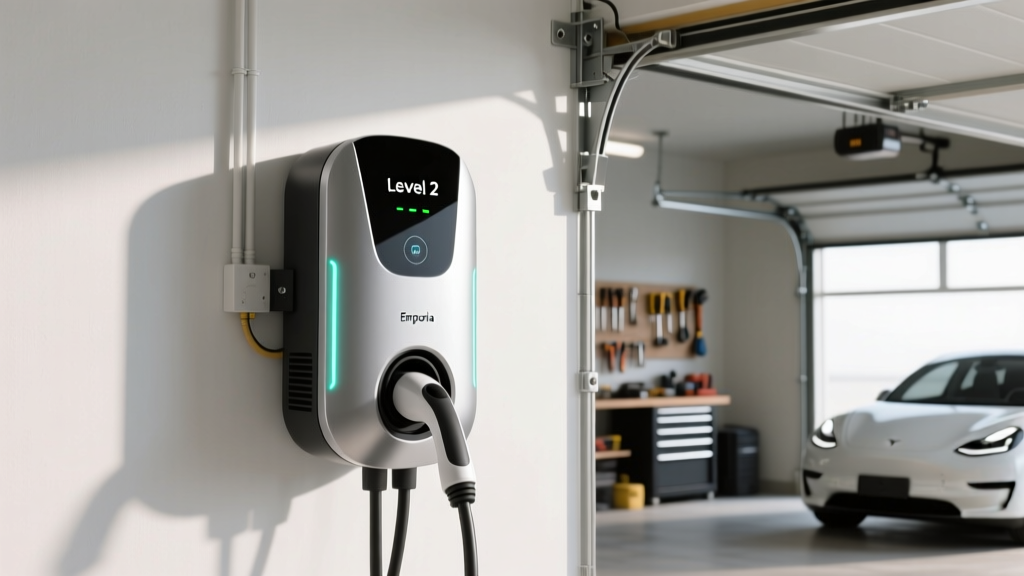
If you own an EV or plug-in hybrid in 2026, the single biggest upgrade to your daily ownership experience isn't a software update — it's a proper Level 2 home charger. The Emporia EV Charger Level 2 has emerged as one of the most discussed units in the smart-home EV space, combining a sub-$400 price point with deep energy monitoring, solar-aware scheduling, and a native NACS (Tesla-style) connector. But hardware is only half the equation. Installation costs, electrical panel capacity, and your home's wiring dictate what you actually get out of the box.
This guide covers the Emporia Level 2 charger in full context: what it outputs, what your house needs to support it, what installation really costs, and how it stacks up against rivals like the ChargePoint Home Flex, Wallbox Pulsar Max, and Tesla Wall Connector.
Emporia EV Charger Level 2: Spec Snapshot
Before we get into installation logistics, here are the hard numbers on the Emporia unit itself. Note that kW (kilowatts) measures power — the rate of energy delivery — while kWh (kilowatt-hours) measures energy capacity, the size of your battery. Confusing these two is the most common EV literacy mistake; we'll keep them strictly separated throughout this guide.
| Specification | Value |
|---|---|
| Max Power Output | 11.5 kW (48 amps on 60A circuit) |
| Voltage | 240V (hardwired) or 208–240V (NEMA 14-50 plug) |
| Connector | NACS (native Tesla); J1772 adapter included for legacy CCS1 EVs |
| Cable Length | 24 feet |
| Wi-Fi / Smart Features | Yes — Emporia app, solar integration, TOU scheduling, energy monitoring |
| Indoor/Outdoor Rating | NEMA 4 (indoor/outdoor, weather-resistant) |
| Energy Star Certified | Yes |
| Warranty | 3 years |
| MSRP (2026) | $399 (charger only) |
The 11.5 kW output is significant: it matches the onboard charger ceiling of most 2026 EVs, including the Tesla Model Y, Hyundai Ioniq 5, Ford Mustang Mach-E, and Rivian R1S. Vehicles with smaller onboard chargers (many PHEVs cap at 6.6–7.2 kW) won't pull the full 11.5 kW, but they'll still charge at their maximum rate.
Charging Levels Explained: Speeds in kW and Miles Per Hour
To understand why the Emporia Level 2 is the sweet spot for home use, it helps to compare all three charging tiers EV drivers actually encounter.
| Level | Voltage | Typical Power (kW) | Miles of Range Added Per Hour | Typical Use Case |
|---|---|---|---|---|
| Level 1 | 120V AC | 1.2–1.9 kW | 3–5 mi/hr | Emergency / PHEV overnight top-up |
| Level 2 | 240V AC | 7.2–11.5 kW | 25–45 mi/hr | Home daily charging (Emporia lives here) |
| DC Fast Charge | 400–800V DC | 50–350 kW | 150–1,000+ mi/hr (peak) | Road trips, 10–80% in 18–40 min |
A few real-world notes on these figures:
- Level 1 is the included mobile cord plugged into a standard household outlet. It's fine for PHEVs with 30–40 miles of electric range, but a 75 kWh BEV battery would take 40+ hours from empty — impractical for daily use.
- Level 2 at 11.5 kW (the Emporia's ceiling) will fully replenish a 75 kWh battery in roughly 7 hours — perfect for overnight charging during off-peak utility rates.
- DC Fast Charging bypasses the car's onboard charger and pushes DC directly into the battery. Peak kW rates apply only in the 10–50% State of Charge (SoC) window; charging tapers significantly above 80% to protect battery health. A Tesla Model Y Long Range (75 kWh, NMC battery) can accept up to 250 kW at a V4 Supercharger, reaching 10–80% in ~18 minutes. An Ioniq 5 with its 800V architecture peaks at 240 kW for a 10–80% time of ~18 minutes as well.
Electrical Requirements: What Your Home Needs
The Emporia EV Charger Level 2 offers two installation paths, each with different electrical demands:
Hardwired Installation (Recommended)
- Circuit required: Dedicated 60-amp, 240V circuit
- Wire gauge: 6 AWG copper (or 4 AWG aluminum for longer runs)
- Delivers: Full 48 amps / 11.5 kW continuous output
- Code note: EV chargers are considered continuous loads under NEC Article 625, so the circuit must be rated at 125% of the charger's draw — hence a 60A breaker for a 48A charger.
NEMA 14-50 Plug-In Installation
- Circuit required: Dedicated 50-amp, 240V circuit
- Delivers: Up to 40 amps / 9.6 kW (NEC limits plug-in continuous loads to 80% of breaker rating)
- Trade-off: You lose ~1.9 kW of output compared to hardwired, but gain portability if you move homes.
How Much Does It Cost to Install a Home EV Charger?
Installation costs vary enormously based on your panel location, run distance, and whether an upgrade is needed. Here's a realistic breakdown for the Emporia Level 2 in 2026:
| Cost Component | Best Case (Short Run, 200A Panel) | Typical Case | Worst Case (Panel Upgrade + Long Run) |
|---|---|---|---|
| Emporia Charger Unit | $399 | $399 | $399 |
| Electrician Labor (2–6 hours @ $85–$150/hr) | $170 | $450 | $900 |
| Materials (wire, conduit, breaker, junction box) | $80 | $200 | $450 |
| Permit Fee | $50 | $125 | $200 |
| Panel Upgrade (if needed) | $0 | $0 | $2,500 |
| Total Installed Cost | $699 | $1,174 | $4,449 |
For context, the IRS §30D tax credit applies to the vehicle, not the charger itself. However, the separate §30C Alternative Fuel Vehicle Refueling Property Credit covers up to 30% of home charger equipment and installation costs (capped at $1,000), subject to income limits and census-tract eligibility. Check irs.gov for current eligibility maps — many suburban and rural tracts qualify, while most urban tracts do not.
What Electrical Upgrades Might I Need?
Beyond a panel upgrade, common pre-installation discoveries include:
- No available breaker slots: Your panel may be full, requiring a tandem breaker swap or sub-panel addition ($200–$600).
- Aluminum wiring in older homes: Requires larger-gauge wire and specific connectors rated for aluminum-to-copper transitions.
- Grounding deficiencies: Pre-1970 homes may lack a proper ground rod, requiring an electrician to install one ($150–$400).
- GFCI breaker requirement: NEC 2023 and later requires GFCI protection for 240V EV receptacles (NEMA 14-50). Hardwired installations are exempt from this specific GFCI requirement, which is another reason hardwired is preferred.
Connector Compatibility: NACS, CCS1, and Adapter Needs
The 2026 charging landscape has consolidated heavily around NACS (North American Charging Standard), the connector Tesla originated and which Ford, GM, Rivian, Hyundai, Kia, and most other automakers have adopted for new vehicles starting in the 2025–2026 model years.
| Connector Type | Vehicles (2026 Examples) | Emporia Compatibility |
|---|---|---|
| NACS (Tesla native) | Tesla Model Y/3/S/X, Ford F-150 Lightning (2025+), GM Ultium vehicles (2025+), Hyundai Ioniq 5 (2025+ refresh), Rivian R1S/R1T (2025+) | Native — plug directly in |
| CCS1 (legacy) | 2024 and earlier Ford Mach-E, VW ID.4, BMW i4, older Hyundai/Kia BEVs | NACS-to-CCS1 adapter required (Emporia includes a J1772 adapter; CCS1 adapters available from Tesla and third parties, $150–$250) |
| CHAdeMO | Nissan Leaf (discontinued 2025), Mitsubishi Outlander PHEV (older model years) | Not directly compatible — CHAdeMO adapters are rare and expensive; consider a dedicated J1772 charger if you own a CHAdeMO vehicle |
| J1772 (legacy Level 2) | All pre-2025 BEVs/PHEVs with non-Tesla ports | Emporia includes a NACS-to-J1772 adapter in the box |
If you're buying a 2026 model-year EV from a major manufacturer, it almost certainly has a NACS port, making the Emporia a native fit. If you're charging a 2023–2024 model with CCS1, factor in the adapter cost and the slight inconvenience of an extra connection step.
Real-World Charging Times: Emporia vs. Common EV Batteries
Here's how long the Emporia Level 2 at full 11.5 kW output takes to charge popular 2026 EVs from 10% to 80% State of Charge:
| Vehicle | Usable Battery (kWh) | Energy Needed (10–80%) | Time at 11.5 kW |
|---|---|---|---|
| Tesla Model Y Long Range | 75 kWh (NMC) | 52.5 kWh | ~4 hrs 35 min |
| Hyundai Ioniq 5 (2026 NACS refresh) | 77.4 kWh (NMC) | 54.2 kWh | ~4 hrs 43 min |
| Ford F-150 Lightning Extended Range | 131 kWh (NMC) | 91.7 kWh | ~7 hrs 59 min |
| Chevrolet Equinox EV | 85 kWh (NMC) | 59.5 kWh | ~5 hrs 10 min |
| Toyota RAV4 Prime (PHEV) | 18.1 kWh (NMC) | 12.7 kWh | ~1 hr 6 min |
Note that onboard charger limits matter: the RAV4 Prime, for example, accepts only 6.6 kW on Level 2, so it would take roughly 1 hour 55 minutes on the Emporia regardless of the charger's 11.5 kW capability. Always check your vehicle's onboard charger spec on fueleconomy.gov.
Cost to Charge: Home vs. Public vs. Gas Per Mile
The economics of home Level 2 charging are where the Emporia pays for itself. Here's a cost-per-mile comparison using 2026 national averages:
| Scenario | Rate | Vehicle Efficiency | Cost Per Mile |
|---|---|---|---|
| Home Level 2 (off-peak TOU rate) | $0.09/kWh | 3.5 mi/kWh (typical BEV) | $0.026/mi |
| Home Level 2 (standard residential avg) | $0.16/kWh | 3.5 mi/kWh | $0.046/mi |
| Public Level 2 (ChargePoint, EVgo, etc.) | $0.35/kWh | 3.5 mi/kWh | $0.100/mi |
| DC Fast Charging (Electrify America, Supercharger) | $0.48/kWh | 3.5 mi/kWh | $0.137/mi |
| Gasoline (28 MPG combined, $3.40/gal) | $3.40/gal | 28 mi/gal | $0.121/mi |
At off-peak home rates, the Emporia delivers fueling at roughly one-fifth the cost of gasoline per mile. Even at standard residential rates without time-of-use optimization, you're paying less than half what a 28 MPG gas car costs per mile. Over 12,000 miles/year, the savings range from $1,140 (off-peak home) to $570 (standard residential) compared to gasoline.
The Emporia's built-in energy monitoring lets you track exactly how many kWh each charging session uses and, when paired with your utility's TOU plan, schedule charging to the cheapest overnight window.
Equipment Comparison: Emporia vs. Competing Level 2 Chargers
The Emporia doesn't exist in a vacuum. Here's how it stacks up against the other leading smart Level 2 chargers in 2026:
Emporia EV Charger Level 2
- Max Output: 11.5 kW / 48A
- Connector: NACS native (J1772 adapter included)
- Cable: 24 ft
- Smart Features: Energy monitoring, solar integration, TOU scheduling, Emporia Vue panel integration
- Price: $399
- Best For: Homeowners with Emporia Vue energy monitors, solar panel owners, budget-conscious buyers wanting NACS native
Tesla Wall Connector
- Max Output: 11.5 kW / 48A
- Connector: NACS native
- Cable: 24 ft
- Smart Features: Wi-Fi, OTA updates, Tesla app integration, power sharing between two units
- Price: $475
- Best For: Tesla-only households wanting seamless ecosystem integration
ChargePoint Home Flex
- Max Output: 12 kW / 50A (configurable down to 16A)
- Connector: J1772 native (NACS adapter required for post-2024 vehicles)
- Cable: 23 ft
- Smart Features: ChargePoint app, Alexa, flexible amperage settings
- Price: $699
- Best For: Mixed-fleet households with older J1772/CCS1 vehicles, users wanting adjustable amperage
Wallbox Pulsar Max
- Max Output: 11.5 kW / 48A
- Connector: Available in NACS or J1772 variants
- Cable: 25 ft
- Smart Features: myWallbox app, solar charging mode, Eco-Smart mode
- Price: $649
- Best For: Design-conscious buyers, solar integration without Emporia Vue dependency
The Emporia's standout advantage is its deep integration with the Emporia Vue whole-home energy monitor ($100 add-on). If you already have a Vue installed, the EV charger can dynamically adjust its power draw based on your home's real-time consumption, preventing breaker trips when the dryer, oven, and EV charger run simultaneously. This is a genuine differentiator for homes with tight panel headroom.
Safety, Code, and Best Practices
Any Level 2 charger installation in the U.S. must comply with NEC Article 625 (Electric Vehicle Charging System Equipment) and your local jurisdiction's amendments. Key requirements:
- Dedicated circuit: The EV charger must have its own breaker — no sharing with other outlets or appliances.
- Permit and inspection: Virtually all jurisdictions require an electrical permit for a new 240V circuit. The installation must pass inspection before the utility will note it (some utilities require inspection proof for TOU rate enrollment).
- Outdoor rating: The Emporia's NEMA 4 rating covers rain, snow, and hose-directed water. It is safe for outdoor mounting but should be installed under an eave or carport when possible to reduce UV exposure and ice buildup on the connector.
- Cable management: NEC requires that the charging cable not create a trip hazard. If your parking spot is far from the mount point, consider a cable retracting system or holster.
- Wi-Fi signal: The Emporia relies on 2.4 GHz Wi-Fi for smart features. Garages with thick concrete walls or metal siding may need a Wi-Fi extender. Without connectivity, the charger still functions as a dumb Level 2 unit but loses scheduling and monitoring.
Frequently Asked Questions
How much does it cost to install a home EV charger?
For the Emporia EV Charger Level 2, expect $700–$1,200 total (charger + electrician + permit) if your electrical panel has capacity. If a 200A panel upgrade is needed, total costs can reach $3,500–$4,500. Always get a load calculation from a licensed electrician before committing.
How fast will each charging level add range?
Level 1 (120V) adds 3–5 miles per hour. Level 2 at 11.5 kW (Emporia) adds 35–45 miles per hour depending on vehicle efficiency. DC Fast Charging adds 150–1,000+ miles per hour at peak, but tapers above 80% SoC. For daily driving needs of 30–50 miles, a Level 2 charger replenishes your daily use in under 90 minutes.
Which connector/charger is compatible with my EV?
If your EV is a 2025 or newer model from Tesla, Ford, GM, Hyundai, Kia, or Rivian, it likely has a NACS port — the Emporia plugs in natively. For 2024 and older non-Tesla EVs with CCS1/J1772 ports, you'll need an adapter (Emporia includes a J1772 adapter; CCS1 adapters are sold separately). CHAdeMO vehicles (older Nissan Leafs) are not well served by NACS chargers.
How much does charging cost per mile vs gas?
At home off-peak rates ($0.09/kWh), EV charging costs roughly $0.026/mile — about one-fifth the cost of gasoline at $3.40/gal in a 28 MPG car ($0.121/mile). Even at public DC fast charging rates ($0.48/kWh), EVs cost $0.137/mile, slightly more than gas but only for road-trip scenarios.
What electrical upgrades might I need?
The most common and costly upgrade is a panel upgrade from 100A to 200A ($1,500–$3,500) if your existing panel lacks capacity. Other potential needs include adding breaker slots via a sub-panel ($200–$600), installing a ground rod for pre-1970 homes ($150–$400), or upgrading wire gauge for long conduit runs over 100 feet.
Does the Emporia charger qualify for any tax credits?
The charger itself may qualify for the §30C Alternative Fuel Vehicle Refueling Property Credit, which covers 30% of equipment and installation costs up to $1,000. Eligibility depends on your income and whether your home is in a qualifying census tract. The IRS §30C page has the current tract map. Note: this is separate from the §30D new-vehicle credit.
Can the Emporia charger work with solar panels?
Yes — this is one of the Emporia's strongest features. When paired with an Emporia Vue energy monitor and a solar inverter, the charger can be set to charge only using excess solar production, effectively fueling your EV for free during sunny hours. The app lets you set a "solar only" schedule or blend grid and solar based on your preference.
Verdict: Who Should Buy the Emporia EV Charger Level 2?
The Emporia EV Charger Level 2 is the right pick if you want a native NACS charger under $400 with genuine smart-home energy integration — especially if you have solar panels or already use the Emporia Vue ecosystem. Its 11.5 kW / 48A output matches the onboard charger limits of most 2026 EVs, and its NEMA 4 outdoor rating and 24-foot cable cover most garage and driveway setups.
It's not the right pick if you own a pre-2025 EV with a CCS1/J1772 port and don't want to deal with adapters (the ChargePoint Home Flex with its native J1772 connector is a cleaner fit). It also isn't ideal if your garage has no Wi-Fi coverage and you want smart scheduling — in that case, the Tesla Wall Connector's offline scheduling capability or a simple "dumb" charger like the Grizzl-E Smart may serve better.
Regardless of which unit you choose, budget realistically for installation, get a professional load calculation, and pull the required permits. A properly installed Level 2 charger is the single highest-impact upgrade to EV ownership satisfaction — and the Emporia delivers that upgrade at one of the lowest entry prices in the smart-charger category.