If you own two electric vehicles and a single 240V circuit, a dual-port Level 2 charger — sometimes searched as a "2 dr charger" for its two-door, two-car garage use case — is the most practical way to keep both batteries full without paying an electrician for a second dedicated line. The Emporia Vue 2 (Dual Charger) has emerged as one of the most capable and affordable options in this niche, offering up to 48 amps of shared output across two connectors with smart load management.
This guide breaks down the Emporia dual-port charger's specs, installation requirements, connector compatibility, and real-world charging times — and compares it to the broader landscape of home Level 2 charging so you can decide whether a shared dual-port unit or two independent chargers is the right call for your garage.
What Is a Dual-Port ("2 DR") EV Charger and Who Needs One?
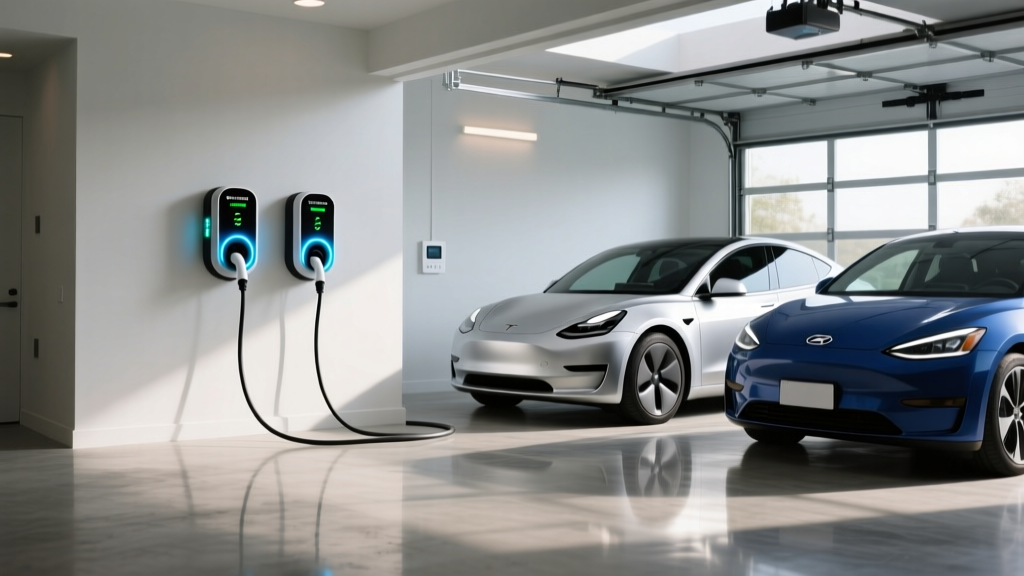
A dual-port Level 2 charger delivers 240V AC power to two EV connectors from a single hardwired circuit. The "2 dr" shorthand — short for "two-door" garage or "dual-rail" — reflects the most common installation scenario: two EVs parked side by side in a residential garage, each plugged into one port of the same unit.
The primary advantage is electrical simplicity. Instead of running two separate 240V/50A circuits (which may require a panel upgrade), a dual-port charger with load-sharing logic splits a single 60A circuit between two vehicles. When one car is plugged in, it gets the full available current. When both are plugged in, the charger intelligently divides the amperage so neither port exceeds the circuit's capacity.
This matters for homes with older 100A or 125A electrical panels where adding two dedicated EV circuits could push total demand past the panel's rating — triggering a $1,500–$3,500 service upgrade to 200A. A single 60A circuit for a dual-port charger is far more feasible for most panels.
Charging Levels Explained: Speeds in kW and Miles Per Hour
Before evaluating any charger, it's critical to understand the three EV charging levels and what they deliver in real terms. Remember: kW (kilowatts) measures power — how fast energy flows — while kWh (kilowatt-hours) measures energy — the total capacity of your battery. Confusing them is the most common EV literacy mistake.
| Level | Voltage | Max Power (kW) | Miles of Range Added Per Hour | Typical Use Case |
|---|---|---|---|---|
| Level 1 | 120V AC | 1.4–1.9 kW | 3–5 mi/hr | Overnight trickle; PHEVs with small batteries |
| Level 2 | 240V AC | 3.3–19.2 kW | 12–75 mi/hr | Home daily charging; destination charging |
| DC Fast Charge | 400–900V DC | 50–350 kW | 150–1,000+ mi/hr | Highway road trips; commercial fleets |
The Emporia 2 DR charger operates at Level 2, delivering up to 11.5 kW (48A × 240V) when one vehicle is charging alone, or splitting to roughly 5.75 kW per port (24A each) when both vehicles charge simultaneously on a shared 60A circuit. At 11.5 kW, most EVs gain roughly 35–45 miles of range per hour. At the split 5.75 kW rate, expect around 18–22 miles per hour per vehicle — still more than enough for overnight replenishment of a typical daily commute.
Emporia Vue 2 Dual Charger: Specs and Equipment Details
Emporia Energy's dual-port Level 2 charger is purpose-built for the two-EV household. Here are the key specifications:
- Max combined output: 48A (11.5 kW at 240V)
- Per-port output (both charging): Up to 24A each (5.75 kW) with automatic load sharing
- Circuit requirement: 60A dedicated breaker
- Connector options: NACS (Tesla) or J1772 (CCS1 vehicles); NACS-to-J1772 adapters available
- Cable length: 24 feet per connector
- Smart features: Wi-Fi connectivity, Emporia app scheduling, energy monitoring per port, solar-integration mode (charge using excess solar production), utility demand-response compatibility
- Enclosure rating: NEMA 4 (indoor/outdoor rated)
- Price: Approximately $599–$699 (equipment only, before installation)
- Warranty: 3 years
The load-sharing logic is the standout feature. Unlike simply installing two separate 24A chargers on one circuit (which risks tripping the breaker if both pull peak current simultaneously), the Emporia's firmware communicates between ports and dynamically adjusts amperage so the combined draw never exceeds the circuit's safe continuous load — which per the National Electrical Code (NEC) is 80% of the breaker rating, or 48A continuous on a 60A breaker.
Home Installation: Electrical Requirements, Panel Upgrades, and Costs
The equipment cost is only part of the equation. Installing any Level 2 charger requires a licensed electrician, permits, and potentially a panel assessment. Here's what to expect with the Emporia 2 DR charger specifically:
Electrical Requirements
- Circuit: Dedicated 60A, 240V breaker (double-pole)
- Wire gauge: 6 AWG copper (or 4 AWG aluminum) for runs up to ~50 feet; thicker gauge for longer runs to minimize voltage drop
- Connection method: Hardwired (no plug — required by code for circuits above 50A in most jurisdictions)
- Continuous load: 48A (80% of 60A breaker per NEC Article 210.20)
Panel Capacity Check
Before installation, your electrician will perform a load calculation per NEC Article 220 to determine if your existing panel can handle an additional 60A continuous load. Homes with 200A service and moderate existing loads (electric dryer, range, HVAC) typically accommodate a 60A EV circuit without issue. Homes with 100A or 125A service — common in builds before the 1990s — may require a panel upgrade.
Installation Cost Breakdown
| Item | Low Estimate | High Estimate | Notes |
|---|---|---|---|
| Emporia Vue 2 Dual Charger (equipment) | $599 | $699 | Varies by connector type and retailer |
| Electrician labor (install + wiring) | $500 | $1,800 | Depends on run length, wall type, conduit needs |
| Permit and inspection fees | $50 | $250 | Varies by municipality |
| Wire, conduit, breaker, misc. materials | $100 | $400 | Longer runs cost more; 6 AWG copper |
| Panel upgrade (if needed) | $1,500 | $3,500 | 100A → 200A service upgrade; not always required |
| Total (no panel upgrade) | $1,249 | $3,149 | Most homes with 200A service |
| Total (with panel upgrade) | $2,749 | $6,649 | Older homes with 100A/125A service |
According to data from the U.S. Department of Energy, the national average for Level 2 home charger installation ranges from $1,000 to $2,500 including equipment. The Emporia dual-port falls within this range for straightforward installs but can climb if your panel needs attention.
Connector Compatibility: NACS, CCS1, and CHAdeMO
As of the 2025–2026 model years, the North American EV connector landscape has consolidated heavily around NACS (the Tesla-designed standard now adopted by Ford, GM, Rivian, Hyundai, Kia, and most major automakers). However, millions of CCS1-equipped vehicles remain on the road, and a few older models still use CHAdeMO.
| Connector | Compatible Brands | Adapter Needed for Emporia Dual-Port? |
|---|---|---|
| NACS (Tesla standard) | Tesla (all), Ford (2025+), GM (2025+), Rivian (2025+), Hyundai/Kia (2025+), BMW, Mercedes, Volvo, Polestar | No — order Emporia with NACS connectors |
| J1772 (Level 2 AC) | All non-Tesla EVs (2024 and earlier); CCS1 vehicles use J1772 for Level 2 AC | No — order Emporia with J1772 connectors |
| CCS1 (DC fast) | Most non-Tesla EVs (2014–2024 models) for DC fast charging only | N/A — Level 2 home charging uses J1772 inlet |
| CHAdeMO | Nissan Leaf (legacy), Mitsubishi Outlander PHEV (older) | N/A — Level 2 AC uses J1772 inlet on these vehicles |
For the Emporia 2 DR charger at home, the relevant distinction is between NACS and J1772 connectors on the cable end. Most 2025+ EVs now accept NACS natively. If you have one Tesla and one CCS1-era vehicle (like a 2023 Hyundai Ioniq 5), you can order the Emporia with one NACS and one J1772 connector — or use a Tesla J1772-to-NACS adapter on the non-Tesla vehicle if both cables are NACS.
Real-World Charging Times: How Fast Will a Dual-Port Charger Replenish Your Battery?
Charging speed depends on your vehicle's onboard charger capacity, battery size, and the amperage available at the port. Here are real-world 10–80% charging times for common EVs on the Emporia dual-port at various power levels:
| Vehicle | Battery (kWh usable) | Onboard Charger Limit | 1 Port (48A / 11.5 kW) | 2 Ports (24A / 5.75 kW each) |
|---|---|---|---|---|
| Tesla Model Y Long Range | 75 kWh | 11.5 kW (48A) | ~4.5 hours | ~9 hours |
| Ford F-150 Lightning (Extended Range) | 131 kWh | 19.2 kW (80A) | ~8 hours | ~16 hours |
| Hyundai Ioniq 5 (2025 NACS) | 77.4 kWh | 10.9 kW (45.4A) | ~5 hours | ~9.5 hours |
| Chevrolet Equinox EV | 85 kWh | 11.5 kW (48A) | ~5.2 hours | ~10.5 hours |
| Toyota bZ4X | 64 kWh | 7.2 kW (30A) | ~6.2 hours | ~8 hours (vehicle-limited) |
Key takeaway: Even at the split 24A rate, most EVs reach 80% overnight (8–10 hours), which covers the needs of a typical two-car household where vehicles are parked from 7 PM to 7 AM. The Toyota bZ4X, limited to 7.2 kW onboard charging, charges at the same speed whether one or both ports are in use — a vehicle-side bottleneck, not a charger limitation.
Cost to Charge: Home vs. Public vs. Gas Per-Mile Comparison
One of the strongest arguments for home Level 2 charging is cost. Here's how the economics stack up across common scenarios, based on a vehicle averaging 3.5 miles per kWh (the approximate efficiency of a Tesla Model Y or Hyundai Ioniq 5):
| Scenario | Rate | Cost Per kWh | Cost Per Mile |
|---|---|---|---|
| Home (national avg. residential electricity) | ~$0.17/kWh | $0.17 | $0.049 |
| Home (off-peak / time-of-use rate) | ~$0.09/kWh | $0.09 | $0.026 |
| Public Level 2 (ChargePoint, EVgo L2) | ~$0.25–$0.35/kWh | $0.30 | $0.086 |
| DC Fast Charge (Electrify America, Tesla Supercharger) | ~$0.35–$0.55/kWh | $0.45 | $0.129 |
| Gasoline vehicle (28 MPG combined, $3.40/gal) | $3.40/gallon | N/A | $0.121 |
At off-peak home rates, charging costs roughly 2.6 cents per mile — about one-fifth the cost of gasoline at current prices. Even at full residential rates, home charging is under 5 cents per mile. Public DC fast charging, by contrast, approaches or exceeds gasoline cost per mile, which is why home charging remains the economic backbone of EV ownership.
The Emporia's smart scheduling feature lets you set charging windows to coincide with your utility's off-peak hours (typically 10 PM – 6 AM), automatically maximizing savings without manual intervention. Per U.S. Energy Information Administration (EIA) data, residential electricity rates vary significantly by state — from roughly $0.11/kWh in Louisiana to over $0.40/kWh in Hawaii — so your actual savings depend on local rates.
Safety, Code Compliance, and Installation Best Practices
Any 240V/60A circuit carries significant energy and must be installed to code. Key safety and compliance considerations for the Emporia 2 DR charger:
- Dedicated circuit: NEC Article 625 requires EV charging equipment to be on a dedicated branch circuit — it cannot share a breaker with other appliances.
- GFCI protection: The 2023 NEC update (Article 625.54) requires GFCI protection for all receptacle-based EV chargers. Hardwired units like the Emporia (on a 60A circuit) are typically exempt from this specific requirement, but local amendments may vary. Check with your inspector.
- Outdoor rating: The Emporia's NEMA 4 enclosure is rated for outdoor installation, protecting against rain, splashing water, and windblown dust. If installing outdoors, ensure the conduit entry point is sealed and the unit is mounted at least 18 inches above grade per most local codes.
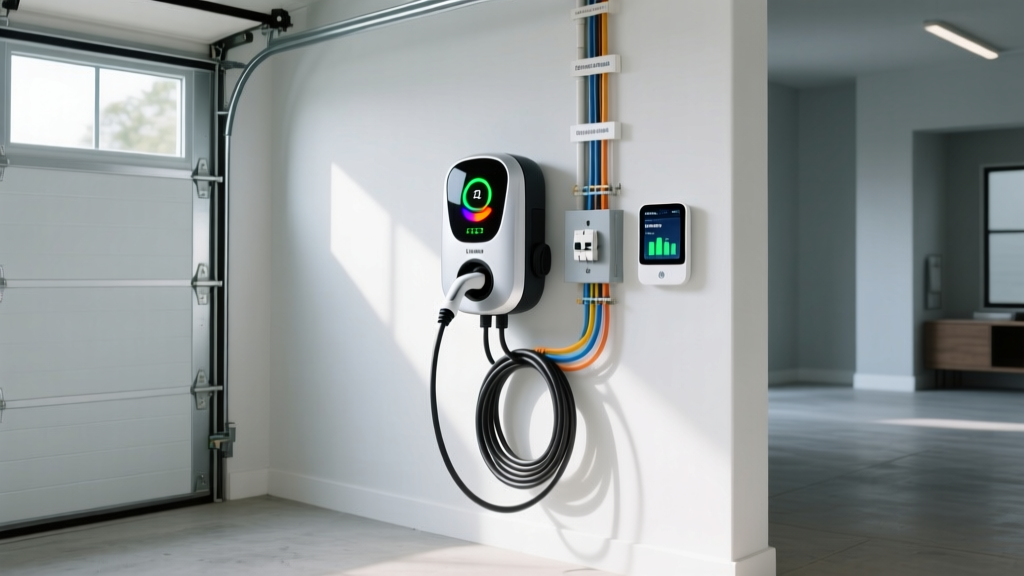
- Strain relief and cable management: With 24-foot cables on each port, proper cable holsters or retractors prevent tripping hazards and connector damage. Emporia includes wall-mount cable holders.
- Wi-Fi and firmware: The Emporia connects via 2.4 GHz Wi-Fi for app control and firmware updates. Ensure your router reaches the garage; a Wi-Fi extender may be needed for detached garages.
Always hire a licensed electrician familiar with NEC Article 625 (Electric Vehicle Charging System Equipment). Permits and inspections are required in virtually all jurisdictions and protect your home insurance coverage in the event of an electrical incident.
Alternative Dual-Port and Multi-Vehicle Charging Options
The Emporia isn't the only path to two-car home charging. Here are alternative approaches:
- Two independent Level 2 chargers: If your panel has capacity for two separate 240V circuits (e.g., two 50A breakers), you can install two single-port chargers like the ChargePoint Home Flex (~$549 each) or Wallbox Pulsar Plus (~$449 each). This gives each vehicle full, independent charging speed but doubles the electrical work.
- Wallbox Quasar 2 (bidirectional): For vehicles supporting V2H/V2G (like the Ford F-150 Lightning), the Quasar 2 offers DC-level home charging and vehicle-to-home backup power — but at ~$3,500+ for equipment alone, it's a premium option.
- Load-management systems: Products like the WallConnect Neo or Sense energy monitor can manage load across multiple chargers on shared circuits, similar to the Emporia's built-in logic but using external hardware.
Frequently Asked Questions
How much does it cost to install a home EV charger with dual ports?
For the Emporia 2 DR charger on an existing 200A panel, expect $1,249–$3,149 total (equipment + electrician + permit + materials). If your home has a 100A or 125A panel that needs upgrading to 200A, add $1,500–$3,500 for the panel upgrade, bringing the total to roughly $2,749–$6,649.
How fast will each charging level add range?
Level 1 (120V) adds 3–5 miles per hour. Level 2 at 48A/11.5 kW adds roughly 35–45 miles per hour for most EVs. Level 2 at the split 24A/5.75 kW rate adds approximately 18–22 miles per hour per vehicle. DC fast charging at 150–350 kW can add 150–1,000+ miles per hour but is not available for home installation.
Which connector is compatible with my EV?
For 2025+ model-year vehicles from Tesla, Ford, GM, Rivian, Hyundai, Kia, BMW, and most others, NACS is the native connector. Older (2024 and earlier) non-Tesla EVs use J1772 for Level 2 AC charging. The Emporia dual-port can be ordered with either connector type, or a mix of one NACS and one J1772.
How much does home charging cost per mile vs. gasoline?
At the national average residential electricity rate (~$0.17/kWh), home charging costs about 5 cents per mile for an EV averaging 3.5 mi/kWh. With off-peak time-of-use rates (~$0.09/kWh), that drops to roughly 2.6 cents per mile. A comparable gasoline vehicle at 28 MPG and $3.40/gallon costs about 12 cents per mile.
What electrical upgrades might I need for a dual-port charger?
The Emporia requires a dedicated 60A/240V breaker. If your electrical panel has sufficient spare capacity (determined by a NEC Article 220 load calculation), no upgrade is needed beyond the new breaker and wiring. If your panel is at or near capacity — common with 100A or 125A service in older homes — you'll need a panel upgrade to 200A, typically costing $1,500–$3,500. Your electrician will determine this during the initial assessment.
Can the Emporia charger handle a Tesla and a non-Tesla EV simultaneously?
Yes. You can order the Emporia dual-port with one NACS connector and one J1772 connector, allowing you to plug in a Tesla and a CCS1-era vehicle (like a 2023 VW ID.4 or 2023 Hyundai Ioniq 5) at the same time. The load-sharing logic manages the split automatically.
Is there a federal tax credit for home charger installation?
The IRS Alternative Fuel Vehicle Refueling Property Credit (§30C) covers up to 30% of the cost of home EV charging equipment and installation, capped at $1,000. Eligibility depends on your census tract meeting certain low-income or non-urban criteria, and the credit is subject to income limitations. Consult a tax professional and verify current-year rules on irs.gov before claiming.